







生物技术通报 ›› 2026, Vol. 42 ›› Issue (7): 126-137.doi: 10.13560/j.cnki.biotech.bull.1985.2025-0959
• 研究报告 • 上一篇
阎晓光( ), 杜艳伟, 马志远, 王彬, 王国梁, 胡丹珠
收稿日期:2025-09-08
出版日期:2026-07-26
发布日期:2026-07-20
通讯作者:
阎晓光gzsyxg001@163.com基金资助:
YAN Xiao-guang(), DU Yan-wei, MA Zhi-yuan, WANG Bin, WANG Guo-liang, HU Dan-zhu
Received:2025-09-08
Published:2026-07-26
Online:2026-07-20
摘要:
目的 Dirigent(DIR)基因在植物生长发育及环境适应中发挥重要作用,鉴定玉米ZmDIR基因家族成员,揭示其在逆境防御中的潜在作用。 方法 利用生物信息学方法鉴定ZmDIR基因家族,对其保守基序、保守结构域、染色体分布、基因复制、启动子区顺式作用元件和系统发育进行系统分析,结合转录组数据阐明该家族在不同组织及生物与非生物胁迫下的表达模式。 结果 在玉米基因组中共鉴定出41个ZmDIR基因,分布在10条染色体上,含有0-4个内含子,78%的ZmDIR基因包含核心保守基序1、基序2和基序4。系统发育分析将ZmDIR蛋白分为6 个亚组。基因复制分析表明,片段复制和串联复制是该家族扩增的主要驱动因素。启动子分析发现,ZmDIR基因富含参与生长发育、植物激素、环境胁迫和光响应等过程的顺式作用元件。组织特异性表达分析显示,ZmDIR在根、茎、叶、叶尖、叶基、胚、胚乳、花药、雌穗和雄穗中差异表达,而且在不同发育组织中的表达模式存在多样性。转录组数据表明,ZmDIR在多种非生物胁迫(高温、盐、紫外线、低温、干旱和水涝)和生物胁迫(禾生炭疽菌)下均呈现差异表达。RT-qPCR实验验证了所选ZmDIR基因在盐(NaCl)、低温(4 ℃)、干旱(PEG)和禾生炭疽菌(Colletotrichum graminicola)胁迫下均发生特异性变化。 结论 在玉米基因组中鉴定出41个ZmDIR基因,该家族广泛响应生物与非生物胁迫,6个关键基因在逆境胁迫下呈显著差异表达,为解析关键成员抗逆机制及分子育种提供了靶标。
阎晓光, 杜艳伟, 马志远, 王彬, 王国梁, 胡丹珠. 玉米ZmDIR基因家族的全基因组鉴定与表达模式分析[J]. 生物技术通报, 2026, 42(7): 126-137.
YAN Xiao-guang, DU Yan-wei, MA Zhi-yuan, WANG Bin, WANG Guo-liang, HU Dan-zhu. Genome-wide Identification and Expression Pattern Analysis of ZmDIR Gene Family in Maize[J]. Biotechnology Bulletin, 2026, 42(7): 126-137.
基因对 Gene pair | 模式 Mode | Ka | Ks | Ka/Ks | 分化时间/百万年 Divergence time/Mya | |
|---|---|---|---|---|---|---|
| ZmDIR39 | ZmDIR11 | 片段复制 | 0.40 | 0.55 | 0.72 | 42.31 |
| ZmDIR11 | ZmDIR22 | 片段复制 | 0.51 | 0.43 | 1.19 | 33.08 |
| ZmDIR34 | ZmDIR36 | 片段复制 | 0.73 | 0.84 | 0.86 | 64.62 |
| ZmDIR25 | ZmDIR33 | 片段复制 | 0.20 | 0.49 | 0.41 | 37.69 |
| ZmDIR38 | ZmDIR22 | 片段复制 | 0.40 | 0.35 | 1.15 | 26.92 |
| ZmDIR11 | ZmDIR12 | 串联复制 | 0.43 | 0.69 | 0.63 | 53.08 |
| ZmDIR28 | ZmDIR27 | 串联复制 | 0.14 | 0.40 | 0.36 | 30.77 |
表1 ZmDIR基因家族中的重复基因对
Table 1 Duplication gene pairs in ZmDIR gene family
基因对 Gene pair | 模式 Mode | Ka | Ks | Ka/Ks | 分化时间/百万年 Divergence time/Mya | |
|---|---|---|---|---|---|---|
| ZmDIR39 | ZmDIR11 | 片段复制 | 0.40 | 0.55 | 0.72 | 42.31 |
| ZmDIR11 | ZmDIR22 | 片段复制 | 0.51 | 0.43 | 1.19 | 33.08 |
| ZmDIR34 | ZmDIR36 | 片段复制 | 0.73 | 0.84 | 0.86 | 64.62 |
| ZmDIR25 | ZmDIR33 | 片段复制 | 0.20 | 0.49 | 0.41 | 37.69 |
| ZmDIR38 | ZmDIR22 | 片段复制 | 0.40 | 0.35 | 1.15 | 26.92 |
| ZmDIR11 | ZmDIR12 | 串联复制 | 0.43 | 0.69 | 0.63 | 53.08 |
| ZmDIR28 | ZmDIR27 | 串联复制 | 0.14 | 0.40 | 0.36 | 30.77 |
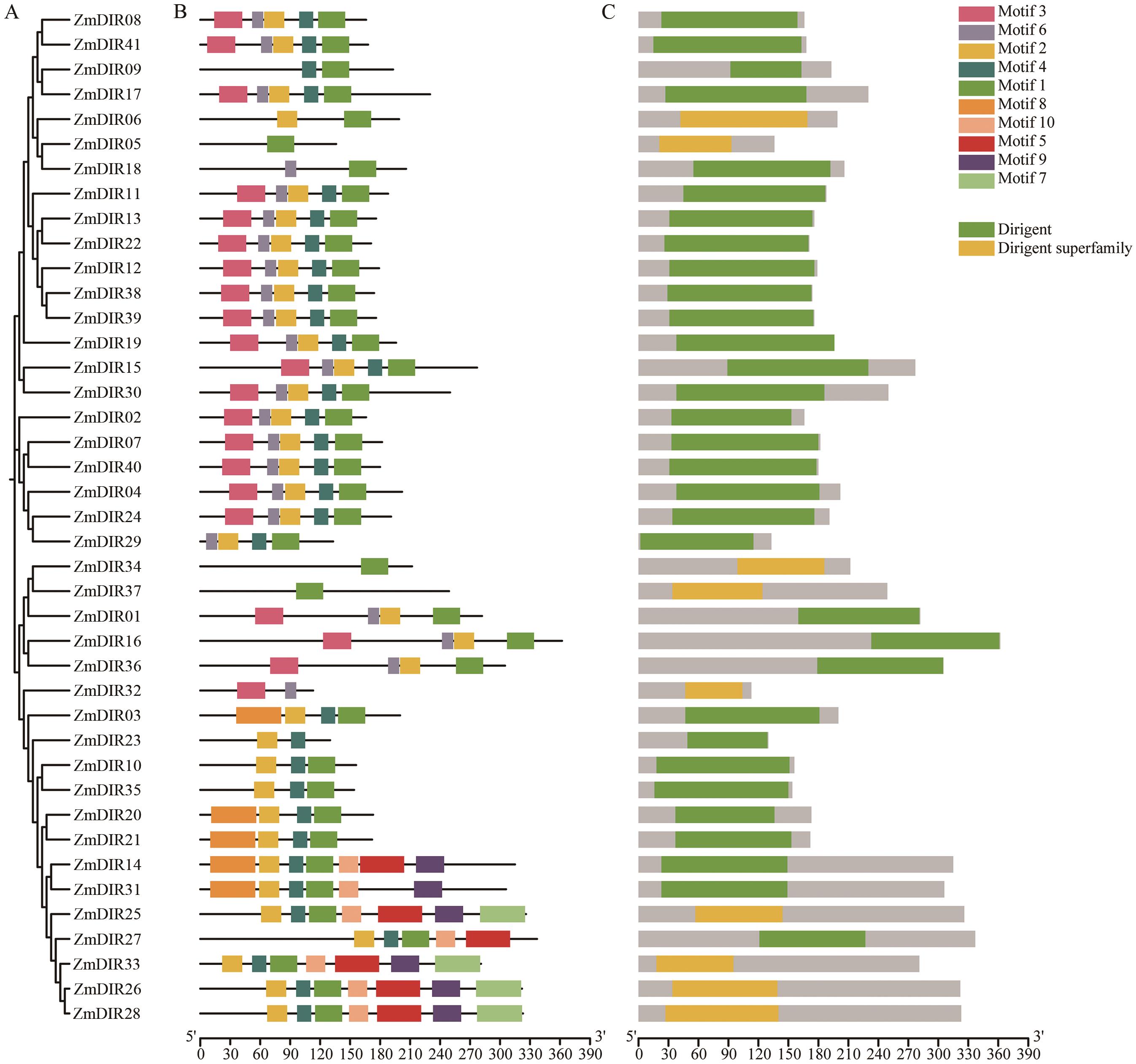
图1 玉米DIR蛋白的保守基序和保守结构域
Fig. 1 Conserved motifs and conserved domain of DIR proteins in Zea mays L.
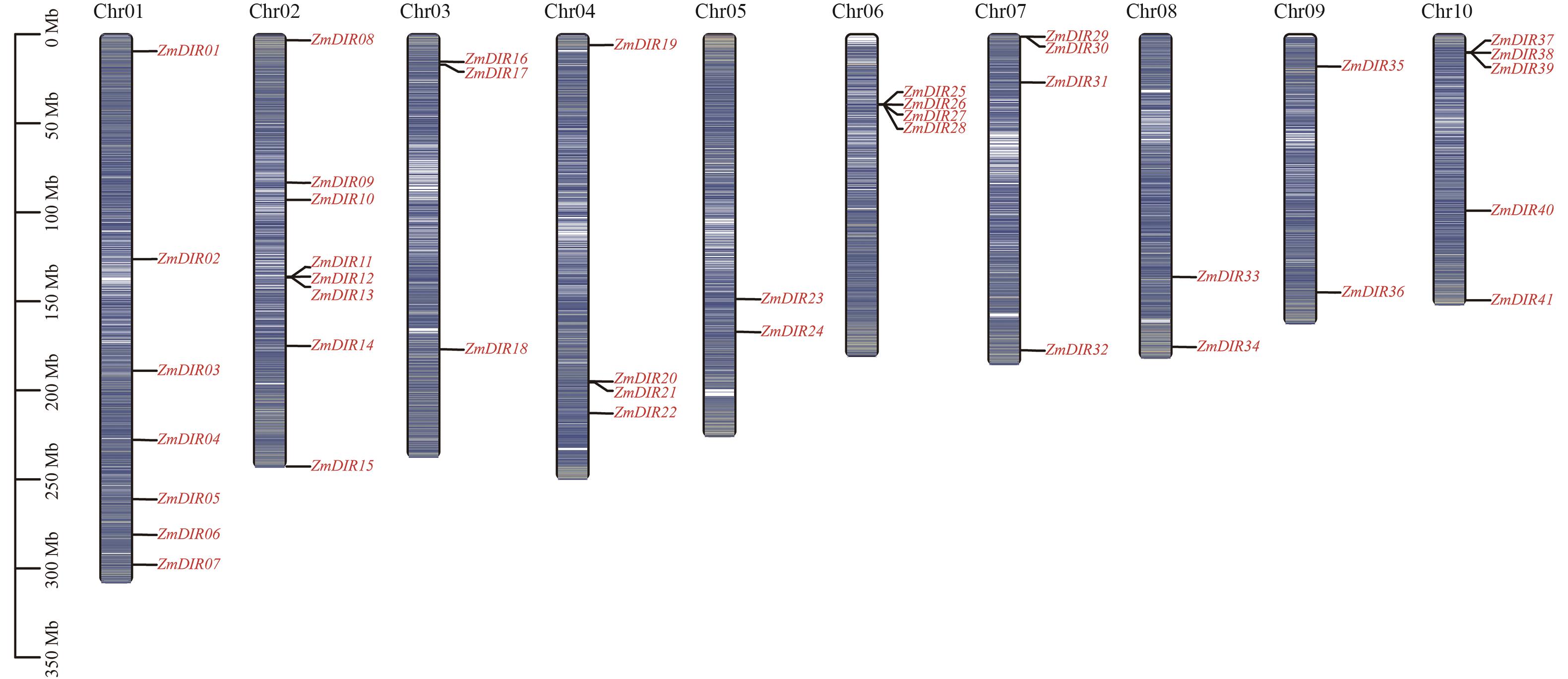
图2 玉米ZmDIR基因家族的染色体分布
Fig. 2 Chromosomal distribution of the ZmDIR gene family in Zea mays L.
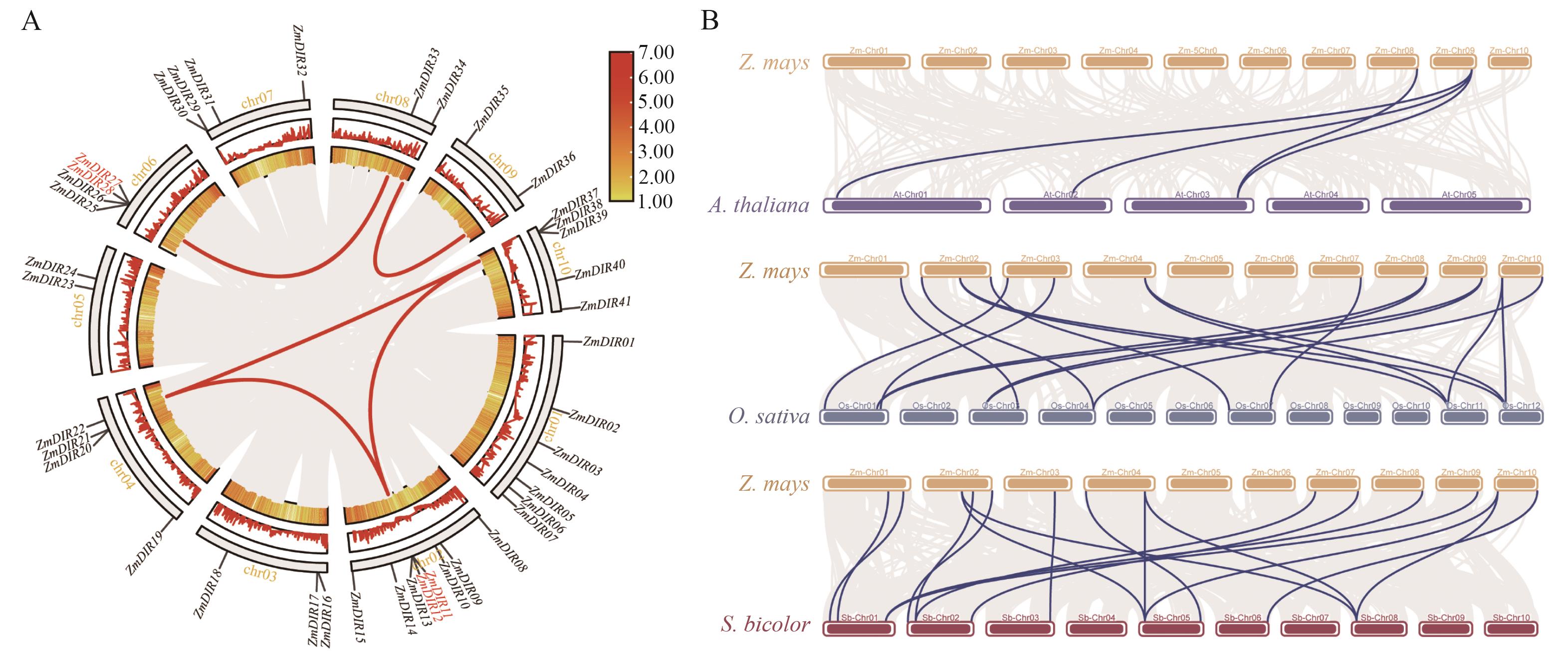
图3 玉米ZmDIR基因的复制事件A:物种内片段复制用红线连接,串联重复基因以红色字体显示。B:不同物种间DIR基因共线性用蓝线连接,玉米与其他基因的共线性在背景中用灰线连接
Fig. 3 Duplication events of ZmDIR genes in maizeA: Intraspecies segmental duplications are connected by red lines, tandemly duplicated genes are highlighted in red. B: Syntenic DIR genes between different species are linked by blue lines, while syntenic relationships between maize and other genes in the plant genome are displayed as gray lines in the background
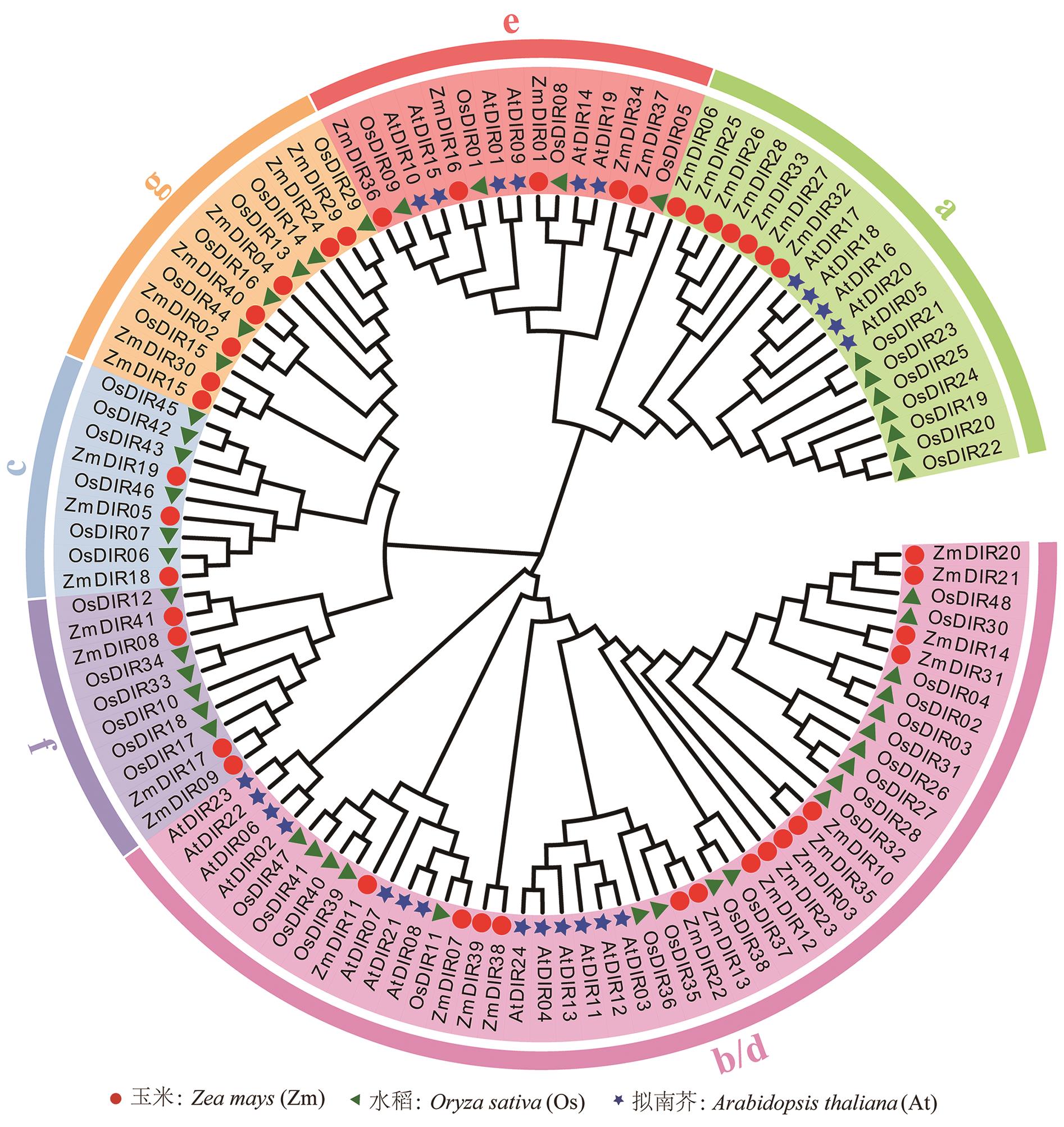
图4 拟南芥、水稻和玉米中DIR蛋白的系统发育树
Fig. 4 Phylogenetic tree of DIR proteins in Arabidopsis, Oryza sativa and Zea mays
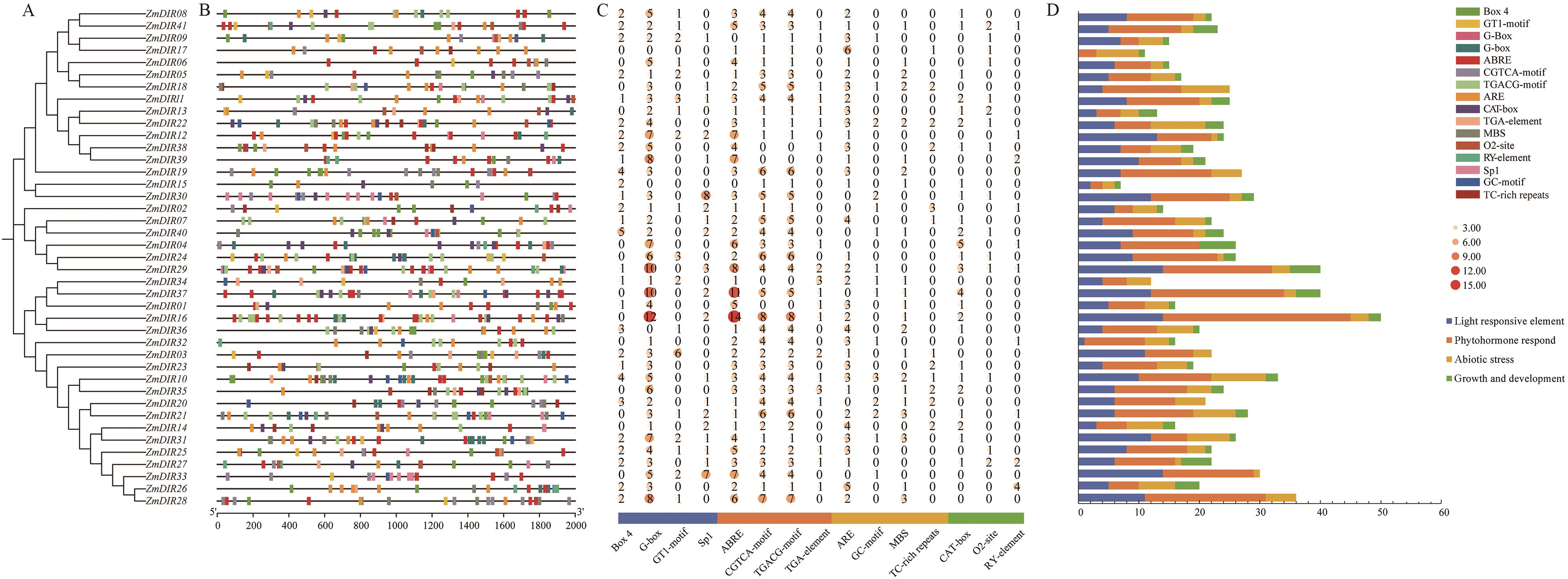
图5 ZmDIR启动子区域中的顺式作用元件分析A:玉米中ZmDIR蛋白的系统发育树。B:顺式作用元件在ZmDIR启动子上的分布。C:ZmDIR启动子区顺式作用元件的类型。D:ZmDIR启动子区不同类型顺式作用元件的数量
Fig. 5 Cis-acting element analysis in ZmDIR promoter regionsA: Phylogenetic tree of ZmDIR protein in Z. mays. B: The distribution of cis-regulatory elements on the ZmDIR genes promoter. C: Types of cis-acting elements in the promoter region of ZmDIR genes. D: Numbers of different types of cis-elements in the promoter regions of ZmDIR genes
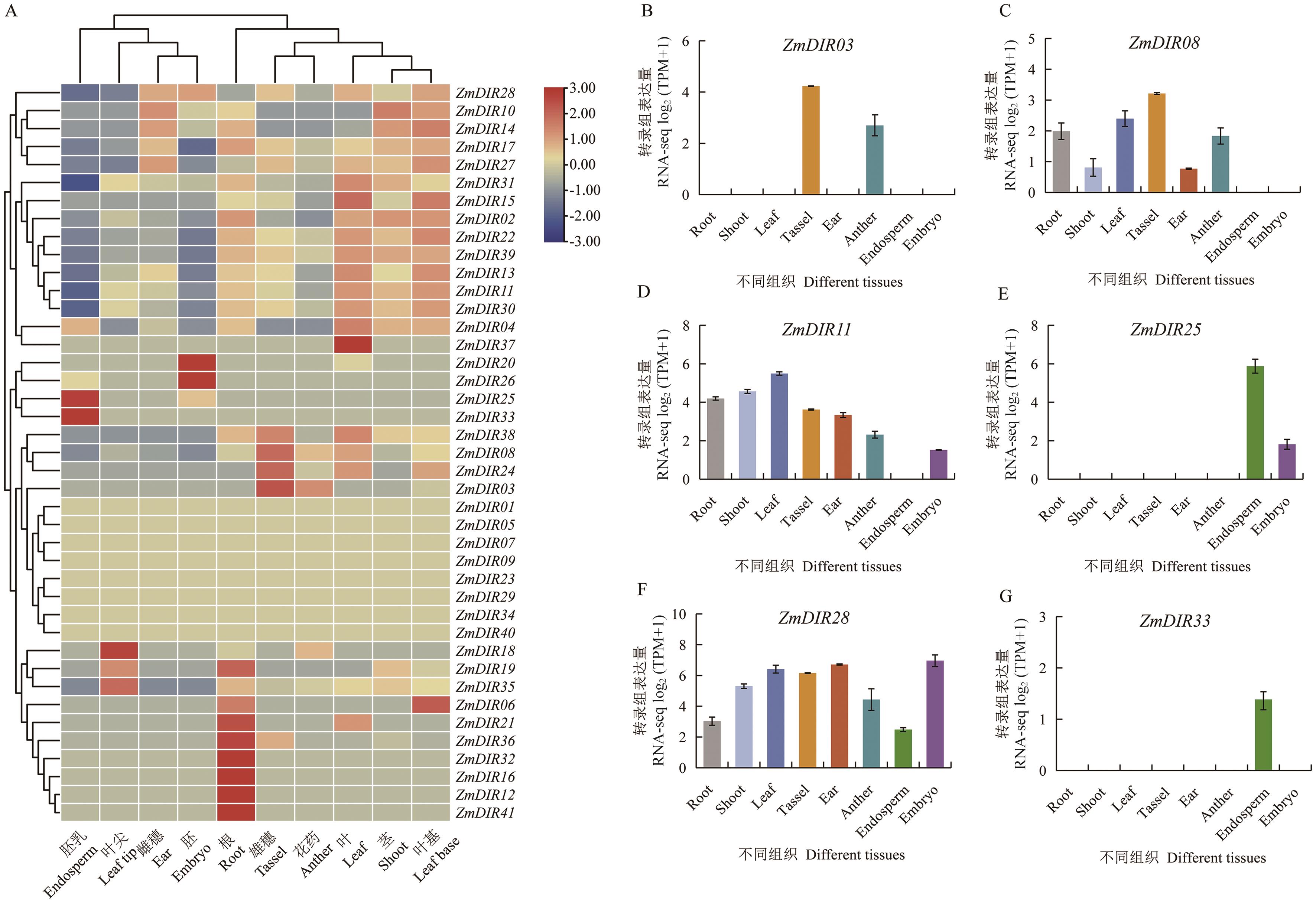
图6 玉米ZmDIR基因在不同组织中的表达模式A:不同组织中ZmDIR基因的表达水平。不同组织包括根、茎、叶、叶尖、叶基、胚、胚乳、花药、雌穗和雄穗。B-G:部分ZmDIR基因的组织特异性表达
Fig. 6 Expression pattern of ZmDIR genes in different tissues of Z. maysA: Expressions of ZmDIR genes at different tissues. The tissue-specific expressions of the ZmDIR gene including the roots, stems, leaves, leaf tip, leaf base, embryo, endosperm, anther, tassel, and ear. B-G: Tissue-specific expressions of some ZmDIR genes
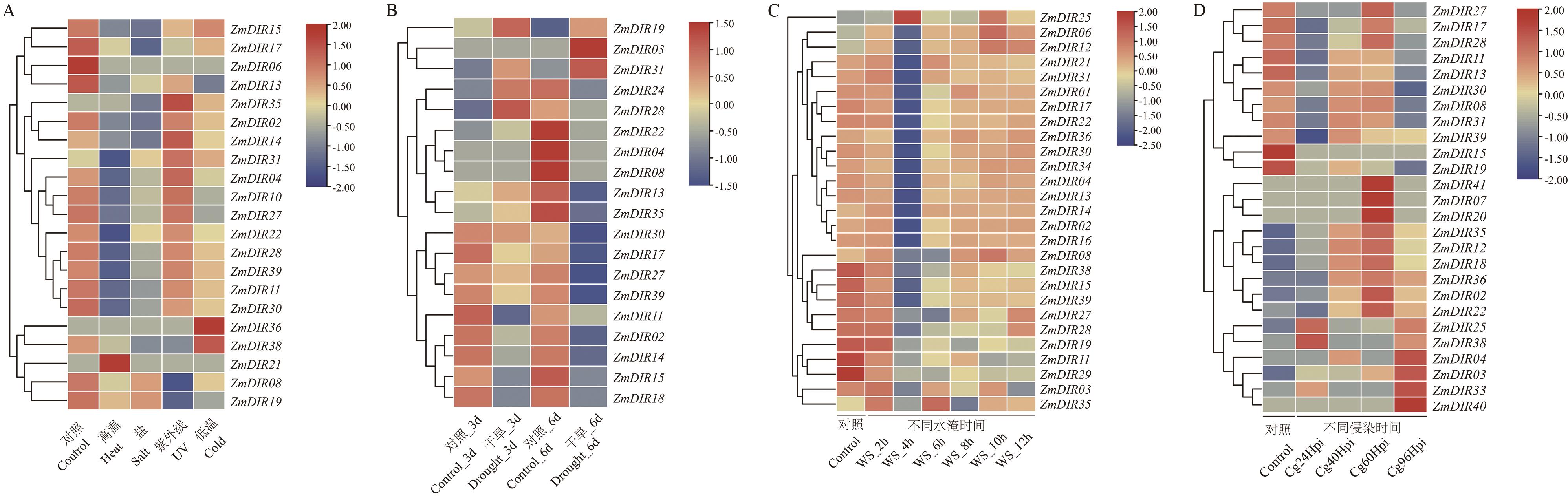
图7 玉米ZmDIR基因在逆境胁迫下的表达模式A:高温、盐、紫外线和低温胁迫下ZmDIR基因的表达。B:干旱胁迫下ZmDIR基因的表达。C:水涝胁迫下ZmDIR基因的表达。D:真菌Colletotrichum graminicola感染后ZmDIR基因在玉米叶片中的表达。Hpi:接种后小时数
Fig. 7 Expression profiles of ZmDIR genes under adversity stress in Z. maysA: Expressions of ZmDIR genes under heat, salt, ultraviolet (UV) and cold stress. B: Expressions of ZmDIR genes under drought stress. C: Expressions of ZmDIR genes under waterlogging stress (WS). D: Expressions of ZmDIR genes in Z. mays leaves treated with Colletotrichum graminicola. Hpi: Hours post-inoculation
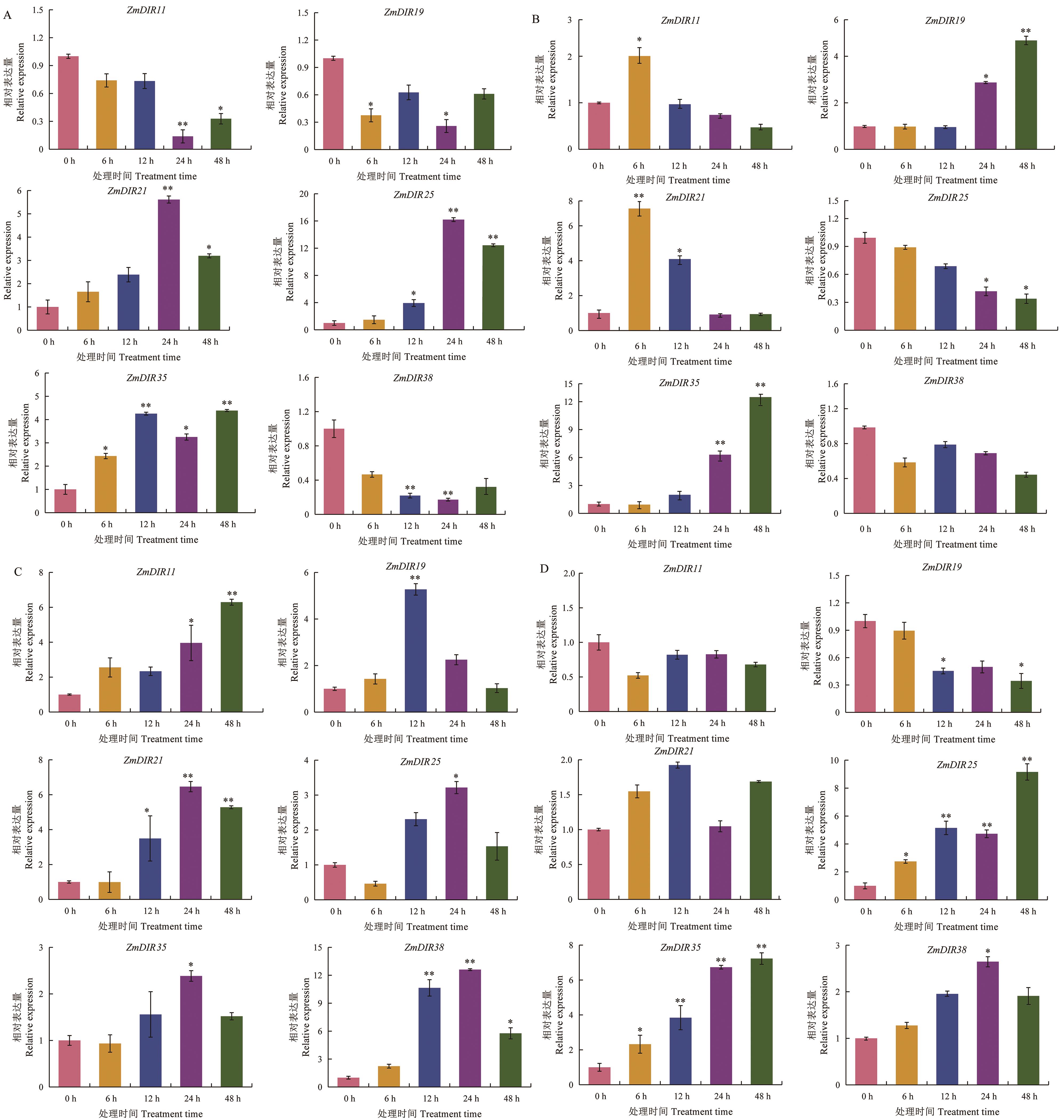
图8 逆境胁迫下叶片中ZmDIR基因的相对表达量A:200 mmol/L NaCl;B:4 ℃低温;C:20% PEG6000;D:禾生炭疽菌。*P<0.05,**P<0.01
Fig. 8 Relative expressions of ZmDIR genes in the leaves under adversity stressA: 200 mmol/L NaCl treatment. B: 4 ℃ cold treatment. C: 20% PEG6000 treatment. D: Colletotrichum graminicola treatment. *P<0.05, **P<0.01
| [1] | Meng Q, Kim SJ, Costa MA, et al. Dirigent protein subfamily function and structure in terrestrial plant phenol metabolism [M]//Biochemical Pathways and Environmental Responses in Plants: Part C. Amsterdam: Elsevier, 2023: 101-150. |
| [2] | Paniagua C, Bilkova A, Jackson P, et al. Dirigent proteins in plants: modulating cell wall metabolism during abiotic and biotic stress exposure [J]. J Exp Bot, 2017, 68(13): 3287-3301. |
| [3] | Halls SC, Davin LB, Kramer DM, et al. Kinetic study of coniferyl alcohol radical binding to the (+)-pinoresinol forming dirigent protein [J]. Biochemistry, 2004, 43(9): 2587-2595. |
| [4] | Pellegrini N, Valtueña S, Ardigò D, et al. Intake of the plant lignans matairesinol, secoisolariciresinol, pinoresinol, and lariciresinol in relation to vascular inflammation and endothelial dysfunction in middle age-elderly men and post-menopausal women living in Northern Italy [J]. Nutr Metab Cardiovasc Dis, 2010, 20(1): 64-71. |
| [5] | Ascacio-valdés JA, Buenrostro-figueroa JJ, Aguilera-carbo A, et al. Ellagitannins: biosynthesis, biodegradation and biological properties [J]. J Med Plants Res, 2011, 5(19): 4696-4703. |
| [6] | 张开京, 何帅帅, 贾利, 等. 黄瓜DIR家族基因的全基因组鉴定及其表达分析 [J]. 中国农业科学, 2023, 56(4): 711-728. |
| Zhang KJ, He SS, Jia L, et al. Genome-wide identification and expression analysis of DIR gene family in cucumber [J]. Sci Agric Sin, 2023, 56(4): 711-728. | |
| [7] | Rivière C, Pawlus AD, Mérillon JM. Natural stilbenoids: distribution in the plant Kingdom and chemotaxonomic interest in Vitaceae [J]. Nat Prod Rep, 2012, 29(11): 1317-1333. |
| [8] | Davin LB, Lewis NG. An historical perspective on lignan biosynthesis: Monolignol, allylphenol and hydroxycinnamic acid coupling and downstream metabolism [J]. Phytochem Rev, 2003, 2(3): 257-288. |
| [9] | Ralph SG, Jancsik S, Bohlmann J. Dirigent proteins in conifer defense II Extended gene discovery, phylogeny, and constitutive and stress-induced gene expression in spruce (Picea spp.) [J]. Phytochemistry, 2007, 68(14): 1975-1991. |
| [10] | Berim A, Ebel R, Schneider B, et al. UDP-glucose: (6-methoxy) podophyllotoxin 7-O-glucosyltransferase from suspension cultures of Linum nodiflorum [J]. Phytochemistry, 2008, 69(2): 374-381. |
| [11] | Borges AF, Ferreira RB, Monteiro S. Transcriptomic changes following the compatible interaction Vitis vinifera-Erysiphe necator. Paving the way towards an enantioselective role in plant defence modulation [J]. Plant Physiol Biochem, 2013, 68: 71-80. |
| [12] | Li NH, Zhao M, Liu TF, et al. A novel soybean dirigent gene GmDIR22 contributes to promotion of lignan biosynthesis and enhances resistance to Phytophthora sojae [J]. Front Plant Sci, 2017, 8: 1185. |
| [13] | Liu ZW, Wang XF, Sun ZW, et al. Evolution, expression and functional analysis of cultivated allotetraploid cotton DIR genes [J]. BMC Plant Biol, 2021, 21(1): 89. |
| [14] | Guo JL, Xu LP, Fang JP, et al. A novel dirigent protein gene with highly stem-specific expression from sugarcane, response to drought, salt and oxidative stresses [J]. Plant Cell Rep, 2012, 31(10): 1801-1812. |
| [15] | Khan A, Li RJ, Sun JT, et al. Genome-wide analysis of dirigent gene family in pepper (Capsicum annuum L.) and characterization of CaDIR7 in biotic and abiotic stresses [J]. Sci Rep, 2018, 8: 5500. |
| [16] | Xu WY, Liu T, Zhang HY, et al. Mungbean DIRIGENT gene subfamilies and their expression profiles under salt and drought stresses [J]. Front Genet, 2021, 12: 658148. |
| [17] | Liao YR, Liu SB, Jiang YY, et al. Genome-wide analysis and environmental response profiling of dirigent family genes in rice (Oryza sativa) [J]. Genes Genom, 2017, 39(1): 47-62. |
| [18] | Thamil Arasan SK, Park JI, Ahmed NU, et al. Characterization and expression analysis of dirigent family genes related to stresses in Brassica [J]. Plant Physiol Biochem, 2013, 67: 144-153. |
| [19] | Ma XF, Xu WY, Liu T, et al. Functional characterization of soybean (Glycine max) DIRIGENT genes reveals an important role of GmDIR27 in the regulation of pod dehiscence [J]. Genomics, 2021, 113(1): 979-990. |
| [20] | Corbin C, Drouet S, Markulin L, et al. A genome-wide analysis of the flax (Linum usitatissimum L.) dirigent protein family: from gene identification and evolution to differential regulation [J]. Plant Mol Biol, 2018, 97(1): 73-101. |
| [21] | Ahmadi B. In vitro - and in vivo-based approaches for doubled haploid production in Zea mays L.: challenges and opportunities [J]. Theor Appl Genet, 2025, 138(4): 87. |
| [22] | Duan W, Xue BP, He YQ, et al. Genome-wide identification and expression pattern analysis of dirigent members in the Genus Oryza [J]. Int J Mol Sci, 2023, 24(8): 7189. |
| [23] | Gong LP, Li BB, Zhu T, et al. Genome-wide identification and expression profiling analysis of DIR gene family in Setaria italica [J]. Front Plant Sci, 2023, 14: 1243806. |
| [24] | Chen CJ, Wu Y, Li JW, et al. TBtools-Ⅱ: a “one for all, all for one” bioinformatics platform for biological big-data mining [J]. Mol Plant, 2023, 16(11): 1733-1742. |
| [25] | Blanc G, Wolfe KH. Widespread paleopolyploidy in model plant species inferred from age distributions of duplicate genes [J]. Plant Cell, 2004, 16(7): 1667-1678. |
| [26] | William Roy S, Gilbert W. The evolution of spliceosomal introns: patterns, puzzles and progress [J]. Nat Rev Genet, 2006, 7(3): 211-221. |
| [27] | 赵玉雪, 任学军, 李云, 等. 谷子Dirigent家族基因鉴定与分析 [J]. 核农学报, 2024, 38(9): 1647-1660. |
| Zhao YX, Ren XJ, Li Y, et al. Genome-wide identification of dirigent gene family and analysis in Setaria italica [J]. J Nucl Agric Sci, 2024, 38(9): 1647-1660. | |
| [28] | Xu GX, Guo CC, Shan HY, et al. Divergence of duplicate genes in exon-intron structure [J]. Proc Natl Acad Sci U S A, 2012, 109(4): 1187-1192. |
| [29] | Moore RC, Purugganan MD. The early stages of duplicate gene evolution [J]. Proc Natl Acad Sci U S A, 2003, 100(26): 15682-15687. |
| [30] | Pfeil BE, Schlueter JA, Shoemaker RC, et al. Placing paleopolyploidy in relation to taxon divergence: a phylogenetic analysis in legumes using 39 gene families [J]. Syst Biol, 2005, 54(3): 441-454. |
| [31] | Burlat V, Kwon M, Davin LB, et al. Dirigent proteins and dirigent sites in lignifying tissues [J]. Phytochemistry, 2001, 57(6): 883-897. |
| [32] | Shi HY, Liu ZH, Zhu L, et al. Overexpression of cotton (Gossypium hirsutum) dirigent1 gene enhances lignification that blocks the spread of Verticillium dahliae [J]. Acta Biochim Biophys Sin: Shanghai, 2012, 44(7): 555-564. |
| [33] | Song M, Peng XY. Genome-wide identification and characterization of DIR genes in Medicago truncatula [J]. Biochem Genet, 2019, 57(4): 487-506. |
| [34] | Zhong RQ, Lee C, Zhou JL, et al. A battery of transcription factors involved in the regulation of secondary cell wall biosynthesis in Arabidopsis [J]. Plant Cell, 2008, 20(10): 2763-2782. |
| [35] | Böttcher C, von Roepenack-Lahaye E, Schmidt J, et al. Metabolome analysis of biosynthetic mutants reveals a diversity of metabolic changes and allows identification of a large number of new compounds in Arabidopsis [J]. Plant Physiol, 2008, 147(4): 2107-2120. |
| [36] | Xu L, Zhu LF, Tu LL, et al. Lignin metabolism has a central role in the resistance of cotton to the wilt fungus Verticillium dahliae as revealed by RNA-Seq-dependent transcriptional analysis and histochemistry [J]. J Exp Bot, 2011, 62(15): 5607-5621. |
| [1] | 万瑞恒, 李晓艳, 李莹莹, 郭扬, 刘应红, 张军杰, 胡育峰, 李炀平, 黄玉碧, 刘汉梅. 基于YOLOv10的玉米籽粒淀粉粒识别与粒径分析系统的开发[J]. 生物技术通报, 2026, 42(6): 208-217. |
| [2] | 李旭龙, 徐世强, 张龙, 李静宇, 何伟贤, 陈立凯, 王继华. 巴戟天萜烯合成酶基因家族鉴定、进化及表达模式分析[J]. 生物技术通报, 2026, 42(6): 314-325. |
| [3] | 张雅宁, 毛春力, 胡志勇, 杨丹, 吴佳海, 王碧娴, 黄琳凯. 象草Dof转录因子的全基因组分析及其对低温胁迫的响应[J]. 生物技术通报, 2026, 42(6): 267-278. |
| [4] | 段雅馨, 李成晨, 潘玉玲, 王丽, 安康, 李小波, 祝光涛, 刘计涛. 马铃薯LEA_2基因家族鉴定及响应低温与激素功能分析[J]. 生物技术通报, 2026, 42(6): 40-52. |
| [5] | 张欣, 陈骋, 霍元博, 黄仁丽, 张丽, 张凯, 童华荣, 袁连玉. 茶树CsCRD1基因的克隆及其对叶绿素生物合成的影响[J]. 生物技术通报, 2026, 42(5): 280-291. |
| [6] | 金旋, 向芬, 戴翠婷, 杨辉, 李赛君, 刘红艳, 钱思维, 蔺万煌, 李维. 茶树CsTDIFL基因的克隆、表达特性分析及其对氨基酸合成的调控[J]. 生物技术通报, 2026, 42(5): 323-331. |
| [7] | 郭苗, 许家佳, 孙天国, 蔡璨, 曹婉笛, 包纪星, 沙伟, 张梅娟, 彭疑芳, 马天意. 过表达砂藓RcOLEO1基因增强拟南芥的耐旱性及耐高温性[J]. 生物技术通报, 2026, 42(5): 312-322. |
| [8] | 彭善麟, 廖卓诚, 王涛, 刘志宇, 刘海忆, 王婷婷, 杨琴, 王哲, 邰欢欢. 不同玉米茎腐病抗性品种根际微生物群落多样性及功能差异[J]. 生物技术通报, 2026, 42(5): 76-88. |
| [9] | 刘青媛, 吴洪启, 陈秀娥, 陈剑, 姜远泽, 何燕子, 喻奇伟, 刘仁祥. 转录因子NtMYB96a调控烟草耐旱性的功能研究[J]. 生物技术通报, 2026, 42(4): 239-250. |
| [10] | 陈登科, 兰刚, 夏芝, 侯保国, 杨六六, 曹彩荣, 李朋波, 吴翠翠. 花生ZF-HD基因家族的鉴定和非生物胁迫响应分析[J]. 生物技术通报, 2026, 42(4): 114-128. |
| [11] | 苏燕竹, 李达, 张爱爱, 刘永光, 张秀荣, 薛其勤. 大豆CAD基因家族的鉴定及表达分析[J]. 生物技术通报, 2026, 42(4): 101-113. |
| [12] | 许孟歌, 宋火焱, 罗佳, 苏亿, 周会汶, 王灿, 孔可可. 大豆GmRLK19基因表达分析及互作蛋白的筛选[J]. 生物技术通报, 2026, 42(4): 92-100. |
| [13] | 张高翔, 吴玉碧, 郭亚静, 纪薇, 杨忠义. 葡萄WD40基因家族鉴定及表达量分析[J]. 生物技术通报, 2026, 42(3): 324-337. |
| [14] | 李天源, 亓新亮, 刘珊, 张建成, 王鹏飞, 张帅, 贾璐婷, 穆霄鹏. 欧李SPL基因家族的鉴定及在果实发育过程中的表达分析[J]. 生物技术通报, 2026, 42(3): 362-373. |
| [15] | 刘林娅, 刘欢艳, 梁鑫钰, 宋姝熠, 何斌, 王绪英, 黄亚成. ‘红阳’猕猴桃BGAL基因家族的全基因组鉴定与表达分析[J]. 生物技术通报, 2026, 42(3): 312-323. |
| 阅读次数 | ||||||
|
全文 |
|
|||||
|
摘要 |
|
|||||
