







生物技术通报 ›› 2026, Vol. 42 ›› Issue (3): 324-337.doi: 10.13560/j.cnki.biotech.bull.1985.2025-0274
张高翔( ), 吴玉碧, 郭亚静, 纪薇(), 杨忠义()
收稿日期:2025-03-14
出版日期:2026-03-26
发布日期:2026-04-23
通讯作者:
纪薇,女,博士,教授,研究方向 :葡萄遗传种质研究与创新利用;E-mail: jiweiputao@163.com作者简介:张高翔,男,硕士研究生,研究方向 :园艺植物栽培生理与品质调控;E-mail: 1450735446@qq.com
基金资助:
ZHANG Gao-xiang(), WU Yu-bi, GUO Ya-jing, JI Wei(), YANG Zhong-yi()
Received:2025-03-14
Published:2026-03-26
Online:2026-04-23
摘要:
目的 WD40超家族广泛存在于真核生物中,具有作为蛋白质复合物支架的基本亚基。WD40蛋白在植物发育和生理过程中发挥重要的调控作用。解析葡萄VvWD40基因家族成员的序列结构和理化性质,了解其在葡萄果实发育过程中的作用,为葡萄分子育种提供基因资源。 方法 基于葡萄全基因组信息,利用生物信息学方法对VvWD40家族进行鉴定,并对家族成员理化性质、染色体分布、基因结构、蛋白保守结构、系统进化、启动子顺式作用元件以及组织表达特性等进行分析,进一步利用转录组及RT-qPCR分析VvWD40基因在‘早黑宝’葡萄不同发育时期的表达模式。 结果 在葡萄基因组鉴定出86个WD40基因,通过系统发育分析将其分为7个组。在葡萄中共鉴定出12对共线基因对。Ka/Ks分析表明,它们在进化过程中主要经历了纯化选择。顺式作用元件分析表明,VvWD40基因家族含有激素及胁迫响应顺式作用元件,这些元件与葡萄果实发育密切相关。其中,VvWD40-62/84含有类黄酮合成元件,表明它们可能与花青素合成有关。‘早黑宝’葡萄4个不同阶段的表达谱分析显示,大多数VvWD40s在果实发育过程中表达。通过RT-qPCR验证8个基因在‘早黑宝’葡萄发育过程中表达量变化情况,VvWD40-34/49基因在葡萄果实发育初期表达量较低,成熟时期表达量最高,表明这2个基因可能在葡萄果实发育转色过程中发挥关键作用。 结论 葡萄中鉴定出86个VvWD40基因,不均匀地分布在19条染色体上。大部分VvWD40在葡萄果实发育过程中表达量变化显著,表明其在葡萄生长发育中发挥重要作用。
张高翔, 吴玉碧, 郭亚静, 纪薇, 杨忠义. 葡萄WD40基因家族鉴定及表达量分析[J]. 生物技术通报, 2026, 42(3): 324-337.
ZHANG Gao-xiang, WU Yu-bi, GUO Ya-jing, JI Wei, YANG Zhong-yi. Identification and Expression Analysis of WD40 Gene Family in Grape[J]. Biotechnology Bulletin, 2026, 42(3): 324-337.
| 基因 Gene | 正向引物 Forward primer (5′‒3′) | 反向引物 Reverse primer (5′‒3′) |
|---|---|---|
| WD40-3 | F: TTGGAAGGACACGAGAAACC | R: GGATACCTGCCACACCTTAATC |
| WD40-9 | F: GACTTCCTCAAGAGCTCCATAAA | R: GTCCAAGCTCAAGCAAGAAAC |
| WD40-27 | F: GTTCCTTCGATGAGACCGTTAG | R: GAGCCATCACGATTGAAATTGG |
| WD40-34 | F: CAGTTTAGAGAGCGGCAAGAA | R: GTCCGTACAGCCATGTCATTAG |
| WD40-42 | F: AGTGCCAGCAAGGATTCTAC | R: TCTAGGCTGCAACTCCAAAC |
| WD40-49 | F: GTGAGGACTCAAAGGTGTATGT | R: GGACTCCAGCTCACACAATTA |
| WD40-51 | F: CGTGCGATCTCTCGTGTATT | R: GCTCTTTCCCTCAGCATCATA |
| WD40-77 | F: CTGACTCGCCACAGGAATATC | R: CTTTCACCGACCAGACATAGAG |
| EF1α | F: GAACTGGGTGCTTGATAGGC | R: ACCAAAATATCCGGAGTAAAAGA |
表1 引物信息
Table 1 Primer information
| 基因 Gene | 正向引物 Forward primer (5′‒3′) | 反向引物 Reverse primer (5′‒3′) |
|---|---|---|
| WD40-3 | F: TTGGAAGGACACGAGAAACC | R: GGATACCTGCCACACCTTAATC |
| WD40-9 | F: GACTTCCTCAAGAGCTCCATAAA | R: GTCCAAGCTCAAGCAAGAAAC |
| WD40-27 | F: GTTCCTTCGATGAGACCGTTAG | R: GAGCCATCACGATTGAAATTGG |
| WD40-34 | F: CAGTTTAGAGAGCGGCAAGAA | R: GTCCGTACAGCCATGTCATTAG |
| WD40-42 | F: AGTGCCAGCAAGGATTCTAC | R: TCTAGGCTGCAACTCCAAAC |
| WD40-49 | F: GTGAGGACTCAAAGGTGTATGT | R: GGACTCCAGCTCACACAATTA |
| WD40-51 | F: CGTGCGATCTCTCGTGTATT | R: GCTCTTTCCCTCAGCATCATA |
| WD40-77 | F: CTGACTCGCCACAGGAATATC | R: CTTTCACCGACCAGACATAGAG |
| EF1α | F: GAACTGGGTGCTTGATAGGC | R: ACCAAAATATCCGGAGTAAAAGA |
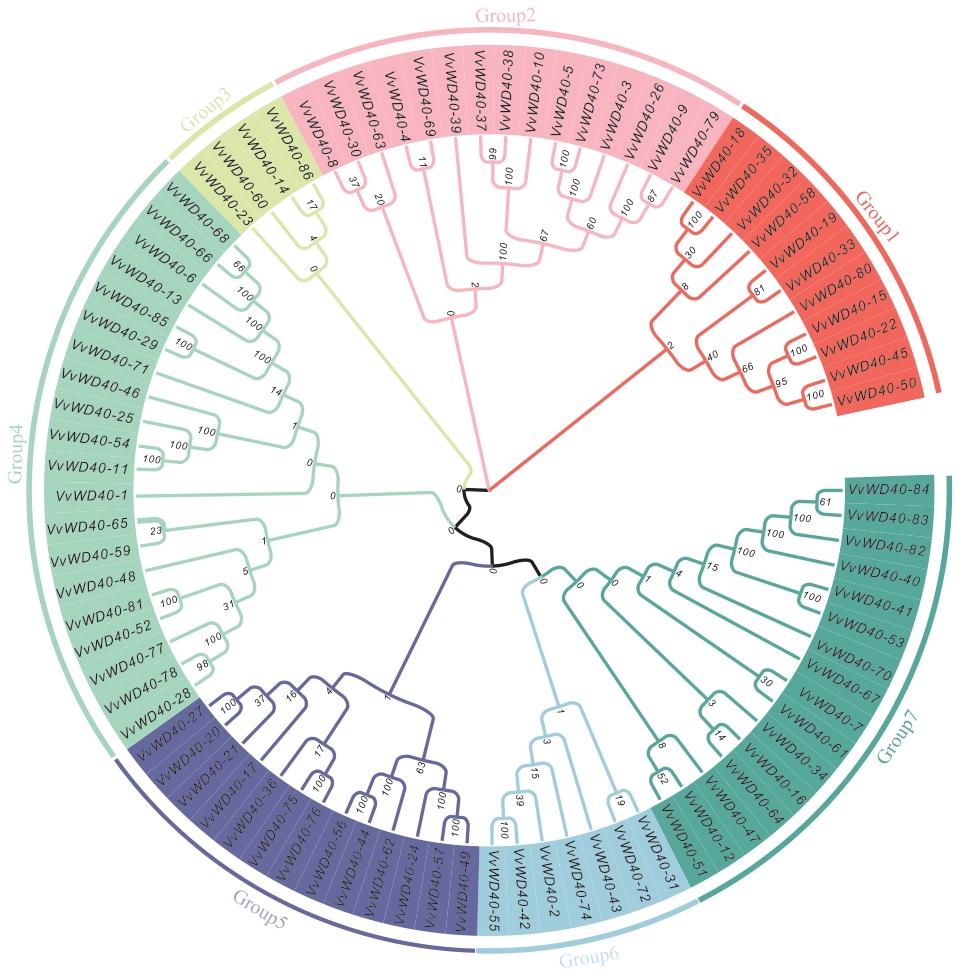
图1 VvWD40基因家族进化树
Fig. 1 Evolutionary treeof VvWD40 gene family
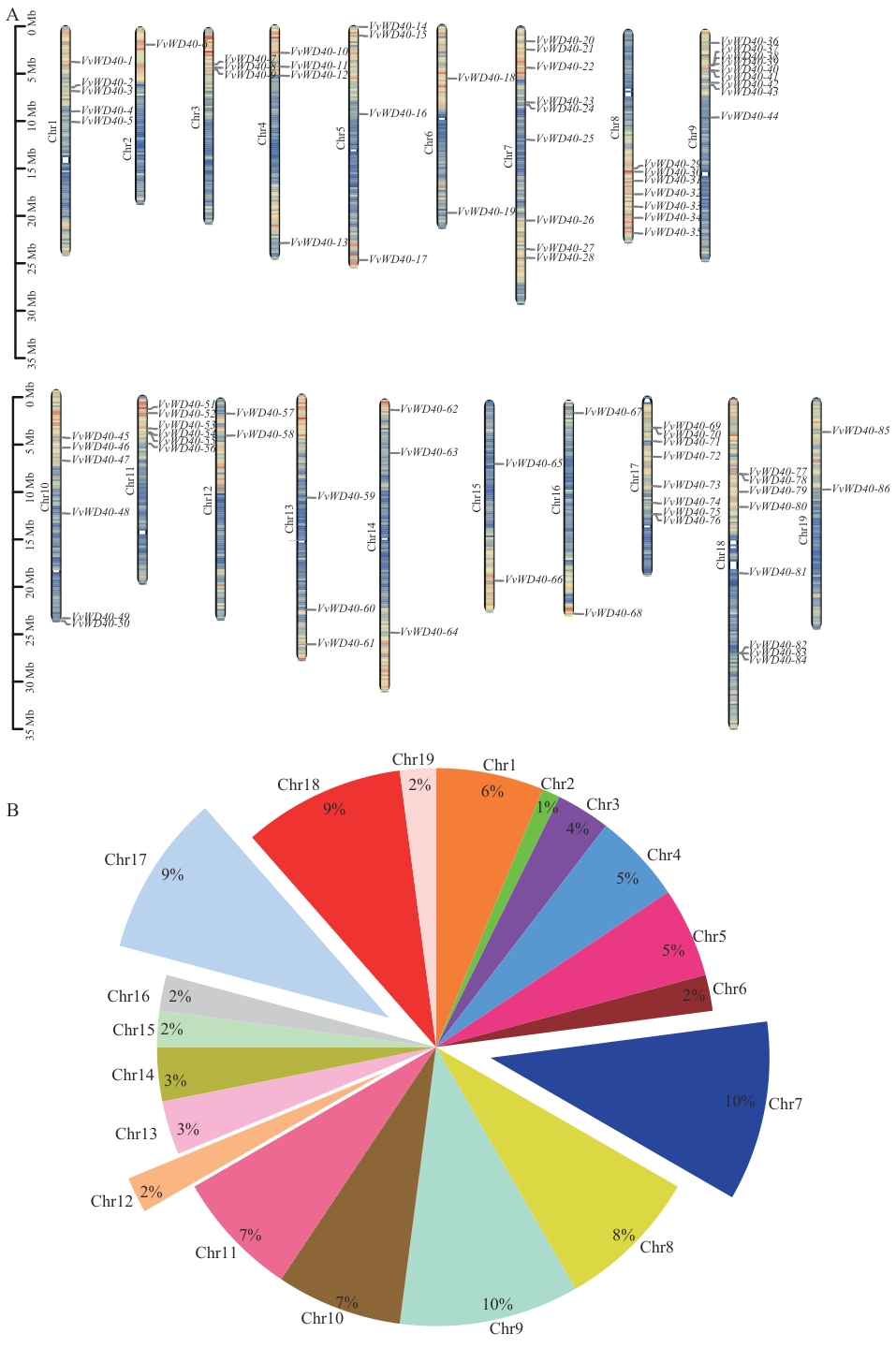
图2 VvWD40基因家族染色体位置
Fig. 2 Chromosome position of VvWD40 gene family
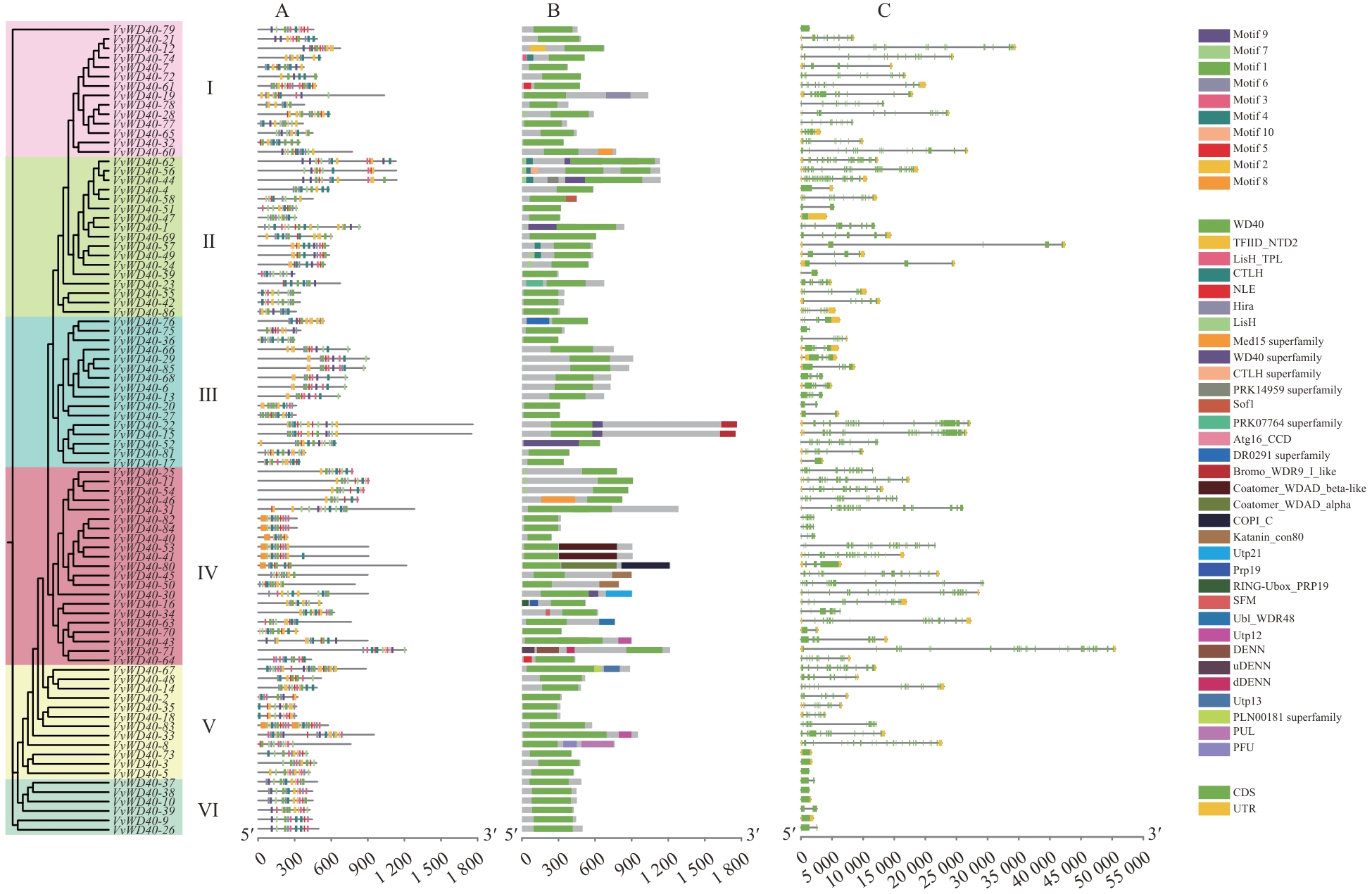
图3 VvWD40基因家族motif(A)、结构域(B)、基因结构(C)分析
Fig. 3 Analysis of the motif (A), domain (B) , and gene structure (C) of the VvWD40 gene family
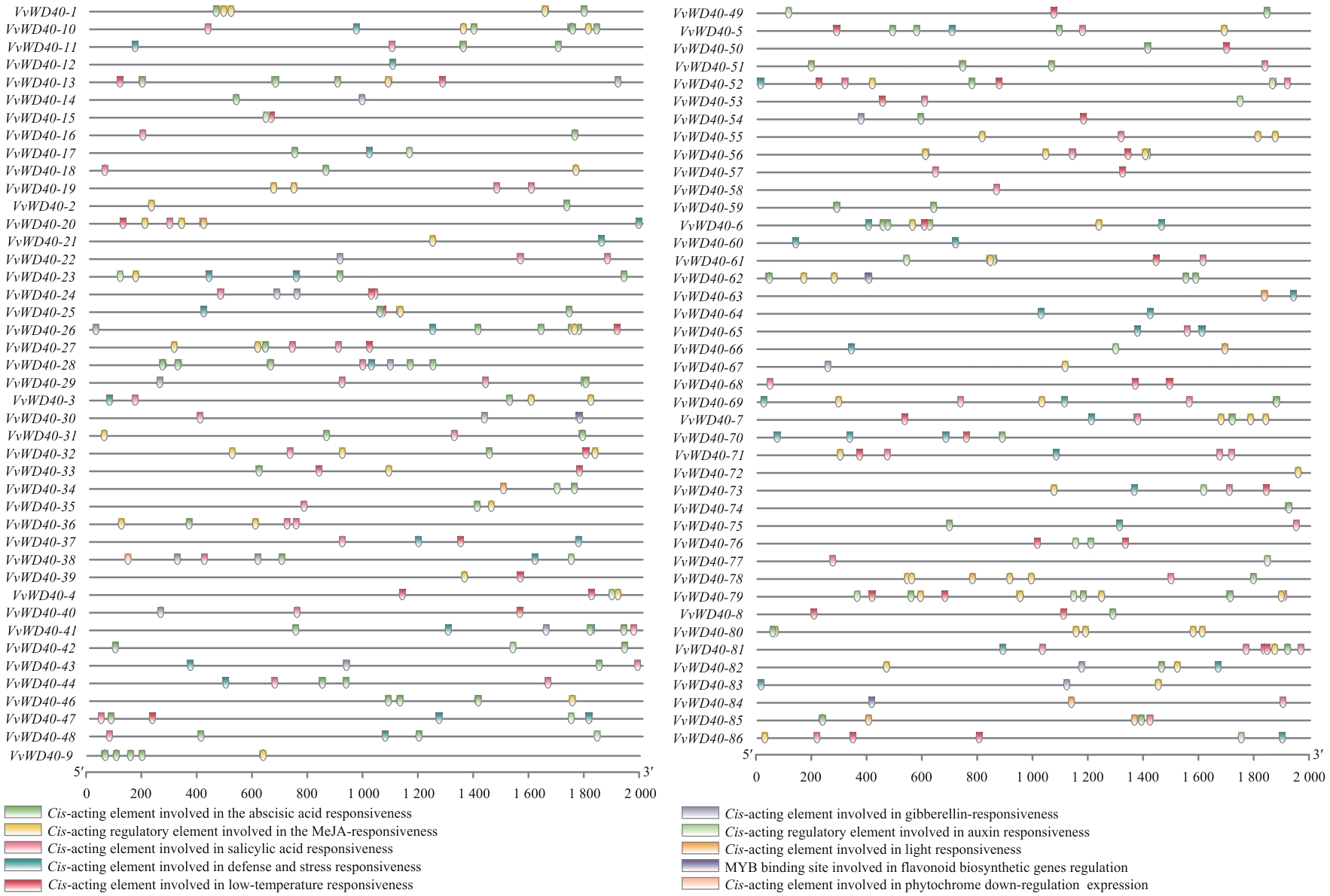
图4 VvWD40基因家族启动子顺式作用元件分析
Fig. 4 Cis-acting elements analysis in VvWD40 gene family promoter
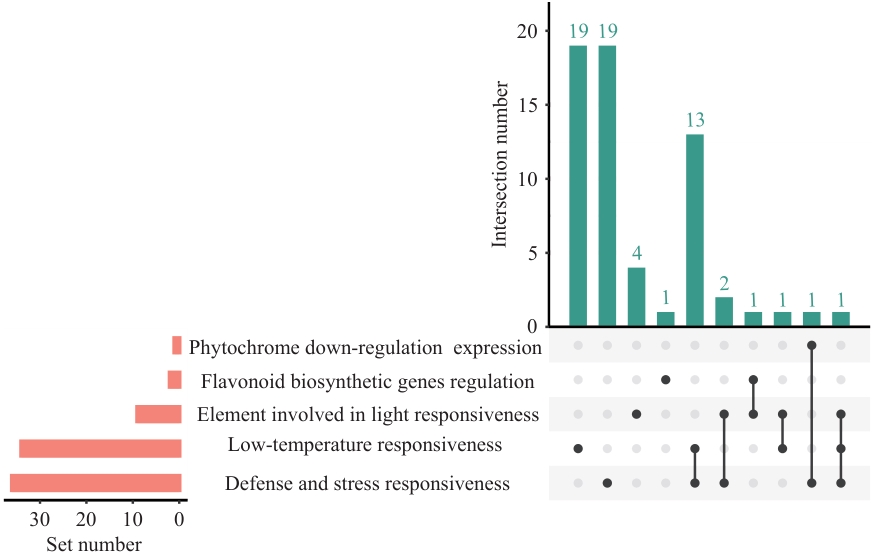
图5 VvWD40基因家族顺式作用元件交集分析
Fig. 5 Intersection analysis of cis-acting elements of VvWD40 gene family
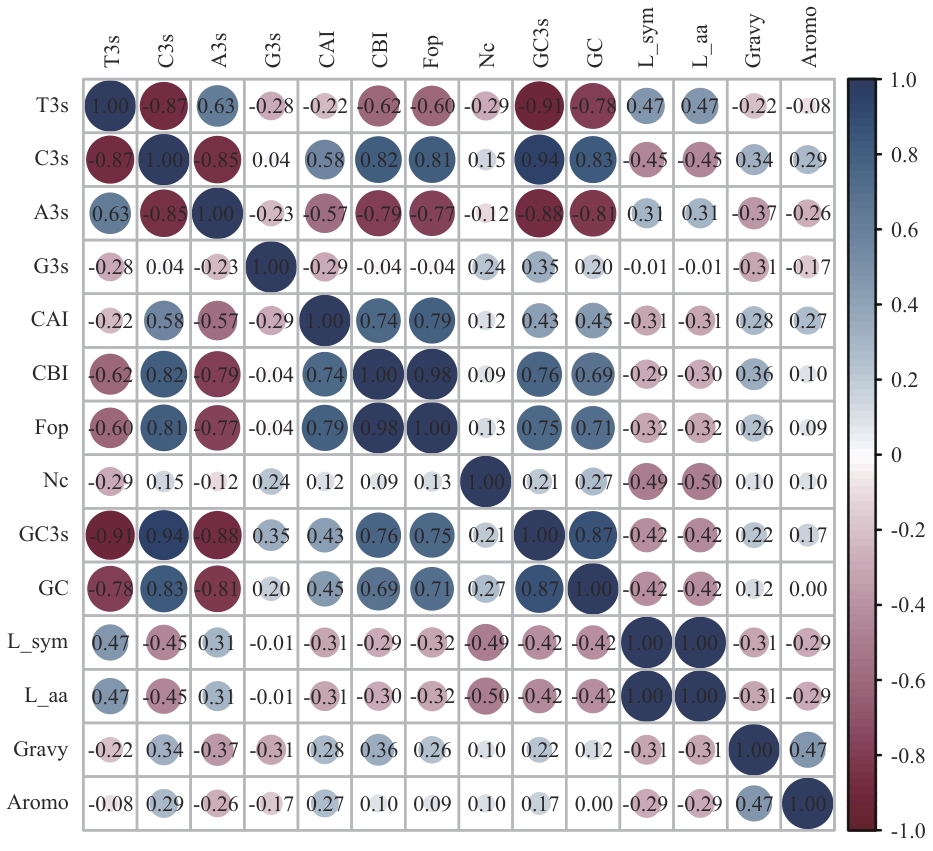
图6 VvWD40基因家族密码子相关性分析
Fig. 6 Correlation analysis of codons in the VvWD40 gene family
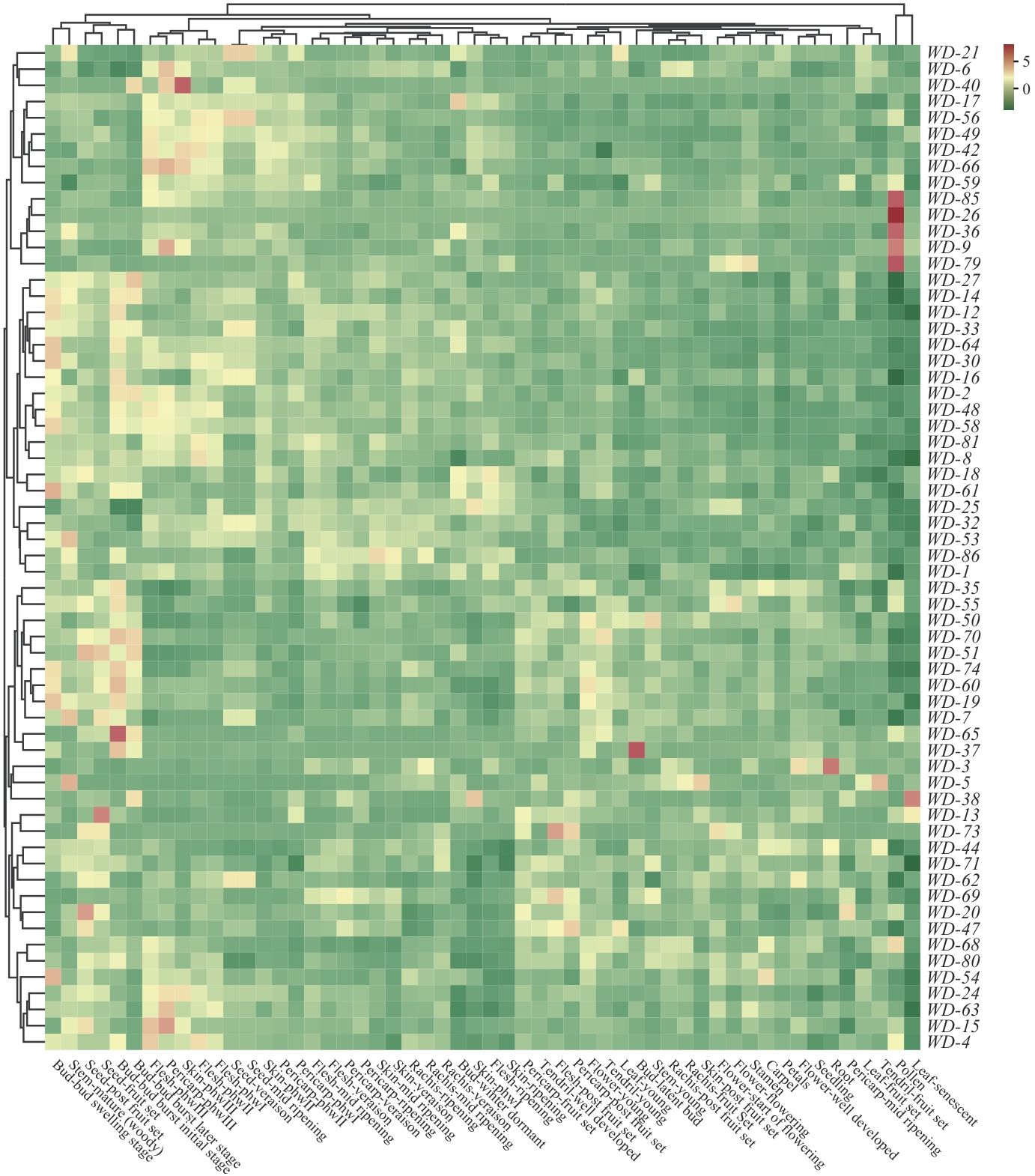
图7 VvWD40基因在葡萄不同组织及不同时期的表达量分析
Fig. 7 Analysis of VvWD40 gene expressions in different tissues and different periods of grape
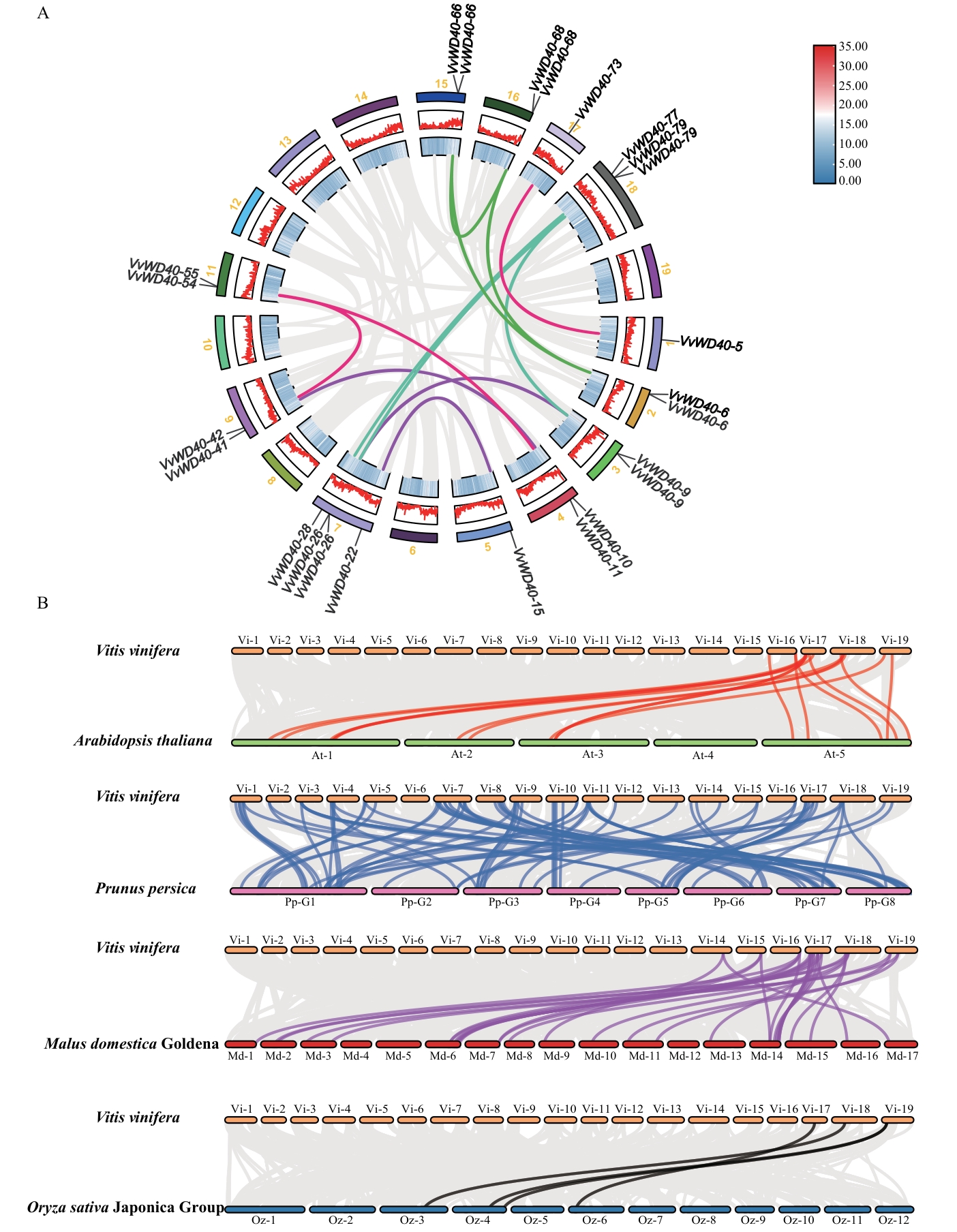
图8 VvWD40基因家族共线性分析
Fig. 8 Collinearity analysis of VvWD40 gene family
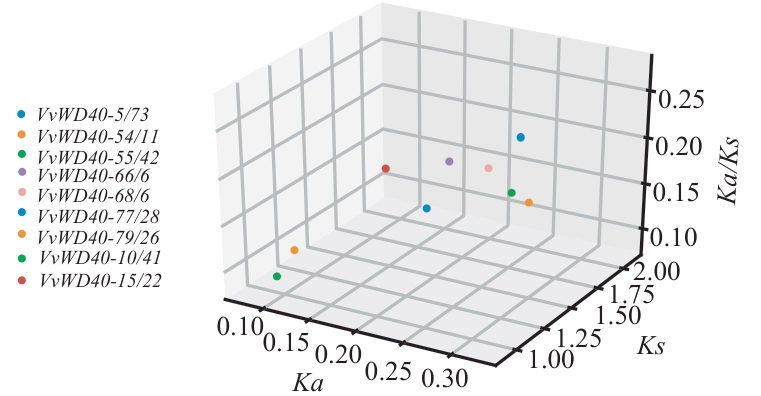
图9 VvWD40基因家族选择压力分析
Fig. 9 Analysis of selective pressure on the VvWD40 gene family
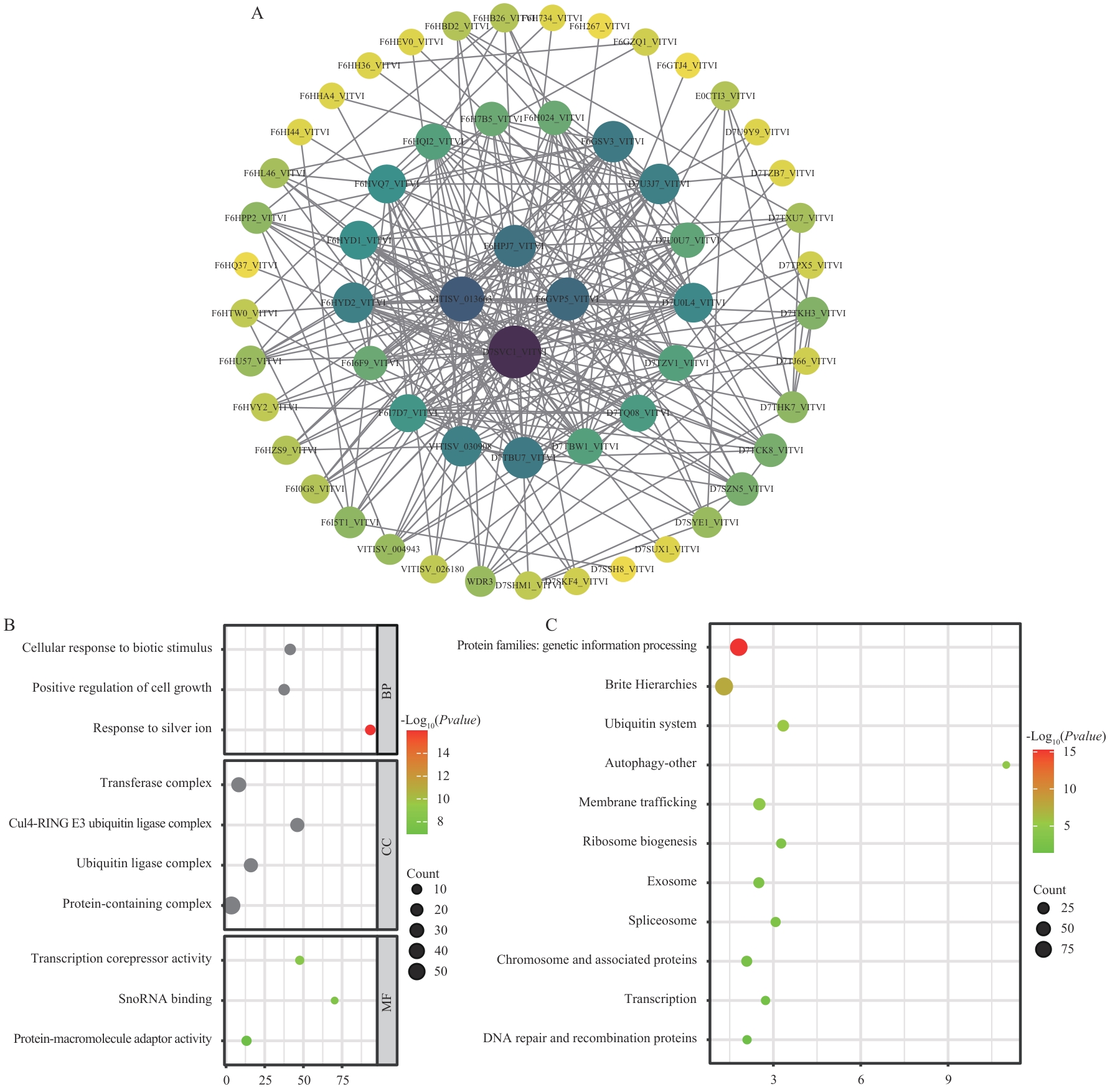
图10 VvWD40基因家族蛋白互作网络分析(A)、GO功能注释(B)和KEGG富集分析(C)
Fig. 10 Protein interaction network analysis (A), GO functional annotation (B), and KEGG enrichment analysis of the VvWD40 gene family
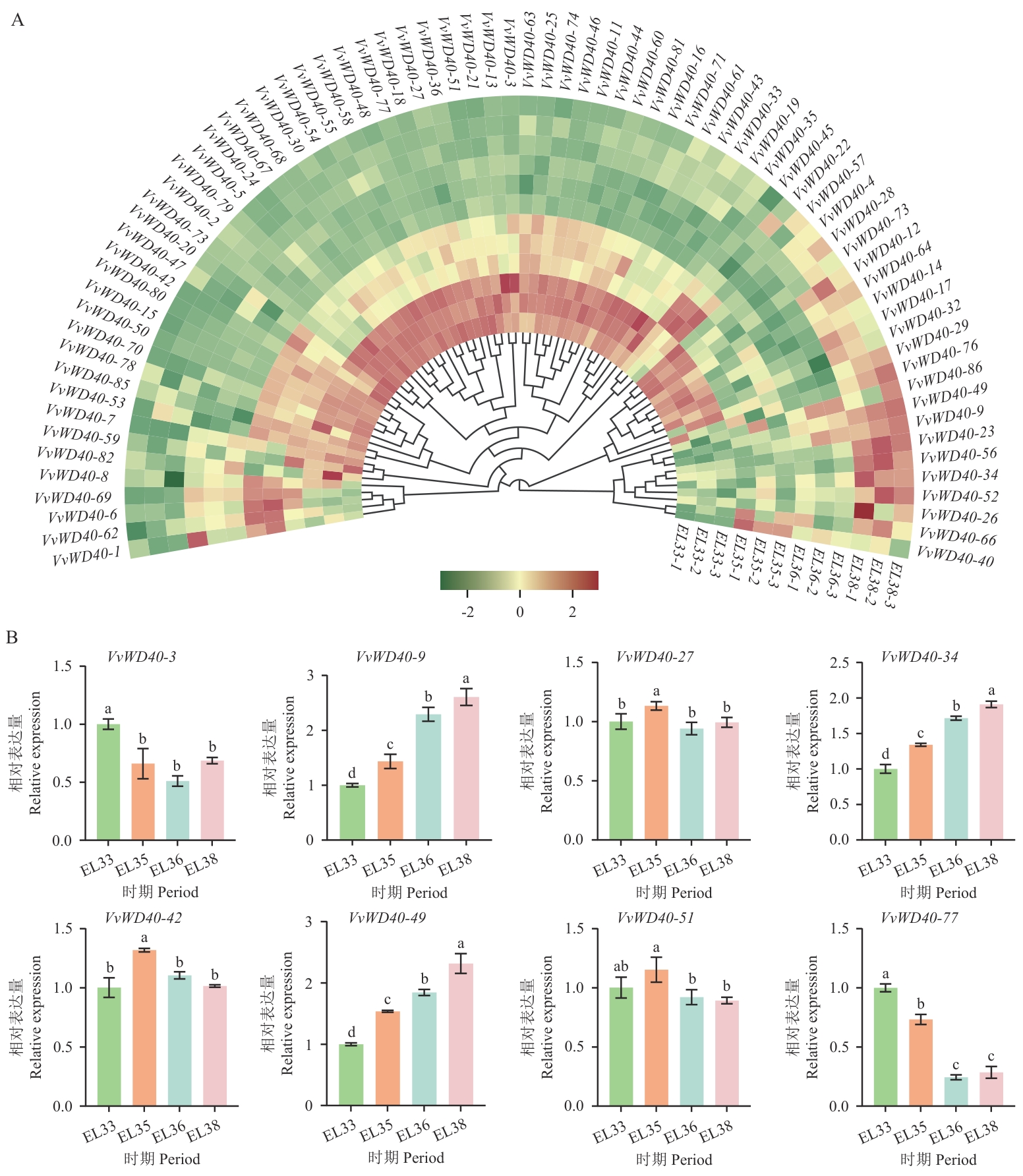
图11 VvWD40基因家族表达模式分析及RT-qPCR验证EL33:浆果仍然坚硬且呈绿色;EL35:浆果开始着色并增大;EL36:浆果具有中等可溶性固形物含量;EL38:浆果收获成熟。不同小写字母表示存在显著差异(P<0.05)
Fig. 11 Analysis of the expression pattern of the VvWD40 gene family and RT-qPCR verificationEL33: The berries are still firm and green. EL35: The berries start to color and increase in size. EL36: The berries have a medium content of soluble solids. EL38: The berries are ready for harvest and fully mature. Different lowercase letters indicate significant differences (P<0.05)
| [1] | Wang WN, Qian YH, Liu RH, et al. Effects of table grape cultivars on fruit quality and aroma components [J]. Foods, 2023, 12(18): 3371. |
| [2] | Ma MZ, Ma XY, Ma ZH, et al. Effects of foliar fertilizer additives on grape fruit quality and endogenous hormones in leaves [J]. BMC Plant Biol, 2025, 25(1): 516. |
| [3] | Jia N, Yin YG, Li MM, et al. Berry thinning affects the fruit quality composition of two table grape cultivars under linkage greenhouse conditions [J]. HortScience, 2023, 58(1): 134-140. |
| [4] | Feng RC, Zhang CH, Ma RJ, et al. Identification and characterization of WD40 superfamily genes in peach [J]. Gene, 2019, 710: 291-306. |
| [5] | Yan CY, Yang T, Wang BK, et al. Genome-wide identification of the WD40 gene family in tomato (Solanum lycopersicum L.) [J]. Genes, 2023, 14(6): 1273. |
| [6] | Ji XL, Zhang MY, Wang D, et al. Genome-wide identification of WD40 superfamily in Cerasus humilis and functional characteristics of ChTTG1 [J]. Int J Biol Macromol, 2023, 225: 376-388. |
| [7] | Wu ZR, Zhang TY, Li JN, et al. Genome-wide analysis of WD40 protein family and functional characterization of BvWD40-82 in sugar beet [J]. Front Plant Sci, 2023, 14: 1185440. |
| [8] | Fan ZY, Zhai YL, Wang Y, et al. Genome-wide analysis of anthocyanin biosynthesis regulatory WD40 gene FcTTG1 and related family in Ficus carica L [J]. Front Plant Sci, 2022, 13: 948084. |
| [9] | Wang C, Tang YF, Li Y, et al. Genome-wide identification and bioinformatics analysis of the WD40 transcription factor family and candidate gene screening for anthocyanin biosynthesis in Rhododendron simsii [J]. BMC Genomics, 2023, 24(1): 488. |
| [10] | Kim YJ, Jung KH. WD40-domain protein GORI is an integrative scaffold that is required for pollen tube growth in rice [J]. Plant Signal Behav, 2023, 18(1): 2082678. |
| [11] | Salih H, Gong WF, Mkulama M, et al. Genome-wide characterization, identification, and expression analysis of the WD40 protein family in cotton [J]. Genome, 2018, 61(7): 539-547. |
| [12] | Colanero S, Tagliani A, Perata P, et al. Alternative splicing in the anthocyanin fruit gene encoding an R2R3 MYB transcription factor affects anthocyanin biosynthesis in tomato fruits [J]. Plant Commun, 2020, 1(1): 100006. |
| [13] | Yang MG, Chen SK, Geng JH, et al. Comprehensive analysis of the Spartina alterniflora WD40 gene family reveals the regulatory role of SaTTG1 in plant development [J]. Front Plant Sci, 2024, 15: 1390461. |
| [14] | Šulc M, Kotíková Z, Paznocht L, et al. Changes in anthocyanidin levels during the maturation of color-fleshed potato (Solanum tuberosum L.) tubers [J]. Food Chem, 2017, 237: 981-988. |
| [15] | Su MY, Wang S, Liu WJ, et al. MdJa2 participates in the brassinosteroid signaling pathway to regulate the synthesis of anthocyanin and proanthocyanidin in red-fleshed apple [J]. Front Plant Sci, 2022, 13: 830349. |
| [16] | Chen C, Yang YT, Pan L, et al. Genome-wide identification of WD40 proteins in Cucurbita maxima reveals its potential functions in fruit development [J]. Genes, 2023, 14(1): 220. |
| [17] | Sun YB, Zhang XJ, Zhong MC, et al. Genome-wide identification of WD40 genes reveals a functional diversification of COP1-like genes in Rosaceae [J]. Plant Mol Biol, 2020, 104(1/2): 81-95. |
| [18] | 尹魁林, 程莎莎, 艾长丰, 等. 枣BZR基因家族的鉴定及其在果实发育中的表达分析 [J/OL]. 分子植物育种. . |
| Yin KL, Cheng SS, Ai CF, et al. Genome-wide identification of ZjBZR gene family and expression analysis in jujube fruit [J/OL]. Mol Plant Breed, 2023. . | |
| [19] | 吴松平. 花椒WD40基因家族分析及ZbTTG1功能研究 [D]. 杨凌: 西北农林科技大学, 2023. |
| Wu SP. Identification of WD40 gene family and functional analysis of ZbTTG1 in Zanthoxylum bungeanum [D]. Yangling: Northwest A & F University, 2023. | |
| [20] | 刘冰晶. 梅花WD40基因家族的鉴定及表达分析 [D]. 合肥: 安徽农业大学, 2018. |
| Liu BJ. Identification and analysis on expression of the WD40 gene family in Prunus mume [D]. Hefei: Anhui Agricultural University, 2018. | |
| [21] | 杨煜琛, 靳雅荣, 骆金婵, 等. 珍珠粟WD40基因家族鉴定及表达特征分析 [J]. 作物学报, 2024, 50(9): 2219-2236. |
| Yang YC, Jin YR, Luo JC, et al. Identification and expression analysis of the WD40 gene family in pearl millet [J]. Acta Agron Sin, 2024, 50(9): 2219-2236. | |
| [22] | 钟梦军. 生菜WD40基因家族分析和控制苋菜红色叶片的基因定位 [D]. 武汉: 华中农业大学, 2021. |
| Zhong MJ. Analysis of WD40 gene family in lettuce and fine gene mapping of controlling red leaf in amaranth [D]. Wuhan: Huazhong Agricultural University, 2021. | |
| [23] | 胡瑞. 小麦WD40基因家族鉴定及TaLWD1L、TaTTG1的功能研究 [D]. 武汉: 华中科技大学, 2020. |
| Hu R. Identification of wheat WD40 gene family and functional analysis of TaLWD1L and TaTTG1 [D]. Wuhan: Huazhong University of Science and Technology, 2020. | |
| [24] | 牛禹极, 吴锦林, 陈耀阳, 等. 木豆WD40基因家族鉴定及响应茉莉酸甲酯的表达分析 [J]. 石河子大学学报: 自然科学版, 2024, 42(1): 36-46. |
| Niu YJ, Wu JL, Chen YY, et al. Identification of WD40 gene family in pigeon pea and their expression pattern responded to Methyl Jasmonate [J]. J Shihezi Univ Nat Sci, 2024, 42(1): 36-46. | |
| [25] | 王刚. 红花WD40基因家族分析及CtWD40-1基因克隆与功能初步研究 [D]. 长春: 吉林农业大学, 2020. |
| Wang G. Bioinformatics of WD40 gene family in safflower and the cloning and preliminary characterization of CtWD40-1 [D]. Changchun: Jilin Agricultural University, 2020. | |
| [26] | 马文. 丹参WD40基因家族鉴定及SmWD40-170基因功能研究 [D]. 西安: 陕西师范大学, 2019. |
| Ma W. Identification of the WD40 gene family in Salvia miltiorrhiza and functional study of the SmWD40-170 gene [D]. Xi’an: Shaanxi Normal University, 2019. | |
| [27] | Grativol C, Thiebaut F, Sangi S, et al. A miniature inverted-repeat transposable element, AddIn-MITE located inside a WD40 gene is conserved in Andropogoneae grasses [J]. PeerJ, 2019, 7: e6080. |
| [28] | Mishra AK, Muthamilarasan M, Khan Y, et al. Genome-wide investigation and expression analyses of WD40 protein family in the model plant foxtail millet (Setaria italica L.) [J]. PLoS One, 2014, 9(1): e86852. |
| [29] | Tevatia R, Oyler GA. Evolution of DDB1-binding WD40 (DWD) in the viridiplantae [J]. PLoS One, 2018, 13(1): e0190282. |
| [30] | Xin Y, Wu YQ, Han X, et al. Overexpression of the Ginkgo biloba WD40 gene GbLWD1-like improves salt tolerance in transgenic Populus [J]. Plant Sci, 2021, 313: 111092. |
| [31] | Chen L, Cui YM, Yao YH, et al. Genome-wide identification of WD40 transcription factors and their regulation of the MYB-bHLH-WD40 (MBW) complex related to anthocyanin synthesis in Qingke (Hordeum vulgare L. var. nudum Hook. f.) [J]. BMC Genomics, 2023, 24(1): 166. |
| [32] | Luo RH, Pan WQ, Liu WQ, et al. The barley DIR gene family: an expanded gene family that is involved in stress responses [J]. Front Genet, 2022, 13: 1042772. |
| [33] | El-Sayed ASA, Mohamed NZ, Safan S, et al. Restoring the taxol biosynthetic machinery of Aspergillus terreus by Podocarpus gracilior pilger microbiome, with retrieving the ribosome biogenesis proteins of WD40 superfamily [J]. Sci Rep, 2019, 9(1): 11534. |
| [34] | Alvarez JM, Bueno N, Cañas RA, et al. Analysis of the WUSCHEL-RELATED HOMEOBOX gene family in Pinus pinaster: New insights into the gene family evolution [J]. Plant Physiol Biochem, 2018, 123: 304-318. |
| [35] | Xu MY, Fu JJ, Ni Y, et al. Genome-wide analysis of the MYB gene family in pumpkin [J]. PeerJ, 2024, 12: e17304. |
| [36] | Zhang Y, Gao WL, Li HT, et al. Genome-wide analysis of the bZIP gene family in Chinese jujube (Ziziphus jujuba Mill.) [J]. BMC Genomics, 2020, 21(1): 483. |
| [37] | Nguyen HM, Putterill J, Dare AP, et al. Two genes, ANS and UFGT2 from Vaccinium spp. are key steps for modulating anthocyanin production [J]. Front Plant Sci, 2023, 14: 1082246. |
| [38] | Zhao ZC, Hu GB, Hu FC, et al. The UDP glucose: flavonoid-3-O-glucosyltransferase (UFGT) gene regulates anthocyanin biosynthesis in litchi (Litchi chinesis Sonn.) during fruit coloration [J]. Mol Biol Rep, 2012, 39(6): 6409-6415. |
| [39] | Gao HN, Jiang H, Lian XY, et al. Identification and functional analysis of the MdLTPG gene family in apple [J]. Plant Physiol Biochem, 2021, 163: 338-347. |
| [40] | Gao YL, Zhang ZX, Cheng J, et al. Genome-wide identification of the CER1 gene family in apple and response of MdCER1-1 to drought stress [J]. Funct Integr Genomics, 2022, 23(1): 17. |
| [41] | Che LL, Lu SX, Liang GP, et al. Identification and expression analysis of the grape pentatricopeptide repeat (PPR) gene family in abiotic stress [J]. Physiol Mol Biol Plants, 2022, 28(10): 1849-1874. |
| [42] | Ge MQ, Zhong R, Sadeghnezhad E, et al. Genome-wide identification and expression analysis of magnesium transporter gene family in grape (Vitis vinifera) [J]. BMC Plant Biol, 2022, 22(1): 217. |
| [43] | Wu XX, Gong QH, Ni XP, et al. UFGT: the key enzyme associated with the petals variegation in Japanese apricot [J]. Front Plant Sci, 2017, 8: 108. |
| [44] | Hu CY, Gong YF, Jin S, et al. Molecular analysis of a UDP-glucose: flavonoid 3-O-glucosyltransferase (UFGT) gene from purple potato (Solanum tuberosum) [J]. Mol Biol Rep, 2011, 38(1): 561-567. |
| [1] | 苏燕竹, 李达, 张爱爱, 刘永光, 张秀荣, 薛其勤. 大豆CAD基因家族的鉴定及表达分析[J]. 生物技术通报, 2026, 42(4): 101-113. |
| [2] | 刘青媛, 吴洪启, 陈秀娥, 陈剑, 姜远泽, 何燕子, 喻奇伟, 刘仁祥. 转录因子NtMYB96a调控烟草耐旱性的功能研究[J]. 生物技术通报, 2026, 42(4): 239-250. |
| [3] | 陈登科, 兰刚, 夏芝, 侯保国, 杨六六, 曹彩荣, 李朋波, 吴翠翠. 花生ZF-HD基因家族的鉴定和非生物胁迫响应分析[J]. 生物技术通报, 2026, 42(4): 114-128. |
| [4] | 刘娜, 曾宝珍, 贾兆星, 祝英方. 表观遗传调控番茄果实发育及成熟的研究进展[J]. 生物技术通报, 2026, 42(3): 37-47. |
| [5] | 胡秋玲, 陈灵, 黄嘉怡, 赵梓乔, 潘璐怡, 刘慧丽, 刘太波. 多胺调控果实发育的研究进展[J]. 生物技术通报, 2026, 42(3): 203-212. |
| [6] | 马世杰, 李铮, 李蔚, 郭仰东, 张娜. 光信号调控园艺作物果实发育的研究进展[J]. 生物技术通报, 2026, 42(3): 5-18. |
| [7] | 崔之瀚, 魏庆镇, 胡娜, 包崇来, 王华森. 园艺作物IQD基因研究进展[J]. 生物技术通报, 2026, 42(3): 230-241. |
| [8] | 彭楚, 孙娟利, 郑蓓蓓, 张若西, 韩月彭, 赵云. 果实花色苷酶促降解机制研究进展[J]. 生物技术通报, 2026, 42(3): 133-144. |
| [9] | 李成泉, 史庆华, 杨晓玉. 园艺作物果实发育的miRNA调控网络:从分子机制到种质创新[J]. 生物技术通报, 2026, 42(3): 19-36. |
| [10] | 刘林娅, 刘欢艳, 梁鑫钰, 宋姝熠, 何斌, 王绪英, 黄亚成. ‘红阳’猕猴桃BGAL基因家族的全基因组鉴定与表达分析[J]. 生物技术通报, 2026, 42(3): 312-323. |
| [11] | 李亚妮, 韩鸿宇, 耿梦爽, 米若兰, 王韦琪, 于文静, 孟宪文, 李传友. ChiC基因调控番茄灰霉病抗性的机制研究[J]. 生物技术通报, 2026, 42(3): 255-262. |
| [12] | 李天源, 亓新亮, 刘珊, 张建成, 王鹏飞, 张帅, 贾璐婷, 穆霄鹏. 欧李SPL基因家族的鉴定及在果实发育过程中的表达分析[J]. 生物技术通报, 2026, 42(3): 362-373. |
| [13] | 徐泽, 周陈平, 邝瑞彬, 吴夏明, 杨敏, 刘传和, 贺涵, 魏岳荣. 番木瓜PG基因家族鉴定及其在果实软化中的功能[J]. 生物技术通报, 2026, 42(3): 349-361. |
| [14] | 罗威, 宫奥, 仲阳, 胡迪, 周洪源, 张泓欣, 艾菊, 罗有卫, 高冬丽. 黄瓜SEPALLATA2基因敲除对果实及疣状结构发育的多效性影响[J]. 生物技术通报, 2026, 42(3): 283-293. |
| [15] | 尹跃, 秦小雅, 米佳, 安巍, 何军, 张锋锋. 枸杞FBN基因家族鉴定及与类胡萝卜素代谢的相关性分析[J]. 生物技术通报, 2026, 42(3): 338-348. |
| 阅读次数 | ||||||
|
全文 |
|
|||||
|
摘要 |
|
|||||
