







生物技术通报 ›› 2026, Vol. 42 ›› Issue (7): 67-80.doi: 10.13560/j.cnki.biotech.bull.1985.2025-1022
李灿妮1, 潘炜松1( ), 吴泰茹2, 吴川3, 曾宝强3, 李伟展3
收稿日期:2025-09-24
出版日期:2026-07-26
发布日期:2026-07-20
通讯作者:
潘炜松joux19@163.com基金资助:
LI Can-ni1, PAN Wei-song1(), WU Tai-ru2, WU Chuan3, Keung Eric Tsang Po3, LI Wei-zhan3
Received:2025-09-24
Published:2026-07-26
Online:2026-07-20
摘要:
植物表达系统以其低成本、可持续性、规模化潜力、安全性与环保性等优势,成为生产重组蛋白及生物活性代谢物(如药用蛋白、疫苗、酶、抗体、维生素、类黄酮、类胡萝卜素等)的理想平台。其中,植物胚乳凭借其天然的生物合成与储存能力,被视为生产这类活性物质的优质生物反应器。本文系统评述了植物胚乳生物反应器在分子农业领域的应用,并通过与其他主流表达系统的比较,凸显了胚乳生物反应器的综合优势。本文重点综述了利用胚乳生物反应器生产药用蛋白、酶、抗体、疫苗等活性物质的最新研究进展与实际应用案例。针对胚乳表达系统中目的蛋白表达量偏低的挑战,深入探讨了通过增强转录效率进行优化的策略。同时,系统分析了利用糖基化代谢工程实现人源化修饰,以解决植物源药物免疫原性问题。最后,讨论了当前制约转基因植物源产品商业化的关键因素(如法规、公众接受度、纯化成本等),并展望了该技术未来的发展前景,特别是在利用胚乳生产高价值生物制品方面的巨大潜力。
李灿妮, 潘炜松, 吴泰茹, 吴川, 曾宝强, 李伟展. 胚乳生物反应器表达重组蛋白的研究进展[J]. 生物技术通报, 2026, 42(7): 67-80.
LI Can-ni, PAN Wei-song, WU Tai-ru, WU Chuan, Keung Eric Tsang Po, LI Wei-zhan. Research Progress in the Expression of Recombinant Proteins in Endosperm Bioreactors[J]. Biotechnology Bulletin, 2026, 42(7): 67-80.
| 名称Name | 表达系统Expression system | 临床研究阶段进展及结果Progress and results of clinical research stage | 参考文献 References |
|---|---|---|---|
| 四价流感病毒 | H1、H3和两种B血凝素蛋白作为VLPs在本氏烟草中瞬时表达 | 临床Ⅲ期,由于该疫苗未达到对匹配菌株引起的呼吸道疾病的70%绝对疫苗效力,已终止 | [ |
| 埃博拉病毒疫苗 | 通过快速瞬时转化在本氏烟草中表达3种植物中和性的单克隆抗体鸡尾酒以生产ZMapp来对抗埃博拉 | 临床Ⅱ/Ⅲ期已完成,已于2022年12月21日获得FDA审批 | [ |
| 轮状病毒疫苗 | 轮状病毒的四种结构抗原(VP2、VP4、VP6和VP7)作为VLPs在植物中表达 | 临床Ⅰ期已终止,20名志愿者中19人产生免疫反应 | [ |
| 狂犬病病毒疫苗 | GP/NP抗原在菠菜中表达 | 临床Ⅰ期早期已终止,受试者9人中有5人对狂犬病毒表现出显著抗体反应 | [ |
| 乙型肝炎病毒疫苗 | HBsAg在莴苣中表达 | 临床Ⅰ期早期已终止,第一次志愿者血清中未检测出显著的水平的特异性抗体;第二次血清检测到其特异性抗体效价超3 IU/L | [ |
| 乙型肝炎病毒疫苗 | HBsAg在马铃薯中表达 | 临床Ⅰ期已终止,16名志愿者中10人食用三剂转基因马铃薯后血清抗HBsAg滴度上升;17名志愿者中9人食用两剂转基因马铃薯后血清抗HBsAg滴度上升 | [ |
| 诺沃克病毒疫苗 | CP在马铃薯中表达 | 临床Ⅰ期早期,20名志愿者中19名出现特异性IgA抗体分泌细胞数量显著增加;4名志愿者出现特异性血清IgG;6名出现特异性排泄物IgA | [ |
| 霍乱细菌疫苗 | CTB抗原在水稻中表达 | 临床Ⅰ期,50%-70%的接种者产生了针对CTB的特异性血清IgG抗体,30%-50%的接种者的粪便样本中检测到了针对CTB的特异性分泌型IgA抗体 | [ |
| 新城疫疫苗 | 血凝素-神经氨酸酶蛋白的功能结构域在烟草细胞BY-2中表达 | 2006年已获得美国农业部的商业审批,接种该植物源HN蛋白疫苗后,能够诱导产生高水平的、针对新城疫病毒HN蛋白的特异性血清抗体 | [ |
| SARS-CoV-2疫苗 | 重组刺突糖蛋白作为VLPs在本氏烟草中表达 | 2022年已获得加拿大卫生部的审批,该疫苗对有症状COVID-19的总体有效性为71.6%,但由于其母公司的资金存在困难,最终在2023年初宣布停止所有运营并关闭 | [ |
表1 处于临床研究阶段的植物源药物
Table 1 Plant-derived drugs in clinical research
| 名称Name | 表达系统Expression system | 临床研究阶段进展及结果Progress and results of clinical research stage | 参考文献 References |
|---|---|---|---|
| 四价流感病毒 | H1、H3和两种B血凝素蛋白作为VLPs在本氏烟草中瞬时表达 | 临床Ⅲ期,由于该疫苗未达到对匹配菌株引起的呼吸道疾病的70%绝对疫苗效力,已终止 | [ |
| 埃博拉病毒疫苗 | 通过快速瞬时转化在本氏烟草中表达3种植物中和性的单克隆抗体鸡尾酒以生产ZMapp来对抗埃博拉 | 临床Ⅱ/Ⅲ期已完成,已于2022年12月21日获得FDA审批 | [ |
| 轮状病毒疫苗 | 轮状病毒的四种结构抗原(VP2、VP4、VP6和VP7)作为VLPs在植物中表达 | 临床Ⅰ期已终止,20名志愿者中19人产生免疫反应 | [ |
| 狂犬病病毒疫苗 | GP/NP抗原在菠菜中表达 | 临床Ⅰ期早期已终止,受试者9人中有5人对狂犬病毒表现出显著抗体反应 | [ |
| 乙型肝炎病毒疫苗 | HBsAg在莴苣中表达 | 临床Ⅰ期早期已终止,第一次志愿者血清中未检测出显著的水平的特异性抗体;第二次血清检测到其特异性抗体效价超3 IU/L | [ |
| 乙型肝炎病毒疫苗 | HBsAg在马铃薯中表达 | 临床Ⅰ期已终止,16名志愿者中10人食用三剂转基因马铃薯后血清抗HBsAg滴度上升;17名志愿者中9人食用两剂转基因马铃薯后血清抗HBsAg滴度上升 | [ |
| 诺沃克病毒疫苗 | CP在马铃薯中表达 | 临床Ⅰ期早期,20名志愿者中19名出现特异性IgA抗体分泌细胞数量显著增加;4名志愿者出现特异性血清IgG;6名出现特异性排泄物IgA | [ |
| 霍乱细菌疫苗 | CTB抗原在水稻中表达 | 临床Ⅰ期,50%-70%的接种者产生了针对CTB的特异性血清IgG抗体,30%-50%的接种者的粪便样本中检测到了针对CTB的特异性分泌型IgA抗体 | [ |
| 新城疫疫苗 | 血凝素-神经氨酸酶蛋白的功能结构域在烟草细胞BY-2中表达 | 2006年已获得美国农业部的商业审批,接种该植物源HN蛋白疫苗后,能够诱导产生高水平的、针对新城疫病毒HN蛋白的特异性血清抗体 | [ |
| SARS-CoV-2疫苗 | 重组刺突糖蛋白作为VLPs在本氏烟草中表达 | 2022年已获得加拿大卫生部的审批,该疫苗对有症状COVID-19的总体有效性为71.6%,但由于其母公司的资金存在困难,最终在2023年初宣布停止所有运营并关闭 | [ |
| 表达体系 Expression system | 优点 Advantages | 缺点 Disadvantages |
|---|---|---|
| 植物生物反应器 | (1)成本低,对生态环境友好; (2)容易实现规模化生产,可以满足市场的大批量供求; (3)安全性更高,植物生产药剂制品时不会产生内毒素,确保了植物源药物更加安全; (4)下游产物的分离和纯化相对简单,还降低了成本 | (1)植物的生产周期较长; (2)植物的糖基化修饰能力与哺乳动物的糖基化修饰能力有一定的相似之处,但也存在差异 (3)实现规模化生产的同时,也存在着基因逃逸的风险 |
| 微生物发酵生物反应器 | (1)成本低,速度快,产量大; (2)操作简单,产业化体系成熟; (3)部分工程菌使用完毕后还可制成饲料进行二次利用 | (1)工程菌使用量大,更新换代快,原材料没有可持续性; (2)下游分离、纯化程序复杂,微生物发酵产生的药物可能与微生物蛋白一起分泌,增加了下游产物分离和纯化的难度和成本; (3)发酵体系虽然成熟,但会产生内毒素,存在细菌污染和产品污染风险; (4)微生物发酵生产的药物存在免疫排斥问题 |
| 哺乳动物细胞生物反应器 | (1)生产人源化药剂时,不存在免疫排斥现象 | (1)易污染,培养成本高,同时对设备及操作技术要求高; (2)对环境的无菌要求极高 |
表2 三种表达体系的优缺点
Table 2 Advantages and disadvantages of three expression systems
| 表达体系 Expression system | 优点 Advantages | 缺点 Disadvantages |
|---|---|---|
| 植物生物反应器 | (1)成本低,对生态环境友好; (2)容易实现规模化生产,可以满足市场的大批量供求; (3)安全性更高,植物生产药剂制品时不会产生内毒素,确保了植物源药物更加安全; (4)下游产物的分离和纯化相对简单,还降低了成本 | (1)植物的生产周期较长; (2)植物的糖基化修饰能力与哺乳动物的糖基化修饰能力有一定的相似之处,但也存在差异 (3)实现规模化生产的同时,也存在着基因逃逸的风险 |
| 微生物发酵生物反应器 | (1)成本低,速度快,产量大; (2)操作简单,产业化体系成熟; (3)部分工程菌使用完毕后还可制成饲料进行二次利用 | (1)工程菌使用量大,更新换代快,原材料没有可持续性; (2)下游分离、纯化程序复杂,微生物发酵产生的药物可能与微生物蛋白一起分泌,增加了下游产物分离和纯化的难度和成本; (3)发酵体系虽然成熟,但会产生内毒素,存在细菌污染和产品污染风险; (4)微生物发酵生产的药物存在免疫排斥问题 |
| 哺乳动物细胞生物反应器 | (1)生产人源化药剂时,不存在免疫排斥现象 | (1)易污染,培养成本高,同时对设备及操作技术要求高; (2)对环境的无菌要求极高 |
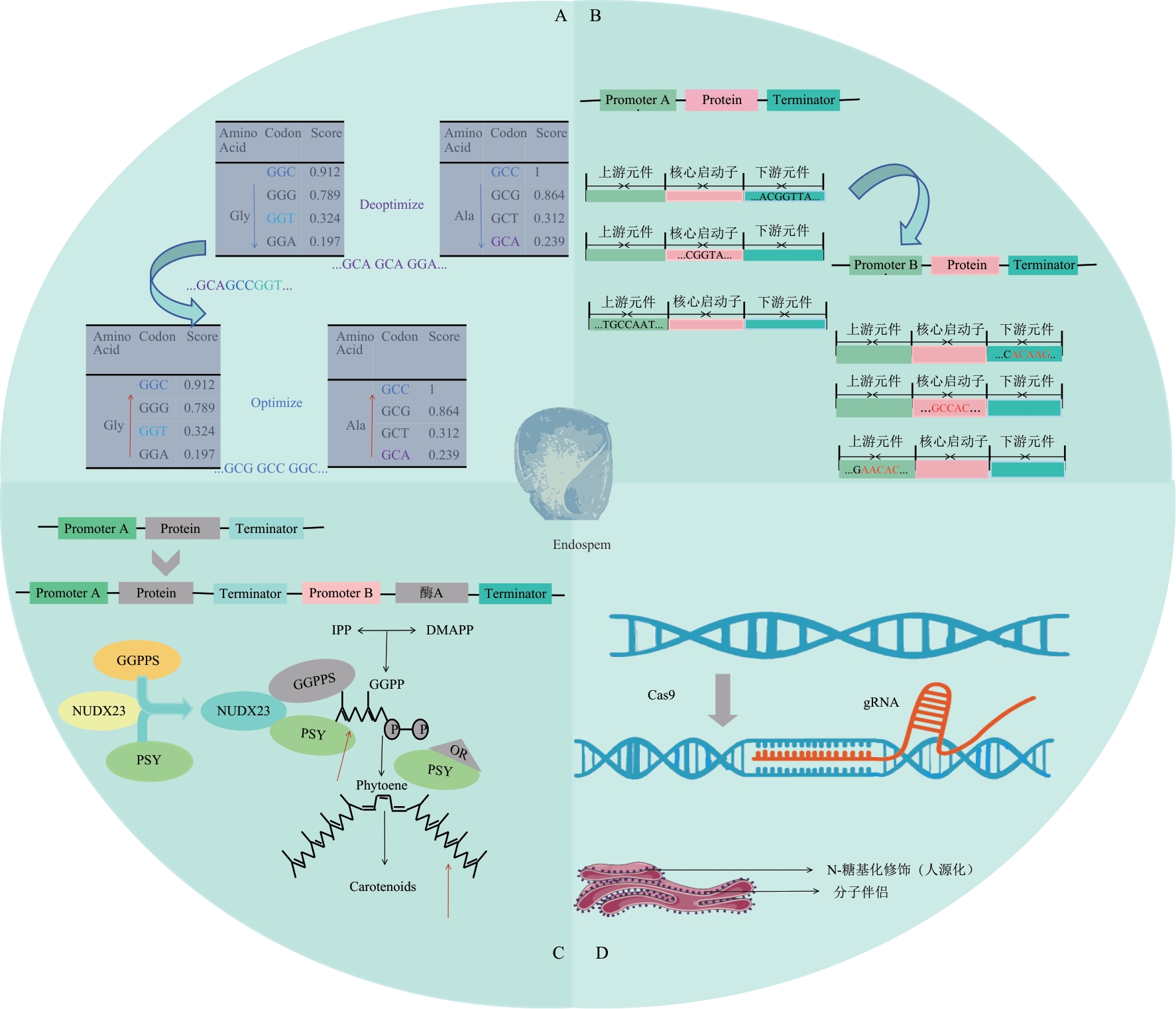
图1 胚乳生物反应器的优化策略A:密码子优化;B:启动子优化;C:关键酶的过表达;D:翻译后修饰优化
Fig. 1 Optimization strategies for endosperm bioreactorsA: Codon optimization; B: promoter optimization; C: over-expression of key enzymes; D: optimization of post-translational modifications
| [35] | Nochi T, Takagi H, Yuki Y, et al. Rice-based mucosal vaccine as a global strategy for cold-chain- and needle-free vaccination [J]. Proc Natl Acad Sci U S A, 2007, 104(26): 10986-10991. |
| [36] | Hiatt A, Caffferkey R, Bowdish K. Production of antibodies in transgenic plants [J]. Nature, 1989, 342(6245): 76-78. |
| [37] | Hood EE, Witcher DR, Maddock S, et al. Commercial production of avidin from transgenic maize: characterization of transformant, production, processing, extraction and purification [J]. Mol Breed, 1997, 3(4): 291-306. |
| [38] | Ning TT, Xie TT, Qiu QC, et al. Oral administration of recombinant human granulocyte-macrophage colony stimulating factor expressed in rice endosperm can increase leukocytes in mice [J]. Biotechnol Lett, 2008, 30(9): 1679-1686. |
| [39] | 丁一, 魏际华, 张宁, 等. 水稻胚乳细胞生物反应器研究进展 [J]. 中国稻米, 2017, 23(3): 6-12. |
| Ding Y, Wei JH, Zhang N, et al. Progress on rice endosperm cells as a bioreactor [J]. China Rice, 2017, 23(3): 6-12. | |
| [40] | He Y, Ning TT, Xie TT, et al. Large-scale production of functional human serum albumin from transgenic rice seeds [J]. Proc Natl Acad Sci USA, 2011, 108(47): 19078-19083. |
| [41] | Cheung SC, Liu LZ, Lan LL, et al. Glucose lowering effect of transgenic human insulin-like growth factor-I from rice: in vitro and in vivo studies [J]. BMC Biotechnol, 2011, 11: 37. |
| [42] | Qian DD, Qiu B, Zhou N, et al. Hypotensive activity of transgenic rice seed accumulating multiple antihypertensive peptides [J]. J Agric Food Chem, 2020, 68(27): 7162-7168. |
| [43] | Zhang Q, Zhang W, Lin CY, et al. Expression of an Acidothermus cellulolyticus endoglucanase in transgenic rice seeds [J]. Protein Expr Purif, 2012, 82(2): 279-283. |
| [44] | Chen RM, Xue GX, Chen P, et al. Transgenic maize plants expressing a fungal phytase gene [J]. Transgenic Res, 2008, 17(4): 633-643. |
| [45] | Martins N, Roriz CL, Morales P, et al. Coloring attributes of betalains: a key emphasis on stability and future applications [J]. Food Funct, 2017, 8(4): 1357-1372. |
| [46] | Tian YS, Fu XY, Yang ZQ, et al. Metabolic engineering of rice endosperm for betanin biosynthesis [J]. New Phytol, 2020, 225(5): 1915-1922. |
| [47] | Zhu QL, Zeng DC, Yu SZ, et al. From golden rice to aSTARice: bioengineering astaxanthin biosynthesis in rice endosperm [J]. Mol Plant, 2018, 11(12): 1440-1448. |
| [48] | Xu RF, Li DD, Li H, et al. Isolation of four rice seed-specific promoters and evaluation of endosperm activity [J]. Plant Cell Tissue Organ Cult, 2017, 128(1): 125-132. |
| [49] | Kajendran K, Chandrasekharan NV, Hettiarachchi CM, et al. Cloning and characterisation of an endosperm specific glutelin B1 promoter from Sri Lankan rice (Oryza sativa L. ssp. indica) variety Bg 250 [J]. J Natl Sci Found Sri Lanka, 2019, 47(4): 383. |
| [50] | Ikemura T. Codon usage and tRNA content in unicellular and multicellular organisms [J]. Mol Biol Evol, 1985, 2 1: 13-34. |
| [51] | Xue GP, Patel M, Johnson JS, et al. Selectable marker-free transgenic barley producing a high level of cellulase (1,4-β-glucanase) in developing grains [J]. Plant Cell Rep, 2003, 21(11): 1088-1094. |
| [52] | Jeong YS, Ku HK, Kim JK, et al. Effect of codon optimization on the enhancement of the β-carotene contents in rice endosperm [J]. Plant Biotechnol Rep, 2017, 11(3): 171-179. |
| [53] | Farré G, Perez-Fons L, Decourcelle M, et al. Metabolic engineering of astaxanthin biosynthesis in maize endosperm and characterization of a prototype high oil hybrid [J]. Transgenic Res, 2016, 25(4): 477-489. |
| [54] | Bai C, Berman J, Farre G, et al. Reconstruction of the astaxanthin biosynthesis pathway in rice endosperm reveals a metabolic bottleneck at the level of endogenous β-carotene hydroxylase activity [J]. Transgenic Res, 2017, 26(1): 13-23. |
| [55] | Strobbe S, Verstraete J, Stove C, et al. Metabolic engineering of rice endosperm towards higher vitamin B1 accumulation [J]. Plant Biotechnol J, 2021, 19(6): 1253-1267. |
| [56] | Li ZJ, Gao JJ, Wang B, et al. Rice carotenoid biofortification and yield improvement conferred by endosperm-specific overexpression of OsGLK1 [J]. Front Plant Sci, 2022, 13: 951605. |
| [57] | Storozhenko S, De Brouwer V, Volckaert M, et al. Folate fortification of rice by metabolic engineering [J]. Nat Biotechnol, 2007, 25(11): 1277-1279. |
| [58] | Ye XD, Al-Babili S, Klöti A, et al. Engineering the provitamin a (β-carotene) biosynthetic pathway into (carotenoid-free) rice endosperm [J]. Science, 2000, 287(5451): 303-305. |
| [59] | Beyer P, Al-Babili S, Ye XD, et al. Golden rice: introducing the β-carotene biosynthesis pathway into rice endosperm by genetic engineering to defeat vitamin a deficiency [J]. J Nutr, 2002, 132(3): 506S-510S. |
| [60] | Zhang L, Paasch BC, Chen J, et al. An important role of l-fucose biosynthesis and protein fucosylation genes in Arabidopsis immunity [J]. New Phytol, 2019, 222(2): 981-994. |
| [61] | Huether CM, Lienhart O, Baur A, et al. Glyco-engineering of moss lacking plant-specific sugar residues [J]. Plant Biol, 2005, 7(3): 292-299. |
| [62] | Kallolimath S, Castilho A, Strasser R, et al. Engineering of complex protein sialylation in plants [J].Proc Natl Acad Sci USA, 2016, 113(34): 9498-9503. |
| [63] | Pang JL, Zhou JQ, Yang DC. Knock-in at GluA1 locus improves recombinant human serum albumin expression in rice grain [J]. J Biotechnol, 2020, 321: 87-95. |
| [64] | Zhang PC, Wang HC, Xu HW, et al. Deep flanking sequence engineering for efficient promoter design using DeepSEED [J]. Nat Commun, 2023, 14: 6309. |
| [65] | Qin KZ, Liu F, Zhang CB, et al. Systems and synthetic biology for plant natural product pathway elucidation [J]. Cell Rep, 2025, 44(6): 115715. |
| [66] | 于文静,郁琼源. 生物育种产业化有序推进——农业农村部有关负责人就试点进展答记者问 [M/OL]. 2023-08-25. . |
| Yu WJ, Yu QY. The orderly promotion of the industrialization of biological breeding—A Ministry of Agriculture and Rural Affairs official answers reporters’ questions on pilot progress [M/OL]. 2023-08-25. . | |
| [67] | 农业农村部. 中华人民共和国农业农村部公告第739号 [EB/OL]. 2023-12-25. . |
| Ministry of Agriculture and Rural Affairs. Announcement No. 739 of the Ministry of Agriculture and Rural Affairs of the People’s Republic of China [EB/OL]. 2023-12-25. . | |
| [68] | 农业农村部. 欧洲议会通过欧盟委员会的新兴基因组技术(NGT)植物立法提案 [M/OL]. 2024-04-09. . |
| Ministry of Agriculture and Rural Affairs. European Parliament passes the European Commission’s legislative proposal on emerging genomic technologies (NGT) in plants [M/OL]. 2024-04-09. . | |
| [69] | 农业农村部. 美国环保局免除玉米食饲产品中苏云金芽孢杆菌Cry 1B.34蛋白的残留限量要求 [EB/OL]. 2025-03-13. . |
| Ministry of Agriculture and Rural Affairs. The U.S. Environmental Protection Agency Exempts Residue Limits for Bacillus thuringiensis Cry 1B.34 Protein in Corn Used for Feed [EB/OL]. 2025-03-13. . | |
| [70] | 农业农村部. 印度尼西亚发布《转基因食品监管条例》 [M/OL]. 2025-02-04. . |
| Ministry of Agriculture and Rural Affairs. Indonesia Issues “Regulations on the Supervision of Genetically Modified Foods” [M/OL]. 2025-02-04. . | |
| [71] | Lin CY, Fang J, Xu XL, et al. A built-In strategy for containment of transgenic plants: creation of selectively terminable transgenic rice [J]. PLoS One, 2008, 3(3): e1818. |
| [72] | Zhang XW, Wang DF, Zhao SN, et al. A double built-in containment strategy for production of recombinant proteins in transgenic rice [J]. PLoS One, 2014, 9(12): e115459. |
| [73] | Webster GR, Teh AY, Ma JK. Synthetic gene design-The rationale for codon optimization and implications for molecular pharming in plants [J]. Biotechnol Bioeng, 2017, 114(3): 492-502. |
| [74] | Wiktorek-Smagur A, Hnatuszko-Konka K, Kononowicz AK, et al. Green way of biomedicine - How to force plants to produce new important proteins [M]// Yelda Özden Çiftçi. Transgenic Plants - Advances and Limitations. Rijeka: Intech. 2012. |
| [75] | 庞建磊. 利用TALEN介导的基因定点敲除插入提高水稻胚乳中重组人血清白蛋白的表达 [D]. 武汉: 武汉大学, 2020. |
| Pang JL. Improving expression of recombinant human serum albumin in rice grain via knock-in at a storage protein locus by site-specific integration [D]. Wuhan: Wuhan University, 2020. | |
| [1] | 蒋铭轩, 李康, 罗亮, 等. 植物表达外源蛋白研究进展及展望 [J]. 生物技术通报, 2023, 39(11): 110-122. |
| Jiang MX, Li K, Luo L, et al. Advances on the expressions of foreign proteins in plants [J]. Biotechnol Bull, 2023, 39(11): 110-122. | |
| [2] | Barta A, Sommergruber K, Thompson D, et al. The expression of a nopaline synthase—human growth hormone chimaeric gene in transformed tobacco and sunflower callus tissue [J]. Plant Mol Biol, 1986, 6(5): 347-357. |
| [3] | Venkataraman S, Hefferon K, Makhzoum A, et al. Combating human viral diseases: will plant-based vaccines be the answer? [J]. Vaccines, 2021, 9(7): 761. |
| [4] | Tregoning JS. First human efficacy study of a plant-derived influenza vaccine [J]. Lancet, 2020, 396(10261): 1464-1465. |
| [5] | Mulangu S, Dodd LE, Davey RT Jr, et al. A randomized, controlled trial of Ebola virus disease therapeutics [J]. N Engl J Med, 2019, 381(24): 2293-2303. |
| [6] | Kurokawa N, Lavoie PO, D'Aoust MA, et al. Development and characterization of a plant-derived rotavirus-like particle vaccine [J]. Vaccine, 2021, 39(35): 4979-4987. |
| [7] | Yusibov V, Hooper DC, Spitsin SV, et al. Expression in plants and immunogenicity of plant virus-based experimental rabies vaccine [J]. Vaccine, 2002, 20(25/26): 3155-3164. |
| [8] | Kapusta J, Modelska A, Figlerowicz M, et al. A plant-derived edible vaccine against hepatitis B virus [J]. FASEB J, 1999, 13(13): 1796. |
| [9] | Thanavala Y, Mahoney M, Pal S, et al. Immunogenicity in humans of an edible vaccine for hepatitis B [J]. Proc Natl Acad Sci U S A, 2005, 102(9): 3378-3382. |
| [10] | Tacket CO, Mason HS, Losonsky G, et al. Human immune responses to a novel Norwalk virus vaccine delivered in transgenic potatoes [J]. J Infect Dis, 2000, 182(1): 302-305. |
| [11] | Nochi T, Yuki Y, Katakai Y, et al. A rice-based oral cholera vaccine induces macaque-specific systemic neutralizing antibodies but does not influence pre-existing intestinal immunity [J]. J Immunol, 2009, 183(10): 6538-6544. |
| [76] | Satheeshkumar PK. Expression of single chain variable fragment (scFv) molecules in plants: a comprehensive update [J]. Mol Biotechnol, 2020, 62(3): 151-167. |
| [77] | Kusnadi AR, Nikolov ZL, Howard JA. Production of recombinant proteins in transgenic plants: Practical considerations [J]. Biotechnol Bioeng, 1997, 56(5): 473-484. |
| [78] | Yao J, Weng YQ, Dickey A, et al. Plants as factories for human pharmaceuticals: applications and challenges [J]. Int J Mol Sci, 2015, 16(12): 28549-28565. |
| [79] | Schillberg S, Raven N, Spiegel H, et al. Critical analysis of the commercial potential of plants for the production of recombinant proteins [J]. Front Plant Sci, 2019, 10: 720. |
| [12] | Lai KS, Yusoff K, Mahmood M. Functional ectodomain of the hemagglutinin-neuraminidase protein is expressed in transgenic tobacco cells as a candidate vaccine against Newcastle disease virus [J]. Plant Cell Tissue Organ Cult, 2013, 112(1): 117-121. |
| [13] | Lopes MA, Larkins BA. Endosperm origin, development, and function [J]. Plant Cell, 1993, 5(10): 1383-1399. |
| [14] | Cai XQ, Ning K, Xu P. Enhancing medicinal proteins production in plant bioreactors: a focal review on promoters [J]. Fitoterapia, 2025, 180: 106338. |
| [15] | Miao YS, Ding Y, Sun QY, et al. Plant bioreactors for pharmaceuticals [J]. Biotechnol Genet Eng Rev, 2008, 25(1): 363-380. |
| [16] | Jolivet P, Boulard C, Bellamy A, et al. Protein composition of oil bodies from mature Brassica napus seeds [J]. PROTEOMICS, 2009, 9(12): 3268-3284. |
| [17] | Webster DE, Thomas MC. Post-translational modification of plant-made foreign proteins; glycosylation and beyond [J]. Biotechnol Adv, 2012, 30(2): 410-418. |
| [18] | Queiroz LN, Paula NT, Guimarães RC, et al. Production of pharmaceutical proteins in genetically modified seeds [M]//Applications of Plant Molecular Farming. Singapore: Springer Nature Singapore, 2024: 259-293. |
| [19] | Wakasa Y. The use of rice seed as a bioreactor [M]//Applications of Plant Molecular Farming. Singapore: Springer Nature Singapore, 2024: 547-567. |
| [20] | Galland M, He DL, Lounifi I, et al. An integrated “multi-omics” comparison of embryo and endosperm tissue-specific features and their impact on rice seed quality [J]. Front Plant Sci, 2017, 8: 1984. |
| [21] | Maheshwari P. An Introduction to the embryology of angiosperms [M]. New York: McGraw-Hill, 1950. |
| [22] | Fineran BA, Wild DJC, Ingerfeld M. Initial wall formation in the endosperm of wheat, Triticum aestivum: a reevaluation [J]. Can J Bot, 1982, 60(9): 1776-1795. |
| [23] | Song SJ, Diao HP, Guo YF, et al. Advances in subcellular accumulation design for recombinant protein production in tobacco [J]. BioDesign Res, 2024, 6: 47. |
| [24] | Beygmoradi A, Homaei A, Hemmati R, et al. Recombinant protein expression: Challenges in production and folding related matters [J]. Int J Biol Macromol, 2023, 233: 123407. |
| [25] | Xu X, Gan QL, Clough RC, et al. Hydroxylation of recombinant human collagen type I alpha 1 in transgenic maize co-expressed with a recombinant human prolyl 4-hydroxylase [J]. BMC Biotechnol, 2011, 11(1): 69. |
| [26] | Tripathi NK. Production and purification of recombinant proteins from Escherichia coli [J]. ChemBioEng Rev, 2016, 3(3): 116-133. |
| [27] | 陆丹丹, 叶苗, 张祖建. 稻米蛋白质及其组分研究概况及其对稻米品质的影响 [J]. 作物杂志, 2022(2): 28-34. |
| Lu DD, Ye M, Zhang ZJ. Research progress on rice protein and its components and their effects on rice quality [J]. Crops, 2022(2): 28-34. | |
| [28] | 周翌城, 郭哈伦, 陆尧, 等. 胚乳蛋白质对稻米品质影响的研究进展 [J]. 中国稻米, 2023, 29(1): 27-34, 43. |
| Zhou YC, Guo HL, Lu Y, et al. Research progress for the effect of endosperm protein on rice quality [J]. China Rice, 2023, 29(1): 27-34, 43. | |
| [29] | Stöger E, Vaquero C, Torres E, et al. Cereal crops as viable production and storage systems for pharmaceutical scFv antibodies [J]. Plant Mol Biol, 2000, 42(4): 583-590. |
| [30] | Reggi S, Onelli E, Moscatelli A, et al. Seed-specific expression of apolipoprotein A-IMilano dimer in engineered rice lines [J]. Rice Sci, 2023, 30(6): 587-597. |
| [31] | 王欣悦. 重组丝蛋白在大肠杆菌和酵母菌中的构建、表达和纯化的研究 [D]. 北京: 北京化工大学, 2024. |
| Wang XY. Research on the construction, expression and purification of recombinant silk proteins in E .coli and yeast [D]. Beijing: Beijing University of Chemical Technology, 2024. | |
| [32] | Mason HS, Lam DM, Arntzen CJ. Expression of hepatitis B surface antigen in transgenic plants [J]. Proc Natl Acad Sci U S A, 1992, 89(24): 11745-11749. |
| [33] | Tacket CO, Mason HS, Losonsky G, et al. Immunogenicity in humans of a recombinant bacterial antigen delivered in a transgenic potato [J]. Nat Med, 1998, 4(5): 607-609. |
| [34] | Chikwamba RK, Scott MP, Mejia LB, et al. Localization of a bacterial protein in starch granules of transgenic maize kernels [J]. Proc Natl Acad Sci U S A, 2003, 100(19): 11127-11132. |
| [1] | 沈晨, 车延年, 丁中平, 王祥文, 葛玉建, 符东青, 周亚星乔, 李瑞梅. 木薯采后生理变质相关基因MeGLYI-13上游转录因子的筛选[J]. 生物技术通报, 2026, 42(6): 98-106. |
| [2] | 张珊, 孙志鹏, 赵德刚, 赵懿琛. 基于杜仲BGL基因创制高效嫁接砧木[J]. 生物技术通报, 2026, 42(5): 292-301. |
| [3] | 郭道祥, 苏全, 李奥婷, 王燕, 陈清, 王小蓉, 何文. 柚MYB基因家族的鉴定及其在砧穗不亲和叶片黄化中的功能分析[J]. 生物技术通报, 2026, 42(4): 170-181. |
| [4] | 李迎辉, 王杨博涵, 周浩博, 卢心如, 张珂欣, 于洋, 李传友, 孙传龙. 番茄VPE基因家族鉴定和抗逆功能分析[J]. 生物技术通报, 2026, 42(3): 263-274. |
| [5] | 李正, 邱炜玥, 孙瑞雪, 赵筱. 不同启动子过表达xylR基因提高大肠杆菌的葡萄糖-木糖共利用能力[J]. 生物技术通报, 2026, 42(1): 329-337. |
| [6] | 张驰昊, 刘晋囡, 晁跃辉. 蒺藜苜蓿bZIP转录因子MtbZIP29的克隆及功能分析[J]. 生物技术通报, 2026, 42(1): 241-250. |
| [7] | 付博晗, 毛华, 赵薪程, 陆虹, 欧庸彬, 姚银安. 不同杨树SOS1基因启动子的克隆及盐胁迫响应分析[J]. 生物技术通报, 2025, 41(7): 205-213. |
| [8] | 张泽, 杨秀丽, 宁东贤. 花生4CL基因家族鉴定及对干旱与盐胁迫响应分析[J]. 生物技术通报, 2025, 41(7): 117-127. |
| [9] | 梁丽存, 王克芬, 宋祖洹, 刘梦婷, 李佳玉, 罗会颖, 姚斌, 杨浩萌. 优化sgRNA提高塔宾曲霉基因编辑效率[J]. 生物技术通报, 2025, 41(3): 62-70. |
| [10] | 林紫依, 吴一舟, 叶芳贤, 朱淑颖, 刘燕敏, 刘骕骦. 大豆GmPM31基因启动子响应高温高湿胁迫的功能分析[J]. 生物技术通报, 2025, 41(3): 90-97. |
| [11] | 薛晓斌, 宁琳, 周鱼, 刘虹君, 高照祖, 王振平, 李栋梅. 酿酒葡萄VvOMTs基因家族鉴定及启动子功能分析[J]. 生物技术通报, 2025, 41(12): 168-176. |
| [12] | 张静安, 胡孝龙, 曹蓓蓓, 廖敏, 束长龙, 张杰, 王奎, 操海群. 苏云金芽胞杆菌可视化快速表达载体的构建与特性分析[J]. 生物技术通报, 2025, 41(1): 95-102. |
| [13] | 毋舒宁, 苏永平, 李冬雪, 柏映国, 刘波, 张志伟. 一种谷氨酸棒杆菌4-异丙基苯甲酸诱导型启动子的设计与应用[J]. 生物技术通报, 2024, 40(7): 108-116. |
| [14] | 李梦然, 叶伟, 李赛妮, 张维阳, 李建军, 章卫民. Lithocarols类化合物生物合成基因litI的表达及其启动子功能分析[J]. 生物技术通报, 2024, 40(6): 310-318. |
| [15] | 王周, 余杰, 王金华, 王永泽, 赵筱. 厌氧表达乳酸脱氢酶以提高大肠杆菌产D-乳酸光学纯度[J]. 生物技术通报, 2024, 40(5): 290-299. |
| 阅读次数 | ||||||
|
全文 |
|
|||||
|
摘要 |
|
|||||
