







生物技术通报 ›› 2026, Vol. 42 ›› Issue (9): 286-296.doi: 10.13560/j.cnki.biotech.bull.1985.2025-0993
• 研究报告 • 上一篇
刘洋1, 白裔凡1, 陈微1, 周晶晶1, 蔡华1( ), 司红起2()
收稿日期:2025-09-17
出版日期:2026-09-26
发布日期:2026-09-16
通讯作者:
蔡华chczh@163.com基金资助:
LIU Yang1, BAI Yi-fan1, CHEN Wei1, ZHOU Jing-jing1, CAI Hua1(), SI Hong-qi2()
Received:2025-09-17
Published:2026-09-26
Online:2026-09-16
摘要:
目的 小麦木聚糖酶抑制剂(Triticum aestivum XI, TaXI)TaXI-Ⅳ在小麦抵御赤霉病的过程中发挥重要作用,既能抑制禾谷镰刀菌木聚糖酶对细胞壁木聚糖的降解,又能抑制其引发的细胞坏死现象。筛选TaXI-Ⅳ互作蛋白,为研究TaXI-Ⅳ在小麦抵御禾谷镰刀菌侵染过程中的分子调控机制,以及发掘小麦中的抗病相关基因提供参考。 方法 通过对TaXI-Ⅳ蛋白进行生物信息学分析和亚细胞定位。用同源重组法构建TaXI-Ⅳ的诱饵载体,并对其进行功能检测和自激活检测。采用酵母双杂交技术筛选TaXI-Ⅳ的互作蛋白,并通过酵母回转试验、荧光素酶互补试验和双分子荧光互补试验进行验证。用RT-qPCR分析互作蛋白对应基因在禾谷镰刀菌侵染小麦后的表达情况,并构建转基因拟南芥,通过对拟南芥叶片注射禾谷镰刀菌,并分析其抗病性。 结果 TaXI-Ⅳ亚细胞定位于细胞膜和(或)细胞壁。重组诱饵载体pBT3N-TaXI-Ⅳ在酵母细胞NMY51中无自激活现象,能够正常表达并翻译成具有功能的蛋白质,适合作为筛选cDNA文库的诱饵载体。采用分裂泛素膜系统酵母双杂交技术从小麦cDNA文库中共筛选获得23个TaXI-Ⅳ互作蛋白,涉及植物的转录调控、胁迫响应、生物防御反应、氧化应激响应等过程。TaXI-Ⅳ与TaHRLI-4D(参与超敏反应的HR样病变诱导蛋白)在酵母和植物体内均有互作。TaHRLI-4D受禾谷镰刀菌诱导表达,过表达TaHRLI-4D能够增强拟南芥对病原菌的抗性。 结论 筛选获得23个TaXI-Ⅳ阳性互作蛋白,其中,包括病程相关蛋白TaNLTP-4B(非特异性脂质转移蛋白)和活性氧代谢相关蛋白TaTrx-4A(硫氧还蛋白)。HR样病变诱导蛋白基因TaHRLI-4D参与小麦对禾谷镰刀菌侵染的防御反应。
刘洋, 白裔凡, 陈微, 周晶晶, 蔡华, 司红起. 小麦TaXI-Ⅳ互作蛋白的筛选及其与TaHRLI-4D的互作验证[J]. 生物技术通报, 2026, 42(9): 286-296.
LIU Yang, BAI Yi-fan, CHEN Wei, ZHOU Jing-jing, CAI Hua, SI Hong-qi. Screening for TaXI-Ⅳ Interacting Proteins in Wheat and Validation of Its Interaction with TaHRLI-4D[J]. Biotechnology Bulletin, 2026, 42(9): 286-296.
| 克隆编号Clone ID | 基因ID/NCBI登录号 Gene ID/NCBI accession | 注释 Annotation | 结构域 Domain | 功能 Function |
|---|---|---|---|---|
| 7 | TraesCS4A02G410800.1 | 水通道蛋白 Aquaporin | MIP(主要内在蛋白) MIP (Major intrinsic protein) | 胁迫响应 Stress response |
| 24 | TraesCS5D02G472000.1 | 磷酸盐转运蛋白 Phosphate transporter protein | Sugar_tr(糖(和其他)转运体) Sugar_tr (Sugar (and other) transporter) | |
| 14 | TraesCS5A02G186800.1 | 质子泵相互作用器 Proton pump interactor | 无匹配项 No matches found | |
| 40 | TraesCS1D02G262400.1 | 冷休克蛋白 Cold shock protein | CSD(“冷休克”DNA结合域);zf-CCHC(锌指关节) CSD (‘Cold-shock’ DNA-binding domain); zf-CCHC (Zinc knuckle) | |
| 36,42/12,27,32,37/34,41,46 | TraesCS2B02G040200.1/TraesCS4B02G316300.1/TraesCS4D02G312900.1 | HR样病变诱导蛋白相关蛋白 HR-like lesion-inducing protein-related protein | HR_lesion(类似于HR的病变诱导) HR_lesion (HR-like lesion-inducing) | 防御反 Defensive reaction |
| 13,29 | TraesCS4B02G393300.1 | 非特异性脂质转移蛋白 Non-specific lipid-transfer protein | LTP_2(脂质转移) LTP_2 (Lipid transfer) | |
| 39 | TraesCS2B02G118800.1 | 蓖麻毒素b样凝集素R40G2 Ricin B-like lectin R40G2 | RicinB_lectin_2(蓖麻毒素型β-三叶凝集素结构域样) RicinB_lectin_2 (Ricin-type beta-trefoil lectin domain-like) | |
| 25 | TraesCS1D02G283900.1 | 几丁质酶 Chitinase | Glyco_hydro_18(糖基水解酶家族18) Glyco_hydro_18 (Glycosyl hydrolases family 18) | |
| 1 | TraesCS4B02G020300.1 | 富含甘氨酸的RNA结合蛋白 Glycine-rich RNA-binding protein | RRM_1(RNA识别基序) RRM_1 (RNA recognition motif) | 胁迫响应、防御反应 Stress response and Defensive reaction |
| 31 | TraesCS4B02G026400.1 | RNA结合蛋白 RNA-binding protein | RRRM_1(NA识别基序);zf-CCHC(锌指关节) RRM_1 (RNA recognition motif); zf-CCHC(Zinc knuckle) | |
| 35,43 | TraesCS6D02G077000.1 | Bax抑制剂1样蛋白 Bax inhibitor 1-like protein | Bax1-I(促凋亡Bax1抑制剂) Bax1-I (Inhibitor of apoptosis-promoting Bax1) | |
| 16,26/30,33,38 | TraesCS4B02G320400.1/TraesCS4D02G316900.1 | 转录因子 Transcription factor | bZIP_1(bZIP转录因子) bZIP_1 (bZIP transcription factor) | 转录调控Transcriptional regulation |
| 3 | TraesCS4A02G157900.1 | 氧化还原酶/过渡金属离子结合蛋白 Oxidoreductase/ transition metal ion binding protein | 无匹配项 No matches found | 氧化应激响应 Oxidative stress response |
| 42 | TraesCS1D02G374600.1 | 酸性磷酸酶/钒依赖性卤素过氧化物酶相关 Acid phosphatase/vanadium-dependent haloperoxidase related | DUF212(PAP2家庭) DUF212 (Divergent PAP2 family) | |
| 44 | TraesCS2B02G490700.1 | 过氧化物酶(S)-2-羟基酸氧化酶 Peroxisomal (S)-2-hydroxy-acid oxidase | FMN_dh(FMN依赖的脱氢酶) FMN_dh (FMN-dependent dehydrogenase) | |
| 48 | TraesCS5D02G211100.1 | 硫氧还蛋白 Thioredoxin | 硫氧还蛋白;TPR_1四肽重复序列 Thioredoxin; TPR_1 (Tetratricopeptide repeat) | |
| 11 | FGSG_01033 | 内质网膜蛋白SH3 ER membrane protein SH3 | SHR3_chaperone(内质网膜蛋白SH3) SHR3_chaperone (ER membrane protein SH3) | 内质网成分 Endoplasmic reticulum components |
| 8 | FGSG_00464 | 假设蛋白 Hypothetical protein | 无匹配项 No matches found | 未知 Unknown |
| 45 | TraesCS5B02G033100.1 | 转甲状腺素样蛋白 Transthyretin-like protein | 无匹配项 No matches found |
表1 酵母双杂交文库筛选获得的TaXI-Ⅳ互作蛋白及其注释和结构域
Table 1 Annotation and domain of TaXI-Ⅳ-interacting proteins screened from a yeast two-hybrid library
| 克隆编号Clone ID | 基因ID/NCBI登录号 Gene ID/NCBI accession | 注释 Annotation | 结构域 Domain | 功能 Function |
|---|---|---|---|---|
| 7 | TraesCS4A02G410800.1 | 水通道蛋白 Aquaporin | MIP(主要内在蛋白) MIP (Major intrinsic protein) | 胁迫响应 Stress response |
| 24 | TraesCS5D02G472000.1 | 磷酸盐转运蛋白 Phosphate transporter protein | Sugar_tr(糖(和其他)转运体) Sugar_tr (Sugar (and other) transporter) | |
| 14 | TraesCS5A02G186800.1 | 质子泵相互作用器 Proton pump interactor | 无匹配项 No matches found | |
| 40 | TraesCS1D02G262400.1 | 冷休克蛋白 Cold shock protein | CSD(“冷休克”DNA结合域);zf-CCHC(锌指关节) CSD (‘Cold-shock’ DNA-binding domain); zf-CCHC (Zinc knuckle) | |
| 36,42/12,27,32,37/34,41,46 | TraesCS2B02G040200.1/TraesCS4B02G316300.1/TraesCS4D02G312900.1 | HR样病变诱导蛋白相关蛋白 HR-like lesion-inducing protein-related protein | HR_lesion(类似于HR的病变诱导) HR_lesion (HR-like lesion-inducing) | 防御反 Defensive reaction |
| 13,29 | TraesCS4B02G393300.1 | 非特异性脂质转移蛋白 Non-specific lipid-transfer protein | LTP_2(脂质转移) LTP_2 (Lipid transfer) | |
| 39 | TraesCS2B02G118800.1 | 蓖麻毒素b样凝集素R40G2 Ricin B-like lectin R40G2 | RicinB_lectin_2(蓖麻毒素型β-三叶凝集素结构域样) RicinB_lectin_2 (Ricin-type beta-trefoil lectin domain-like) | |
| 25 | TraesCS1D02G283900.1 | 几丁质酶 Chitinase | Glyco_hydro_18(糖基水解酶家族18) Glyco_hydro_18 (Glycosyl hydrolases family 18) | |
| 1 | TraesCS4B02G020300.1 | 富含甘氨酸的RNA结合蛋白 Glycine-rich RNA-binding protein | RRM_1(RNA识别基序) RRM_1 (RNA recognition motif) | 胁迫响应、防御反应 Stress response and Defensive reaction |
| 31 | TraesCS4B02G026400.1 | RNA结合蛋白 RNA-binding protein | RRRM_1(NA识别基序);zf-CCHC(锌指关节) RRM_1 (RNA recognition motif); zf-CCHC(Zinc knuckle) | |
| 35,43 | TraesCS6D02G077000.1 | Bax抑制剂1样蛋白 Bax inhibitor 1-like protein | Bax1-I(促凋亡Bax1抑制剂) Bax1-I (Inhibitor of apoptosis-promoting Bax1) | |
| 16,26/30,33,38 | TraesCS4B02G320400.1/TraesCS4D02G316900.1 | 转录因子 Transcription factor | bZIP_1(bZIP转录因子) bZIP_1 (bZIP transcription factor) | 转录调控Transcriptional regulation |
| 3 | TraesCS4A02G157900.1 | 氧化还原酶/过渡金属离子结合蛋白 Oxidoreductase/ transition metal ion binding protein | 无匹配项 No matches found | 氧化应激响应 Oxidative stress response |
| 42 | TraesCS1D02G374600.1 | 酸性磷酸酶/钒依赖性卤素过氧化物酶相关 Acid phosphatase/vanadium-dependent haloperoxidase related | DUF212(PAP2家庭) DUF212 (Divergent PAP2 family) | |
| 44 | TraesCS2B02G490700.1 | 过氧化物酶(S)-2-羟基酸氧化酶 Peroxisomal (S)-2-hydroxy-acid oxidase | FMN_dh(FMN依赖的脱氢酶) FMN_dh (FMN-dependent dehydrogenase) | |
| 48 | TraesCS5D02G211100.1 | 硫氧还蛋白 Thioredoxin | 硫氧还蛋白;TPR_1四肽重复序列 Thioredoxin; TPR_1 (Tetratricopeptide repeat) | |
| 11 | FGSG_01033 | 内质网膜蛋白SH3 ER membrane protein SH3 | SHR3_chaperone(内质网膜蛋白SH3) SHR3_chaperone (ER membrane protein SH3) | 内质网成分 Endoplasmic reticulum components |
| 8 | FGSG_00464 | 假设蛋白 Hypothetical protein | 无匹配项 No matches found | 未知 Unknown |
| 45 | TraesCS5B02G033100.1 | 转甲状腺素样蛋白 Transthyretin-like protein | 无匹配项 No matches found |
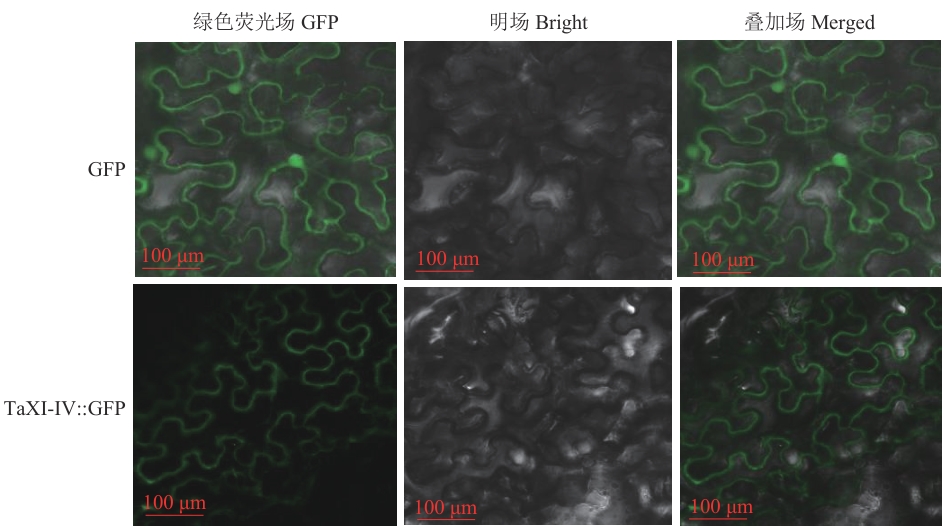
图1 TaXI-Ⅳ在烟草叶片上亚细胞定位
Fig. 1 TaXI-Ⅳ subcellular localization in tobacco leaves
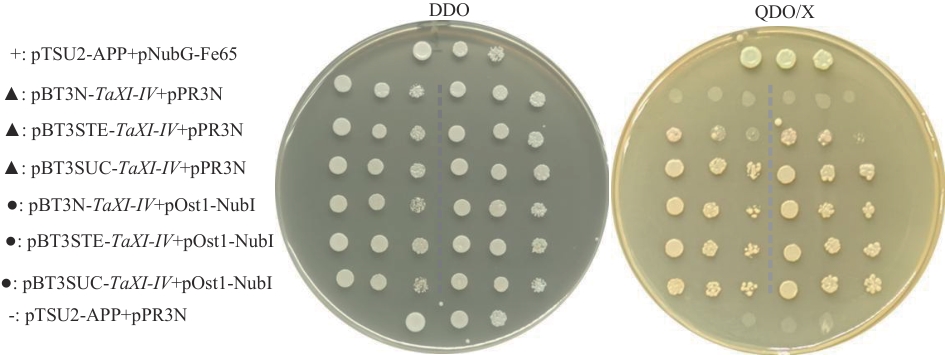
图2 重组诱饵载体转化酵母功能检测与自激活检测+:阳性对照组;-:阴性对照组;▲:自激活检测组;●:功能检测组;虚线两侧为2个重复
Fig. 2 Functional and auto-activation tests of the recombinant bait vector in yeast+: Positive control group. -: Negative control group. ▲: Autoactivation detection group. ●: Function test group. There are two repetitions on both sides of the dotted line
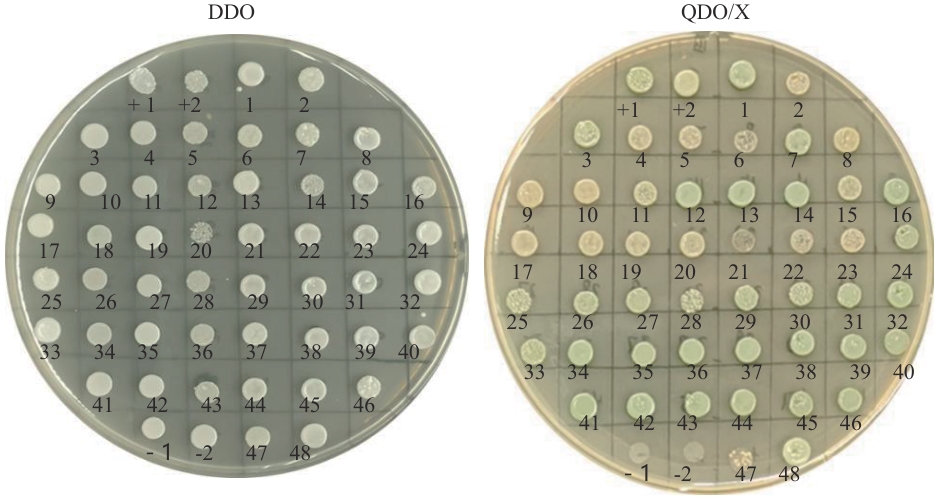
图3 木聚糖酶TaXI-Ⅳ互作蛋白的筛选-1:阴性对照 pTSU2-APP+pPR3N;-2:阴性对照 pBT3N-TaXI-Ⅳ+pPR3N;+1:阳性对照 pTSU2-APP+pNubG-Fe65;+2:阳性对照 pBT3N-TaXI-Ⅳ+pOst1-NubI;1‒48:与TaXI-Ⅳ存在互作关系的阳性菌株鉴定
Fig. 3 Screening of xylanase TaXI-Ⅳ interacting proteins-1: Negative control pTSU2-APP+pPR3N. -2: Negative control pBT3N-TaXI-Ⅳ+pPR3N. +1: Positive control pBTSU2-APP+pNubG-Fe65. +2: Positive control pBT3N-TaXI-Ⅳ+pOst1-NubI. 1-48: Identification of positive strains interacting with TaXI-Ⅳ
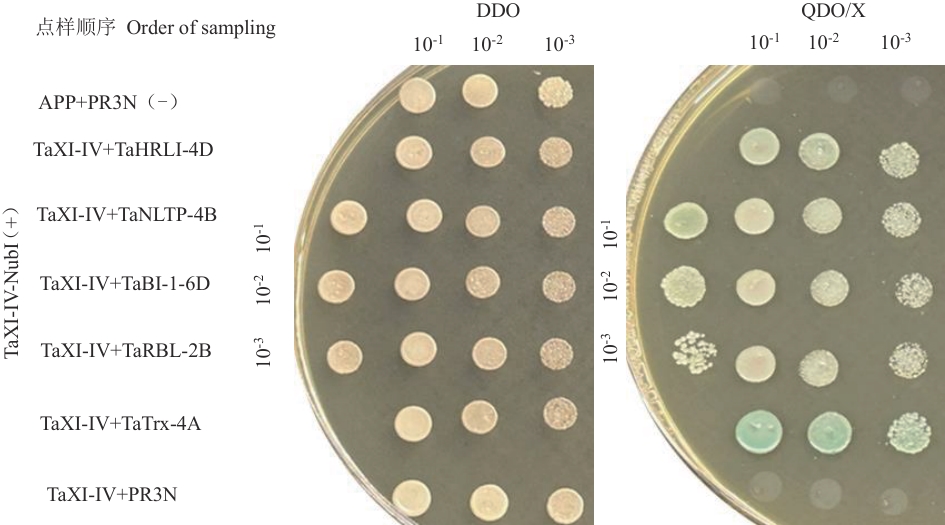
图4 TaXI-Ⅳ蛋白与候选互作蛋白回转验证+:阳性对照;-:阴性对照
Fig. 4 Retransformation assay of TaXI-Ⅳ protein and candidate interacting proteins+: Positive control. -: Negative control
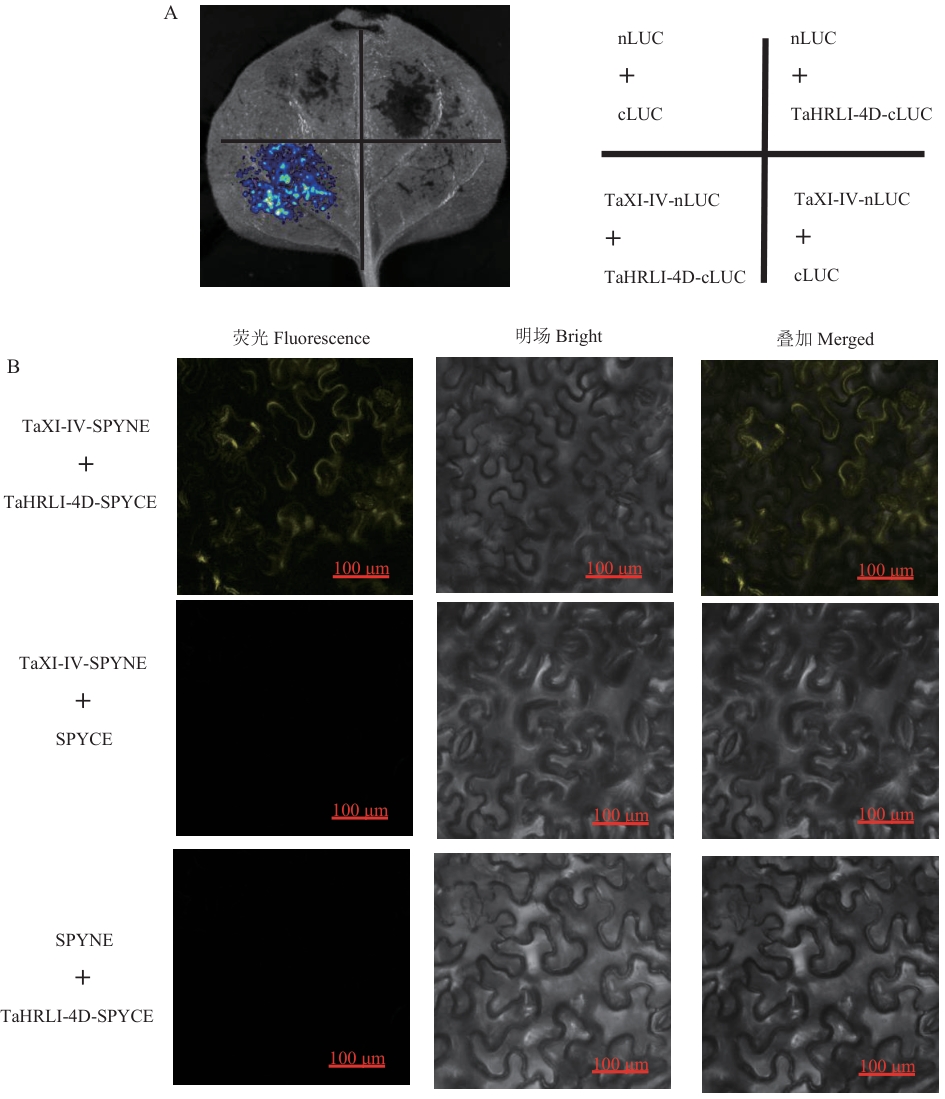
图5 TaXI-Ⅳ蛋白与TaHRLI-4D的荧光素酶互补试验(A)和双分子荧光互补试验(B)验证
Fig. 5 Validation of the TaXI‑Ⅳ protein and TaHRLI-4D interaction by luciferase complementation assay (A) and bimolecular fluorescence complementation assay (B)
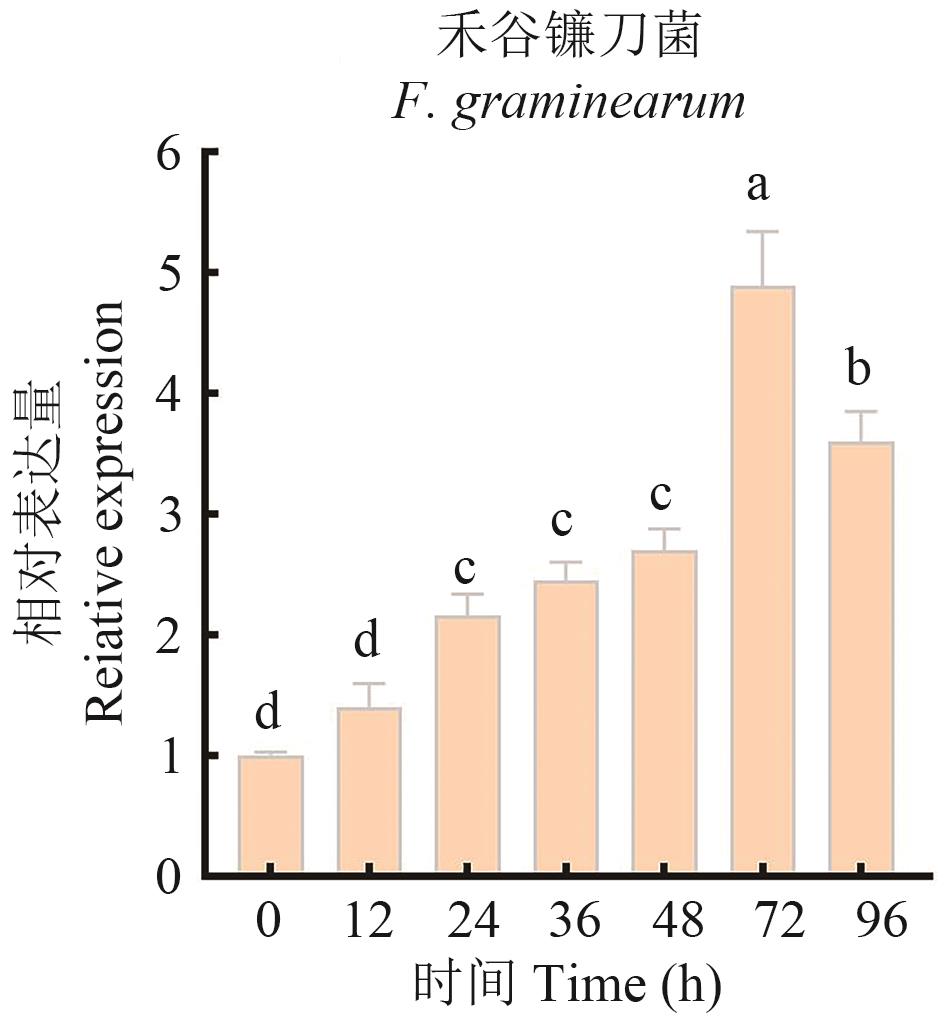
图6 禾谷镰刀菌侵染条件下TaHRLI-4D的表达分析不同小写字母表示显著差异(P<0.05)
Fig. 6 Expression of TaHRLI-4D gene under F. graminearum infectionDifferent lowercase letters indicate significant differences(P<0.05)
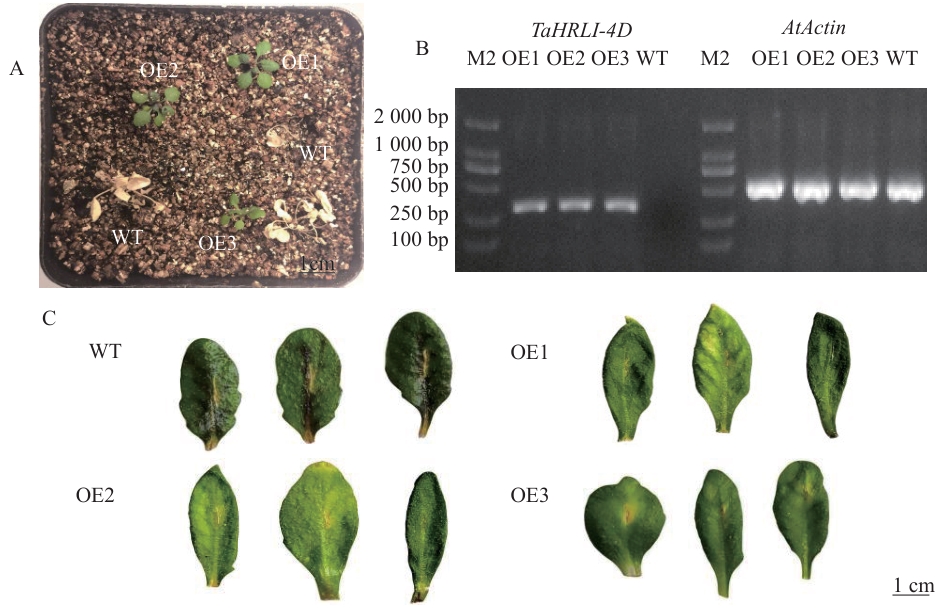
图7 转TaHRLI-4D拟南芥的鉴定(A、B)及其对禾谷镰刀菌抗性的评估(C)A:喷施Basta筛选转基因拟南芥;B:转TaHRLI-4D拟南芥的RT-PCR鉴定;C:转TaHRLI-4D拟南芥对禾谷镰刀菌的抗性鉴定。WT:野生型拟南芥;OE1‒OE3:转TaHRLI-4D拟南芥;M2:Trans2K DNA marker
Fig. 7 Identification of TaHRLI-4D-overexpressed Arabidopsis thaliana lines (A, B) and evaluation of their resistance to F. graminearum (C)A: Basta-sprayed selection of transgenic Arabidopsis. B: RT-PCR verification of TaHRLI-4D-overexpressed Arabidopsis thaliana lines. C: Disease resistance assessment of TaHRLI-4D overexpressing lines to Fusarium graminearum. WT: Wild-type A. thaliana; OE1-OE3: TaHRLI-4D overexpressing lines. M2: Trans2K DNA marker
| [1] | 万育民, 乔伟. 浅析小麦赤霉病的发病原因与防治措施 [J]. 种子科技, 2012, 30(6): 45-46. |
| Wan YM, Qiao W. Analysis on the causes and control measures of wheat scab [J]. Seed Sci Technol, 2012, 30(6): 45-46. | |
| [2] | 夏腾飞, 熊子君. 小麦赤霉病及其防治策略概况与展望 [J]. 分子植物育种, 2021, 19(19): 6460-6467. |
| Xia TF, Xiong ZJ. Overview and perspective on Fusarium head blight in wheat and its control strategies [J]. Mol Plant Breed, 2021, 19(19): 6460-6467. | |
| [3] | 高德荣, 胡文静, 张勇, 等. 小麦抗赤霉病遗传育种研究进展及思考 [J]. 长江大学学报: 自科版, 2021, 18(5): 66-77. |
| Gao DR, Hu WJ, Zhang Y, et al. Research progress and thinking on genetics and breeding of resistance to Fusarium head blight in wheat [J]. J Yangtze Univ Nat Sci Ed, 2021, 18(5): 66-77. | |
| [4] | Tanaka S, Kahmann R. Cell wall-associated effectors of plant-colonizing fungi [J]. Mycologia, 2021, 113(2): 247-260. |
| [5] | Kikot GE, Hours RA, Alconada TM. Contribution of cell wall degrading enzymes to pathogenesis of Fusarium graminearum: a review [J]. J Basic Microbiol, 2009, 49(3): 231-241. |
| [6] | Collins T, Gerday C, Feller G. Xylanases, xylanase families and extremophilic xylanases [J]. FEMS Microbiol Rev, 2005, 29(1): 3-23. |
| [7] | Beliën T, Van Campenhout S, Van Acker M, et al. Cloning and characterization of two endoxylanases from the cereal phytopathogen Fusarium graminearum and their inhibition profile against endoxylanase inhibitors from wheat [J]. Biochem Biophys Res Commun, 2005, 327(2): 407-414. |
| [8] | Sella L, Gazzetti K, Faoro F, et al. A Fusarium graminearum xylanase expressed during wheat infection is a necrotizing factor but is not essential for virulence [J]. Plant Physiol Biochem, 2013, 64: 1-10. |
| [9] | Tundo S, Moscetti I, Faoro F, et al. Fusarium graminearum produces different xylanases causing host cell death that is prevented by the xylanase inhibitors XIP-I and TAXI-Ⅲ in wheat [J]. Plant Sci, 2015, 240: 161-169. |
| [10] | Dornez E, Croes E, Gebruers K, et al. Accumulated evidence substantiates a role for three classes of wheat xylanase inhibitors in plant defense [J]. Crit Rev Plant Sci, 2010, 29(4): 244-264. |
| [11] | Debyser W, Derdelinckx G, Delcour JA. Arabinoxylan solubilization and inhibition of the barley malt xylanolytic system by wheat during mashing with wheat wholemeal adjunct: evidence for a new class of enzyme inhibitors in wheat [J]. J Am Soc Brew Chem, 1997, 55(4): 153-156. |
| [12] | Igawa T, Ochiai-Fukuda T, Takahashi-Ando N, et al. New TAXI-type xylanase inhibitor genes are inducible by pathogens and wounding in hexaploid wheat [J]. Plant Cell Physiol, 2004, 45(10): 1347-1360. |
| [13] | Dornez E, Croes E, Gebruers K, et al. 2-D DIGE reveals changes in wheat xylanase inhibitor protein families due to Fusarium graminearum ΔTri5 infection and grain development [J]. Proteomics, 2010, 10(12): 2303-2319. |
| [14] | Moscetti I, Faoro F, Moro S, et al. The xylanase inhibitor TAXI-Ⅲ counteracts the necrotic activity of a Fusarium graminearum xylanase in vitro and in durum wheat transgenic plants [J]. Mol Plant Pathol, 2015, 16(6): 583-592. |
| [15] | Moscetti I, Tundo S, Janni M, et al. Constitutive expression of the xylanase inhibitor TAXI-Ⅲ delays Fusarium head blight symptoms in durum wheat transgenic plants [J]. Mol Plant Microbe Interact, 2013, 26(12): 1464-1472. |
| [16] | Liu Y, Han NN, Wang S, et al. Genome-wide identification of Triticum aestivum xylanase inhibitor gene family and inhibitory effects of Ⅺ-2 subfamily proteins on Fusarium graminearum GH11 xylanase [J]. Front Plant Sci, 2021, 12: 665501. |
| [17] | 张雨佳, 刘丽, 邹龙海, 等. 毛竹PheFT12a基因过表达对拟南芥开花及芽发育的影响 [J]. 核农学报, 2023, 37(11): 2142-2150. |
| Zhang YJ, Liu L, Zou LH, et al. Effects of overexpression of the moso bamboo PheFT12a on flowering and bud development of Arabidopsis [J]. J Nucl Agric Sci, 2023, 37(11): 2142-2150. | |
| [18] | 刘蓉. 细胞自噬参与拟南芥对禾谷镰刀菌侵染响应的初步研究 [D]. 广州: 华南农业大学, 2020: 11. |
| Liu R. Preliminary study on autophagy involved in the response of Arabidopsis thaliana to Fusarium graminearum infection [D]. Guangzhou: South China Agricultural University, 2020: 11. | |
| [19] | Fields S, Song O. A novel genetic system to detect protein-protein interactions [J]. Nature, 1989, 340(6230): 245-246. |
| [20] | 王子颖, 龙晨洁, 范兆宇, 等. 利用酵母双杂交系统筛选水稻中与OsCRK5互作蛋白 [J]. 生物技术通报, 2023, 39(9): 117-125. |
| Wang ZY, Long CJ, Fan ZY, et al. Screening of OsCRK5-interacted proteins in rice using yeast two-hybrid system [J]. Biotechnol Bull, 2023, 39(9): 117-125. | |
| [21] | 谢瑞莹, 曾露桂, 姜超英, 等. 烟草NtMYB4a基因酵母双杂交诱饵载体的构建及互作蛋白的筛选 [J]. 核农学报, 2022, 36(7): 1318-1328. |
| Xie RY, Zeng LG, Jiang CY, et al. Construction of yeast two-hybrid bait vector and identification of proteins interacting with NtMYB4a in tobacco [J]. J Nucl Agric Sci, 2022, 36(7): 1318-1328. | |
| [22] | Johnsson N, Varshavsky A. Split ubiquitin as a sensor of protein interactions in vivo [J]. Proc Natl Acad Sci USA, 1994, 91(22): 10340-10344. |
| [23] | 张瑞芳, 张合红, 魏中艳, 等. 与南方水稻黑条矮缩病毒外壳蛋白P10互作的寄主因子筛选 [J]. 核农学报, 2021, 35(5): 1067-1073. |
| Zhang RF, Zhang HH, Wei ZY, et al. Screening of host factors and interaction with coat protein P10 of southern rice black streak dwarf virus [J]. J Nucl Agric Sci, 2021, 35(5): 1067-1073. | |
| [24] | 侯筱媛, 车郑郑, 李姮静, 等. 大豆膜系统cDNA文库的构建及大豆疫霉效应子PsAvr3a互作蛋白的筛选 [J]. 生物技术通报, 2023, 39(4): 268-276. |
| Hou XY, Che ZZ, Li HJ, et al. Construction of the soybean membrane system cDNA library and interaction proteins screening for effector PsAvr3a [J]. Biotechnol Bull, 2023, 39(4): 268-276. | |
| [25] | Zhu F, Cao MY, Zhu PX, et al. Non-specific lipid transfer protein 1 enhances immunity against tobacco mosaic virus in Nicotiana benthamiana [J]. J Exp Bot, 2023, 74(17): 5236-5254. |
| [26] | de Oliveira Dias R, Dos Santos Machado L, Migliolo L, et al. Insights into animal and plant lectins with antimicrobial activities [J]. Molecules, 2015, 20(1): 519-541. |
| [27] | Song PW, Zhang LF, Wu LL, et al. A ricin B-like lectin protein physically interacts with TaPFT and is involved in resistance to Fusarium head blight in wheat [J]. Phytopathology, 2021, 111(12): 2309-2316. |
| [28] | Xu QL, Reed JC. Bax inhibitor-1, a mammalian apoptosis suppressor identified by functional screening in yeast [J]. Mol Cell, 1998, 1(3): 337-346. |
| [29] | Babaeizad V, Imani J, Kogel KH, et al. Over-expression of the cell death regulator BAX inhibitor-1 in barley confers reduced or enhanced susceptibility to distinct fungal pathogens [J]. Theor Appl Genet, 2009, 118(3): 455-463. |
| [30] | Lu PP, Yu TF, Zheng WJ, et al. The wheat bax inhibitor-1 protein interacts with an aquaporin TaPIP1 and enhances disease resistance in Arabidopsis [J]. Front Plant Sci, 2018, 9: 20. |
| [31] | Potters G, Horemans N, Jansen MAK. The cellular redox state in plant stress biology-A charging concept [J]. Plant Physiol Biochem, 2010, 48(5): 292-300. |
| [32] | 闫宝琴, 陈燕桂, 史贤成, 等. 拟南芥AtTrx5增强植物菌核病的抗性研究 [J]. 中国油料作物学报, 2023, 45(6): 1109-1118. |
| Yan BQ, Chen YG, Shi XC, et al. Arabidopsis thioredoxin gene (AtTrx5) enhances plant resistance to Sclerotinia [J]. Chin J Oil Crop Sci, 2023, 45(6): 1109-1118. | |
| [33] | Park SR, Moon SJ, Shin DJ, et al. Isolation and characterization of rice OsHRL gene related to bacterial blight resistance [J]. Plant Pathol J, 2010, 26(4): 417-420. |
| [34] | Wu XY, Lai YC, Rao SF, et al. Genome-wide identification reveals that Nicotiana benthamiana hypersensitive response (HR)-like lesion inducing protein 4 (NbHRLI4) mediates cell death and salicylic acid-dependent defense responses to turnip mosaic virus [J]. Front Plant Sci, 2021, 12: 627315. |
| [1] | 吕正, 连如赢, 刘怡德, 刘易科, 宁强, 王书平. 小麦HD-Zip基因家族的鉴定及对禾谷镰刀菌的响应[J]. 生物技术通报, 2026, 42(8): 123-132. |
| [2] | 吕红珍, 徐莉莉, 张琳, 高敏, 谭镇炜, 王亚雯, 张秀格, 王硕, 马爱军, 王承民. 高效解磷菌筛选优化及其对弱碱土小麦促生效应[J]. 生物技术通报, 2026, 42(8): 263-275. |
| [3] | 王欣悦, 邵庆一, 陈宇姝, 胡昳凡, 赵楠, 王嫱, 王敏丽, 王雪松, 金忠民, 刘丽杰. 冬小麦TaMYBS1-like基因的克隆及功能分析[J]. 生物技术通报, 2026, 42(6): 218-226. |
| [4] | 李万, 武亚倩, 吴芳, 赵永平. 马铃薯StDREB4基因响应盐和干旱胁迫的功能研究[J]. 生物技术通报, 2026, 42(6): 53-63. |
| [5] | 江昕桦, 方天宇, 张晶晶, 李相媛, 张邦跃, 廖晓珊, 荣朵艳. 地钱MpPP2A-C基因的鉴定及功能分析[J]. 生物技术通报, 2026, 42(4): 216-226. |
| [6] | 许孟歌, 宋火焱, 罗佳, 苏亿, 周会汶, 王灿, 孔可可. 大豆GmRLK19基因表达分析及互作蛋白的筛选[J]. 生物技术通报, 2026, 42(4): 92-100. |
| [7] | 豆飞飞, 任毓昭, 王石磊, 刘春颖, 王晓东, 王昭懿, 刘彩霞, 刘凤楼, 王掌军, 李清峰. 宁春4号小麦EMS突变体库的构建及表型变异分析[J]. 生物技术通报, 2025, 41(8): 92-101. |
| [8] | 张越, 毕钰, 慕雪男, 郑子薇, 王志刚, 徐伟慧. 小麦赤霉病拮抗菌JB7的生防特性[J]. 生物技术通报, 2025, 41(7): 261-271. |
| [9] | 李成花, 豆飞飞, 任毓昭, 刘彩霞, 刘凤楼, 王掌军, 李清峰. 外施水杨酸对白粉菌侵染小麦的影响及白粉菌转录组分析[J]. 生物技术通报, 2025, 41(7): 272-280. |
| [10] | 王轶民, 李莹, 董海涛, 张恒瑞, 常璐, 高田甜, 韩德俊, 吴建辉. SRO家族蛋白在小麦多倍化进程中的演化规律[J]. 生物技术通报, 2025, 41(5): 70-81. |
| [11] | 曲珊, 赵月, 李雅华, 郑桂玲, 咸洪泉. 调控棘孢木霉几丁质酶Tachi2基因的转录因子和蛋白的互作研究[J]. 生物技术通报, 2025, 41(5): 310-319. |
| [12] | 王伟伟, 赵振杰, 王志, 邹景伟, 罗政辉, 张玉杰, 钮力亚, 于亮, 杨学举. 盐胁迫下与小麦生理响应相关的耐盐基因研究进展[J]. 生物技术通报, 2025, 41(5): 14-22. |
| [13] | 刘丽, 王辉, 关天舒, 李柏宏, 于舒怡. 葡萄脱落酸受体VvPYL4互作蛋白的筛选及互作蛋白基因表达[J]. 生物技术通报, 2025, 41(4): 188-197. |
| [14] | 马耀武, 张麒宇, 杨淼, 蒋诚, 张振宇, 张伊琳, 李梦莎, 许嘉阳, 张斌, 崔光周, 姜瑛. 烟草根际促生菌的筛选鉴定及促生性能研究[J]. 生物技术通报, 2025, 41(3): 271-281. |
| [15] | 葛仕杰, 刘怡德, 张华东, 宁强, 朱展望, 王书平, 刘易科. 小麦蛋白质二硫键异构酶基因家族的鉴定与表达[J]. 生物技术通报, 2025, 41(2): 85-96. |
| 阅读次数 | ||||||
|
全文 |
|
|||||
|
摘要 |
|
|||||
