







生物技术通报 ›› 2026, Vol. 42 ›› Issue (9): 1-13.doi: 10.13560/j.cnki.biotech.bull.1985.2025-0924
• 植物发育生物学专题 •
王鑫, 陈炜, 孙博( )
)
收稿日期:2025-08-26
出版日期:2026-09-26
发布日期:2026-09-16
通讯作者:
孙博sunbo@nju.edu.cn作者简介:第一联系人:同等贡献
基金资助:
WANG Xin, CHEN Wei, SUN Bo()
Received:2025-08-26
Published:2026-09-26
Online:2026-09-16
摘要:
花是被子植物传代重要的繁殖器官,在演化过程中形成了繁复的多样化性状。花分生组织(floral meristem, FM)中的干细胞为花器官(floral organ)的发育提供了细胞来源,对FM活性的调控直接影响FM的大小和花器官的数目。外在环境信号、植物激素和内源调控因子构成的调控网络决定了花原基的起始、花分生组织的建立与适时终止以及花器官身份特化的过程。FM活性直接影响作物的产量,因此众多作物育种改良均关注FM调控这一过程。本文以模式植物拟南芥为主,系统梳理了生长素信号及下游转录因子调控花原基起始与FM建立的分子机制,“ABCDE”模型决定花器官身份特性的原理,以CLAVATA-WUSCHEL负反馈通路为核心的FM活性维持与抑制机制,以及多级转录因子介导的FM程序性终止通路。同时,本文也总结了单子叶作物(包括水稻与玉米等)花发育以及FM活性调控的最新进展。通过单子叶植物与拟南芥、番茄等双子叶植物间的比较,揭示了“ABCDE”模型对花器官身份的决定作用,以及CLE(CLV3/ENDOSPERM SURROUNDING REGION)小肽通路抑制FM活性在被子植物中的保守性。在此基础上,猜测C类同源异型基因-C2H2/YABBY转录因子模块是调控被子植物FM适时终止的关键因子。此外,本文亦综述了近年来FM活性研究中涉及的新兴技术及其应用场景,特别探讨了快速发展的单细胞(核)转录组、空间转录组以及单细胞多组学测序等技术在多组学时代背景下,克服FM高度异质性与细胞多样性,以高效、深入解析FM活性调控网络的应用潜力。最后展望了FM发育相关研究的未来方向及可能面临的挑战,旨在为深入解析FM活性调控机制与基于FM活性设计的分子育种策略提供理论依据。
王鑫, 陈炜, 孙博. 植物花分生组织活性的调控机制[J]. 生物技术通报, 2026, 42(9): 1-13.
WANG Xin, CHEN Wei, SUN Bo. Regulatory Mechanism of Plant Floral Meristem Activity[J]. Biotechnology Bulletin, 2026, 42(9): 1-13.
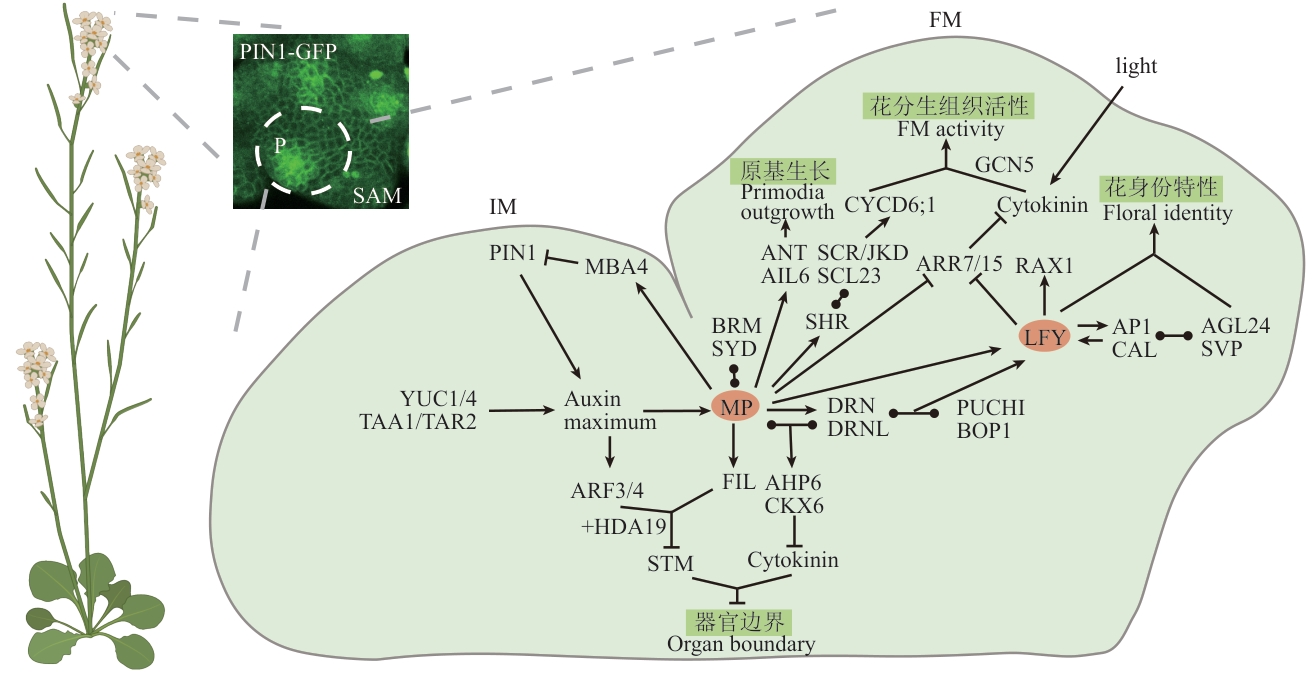
图1 拟南芥花原基起始和花分生组织活性建立的基因调控网络植物的花原基起始和分生组织活性的建立是由环境信号、激素和内源基因表达形成的复杂调控网络决定的。在茎尖分生组织周边区(PZ)形成的生长素最大值通过激活下游转录因子MP,启动花原基起始程序。MP及其靶基因LFY通过表观修饰依赖的方式调控众多靶基因表达,激活细胞分裂素信号,从而限定器官边界,确定花身份特性,促进花原基生长,建立FM活性
Fig. 1 Regulatory network for the establishment of floral primordium and floral meristem in ArabidopsisThe establishment of floral primordia initiation and meristem activity is determined by a complex regulatory network formed by environmental signals, hormones, and endogenous gene expression. Auxin maxima formed in the peripheral zone (PZ) of the inflorescence meristem (IM) leads to floral primordia initiation through the activation of downstream transcription factor MP. MP, together with its target gene LFY, regulate the expressions of numerous targeted genes and activate cytokinin signaling in an epigenetic modification-dependent manner, thereby defining floral identities, delimiting organ boundaries, promoting floral primordia growth, and establishing FM activity
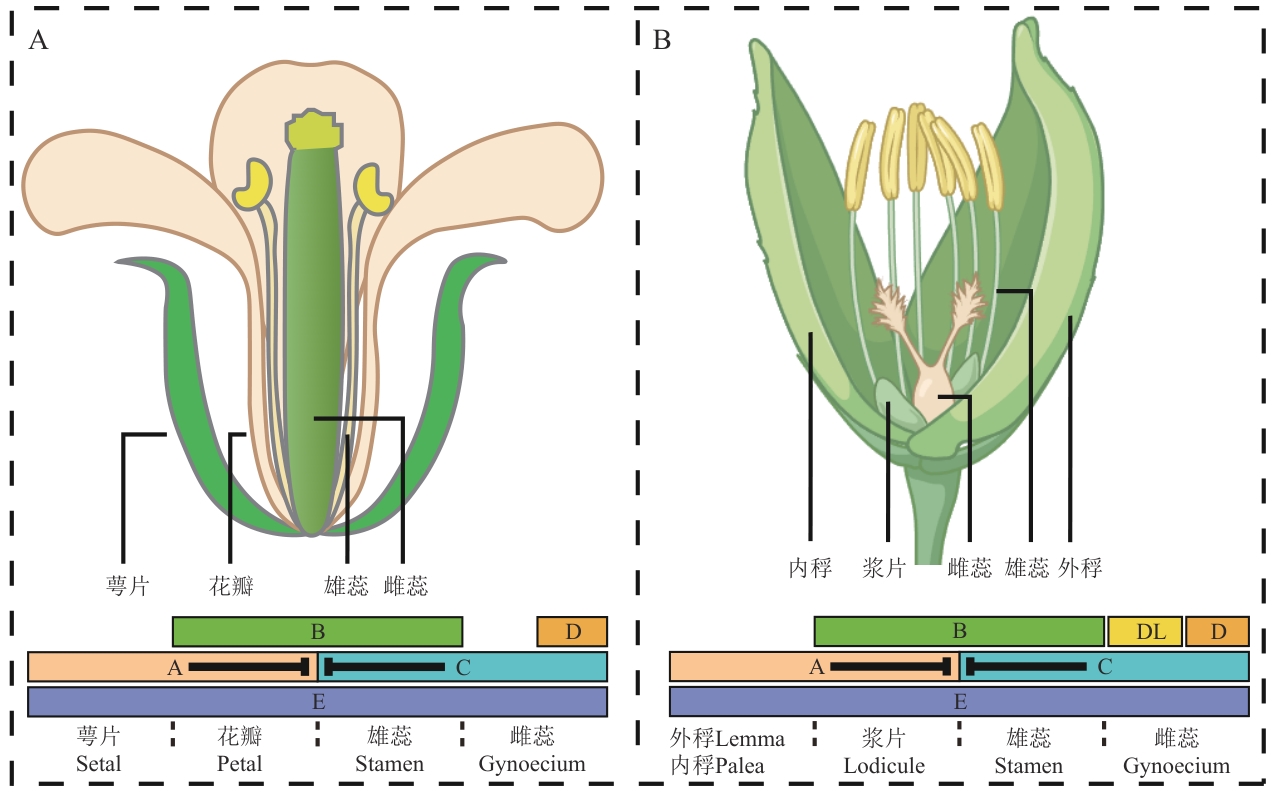
图2 花器官决定的“ABCDE”模型示意图A:双子叶植物拟南芥的花器官决定的“ABCDE”模型;从外向内依次为4枚萼片、4枚花瓣、6枚雄蕊和1枚融合的雌蕊;B:单子叶植物水稻的花器官决定的“ABCDE”模型;从外向内依次为1枚外稃、1枚内稃、2枚浆片、6枚雄蕊和1枚雌蕊
Fig. 2 The ABCDE model of floral organ identity specificationA: The ABCDE model of floral organ identity specification in the dicot Arabidopsis thaliana. From the outermost to the innermost whorl, the flower consists of four sepals, four petals, six stamens, and one fused gynoecium. B: The ABCDE model of floral organ identity specification in the monocot rice (Oryza sativa). From the outermost to the innermost whorl, the floret consists of one lemma, one palea, two lodicules, six stamens, and a single pistil
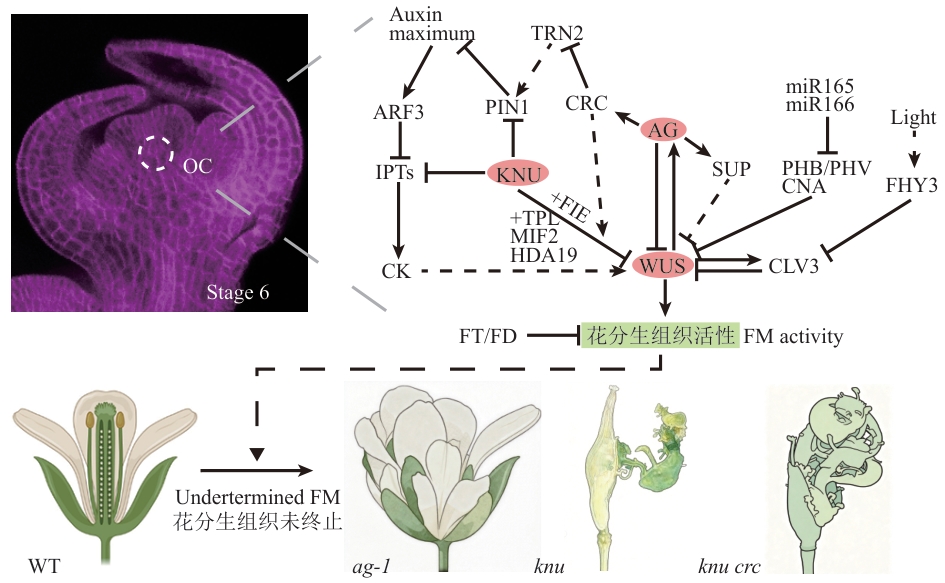
图3 拟南芥花分生组织活性的抑制与适时终止的分子调控机制植物中存在精密的调控网络以抑制过高的FM活性,并在合适的时间终止FM活性以促进雌蕊原基的分化和发育。在花发育早期阶段,对生长素和细胞分裂素等主要植物激素和干细胞决定基因WUS的调控是抑制过量FM活性的主要途径。拟南芥中,MADS结构域蛋白AG一方面从花发育第3期起直接对WUS起到抑制作用,也在花发育第6期,诱导C2H2型锌指转录因子KNU的表达,并由KNU启动表观修饰依赖的转录抑制途径,快速抑制WUS和干细胞标志基因CLV3表达,实现对FM活性的适时终止。ag、knu和knu crc突变体中未终止的FM活性产生额外轮次的花器官[72-74]
Fig. 3 Molecular regulatory mechanisms underlying the inhibition and timely termination of FM termination in ArabidopsisFine-tuned regulatory networks exist in plants to suppress excessive FM activity and to timely terminate FM activity for gynoecium differentiation and development. In the early phases of floral development, phytohormonal regulation (encompassing auxin and cytokinin) and the function of the stem cell identity gene WUS together act as key regulators to constrain hyperactivation of the floral meristem (FM). In Arabidopsis, the MADS-domain protein AG not only could directly repress WUS at floral stage 3, but also activates the C2H2-type zinc finger transcription repressor KNU at floral stage 6. KNU subsequently initiates the epigenetic-dependent transcriptional repression, and rapidly suppresses the expressions of WUS and the stem cell marker gene CLV3, thereby timely terminates the FM activity. Unterminated FM activity in ag, knu, and knu crc mutants produces additional whorls of floral organs [72-74]
| [1] | Denay G, Chahtane H, Tichtinsky G, et al. A flower is born: an update on Arabidopsis floral meristem formation [J]. Curr Opin Plant Biol, 2017, 35: 15-22. |
| [2] | Wang CY, Yang XJ, Li G. Molecular insights into inflorescence meristem specification for yield potential in cereal crops [J]. Int J Mol Sci, 2021, 22(7): 3508. |
| [3] | Yadav S, Kumar H, Mahajan M, et al. Local auxin biosynthesis promotes shoot patterning and stem cell differentiation in Arabidopsis shoot apex [J]. Development, 2023, 150(23): dev202014. |
| [4] | Benková E, Michniewicz M, Sauer M, et al. Local, efflux-dependent auxin gradients as a common module for plant organ formation [J]. Cell, 2003, 115(5): 591-602. |
| [5] | Bahafid E, Bradtmöller I, Thies AM, et al. The Arabidopsis SHORTROOT network coordinates shoot apical meristem development with auxin-dependent lateral organ initiation [J]. eLife, 2023, 12: e83334. |
| [6] | Wójcikowska B, Belaidi S, Robert HS. Game of thrones among AUXIN RESPONSE FACTORs-over 30 years of MONOPTEROS research [J]. J Exp Bot, 2023, 74(22): 6904-6921. |
| [7] | Chung Y, Zhu Y, Wu MF, et al. Auxin Response Factors promote organogenesis by chromatin-mediated repression of the pluripotency gene SHOOTMERISTEMLESS [J]. Nat Commun, 2019, 10: 886. |
| [8] | Dai YQ, Luo LJ, Zhao Z. Genetic robustness control of auxin output in priming organ initiation [J]. Proc Natl Acad Sci USA, 2023, 120(28): e2221606120. |
| [9] | Chandler JW, Werr W. DORNRÖSCHEN, DORNRÖSCHEN-LIKE, and PUCHI redundantly control floral meristem identity and organ initiation in Arabidopsis [J]. J Exp Bot, 2017, 68(13): 3457-3472. |
| [10] | Manuela D, Xu ML. AINTEGUMENTA and redundant AINTEGUMENTA-LIKE6 are required for bract outgrowth in Arabidopsis [J]. J Exp Bot, 2024, 75(13): 3920-3931. |
| [11] | Chahtane H, Vachon G, Le Masson M, et al. A variant of LEAFY reveals its capacity to stimulate meristem development by inducing RAX1 [J]. Plant J, 2013, 74(4): 678-689. |
| [12] | Yoshida S, Mandel T, Kuhlemeier C. Stem cell activation by light guides plant organogenesis [J]. Genes Dev, 2011, 25(13): 1439-1450. |
| [13] | Furutani M, Nakano Y, Tasaka M. MAB4-induced auxin sink generates local auxin gradients in Arabidopsis organ formation [J]. Proc Natl Acad Sci USA, 2014, 111(3): 1198-1203. |
| [14] | Hawar A, Chen W, Zhu T, et al. The histone acetyltransferase GCN5 regulates floral meristem activity and flower development in Arabidopsis [J]. Plant Cell, 2025, 37(6): koaf135. |
| [15] | Thomson B, Wellmer F. Molecular regulation of flower development [J]. Curr Top Dev Biol, 2019, 131: 185-210. |
| [16] | Winter CM, Yamaguchi N, Wu MF, et al. Transcriptional programs regulated by both LEAFY and APETALA1 at the time of flower formation [J]. Physiol Plant, 2015, 155(1): 55-73. |
| [17] | Hu TQ, Li XH, Du LR, et al. LEAFY and APETALA1 down-regulate ZINC FINGER PROTEIN 1 and 8 to release their repression on class B and C floral homeotic genes [J]. Proc Natl Acad Sci USA, 2023, 120(22): e2221181120. |
| [18] | Thoris K, Correa Marrero M, Fiers M, et al. Uncoupling FRUITFULL’s functions through modification of a protein motif identified by co-ortholog analysis [J]. Nucleic Acids Res, 2024, 52(21): 13290-13304. |
| [19] | Sims K, Abedi-Samakush F, Szulc N, et al. OsARF11 promotes growth, meristem, seed, and vein formation during rice plant development [J]. Int J Mol Sci, 2021, 22(8): 4089. |
| [20] | Liu JJ, Shi XA, Chang ZY, et al. Auxin efflux transporters OsPIN1c and OsPIN1d function redundantly in regulating rice (Oryza sativa L.) panicle development [J]. Plant Cell Physiol, 2022, 63(3): 305-316. |
| [21] | Liu JJ, Song Y, Mei M, et al. Gene editing unlocks superior mutants from once detrimental RFL for enhanced rice yield traits [J]. Plant J, 2025, 123(5): e70454. |
| [22] | Liu YX, Chen NN, Fan XW, et al. SP3 and DEP1 orchestrate panicle architecture by jointly regulating APO2 expression in rice [J]. Adv Sci, 2025: e08230. |
| [23] | Coen ES, Meyerowitz EM. The war of the whorls: genetic interactions controlling flower development [J]. Nature, 1991, 353(6339): 31-37. |
| [24] | Maio KA, Moubayidin L. ‘Organ’ising floral organ development [J]. Plants, 2024, 13(12): 1595. |
| [25] | Bowman JL, Moyroud E. Reflections on the ABC model of flower development [J]. Plant Cell, 2024, 36(5): 1334-1357. |
| [26] | Bowman JL, Smyth DR, Meyerowitz EM. Genetic interactions among floral homeotic genes of Arabidopsis [J]. Development, 1991, 112(1): 1-20. |
| [27] | Kramer EM, Jaramillo MA, Di Stilio VS. Patterns of gene duplication and functional evolution during the diversification of the AGAMOUS subfamily of MADS box genes in angiosperms [J]. Genetics, 2004, 166(2): 1011-1023. |
| [28] | Dreni L. The ABC of flower development in monocots: the model of rice spikelet [J]. Methods Mol Biol, 2023, 2686: 59-82. |
| [29] | Cai ZZ, Li JQ, Su YY, et al. The MADS6, JAGGED, and YABBY proteins synergistically determine floral organ development in rice [J]. Plant Physiol, 2025, 197(3): kiaf076. |
| [30] | Min Y. Position and identity, two separable but inseparable processes in floral meristem patterning [J]. Curr Opin Plant Biol, 2025, 88: 102785. |
| [31] | Prunet N, Yang WB, Das P, et al. SUPERMAN prevents class B gene expression and promotes stem cell termination in the fourth whorl of Arabidopsis thaliana flowers [J]. Proc Natl Acad Sci USA, 2017, 114(27): 7166-7171. |
| [32] | Takeda S, Hamamura Y, Sakamoto T, et al. Non-cell-autonomous regulation of petal initiation in Arabidopsis thaliana [J]. Development, 2022, 149(17): dev200684. |
| [33] | Roque E, Rodas AL, Beltrán JP, et al. SUPERMAN genes: uncovering a new function in the development of complex inflorescences [J]. Physiol Plant, 2024, 176(5): e14496. |
| [34] | Lampugnani ER, Kilinc A, Smyth DR. Auxin controls petal initiation in Arabidopsis [J]. Development, 2013, 140(1): 185-194. |
| [35] | Xu YF, Prunet N, Gan ES, et al. SUPERMAN regulates floral whorl boundaries through control of auxin biosynthesis [J]. EMBO J, 2018, 37(11): e97499. |
| [36] | Hong L, Fletcher JC. Stem cells: engines of plant growth and development [J]. Int J Mol Sci, 2023, 24(19): 14889. |
| [37] | Yadav RK, Perales M, Gruel J, et al. WUSCHEL protein movement mediates stem cell homeostasis in the Arabidopsis shoot apex [J]. Genes Dev, 2011, 25(19): 2025-2030. |
| [38] | Rodriguez K, Do A, Senay-Aras B, et al. Concentration-dependent transcriptional switching through a collective action of cis-elements [J]. Sci Adv, 2022, 8(32): eabo6157. |
| [39] | Je BI, Gruel J, Lee YK, et al. Signaling from maize organ primordia via FASCIATED EAR3 regulates stem cell proliferation and yield traits [J]. Nat Genet, 2016, 48(7): 785-791. |
| [40] | Brand U, Fletcher JC, Hobe M, et al., Dependence of stem cell fate in Arabidopsis an a feedback loop regulated by CLV3 activity [J]. Science, 2000, 289 (5479): 617-619. |
| [41] | Xu YY, Wang XM, Li J, et al. Activation of the WUS gene induces ectopic initiation of floral meristems on mature stem surface in Arabidopsis thaliana [J]. Plant Mol Biol, 2005, 58(6): 915. |
| [42] | Muños S, Ranc N, Botton E, et al. Increase in tomato locule number is controlled by two single-nucleotide polymorphisms located near WUSCHEL [J]. Plant Physiol, 2011, 156(4): 2244-2254. |
| [43] | Aguirre L, Hendelman A, Hutton SF, et al. Idiosyncratic and dose-dependent epistasis drives variation in tomato fruit size [J]. Science, 2023, 382(6668): 315-320. |
| [44] | Chen ZL, Li W, Gaines C, et al. Structural variation at the maize WUSCHEL1 locus alters stem cell organization in inflorescences [J]. Nat Commun, 2021, 12: 2378. |
| [45] | Zhang D, Tang SY, Chen JY, et al. Chromosomal inversion at the DG1 promoter drives double-grain spikelets and enhances grain yield in sorghum [J]. Nat Plants, 2025, 11(3): 453-467. |
| [46] | Tanaka W, Ohmori Y, Ushijima T, et al. Axillary meristem formation in rice requires the WUSCHEL ortholog TILLERS ABSENT1 [J]. Plant Cell, 2015, 27(4): 1173-1184. |
| [47] | Ohmori Y, Tanaka W, Kojima M, et al. WUSCHEL-RELATED HOMEOBOX4 is involved in meristem maintenance and is negatively regulated by the CLE gene FCP1 in rice [J]. Plant Cell, 2013, 25(1): 229-241. |
| [48] | Fletcher JC. The CLV-WUS stem cell signaling pathway: a roadmap to crop yield optimization [J]. Plants, 2018, 7(4): 87. |
| [49] | Liu L, Gallagher J, Arevalo ED, et al. Enhancing grain-yield-related traits by CRISPR-Cas9 promoter editing of maize CLE genes [J]. Nat Plants, 2021, 7(3): 287-294. |
| [50] | Meng WJ, Cheng ZJ, Sang YL, et al. Type-B ARABIDOPSIS RESPONSE REGULATORs specify the shoot stem cell niche by dual regulation of WUSCHEL [J]. Plant Cell, 2017, 29(6): 1357-1372. |
| [51] | Higuchi M, Pischke MS, Mähönen AP, et al. In planta functions of the Arabidopsis cytokinin receptor family [J]. Proc Natl Acad Sci USA, 2004, 101(23): 8821-8826. |
| [52] | Kurakawa T, Ueda N, Maekawa M, et al. Direct control of shoot meristem activity by a cytokinin-activating enzyme [J]. Nature, 2007, 445(7128): 652-655. |
| [53] | Takei K, Ueda N, Aoki K, et al. AtIPT3 is a key determinant of nitrate-dependent cytokinin biosynthesis in Arabidopsis [J]. Plant Cell Physiol, 2004, 45(8): 1053-1062. |
| [54] | Werner T, Motyka V, Laucou V, et al. Cytokinin-deficient transgenic Arabidopsis plants show multiple developmental alterations indicating opposite functions of cytokinins in the regulation of shoot and root meristem activity [J]. Plant Cell, 2003, 15(11): 2532-2550. |
| [55] | Vernoux T, Besnard F, Traas J. Auxin at the shoot apical meristem [J]. Cold Spring Harb Perspect Biol, 2010, 2(4): a001487. |
| [56] | Bhatia N, Bozorg B, Larsson A, et al. Auxin acts through MONOPTEROS to regulate plant cell polarity and pattern phyllotaxis [J]. Curr Biol, 2016, 26(23): 3202-3208. |
| [57] | Hawar A, Xiong SQ, Yang Z, et al. Histone acetyltransferase SlGCN5 regulates shoot meristem and flower development in Solanum lycopersicum [J]. Front Plant Sci, 2022, 12: 805879. |
| [58] | Wang SW, Liu M, Hu DP, et al. Control of DNA demethylation by superoxide anion in plant stem cells [J]. Nat Chem Biol, 2025, 21: 567-576. |
| [59] | Fletcher JC. CLAVATA3 signaling buffers Arabidopsis shoot apical meristem activity in response to photoperiod [J]. Int J Mol Sci, 2024, 25(17): 9357. |
| [60] | Wu JQ, Sun WR, Sun C, et al. Cold stress induces malformed tomato fruits by breaking the feedback loops of stem cell regulation in floral meristem [J]. New Phytol, 2023, 237(6): 2268-2283. |
| [61] | Cerbantez-Bueno VE, Reddy GV. Temperature regulation of CLAVATA3 arabinosylation [J]. Mol Plant, 2025, 18(8): 1262-1264. |
| [62] | Arshad MS, Farooq M, Asch F, et al. Thermal stress impacts reproductive development and grain yield in rice [J]. Plant Physiol Biochem, 2017, 115: 57-72. |
| [63] | Li G, Kuijer HNJ, Yang XJ, et al. MADS1 maintains barley spike morphology at high ambient temperatures [J]. Nat Plants, 2021, 7(8): 1093-1107. |
| [64] | Zhang K, Zhang H, Pan YY, et al. Cell- and noncell-autonomous AUXIN RESPONSE FACTOR3 controls meristem proliferation and phyllotactic patterns [J]. Plant Physiol, 2022, 190(4): 2335-2349. |
| [65] | Rodas AL, Roque E, Hamza R, et al. MtSUPERMAN plays a key role in compound inflorescence and flower development in Medicago truncatula [J]. Plant J, 2021, 105(3): 816-830. |
| [66] | Xu W, Zhu WW, Yang L, et al. SMALL REPRODUCTIVE ORGANS, a SUPERMAN-like transcription factor, regulates stamen and pistil growth in rice [J]. New Phytol, 2022, 233(4): 1701-1718. |
| [67] | Lee C, Clark SE. A WUSCHEL-independent stem cell specification pathway is repressed by PHB, PHV and CNA in Arabidopsis [J]. PLoS One, 2015, 10(5): e0126006. |
| [68] | Nie J, Shan N, Liu H, et al. Transcriptional control of local auxin distribution by the CsDFB1-CsPHB module regulates floral organogenesis in cucumber [J]. Proc Natl Acad Sci USA, 2021, 118(8): e2023942118. |
| [69] | Tezuka T, Sato R, Itoh JI, et al. Adaxial-abaxial bipolar leaf genes encode a putative cytokinin receptor and HD-Zip III and control the formation of ectopic shoot meristems in rice [J]. Development, 2024, 151(16): dev202607. |
| [70] | Li DM, Fu X, Guo L, et al., FAR-RED ELONGATED HYPOCOTYL3 activates SEPALLATA2 but inhibits CLAVATA3 to regulate meristem determinacy and maintenance in Arabidopsis [J]. Proc Natl Acad Sci USA, 2016, 113(33): 9375-9380. |
| [71] | Romera-Branchat M, Pocard C, Vincent C, et al. FD and FDP bZIP transcription factors and FT florigen regulate floral development and control homeotic gene expression in Arabidopsis floral meristems [J]. Development, 2025, 152(10): dev204241. |
| [72] | Sun B, Xu YF, Ng KH, et al. A timing mechanism for stem cell maintenance and differentiation in the Arabidopsis floral meristem [J]. Genes Dev, 2009, 23(15): 1791-1804. |
| [73] | Yamaguchi N, Huang JB, Xu YF, et al. Fine-tuning of auxin homeostasis governs the transition from floral stem cell maintenance to gynoecium formation [J]. Nat Commun, 2017, 8: 1125. |
| [74] | Payne T, Johnson SD, Koltunow AM. KNUCKLES (KNU) encodes a C2H2 zinc-finger protein that regulates development of basal pattern elements of the Arabidopsis gynoecium [J]. Development, 2004, 131(15): 3737-3749. |
| [75] | Lenhard M, Bohnert A, Jürgens G, et al. Termination of stem cell maintenance in Arabidopsis floral meristems by interactions between WUSCHEL and AGAMOUS [J]. Cell, 2001, 105(6): 805-814. |
| [76] | Liu XG, Kim YJ, Müller R, et al. AGAMOUSterminates floral stem cell maintenance in Arabidopsis by directly repressing WUSCHELthrough recruitment of polycomb group proteins [J]. Plant Cell, 2011, 23(10): 3654-3670. |
| [77] | Chen XM. A microRNA as a translational repressor of APETALA2 in Arabidopsis flower development [J]. Science, 2004, 303(5666): 2022-2025. |
| [78] | Huang ZG, Shi T, Zheng BL, et al. APETALA2 antagonizes the transcriptional activity of AGAMOUS in regulating floral stem cells in Arabidopsis thaliana [J]. New Phytol, 2017, 215(3): 1197-1209. |
| [79] | Sun B, Looi LS, Guo SY, et al. Timing mechanism dependent on cell division is invoked by polycomb eviction in plant stem cells [J]. Science, 2014, 343(6170): 1248559. |
| [80] | Sun B, Zhou YY, Cai J, et al. Integration of transcriptional repression and polycomb-mediated silencing of WUSCHEL in floral meristems [J]. Plant Cell, 2019, 31(7): 1488-1505. |
| [81] | Bollier N, Sicard A, Leblond J, et al. At- MINI ZINC FINGER 2 and Sl- INHIBITOR OF MERISTEM ACTIVITY, a conserved missing link in the regulation of floral meristem termination in Arabidopsis and tomato [J]. Plant Cell, 2018, 30(1): 83-100. |
| [82] | Shang EL, Wang X, Li TH, et al. Robust control of floral meristem determinacy by position-specific multifunctions of KNUCKLES [J]. Proc Natl Acad Sci USA, 2021, 118(36): e2102826118. |
| [83] | Wang GL, Wu ZY, Sun B. KNUCKLES regulates floral meristem termination by controlling auxin distribution and cytokinin activity [J]. Plant Cell, 2024, 37(1): koae312. |
| [84] | Li DB, Yang W, Wu ZY, et al. SlKNUCKLES regulates floral meristem activity and controls fruit size in Solanum lycopersicum [J]. Hortic Res, 2025, 12(3): uhae331. |
| [85] | Uemura A, Yamaguchi N, Xu YF, et al. Regulation of floral meristem activity through the interaction of AGAMOUS, SUPERMAN, and CLAVATA3 in Arabidopsis [J]. Plant Reprod, 2018, 31(1): 89-105. |
| [86] | Castañeda L, Giménez E, Pineda B, et al. Tomato CRABS CLAW paralogues interact with chromatin remodelling factors to mediate carpel development and floral determinacy [J]. New Phytol, 2022, 234(3): 1059-1074. |
| [87] | Wu JQ, Li PX, Li M, et al. Heat stress impairs floral meristem termination and fruit development by affecting the BR-SlCRCa cascade in tomato [J]. Plant Commun, 2024, 5(4): 100790. |
| [88] | Sugiyama SH, Yasui Y, Ohmori S, et al. Rice flower development revisited: regulation of carpel specification and flower meristem determinacy [J]. Plant Cell Physiol, 2019, 60(6): 1284-1295. |
| [89] | Cai ZZ, Su YY, Kong L, et al. JAGGED and DROOPING LEAF synergistically establish sexual organs and terminate floral meristem in rice [J]. Plant J, 2025, 123(1): e70346. |
| [90] | Paraiso F, Lin HQ, Li CX, et al. LEAFY and WAPO1 jointly regulate spikelet number per spike and floret development in wheat [J]. Development, 2024, 151(15): dev202803. |
| [91] | Rambaud-Lavigne L, Chatterjee A, Bovio S, et al. Heterogeneous identity, stiffness and growth characterise the shoot apex of Arabidopsis stem cell mutants [J]. Development, 2024, 151(11): dev202810. |
| [92] | Yang WB, Cortijo S, Korsbo N, et al. Molecular mechanism of cytokinin-activated cell division in Arabidopsis [J]. Science, 2021, 371(6536): 1350-1355. |
| [93] | Xu XS, Passalacqua M, Rice B, et al. Large-scale single-cell profiling of stem cells identifies redundant regulators of shoot development and yield trait variation [J]. Dev Cell, 2025. . |
| [94] | Lee TA, Illouz-Eliaz N, Nobori T, et al. A single-cell, spatial transcriptomic atlas of the Arabidopsis life cycle [J]. Nat Plants, 2025, 11(9): 1960-1975. |
| [95] | Li XH, Wan YM, Wang DZ, et al. Spatiotemporal transcriptomics reveals key gene regulation for grain yield and quality in wheat [J]. Genome Biol, 2025, 26(1): 93. |
| [96] | You C, Yang H, Zhao YY, et al. Spatiotemporal transcriptomic atlas reveals the regulatory mechanisms underlying early inflorescence development and sex differentiation in spinach [J]. Adv Sci, 2025, 12(36): e07818. |
| [97] | Wang YB, Luo Y, Guo X, et al. A spatial transcriptome map of the developing maize ear [J]. Nat Plants, 2024, 10(5): 815-827. |
| [98] | Xue HC, Xu ZG, Liu YJ, et al. A unified cell atlas of vascular plants reveals cell-type foundational genes and accelerates gene discovery [J]. Cell, 2025. . |
| [99] | Wang XY, Huang HW, Jiang SJ, et al. A single-cell multi-omics atlas of rice [J]. Nature, 2025, 644(8077): 722-730. |
| [1] | 秦娟, 卢蔚雯, 李佳徽, 李晨, 李斌, 王治业. 红花2个G6PDH基因的克隆与表达特征分析[J]. 生物技术通报, 2026, 42(8): 217-228. |
| [2] | 刘柔知, 吴嘉琦, 吴辉烨, 袁婧怡, 程堂仁, 张启翔, 袁存权. 三种不同栽培类型菊花品种的叶绿体基因组特征对比分析[J]. 生物技术通报, 2026, 42(8): 239-250. |
| [3] | 赵静玮, 常娜, 金宵溦, 张立全. 黄花苜蓿MfWRKY22的克隆及抗逆性功能分析[J]. 生物技术通报, 2026, 42(7): 236-245. |
| [4] | 游欣, 王淅, 张新妤, 魏绪英, 程华, 蔡军火. 基于非靶向代谢组解析红花石蒜叶片对高温胁迫的响应[J]. 生物技术通报, 2026, 42(7): 173-181. |
| [5] | 赵文娟, 李辉, 杨雪莹, 王朝露, 祝建波. 马铃薯‘新疆2号’遗传转化体系的建立[J]. 生物技术通报, 2026, 42(6): 87-97. |
| [6] | 刘嘉欢, 曹德法, 于玟瑶, 邓红红, 谭伦东, 郭海, 黄光卉, 王均, 王迅, 汪志辉. 晚熟柑橘花粉直感效应及SCoT分子标记鉴定[J]. 生物技术通报, 2026, 42(6): 227-236. |
| [7] | 武小娟, 赵雪雯, 王沛捷, 聂虎帅, 李楠, 马宇, 杨恩泽, 马杰茹, 马艳红. 马铃薯GARP转录因子家族分析及StARR14-X1基因功能验证[J]. 生物技术通报, 2026, 42(6): 22-30. |
| [8] | 安飞飞, 罗秀芹, 蔡杰, 薛晶晶, 朱文丽. 木薯MeMYB106基因克隆及其在叶片花青素合成中的功能[J]. 生物技术通报, 2026, 42(6): 13-21. |
| [9] | 吴夏明, 刘传和, 贺涵, 周陈平, 杨敏, 邝瑞彬, 徐泽, 魏岳荣. 草莓耐高温分子响应机制的研究进展[J]. 生物技术通报, 2026, 42(6): 175-185. |
| [10] | 顾恒, 郑栋, 宰舟颖, 陈贡伟, 岳远征, 王良桂, 杨秀莲. 桂花OfSVB1响应盐胁迫的功能研究[J]. 生物技术通报, 2026, 42(5): 332-339. |
| [11] | 张初署, 曹世宁, 王发明, 周海翔, 胡晓君, 唐月异, 周晓燕, 王冕, 陈静, 张建成. 乳酸菌发酵花生衣提取物过程中的代谢物特征分析[J]. 生物技术通报, 2026, 42(5): 340-352. |
| [12] | 陈登科, 兰刚, 夏芝, 侯保国, 杨六六, 曹彩荣, 李朋波, 吴翠翠. 花生ZF-HD基因家族的鉴定和非生物胁迫响应分析[J]. 生物技术通报, 2026, 42(4): 114-128. |
| [13] | 王振泉, 钟毅, 马波, 吴静, 胡增辉. 牡丹PsMYB43调控芳樟醇合成的功能解析[J]. 生物技术通报, 2026, 42(4): 263-271. |
| [14] | 彭楚, 孙娟利, 郑蓓蓓, 张若西, 韩月彭, 赵云. 果实花色苷酶促降解机制研究进展[J]. 生物技术通报, 2026, 42(3): 133-144. |
| [15] | 殷诗情, 田泰, 黄凤庭, 冯珑强, 王浩, 张静, 何文, 陈清, 王小蓉, 王燕. 果树果实硬度的调控机制研究进展[J]. 生物技术通报, 2026, 42(3): 213-229. |
| 阅读次数 | ||||||
|
全文 |
|
|||||
|
摘要 |
|
|||||
