







生物技术通报 ›› 2026, Vol. 42 ›› Issue (5): 174-184.doi: 10.13560/j.cnki.biotech.bull.1985.2025-0847
• 微生物组学专题 • 上一篇
张英英( ), 吴之涛, 常浩, 徐志鹏, 杨小龙, 杨克泽, 魏玉杰()
收稿日期:2025-08-04
出版日期:2026-05-26
发布日期:2026-06-10
通讯作者:
魏玉杰,研究员,研究方向 :中药材栽培与新品种选育;E-mail: gswwwyj67@163.com作者简介:张英英,副研究员,研究方向 :土壤生态与中药材栽培;E-mail: 495285884@qq.com
基金资助:
ZHANG Ying-ying(), WU Zhi-tao, CHANG Hao, XU Zhi-peng, YANG Xiao-long, YANG Ke-ze, WEI Yu-jie()
Received:2025-08-04
Published:2026-05-26
Online:2026-06-10
摘要:
目的 探明连作年限对黄芪根际土壤性质及微生物群落结构的影响,揭示导致黄芪连作障碍的关键因子与微生物群落演变之间的互作机制,为探索缓解黄芪连作障碍的微生态调控途径提供理论依据。 方法 采用Illumina NovaSeq高通量测序法和常规分析方法,分析不同种植年限对土壤性质及根际土壤微生物群落多样性影响。 结果 (1)随种植年限增加,黄芪根际土壤pH值显著下降,有效磷、速效钾含量显著增加。种植5年后,过氧化氢酶显著升高,脲酶和蔗糖酶显著下降。(2)黄芪根际土壤细菌和真菌α-多样性指数均呈下降趋势,细菌群落中鞘氨醇单胞菌属(Sphingomonas)、溶杆菌属(Lysobacter)的相对丰度显著增加,真菌群落中镰刀菌属(Fusarium)等潜在致病菌相对丰度显著增加。连作导致土壤细菌和真菌微生物网络稳定性下降。连作5年黄芪根际土壤细菌群落之间的关系以拮抗为主。子囊菌门在真菌共生网络中占主导地位。(3)pH、有效磷、速效钾、碱解氮、脲酶和碱性磷酸酶对细菌群落组成相对丰度影响显著。pH、有效磷、碱解氮、脲酶对真菌群落多样性影响显著。 结论 黄芪连作通过改变土壤理化性质、酶活性及微生物群落结构与互作关系,导致微生物多样性下降、病原菌增殖和网络稳定性减弱,最终引发连作障碍。
张英英, 吴之涛, 常浩, 徐志鹏, 杨小龙, 杨克泽, 魏玉杰. 连作年限对黄芪根际土壤性质及微生物群落结构的影响[J]. 生物技术通报, 2026, 42(5): 174-184.
ZHANG Ying-ying, WU Zhi-tao, CHANG Hao, XU Zhi-peng, YANG Xiao-long, YANG Ke-ze, WEI Yu-jie. Effects of Continuous Cropping Years on Rhizosphere Soil Properties and Microbial Community Structure of Astragalus membranaceus var. mongholicus[J]. Biotechnology Bulletin, 2026, 42(5): 174-184.
| 指标 Index | CK | Y1 | Y3 | Y5 |
|---|---|---|---|---|
| pH | 8.09±0.03ab | 8.20±0.03a | 7.97±0.10bc | 7.85±0.01c |
| 电导率 Electrical conductivity (μs/cm) | 185.30±26.59a | 144.87±11.50a | 225.70±61.68a | 243.67±9.17a |
| 有机质 Organic matter (g/kg) | 48.20±1.24ab | 44.81±1.65b | 51.14±0.77a | 48.37±1.94ab |
| 全氮 Total nitrogen (g/kg) | 2.56±0.06a | 2.37±0.09ab | 2.47±0.06ab | 2.29±0.02b |
| 碱解氮 Available nitrogen (mg/kg) | 436.17±60.89ab | 423.78±18.17bc | 543.41±26.82a | 316.67±13.45c |
| 有效磷 Available phosphorus (mg/kg) | 32.50±5.77b | 28.42±1.18b | 29.50±5.13b | 55.83±2.26a |
| 速效钾 Available phosphorus (mg/kg) | 100.67±3.84b | 90.00±5.51b | 118.00±15.10ab | 131.67±1.67a |
| 脲酶 Urease activity (μg NH4+-N·g-1 DW·d-1) | 4.09±0.18a | 3.70±0.19a | 4.07±0.04a | 2.70±0.14b |
| 蔗糖酶 Invertasc (mg reducing sugar·g-1 DW·d-1) | 77.64±1.21a | 62.76±3.15b | 69.49±1.20ab | 60.54±5.26b |
| 碱性磷酸酶 Alkaline phosphatase (μmol phenol·g-1 DW·d-1) | 2.71±0.14a | 2.65±0.15a | 2.74±0.04a | 2.16±0.07b |
| 过氧化氢酶 Catalase (μmol H2O2 degraded-1 DW·d-1 ) | 0.07±0.00b | 0.1±0.01ab | 0.08±0.00b | 0.12±0.01a |
表1 不同连作年限对黄芪根际土壤化学性质和酶活性的影响
Table 1 Effects of different continuous cropping years on chemical properties and enzyme activities of rhizosphere soil of Astragalus membranaceus var. mongholicus
| 指标 Index | CK | Y1 | Y3 | Y5 |
|---|---|---|---|---|
| pH | 8.09±0.03ab | 8.20±0.03a | 7.97±0.10bc | 7.85±0.01c |
| 电导率 Electrical conductivity (μs/cm) | 185.30±26.59a | 144.87±11.50a | 225.70±61.68a | 243.67±9.17a |
| 有机质 Organic matter (g/kg) | 48.20±1.24ab | 44.81±1.65b | 51.14±0.77a | 48.37±1.94ab |
| 全氮 Total nitrogen (g/kg) | 2.56±0.06a | 2.37±0.09ab | 2.47±0.06ab | 2.29±0.02b |
| 碱解氮 Available nitrogen (mg/kg) | 436.17±60.89ab | 423.78±18.17bc | 543.41±26.82a | 316.67±13.45c |
| 有效磷 Available phosphorus (mg/kg) | 32.50±5.77b | 28.42±1.18b | 29.50±5.13b | 55.83±2.26a |
| 速效钾 Available phosphorus (mg/kg) | 100.67±3.84b | 90.00±5.51b | 118.00±15.10ab | 131.67±1.67a |
| 脲酶 Urease activity (μg NH4+-N·g-1 DW·d-1) | 4.09±0.18a | 3.70±0.19a | 4.07±0.04a | 2.70±0.14b |
| 蔗糖酶 Invertasc (mg reducing sugar·g-1 DW·d-1) | 77.64±1.21a | 62.76±3.15b | 69.49±1.20ab | 60.54±5.26b |
| 碱性磷酸酶 Alkaline phosphatase (μmol phenol·g-1 DW·d-1) | 2.71±0.14a | 2.65±0.15a | 2.74±0.04a | 2.16±0.07b |
| 过氧化氢酶 Catalase (μmol H2O2 degraded-1 DW·d-1 ) | 0.07±0.00b | 0.1±0.01ab | 0.08±0.00b | 0.12±0.01a |
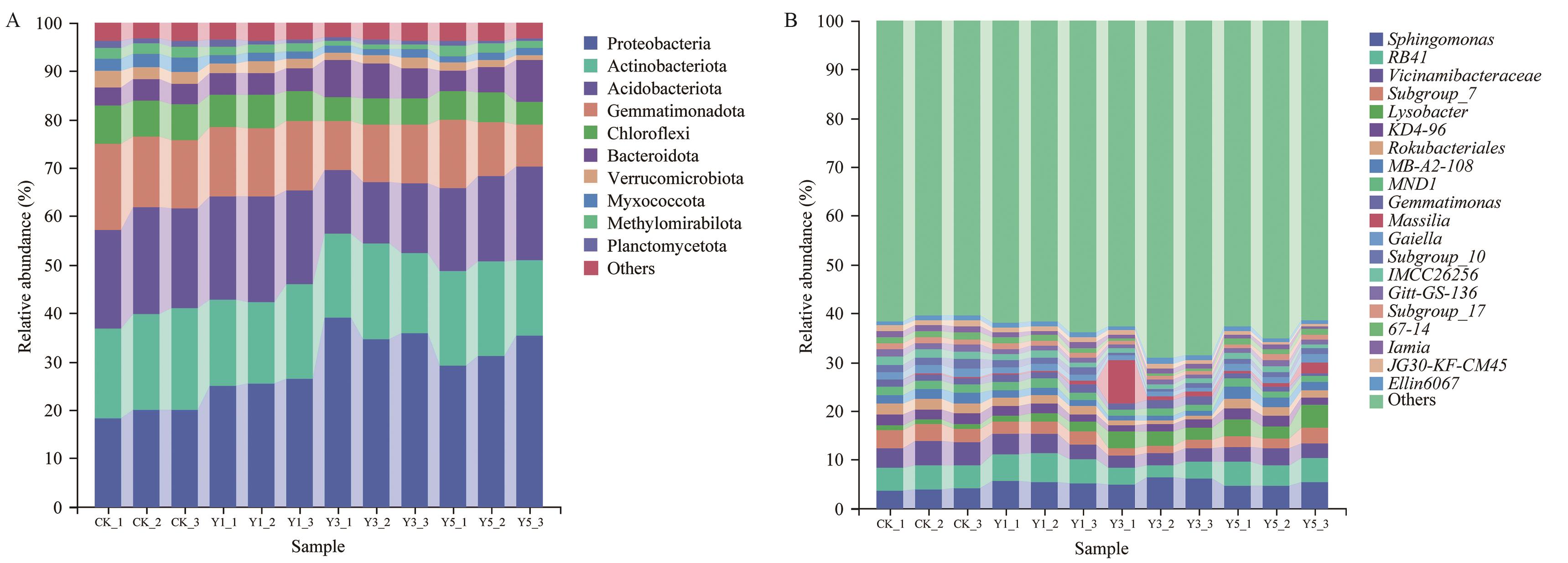
图1 不同连作年限黄芪根际土壤微生物细菌门和细菌属水平上的群落组成A:土壤微生物细菌门水平分类组成;B:土壤微生物细菌属水平的分类组成
Fig. 1 Community composition of soil bacterial phyla and genera in the rhizosphere of A. membranaceus var. mongholicus under different continuous cropping yearsA: Taxonomic composition of bacterial communities in soils at the phylum level. B: Taxonomic composition of bacterial communities in soils at the genus level
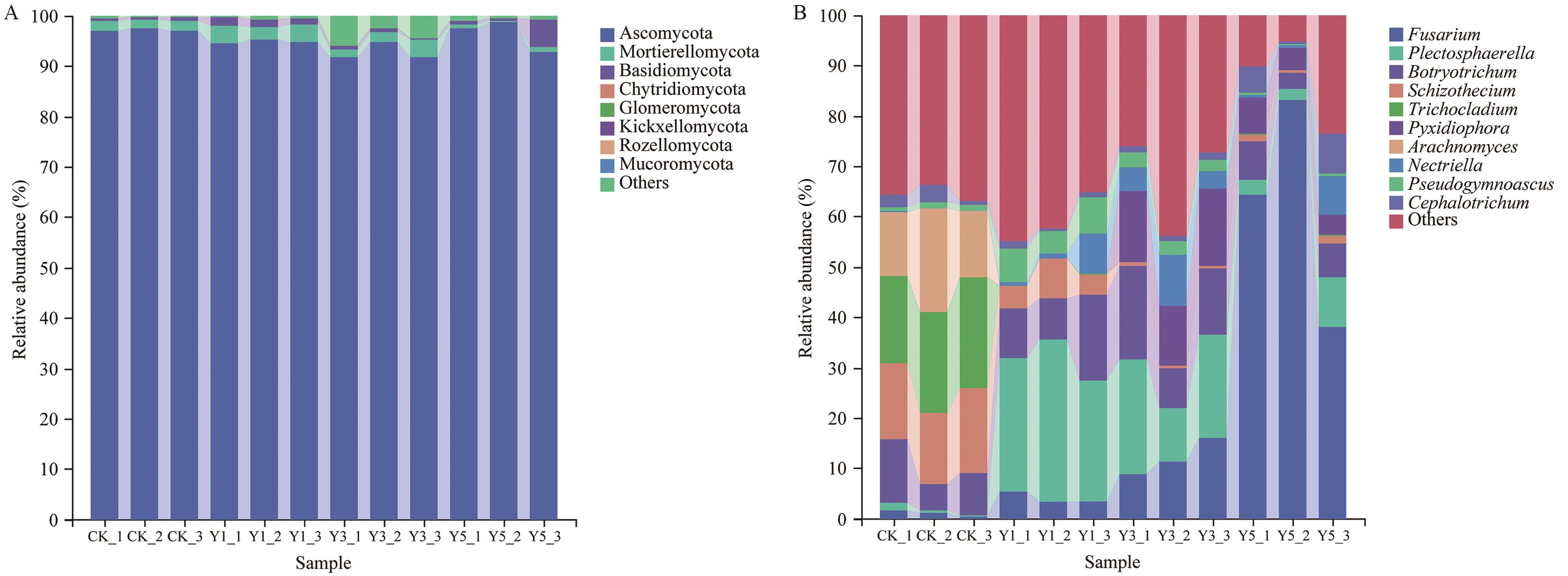
图2 不同连作年限黄芪根际土壤微生物真菌门和真菌属水平上的群落组成A:土壤微生物真菌门水平分类组成;B:土壤微生物真菌属水平的分类组成
Fig. 2 Community composition of soil fungi phyla and genera in the rhizosphere of A. membranaceus var. mongholicus under different planting yearsA: Taxonomic composition of fungi communities in soils at the phylum level. B: Taxonomic composition of fungi communities in soils at the genus level
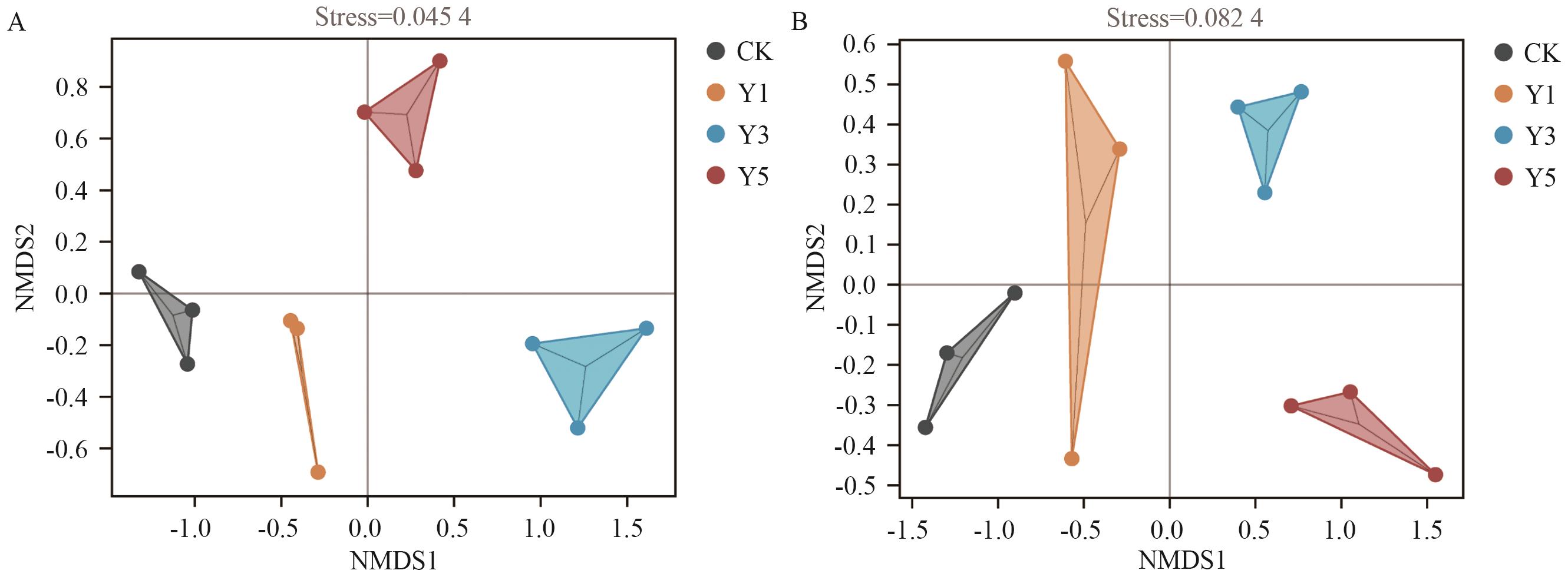
图3 土壤微生物群落NMDS分析A:土壤细菌群落NMDS分析;B:土壤真菌群落NMDS分析
Fig. 3 NMDS analysis of soil microbial communityA: NMDS analysis of the soil bacterial community. B: NMDS analysis of the soil fungal community
| 类别Classification | 处理Treatment | 节点数Total nods | 边数Total links | 平均度Average degree | 网络直径Network diameter | 模块化Modularity | 平均聚类系数Average clustering coefficient | 正相关Positivity | 负相关Negative |
|---|---|---|---|---|---|---|---|---|---|
| 细菌 Bacteria | CK | 305 | 470 | 1.57 | 10 | 0.962 | 0.326 | 53.37 | 46.63 |
| Y1 | 300 | 520 | 1.91 | 10 | 0.937 | 0.338 | 54.02 | 45.98 | |
| Y3 | 308 | 533 | 1.78 | 15 | 0.917 | 0.295 | 54.41 | 45.59 | |
| Y5 | 300 | 488 | 1.63 | 7 | 0.906 | 0.331 | 46.52 | 53.48 | |
| 真菌 Fungus | CK | 241 | 3 167 | 26.82 | 13 | 0.75 | 0.91 | 87.81 | 12.19 |
| Y1 | 241 | 3 639 | 30.199 | 19 | 0.727 | 0.87 | 89.2 | 10.8 | |
| Y3 | 238 | 3 890 | 32.282 | 24 | 0.694 | 0.876 | 91.31 | 8.69 | |
| Y5 | 154 | 1 105 | 14.351 | 13 | 0.577 | 0.951 | 93.47 | 6.43 |
表2 不同连作年限黄芪根际细菌和真菌网络拓扑结构
Table 2 Network topology of rhizosphere bacterial and fungal communities in A. mongholicus var. mongholicus under different continuous cropping years
| 类别Classification | 处理Treatment | 节点数Total nods | 边数Total links | 平均度Average degree | 网络直径Network diameter | 模块化Modularity | 平均聚类系数Average clustering coefficient | 正相关Positivity | 负相关Negative |
|---|---|---|---|---|---|---|---|---|---|
| 细菌 Bacteria | CK | 305 | 470 | 1.57 | 10 | 0.962 | 0.326 | 53.37 | 46.63 |
| Y1 | 300 | 520 | 1.91 | 10 | 0.937 | 0.338 | 54.02 | 45.98 | |
| Y3 | 308 | 533 | 1.78 | 15 | 0.917 | 0.295 | 54.41 | 45.59 | |
| Y5 | 300 | 488 | 1.63 | 7 | 0.906 | 0.331 | 46.52 | 53.48 | |
| 真菌 Fungus | CK | 241 | 3 167 | 26.82 | 13 | 0.75 | 0.91 | 87.81 | 12.19 |
| Y1 | 241 | 3 639 | 30.199 | 19 | 0.727 | 0.87 | 89.2 | 10.8 | |
| Y3 | 238 | 3 890 | 32.282 | 24 | 0.694 | 0.876 | 91.31 | 8.69 | |
| Y5 | 154 | 1 105 | 14.351 | 13 | 0.577 | 0.951 | 93.47 | 6.43 |
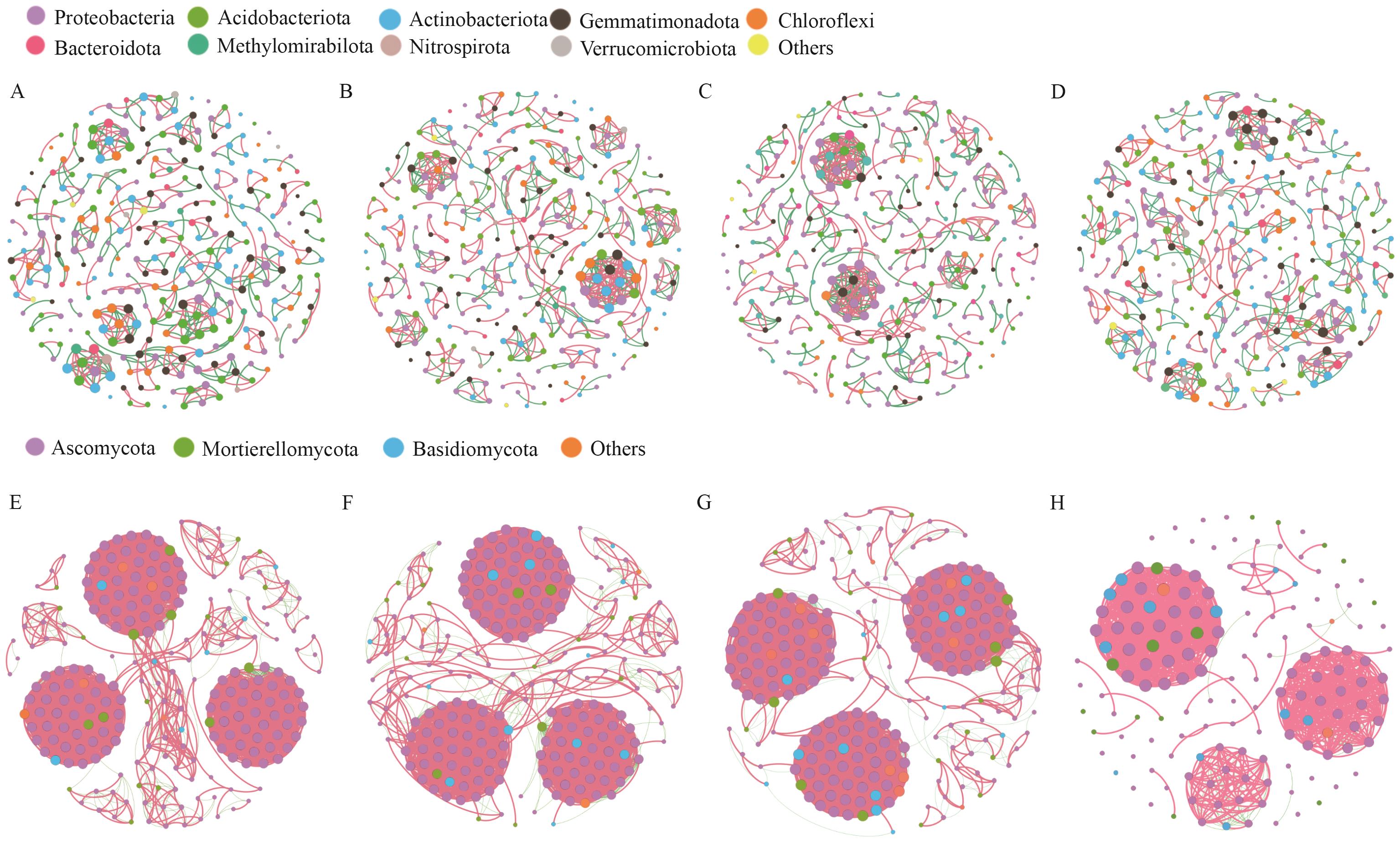
图4 不同连作年限黄芪根际土壤微生物群落生态网络分析A、B、C、D分别代表种植0年、1年、3年、5年的土壤细菌微生物网络;E、F、G、H分别代表种植0年、1年、3年、5年的土壤真菌微生物网络
Fig. 4 Ecological network analysis of microbial communities around rhizosphere soil of A. membranaceus var. mongholicus with different continuous cropping yearsA, B, C, and D refer to the soil bacterial microbial networks for 0, 1, 3, and 5 years of cultivation, respectively. E, F, G, and H refer to the soil fungal microbial networks for 0, 1, 3, and 5 years of cultivation, respectively
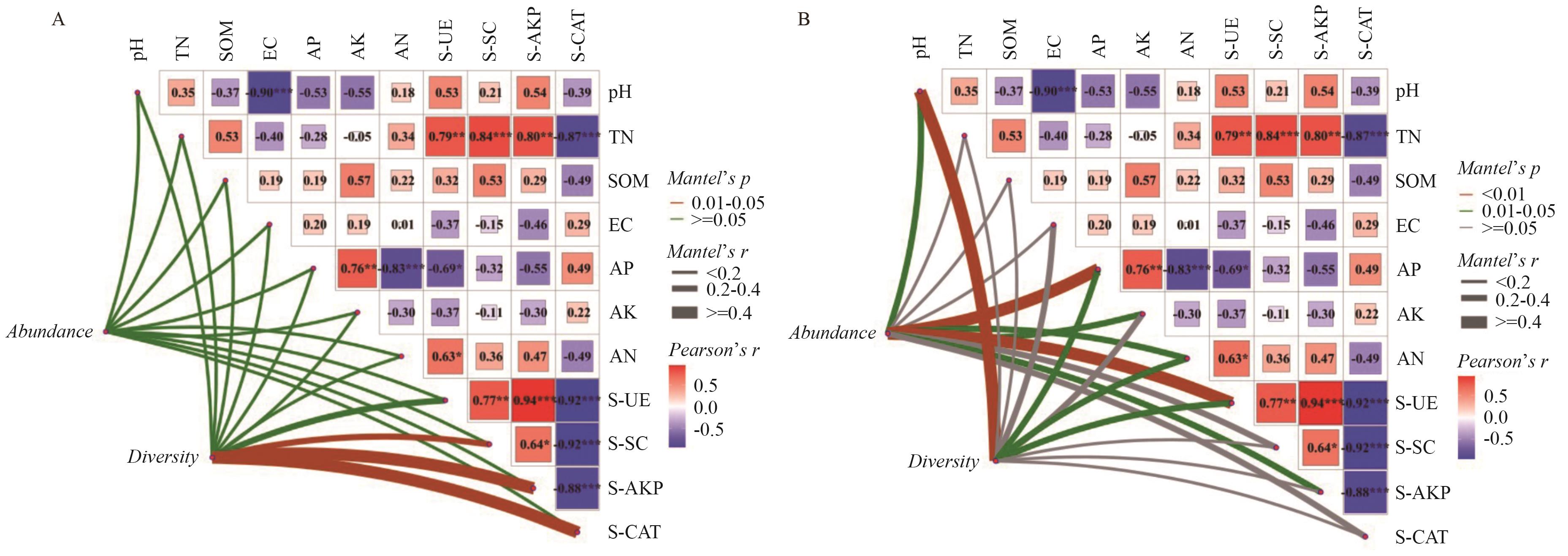
图5 不同连作年限黄芪根际土壤微生物和环境因子的Mental分析A:细菌群落Mental分析 B:真菌群落Mental分析
Fig. 5 Mental analysis of rhizosphere soil microorganisms and environmental factors of A. membranaceus var. mongholicus with different continuous cropping yearsA: Mental analysis of the bacterial community. B: Mental analysis of the fungal community
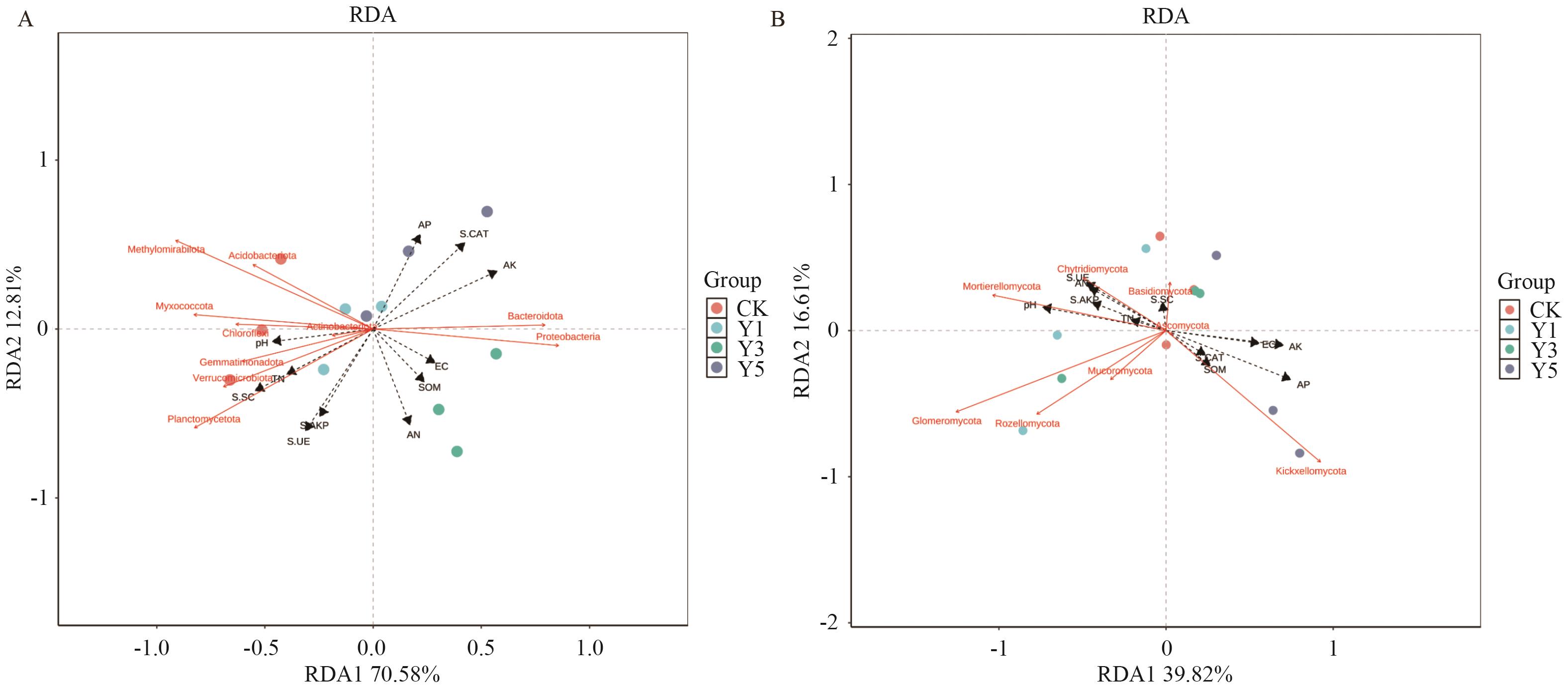
图6 土壤环境因子与微生物群落RDA分析A:细菌群落RDA分析 B:真菌群落RDA分析
Fig. 6 RDA analysis of soil physical and chemical properties and microbial communityA: RDA analysis of the bacterial community. B: RDA analysis of the fungal community
| [1] | 马莹莹, 关一鸣, 王秋霞, 等. 黄芪主要病害及防治措施研究进展 [J]. 特产研究, 2019, 41(4): 101-107. |
| Ma YY, Guan YM, Wang QX, et al. Research progress on main diseases and control measures of Astragalus membranaceus [J]. Spec Wild Econ Anim Plant Res, 2019, 41(4): 101-107. | |
| [2] | 郭文芳, 李旻辉, 伊乐泰, 等. 蒙古黄芪种植技术研究进展 [J]. 农学学报, 2019, 9(3): 36-43. |
| Guo WF, Li MH, Yi LT, et al. Planting techniques of Astragalus membranaceus (Fisch.) bge. var. mongholicus (Bge.) Hsiao: a review [J]. J Agric, 2019, 9(3): 36-43. | |
| [3] | 陈玉武, 张海星, 高晓昱, 等. 陇药种植产业发展现状及对策研究 [J]. 中国药学杂志, 2020, 55(6): 486-490. |
| Chen YW, Zhang HX, Gao XY, et al. Development status of Gansu Chinese materia medica planting industry and countermeasures for the existing problems [J]. Chin Pharm J, 2020, 55(6): 486-490. | |
| [4] | 陈垣, 朱蕾, 郭凤霞, 等. 甘肃渭源蒙古黄芪根腐病病原菌的分离与鉴定 [J]. 植物病理学报, 2011, 41(4): 428-431. |
| Chen Y, Zhu L, Guo FX, et al. Isolation and identification of the pathogens causing Astragalus membranaceus var. mongholicus root rot in Weiyuan of Gansu Province [J]. Acta Phytopathol Sin, 2011, 41(4): 428-431. | |
| [5] | 李志军, 孙德智, 贾俊英, 等. 不同栽培方式对蒙古黄芪药效品质及土壤微生态的影响 [J]. 时珍国医国药, 2024, 35(1): 197-200. |
| Li ZJ, Sun DZ, Jia JY, et al. Effects of different cultivation methods on pharmacological quality and soil microecology of Astragalus mongholicus [J]. Lishizhen Med Mater Med Res, 2024, 35(1): 197-200. | |
| [6] | 彭政, 郭秀芝, 徐扬, 等. 药用植物与根际微生物互作的研究进展与展望 [J]. 中国中药杂志, 2020, 45(9): 2023-2030. |
| Peng Z, Guo XZ, Xu Y, et al. Advances in interaction between medicinal plants and rhizosphere microorganisms [J]. China J Chin Mater Med, 2020, 45(9): 2023-2030. | |
| [7] | 周冬宇, 李杨, 邢咏梅, 等. 药用植物微生物组及其与药用植物次生代谢产物的关系 [J]. 微生物学通报, 2022, 49(9): 3989-4003. |
| Zhou DY, Li Y, Xing YM, et al. Microbiome of medicinal plants and its effect on medicinal plant secondary metabolites: a review [J]. Microbiol China, 2022, 49(9): 3989-4003. | |
| [8] | 程龙媛, 张国卉, 孙燕, 等. 药用植物-内生菌-根际微生物互作研究进展 [J]. 中草药, 2024, 55(15): 5264-5273. |
| Cheng LY, Zhang GH, Sun Y, et al. Research progress on tripartite interaction of medicinal plants-endophytic fungi-rhizosphere microbes [J]. Chin Tradit Herb Drugs, 2024, 55(15): 5264-5273. | |
| [9] | Vorholt JA, Vogel C, Carlström CI, et al. Establishing causality: opportunities of synthetic communities for plant microbiome research [J]. Cell Host Microbe, 2017, 22(2): 142-155. |
| [10] | 郭晗玥, 王东升, 阮杨, 等. 西瓜连作根际土壤微生物群落演替特征 [J]. 中国农业科学, 2023, 56(21): 4245-4258. |
| Guo HY, Wang DS, Ruan Y, et al. Characteristics and succession of rhizosphere soil microbial communities in continuous cropping watermelon [J]. Sci Agric Sin, 2023, 56(21): 4245-4258. | |
| [11] | 杨阳, 李海亮, 马凯丽, 等. 连作对党参根际土壤理化性质、微生物活性及群落特征的影响 [J]. 环境科学, 2023, 44(11): 6387-6398. |
| Yang Y, Li HL, Ma KL, et al. Effect of continuous cropping on the physicochemical properties, microbial activity, and community characteristics of the rhizosphere soil of Codonopsis pilosula [J]. Environ Sci, 2023, 44(11): 6387-6398. | |
| [12] | 鲍士旦.土壤农化分析(第三版)[M]. 北京:中国农业出版社, 2000. |
| Bao SD. Soil agrochemical analysis (3rd Edition) [M]. Beijing: China Agricultural Press, 2000. | |
| [13] | Bokulich NA, Kaehler BD, Rideout JR, et al. Optimizing taxonomic classification of marker-gene amplicon sequences with QIIME 2's q2-feature-classifier plugin [J]. Microbiome, 2018, 6(1): 90. |
| [14] | 李璐, 程晓钰, 刘晓燕, 等. 湖北和尚洞固氮微生物群落的生境特异性及网络分析 [J]. 微生物学报, 2023, 63(6): 2120-2135. |
| Li L, Cheng XY, Liu XY, et al. Habitat specificity and network analysis of nitrogen-fixing bacteria in the Heshang Cave, Hubei Province [J]. Acta Microbiol Sin, 2023, 63(6): 2120-2135. | |
| [15] | Zhao ML, Zhao J, Yuan J, et al. Root exudates drive soil-microbe-nutrient feedbacks in response to plant growth [J]. Plant Cell Environ, 2021, 44(2): 613-628. |
| [16] | Shi GY, Sun HQ, Calderón-Urrea A, et al. Bacterial communities as indicators of soil health under a continuous cropping system [J]. Land Degrad Dev, 2021, 32(7): 2393-2408. |
| [17] | 王雨欣, 徐浩然, 张鹏, 等. 黄连与根际微生物互作关系及机制的研究进展 [J]. 中草药, 2025, 56(11): 4158-4164. |
| Wang YX, Xu HR, Zhang P, et al. Research progress on interaction and mechanism between Coptis chinensis and rhizosphere microorganisms [J]. Chin Tradit Herb Drugs, 2025, 56(11): 4158-4164. | |
| [18] | 周冰谦, 赵恒强, 王晓, 等. 不同连作年限山地丹参根际土壤细菌群落结构变化及其多样性分析 [J]. 中华中医药杂志, 2019, 34(9): 3980-3985. |
| Zhou BQ, Zhao HQ, Wang X, et al. Diversity analysis and characteristic of bacterial community in rhizosphere soil of Salvia miltiorrhiza Bge. in different continuous cropping years [J]. China J Tradit Chin Med Pharm, 2019, 34(9): 3980-3985. | |
| [19] | 吴林坤, 黄伟民, 王娟英, 等. 不同连作年限野生地黄根际土壤微生物群落多样性分析 [J]. 作物学报, 2015, 41(2): 308-317. |
| Wu LK, Huang WM, Wang JY, et al. Diversity analysis of rhizosphere microflora of wild R. glutinosa grown in monocropping for different years [J]. Acta Agron Sin, 2015, 41(2): 308-317. | |
| [20] | 李莹, 刘兰英, 姜宇杰, 等. 辣椒连作对土壤细菌群落的影响 [J]. 微生物学报, 2023, 63(1): 297-318. |
| Li Y, Liu LY, Jiang YJ, et al. Effect of pepper continuous cropping on soil bacterial community [J]. Acta Microbiol Sin, 2023, 63(1): 297-318. | |
| [21] | Fierer N, Bradford MA, Jackson RB. Toward an ecological classification of soil bacteria [J]. Ecology, 2007, 88(6): 1354-1364. |
| [22] | 王光华, 刘俊杰, 于镇华, 等. 土壤酸杆菌门细菌生态学研究进展 [J]. 生物技术通报, 2016, 32(2): 14-20. |
| Wang GH, Liu JJ, Yu ZH, et al. Research progress of Acidobacteria ecology in soils [J]. Biotechnol Bull, 2016, 32(2): 14-20. | |
| [23] | 丛微, 喻海茫, 于晶晶, 等. 人参种植对林地土壤细菌群落结构和代谢功能的影响 [J]. 生态学报, 2021, 41(1): 162-171. |
| Cong W, Yu HM, Yu JJ, et al. Effects of Ginseng cultivation on soil microbial community structure and metabolic functions in forest land [J]. Acta Ecol Sin, 2021, 41(1): 162-171. | |
| [24] | 张仲富, 喻庆国, 王行, 等. 植物群落和土壤理化性质对碧塔海湿地土壤细菌群落的影响 [J]. 应用生态学报, 2021, 32(6): 2199-2208. |
| Zhang ZF, Yu QG, Wang H, et al. Effects of plant community and soil properties on soil bacterial community in Bitahai Wetland, Southwest China [J]. Chin J Appl Ecol, 2021, 32(6): 2199-2208. | |
| [25] | 胡杰, 何晓红, 李大平, 等. 鞘氨醇单胞菌研究进展 [J]. 应用与环境生物学报, 2007, 13(3): 431-437. |
| Hu J, He XH, Li DP, et al. Progress in research of Sphingomonas [J]. Chin J Appl Environ Biol, 2007, 13(3): 431-437. | |
| [26] | 李华伟, 罗文彬, 许国春, 等. 基于高通量测序的福建北部马铃薯晚疫病株根际土壤细菌群落分析 [J]. 微生物学通报, 2022, 49(3): 1017-1029. |
| Li HW, Luo WB, Xu GC, et al. High-throughput sequencing of bacterial community in the rhizosphere soil of potato infected by late blight in northern Fujian Province [J]. Microbiol China, 2022, 49(3): 1017-1029. | |
| [27] | 郑立伟, 赵阳阳, 王一冰, 等. 不同连作年限甜瓜种植土壤性质和微生物多样性 [J]. 微生物学通报, 2022, 49(1): 101-114. |
| Zheng LW, Zhao YY, Wang YB, et al. Soil properties and microbial diversity in the muskmelon fields after continuous cropping for different years [J]. Microbiol China, 2022, 49(1): 101-114. | |
| [28] | 胡朋举. 花生果腐病发生的土壤微生态变化及其防控 [D]. 秦皇岛: 河北科技师范学院, 2022. |
| Hu PJ. Soil microecological changes of peanut pod rot and its prevention and control [D]. Qinhuangdao: Hebei Normal University of Science & Technology, 2022. | |
| [29] | 苗翠苹. 三七根际土壤微生物的群落特征 [D]. 昆明: 云南大学, 2015. |
| Miao CP. Microbial community characteristics in rhizosphere soil of Panax notoginseng [D]. Kunming: Yunnan University, 2015. | |
| [30] | 王豪吉, 官会林, 周瑞春, 等. 健康与根腐豌豆根际土壤微生物群落组成特征与影响因素 [J]. 植物保护, 2025, 51(3): 135-143. |
| Wang HJ, Guan HL, Zhou RC, et al. Characteristics and influencing factors of microbial community composition in the rhizosphere soil of healthy and root-rot peas [J]. Plant Prot, 2025, 51(3): 135-143. | |
| [31] | 王小国. 根茎类药用植物连作障碍研究进展 [J]. 黑龙江农业科学, 2024(3): 110-115, 128. |
| Wang XG. Research progress on continuous cropping obstacle of rhizome medicinal plants [J]. Heilongjiang Agric Sci, 2024(3): 110-115, 128. | |
| [32] | 林春英, 李希来, 张玉欣, 等. 黄河源区高寒沼泽湿地土壤微生物群落结构对不同退化的响应 [J]. 环境科学, 2021, 42(8): 3971-3984. |
| Lin CY, Li XL, Zhang YX, et al. Responses of different degradation stages of alpine wetland on soil microbial community in the Yellow River source zone [J]. Environ Sci, 2021, 42(8): 3971-3984. |
| [1] | 廖艳婷, 王灿琴, 韦娇君, 赵承刚, 黄世旅, 罗阳兰, 阎勇. 羊肚菌连作对土壤理化性质、微生物群落变化的影响及其关联机制[J]. 生物技术通报, 2026, 42(5): 134-146. |
| [2] | 白雨果, 李婉迪, 梁建萍, 石志勇, 卢庚龙, 刘红军, 牛景萍. 哈茨木霉T9131对黄芪幼苗的促生机理[J]. 生物技术通报, 2025, 41(8): 175-185. |
| [3] | 赵春夺, 李玉娥, 刘友杰, 王新航, 赵伟, 黄永成, 李虎林, 姬文秀. 轮作与连作对烟草根际土壤养分、酶活性及微生物群落结构的影响[J]. 生物技术通报, 2025, 41(4): 312-322. |
| [4] | 宋奋奋, 段艳雪, 桑愉, 王继朋, 彭锐, 孙年喜, 李勇. 患病和健康羊肚菌菌丝际土壤微生物群落特征[J]. 生物技术通报, 2025, 41(4): 323-334. |
| [5] | 李雪, 李容欧, 孔美懿, 黄磊. 解淀粉芽孢杆菌SQ-2对水稻的促生作用[J]. 生物技术通报, 2024, 40(2): 109-119. |
| [6] | 赵林艳, 徐武美, 王豪吉, 王昆艳, 魏富刚, 杨绍周, 官会林. 施用生物炭对连作三七根际真菌群落与存活率的影响[J]. 生物技术通报, 2023, 39(7): 219-227. |
| [7] | 孙海航, 官会林, 王旭, 王童, 李泓霖, 彭文洁, 刘柏桢, 樊芳玲. 生物炭对三七连作土壤性质及真菌群落的影响[J]. 生物技术通报, 2023, 39(2): 221-231. |
| [8] | 赵林艳, 官会林, 王克书, 卢燕磊, 向萍, 魏富刚, 杨绍周, 徐武美. 土壤含水量对三七连作土壤微生物群落的影响[J]. 生物技术通报, 2022, 38(7): 215-223. |
| [9] | 赵忠娟, 杨凯, 扈进冬, 魏艳丽, 李玲, 徐维生, 李纪顺. 盐胁迫条件下哈茨木霉ST02对椒样薄荷生长及根区土壤理化性质的影响[J]. 生物技术通报, 2022, 38(7): 224-235. |
| [10] | 刘天海, 羊淑琴, 刘付彭, 苗人云, 余洋, 吴翔, 唐杰, 王勇, 彭卫红, 谭昊. 麦秸鸡粪发酵有机肥对六妹羊肚菌连作的影响[J]. 生物技术通报, 2022, 38(12): 263-273. |
| [11] | 武杞蔓, 田诗涵, 李昀烨, 潘英杰, 张颖. 微生物菌肥对设施黄瓜生长、产量及品质的影响[J]. 生物技术通报, 2022, 38(1): 125-131. |
| [12] | 刘传和, 贺涵, 何秀古, 刘开, 邵雪花, 赖多, 匡石滋, 肖维强. 不同连作年限菠萝园土壤差异代谢物和细菌群落结构分析[J]. 生物技术通报, 2021, 37(8): 162-175. |
| [13] | 袁源, 黄海辰, 李琳, 刘国辉, 傅俊生, 吴小平. 石灰对灵芝覆土连作障碍的防控作用及其微生物群落分析[J]. 生物技术通报, 2021, 37(4): 70-84. |
| [14] | 赵晓霞, 牛世全, 文娜, 苏锋锋. 黄芪根腐病生防芽孢杆菌的筛选鉴定与盆栽防效试验[J]. 生物技术通报, 2019, 35(9): 107-111. |
| [15] | 洪洁, 康建依, 刘一倩, 高秀芝, 易欣欣. 生菜连作及生菜-菠菜轮作对土壤细菌群落结构的影响[J]. 生物技术通报, 2019, 35(8): 17-26. |
| 阅读次数 | ||||||
|
全文 |
|
|||||
|
摘要 |
|
|||||
