







生物技术通报 ›› 2026, Vol. 42 ›› Issue (3): 302-311.doi: 10.13560/j.cnki.biotech.bull.1985.2025-0535
陈常璐1( ), 杨志芳1, 曹嵩晓2, 李杨青1, 叶靖烽1, 吕海艳1, 陈姗姗1, 陈昊1()
收稿日期:2025-05-25
出版日期:2026-03-26
发布日期:2026-04-23
通讯作者:
陈昊,男,博士,讲师,研究方向 :甜瓜设施栽培与生理;E-mail: haoc@jlau.edu.cn作者简介:陈常璐,女,硕士,研究方向 :甜瓜设施栽培与生理;E-mail: 1148402745@qq.com
基金资助:
CHEN Chang-lu1(), YANG Zhi-fang1, CAO Song-xiao2, LI Yang-qing1, YE Jing-feng1, LYU Hai-yan1, CHEN Shan-shan1, CHEN Hao1()
Received:2025-05-25
Published:2026-03-26
Online:2026-04-23
摘要:
目的 探究外源脱落酸(ABA)及其合成抑制剂NDGA对‘绿美人’薄皮甜瓜采后软化的调控机制,重点阐明ABA通过乙烯信号通路及ASR转录因子的层级调控网络,解析ABA与乙烯协同、独立调控果实软化的时空模式,为靶向保鲜技术的开发提供理论依据。 方法 以薄皮甜瓜‘绿美人’为材料,外源注射600 μmol/L ABA或50 μmol/L NDGA,测定贮藏期间果实硬度、呼吸速率、乙烯释放量及关键酶活性,结合转录组测序分析差异表达基因(DEGs),并通过qPCR验证ABA和乙烯相关基因的时序表达特征。 结果 ABA处理诱导果实提前软化,早期短暂抑制PG活性,激活β-Gal,后期显著提升PG活性、乙烯释放量及呼吸跃变峰值。NDGA有效延缓软化,维持硬度,抑制乙烯释放及PG活性高峰。转录组筛选到4 ABA vs 4 CK的4 014个DEGs和8 ABA vs 8 CK的5 161个DEGs,富集于植物激素信号转导(KO04075)、苯丙烷生物合成(KO00940)及MAPK通路(KO04016)。CmEIN/EIL/ERF与CmNCED/CYP707A形成共表达模块,而CmASR1与乙烯合成基因(LOC103483612)显著正相关。qPCR证实ABA诱导CmASR1/3持续高表达、CmACS1/6和CmACO3早期高表达,晚期通过CmEIN3-like1和CmERF1上调CmACO3,抑制CmCYP707A2。NDGA则激活CmASR2。 结论 ABA可能通过激活ASR家族基因诱导CmEIN3和CmACO基因时序性表达,协同调控乙烯合成与细胞壁代谢,而NDGA通过抑制CmCYP707A2延缓软化。揭示ABA-ASR-乙烯级联通路在薄皮甜瓜采后成熟中的重要作用,为靶向调控果实成熟提供理论依据。
陈常璐, 杨志芳, 曹嵩晓, 李杨青, 叶靖烽, 吕海艳, 陈姗姗, 陈昊. 脱落酸与乙烯协同调控薄皮甜瓜果实软化的机制[J]. 生物技术通报, 2026, 42(3): 302-311.
CHEN Chang-lu, YANG Zhi-fang, CAO Song-xiao, LI Yang-qing, YE Jing-feng, LYU Hai-yan, CHEN Shan-shan, CHEN Hao. Mechanism of Abscisic Acid and Ethylene Collaboratively Regulating the Softening of Oriental Melon Fruits[J]. Biotechnology Bulletin, 2026, 42(3): 302-311.
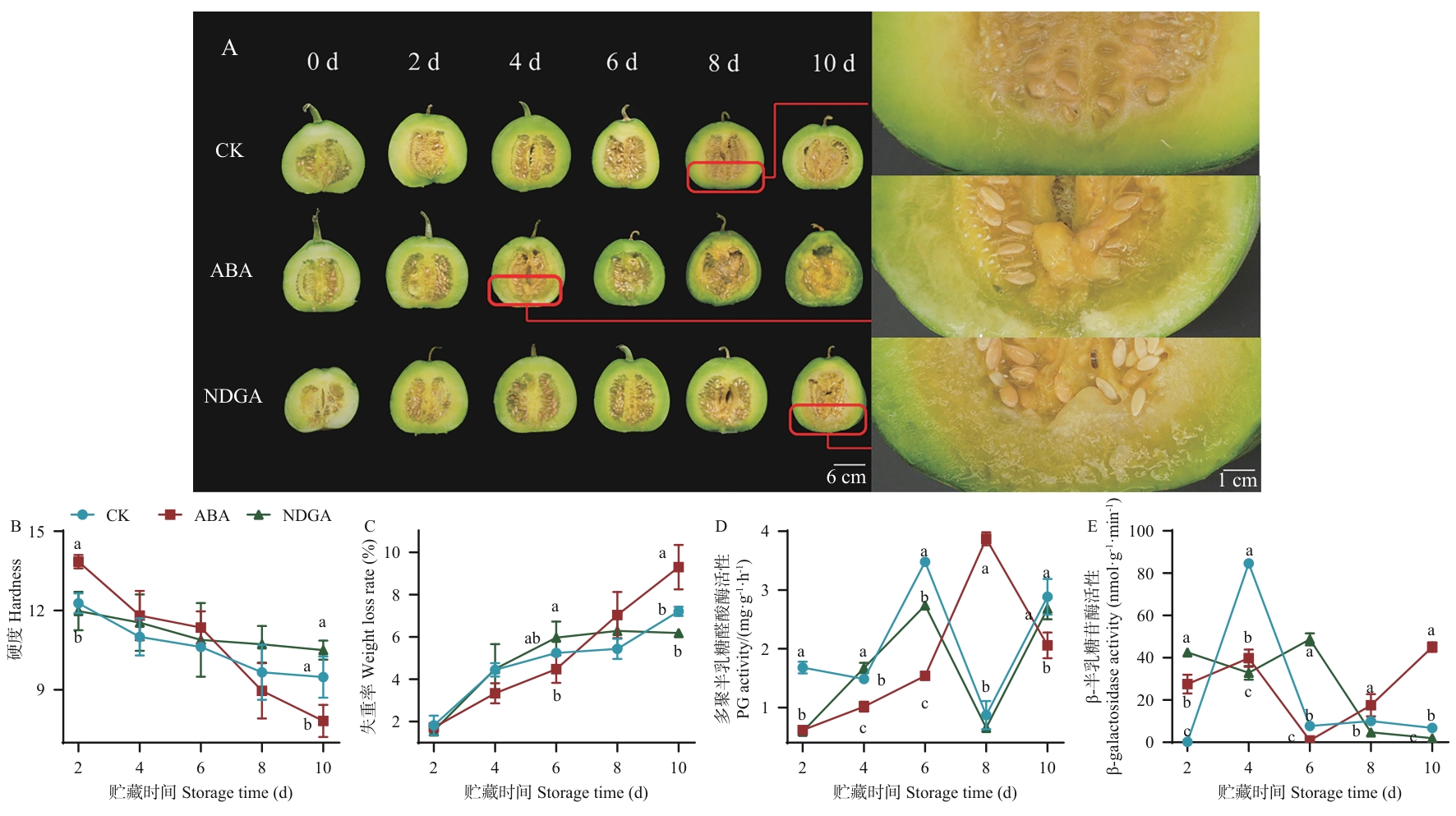
图1 ABA、NDGA处理对采后薄皮甜瓜果实横切面(A)、硬度(B)、失重率(C)、PG酶活性(D)、β-Gal(E)的影响图中误差线表示标准差。小写字母代表 P<0.05 水平下差异显著,下同
Fig. 1 Effects of ABA and NDGA treatments on cross-sectional section (A), hardness (B), weight loss rate (C), PG enzyme activity (D), and β-Gal (E) of post-harvest oriental melon fruitsThe error bars in the graph indicate the standard deviation. Lowercase letters indicate significant differences at the P<0.05 level, the same below
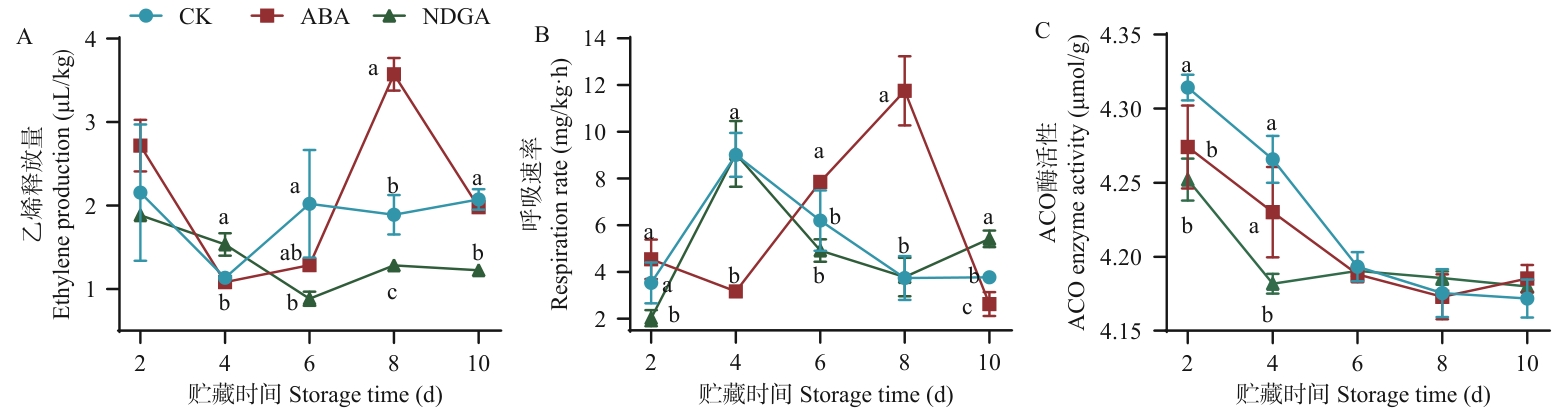
图2 ABA、NDGA处理对采后薄皮甜瓜果实乙烯释放量(A)、呼吸速率(B)、ACO酶活性(C)的影响
Fig. 2 Effects of ABA and NDGA treatments on ethylene release (A), respiration rate (B) and ACO enzyme activity (C) of post-harvest oriental melon fruits
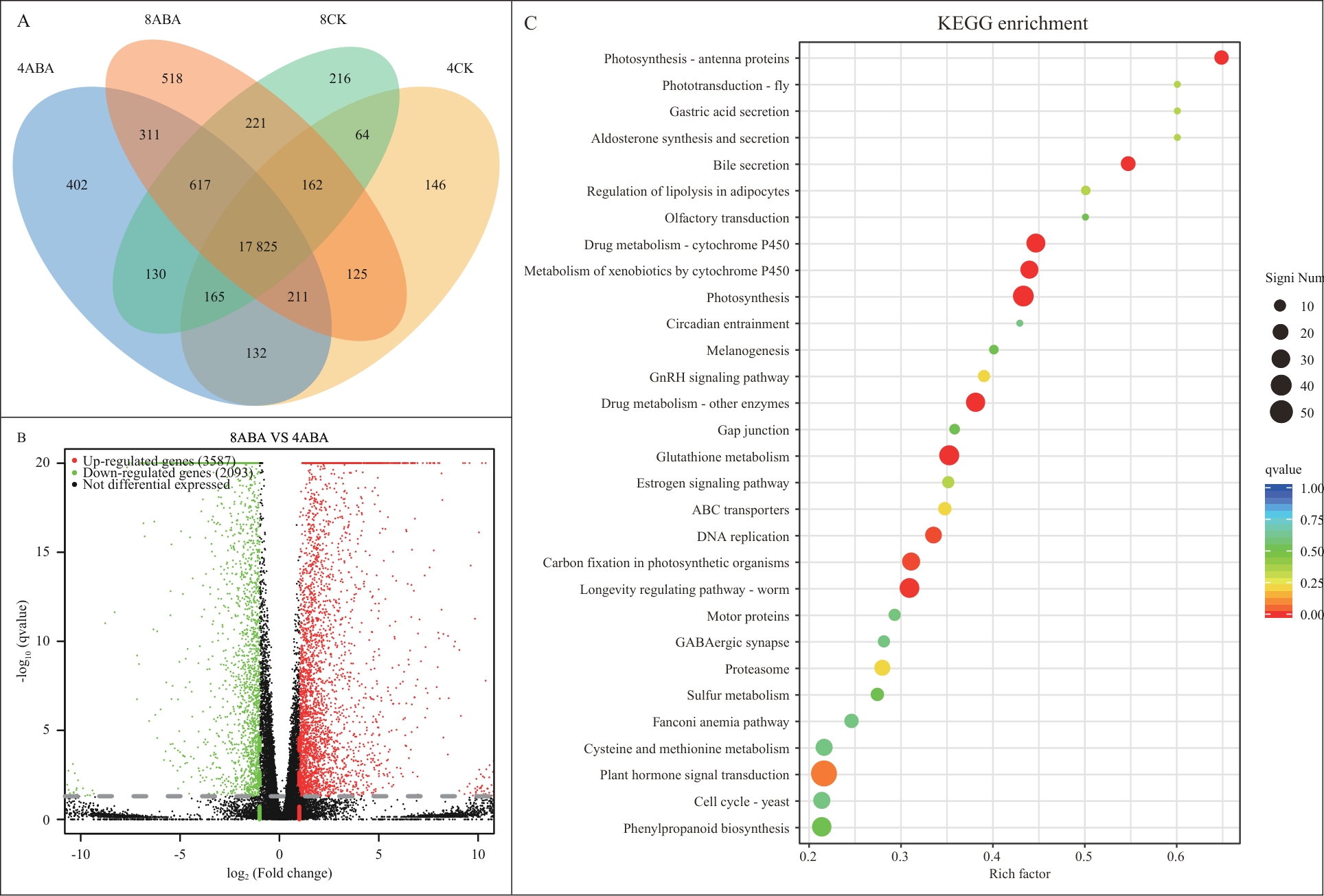
图3 样品间差异表达基因韦恩图、基因表达火山图和差异基因KEGG通路富集分析A:韦恩图为总DEGs;B:8 ABA与4 ABA的差异表达火山图;ABA代表脱落酸处理组、4和8代表处理后贮藏天数;C:脱落酸处理4 d和对照4 d(4 ABA vs 4 CK)
Fig. 3 Venn diagram, volcano plot of gene expression, and KEGG pathway enrichment analysis of differentially expressed genes between samplesA: Venn diagram is the total DEGs. B: Volcano plot of differential expression of 8ABA vs. 4ABA. ABA refers to abscisic acid treatment group, 4 and 8 refers to storage days after treatment. C: Abscisic acid treatment for 4 d and control for 4 d (4ABA vs 4CK)
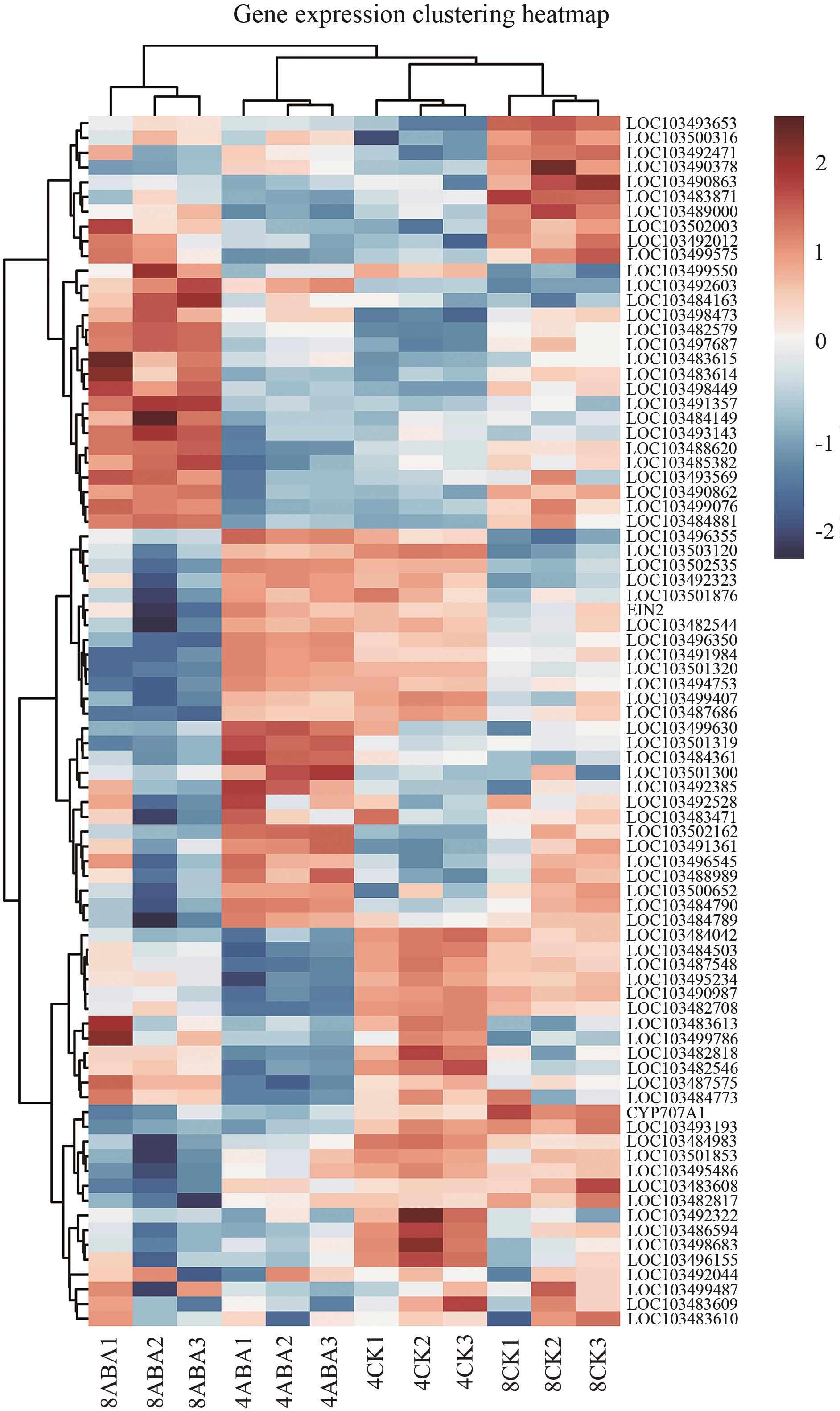
图4 4 d和8 d CK及ABA处理中脱落酸、乙烯和软化相关差异表达基因聚类热图
Fig. 4 Cluster heat maps of abscisic acid, ethylene and softening-related differentially expressed genes in 4 d and 8 d CK and ABA treatments
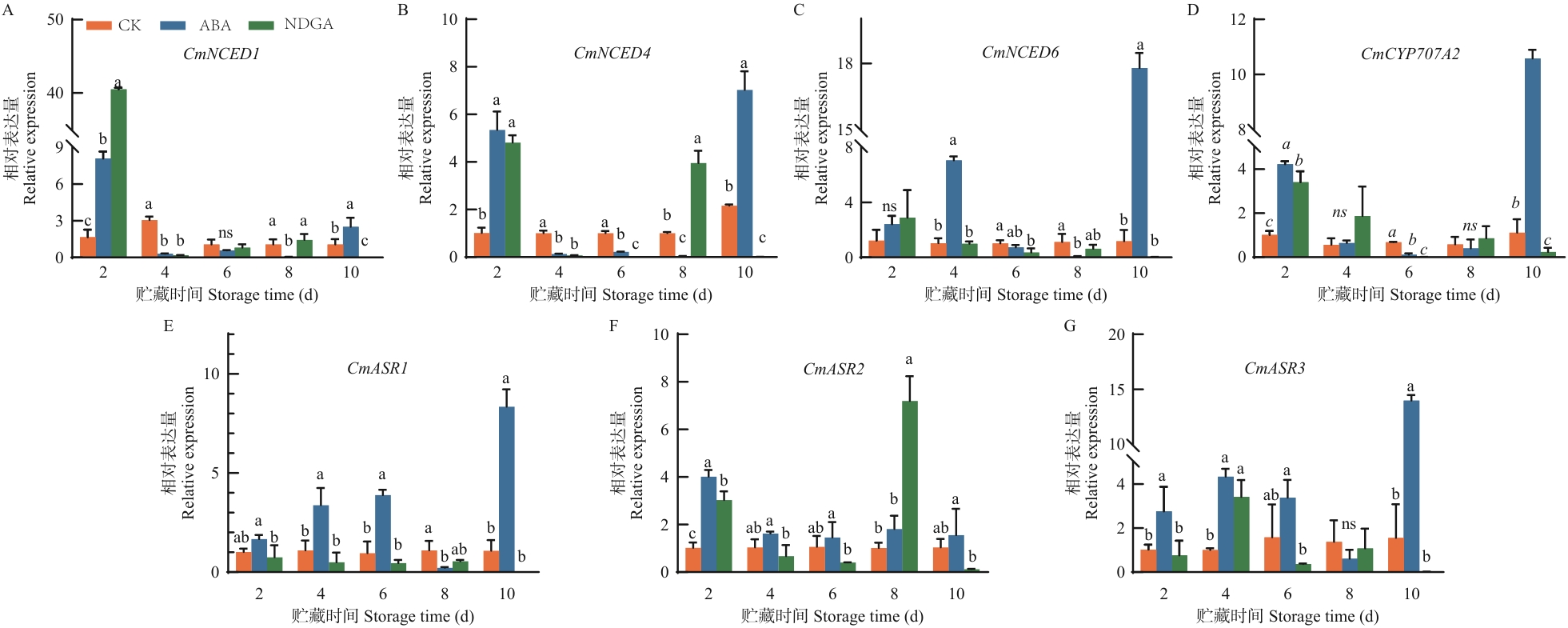
图5 ABA、NDGA处理对采后薄皮甜瓜果实ABA相关基因的时空表达分析
Fig. 5 Spatiotemporal expression analysis of ABA-related genes in post-harvest oriental melon fruit by ABA and NDGA treatments
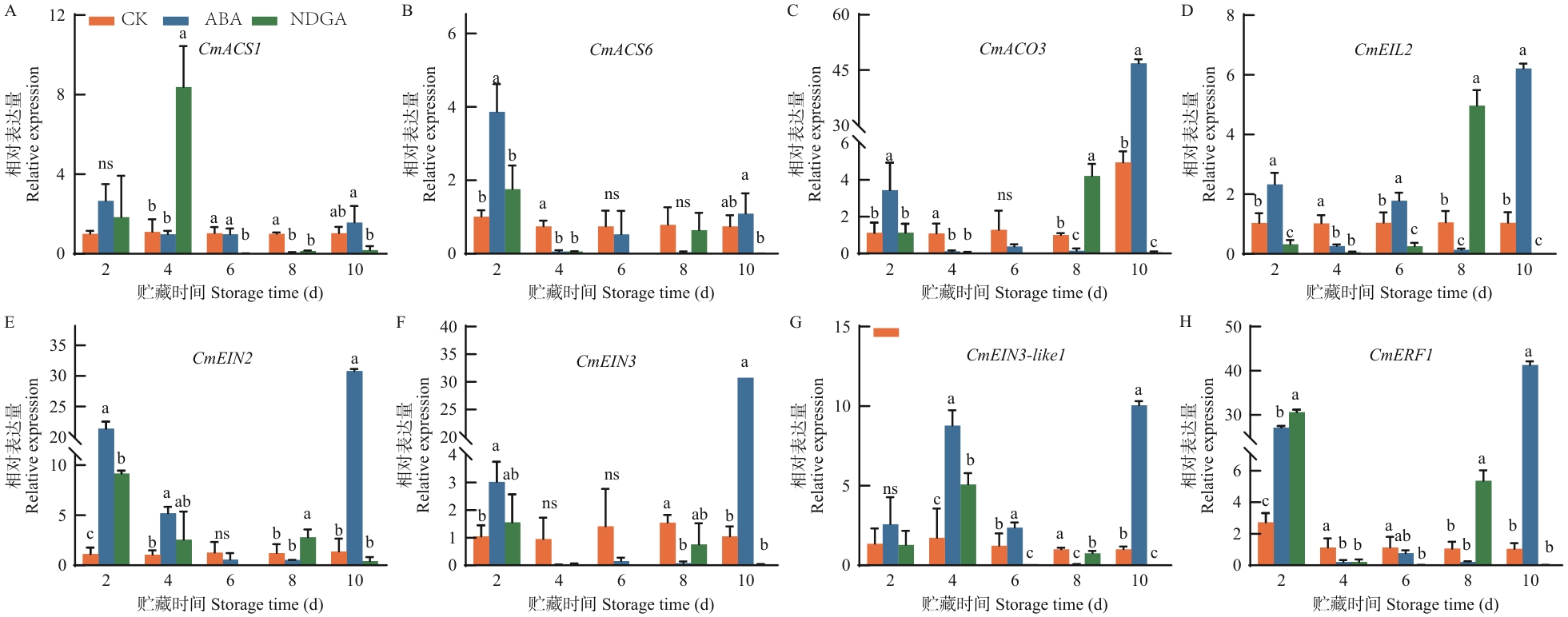
图6 ABA、NDGA处理对采后薄皮甜瓜果实乙烯相关基因的时空表达分析
Fig. 6 Spatiotemporal expression analysis of ABA and NDGA treatments on ethylene-related genes in post-harvest oriental melon fruit
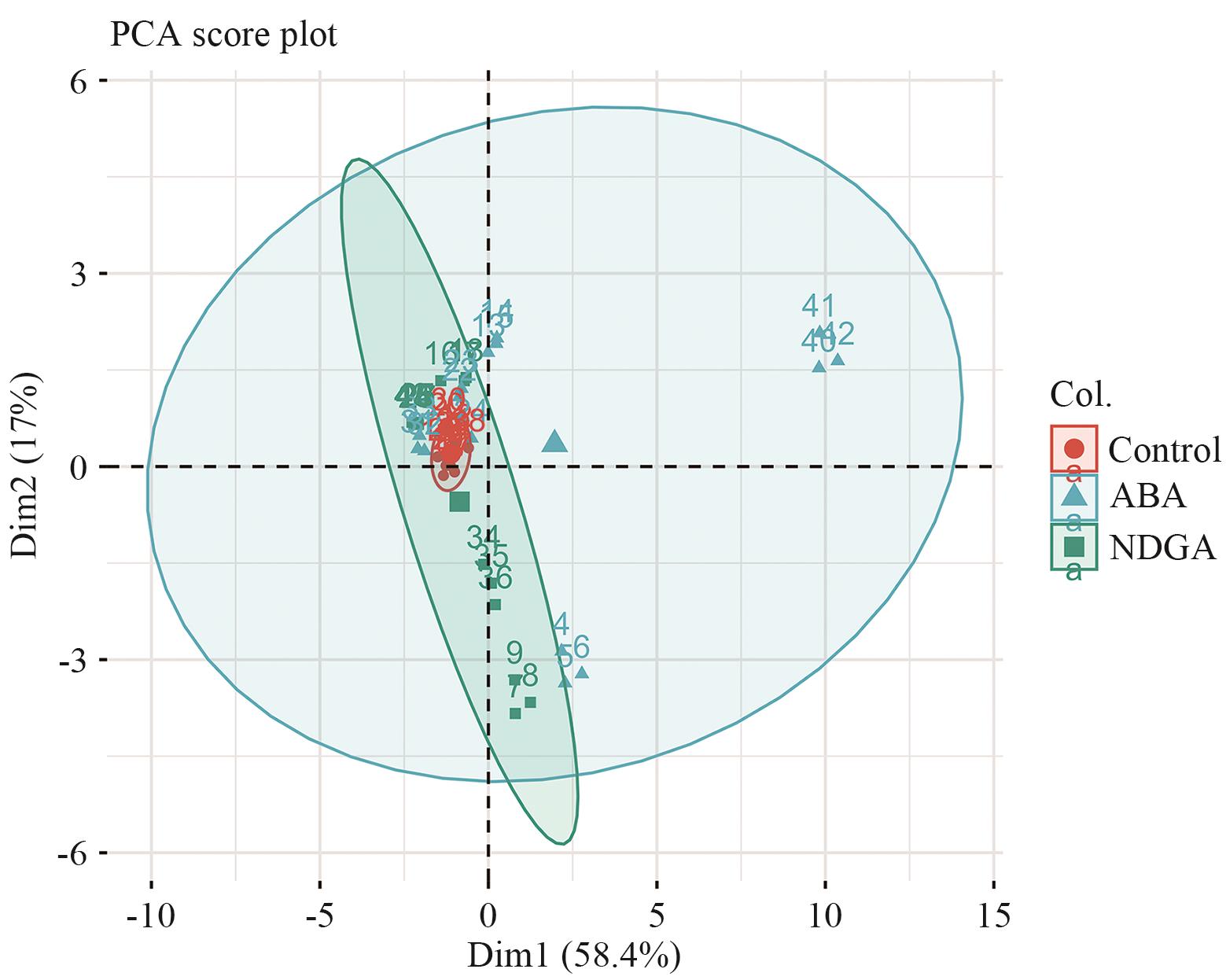
图7 ABA、NDGA处理对采后薄皮甜瓜果实ABA、乙烯相关基因主成分得分图编号1-45依次代表ABA处理组、NDGA处理组及CK中15个差异表达基因的3次生物学重复样本
Fig. 7 Principal component scores of ABA and ethylene-related genes in post-harvest oriental melon treated with ABA and NDGANumber 1-45 refers to three biological replicates of 15 differentially expressed genes in ABA-treated group, NDGA group, and CK
| [1] | 林德佩. 甜瓜(Cucumis melo L. )种下分类专论 [J]. 中国瓜菜, 2012, 25(5): 42-46. |
| Lin DP. Classification monograph on planting melons (Cucumis melo L.) [J]. China Cucurbits Veg, 2012, 25(5): 42-46. | |
| [2] | Kou XH, Feng Y, Yuan S, et al. Different regulatory mechanisms of plant hormones in the ripening of climacteric and non-climacteric fruits: a review [J]. Plant Mol Biol, 2021, 107(6): 477-497. |
| [3] | Wu W, Cao SF, Shi LY, et al. Abscisic acid biosynthesis, metabolism and signaling in ripening fruit [J]. Front Plant Sci, 2023, 14: 1279031. |
| [4] | Huang W, Hu N, Xiao ZN, et al. A molecular framework of ethylene-mediated fruit growth and ripening processes in tomato [J]. Plant Cell, 2022, 34(9): 3280-3300. |
| [5] | Li ZF, Huang RF. The reciprocal regulation of abscisic acid and ethylene biosyntheses [J]. Plant Signal Behav, 2011, 6(11): 1647-1650. |
| [6] | Wang PF, Lu SY, Zhang XY, et al. Double NCED isozymes control ABA biosynthesis for ripening and senescent regulation in peach fruits [J]. Plant Sci, 2021, 304: 110739. |
| [7] | 兰德国, 廖星强, 翟夏琬, 等. 外源ABA处理对红阳猕猴桃果实采后成熟及关键基因的影响 [J]. 江西农业大学学报, 2023, 45(6): 1358-1369. |
| Lan DG, Liao XQ, Zhai XW, et al. Effects of ABA treatment on postharvest ripening and key genes of Actinidia chinensis cv. ‘Hongyang’ [J]. Acta Agric Univ Jiangxiensis, 2023, 45(6): 1358-1369. | |
| [8] | Ying W, Liao LH, Wei H, et al. Structural basis for abscisic acid efflux mediated by ABCG25 in Arabidopsis thaliana [J]. Nat Plants, 2023, 9(10): 1697-1708. |
| [9] | 林涛, 任丹丹, 张克岩, 等. 甜瓜NCED基因家族的鉴定及CGMMV侵染后的表达模式 [J]. 分子植物育种, 2025, 23(13): 4262-4271. |
| Lin T, Ren DD, Zhang KY, et al. Identification of melon NCED gene family and its expression pattern on CGMMV infection [J]. Mol Plant Breed, 2025, 23(13): 4262-4271. | |
| [10] | Jia HF, Jiu ST, Zhang C, et al. Abscisic acid and sucrose regulate tomato and strawberry fruit ripening through the abscisic acid-stress-ripening transcription factor [J]. Plant Biotechnol J, 2016, 14(10): 2045-2065. |
| [11] | 孟亚轩, 孙颖琦, 赵心月, 等. 主要禾本科作物ASR基因家族全基因组鉴定及表达分析 [J]. 河南农业科学, 2021, 50(12): 10-22. |
| Meng YX, Sun YQ, Zhao XY, et al. Genome-wide identification and expression analysis of ASR gene family in main Gramineae crops [J]. J Henan Agric Sci, 2021, 50(12): 10-22. | |
| [12] | Muhammad Muzammal Aslam. 糖代谢和ABA信号转导关键基因调控桃果实成熟的分子机制 [D]. 北京: 中国农业科学院, 2021. |
| Muhammad M. Molecular mechanisms of sugar metabolic and ABA signal transduction key genes in regulating peach fruit ripening [D]. Beijing: Chinese Academy of Agricultural Sciences, 2021. | |
| [13] | 王启慧. 外源ABA处理对甜瓜果实采后愈伤的影响及其部分机制 [D]. 兰州: 甘肃农业大学, 2024. |
| Wang QH. Effect of exogenous ABA treatment on muskmelon wound healing and its partial mechanism [D]. Lanzhou: Gansu Agricultural University, 2024. | |
| [14] | 崔春晓. 番茄成熟过程中ABA相关转录因子调控乙烯合成的研究 [D]. 郑州: 河南工业大学, 2023. |
| Cui CX. Research on the regulation of ethylene synthesis by ABA-related transcription factors during tomato ripening [D]. Zhengzhou: Henan University of Technology, 2023. | |
| [15] | 陈雷. 不同品种薄皮甜瓜果实成熟和采后生理生化变化规律的研究 [D]. 哈尔滨: 东北农业大学, 2000. |
| Chen L. Research on the physiological and biochemical changes of fruits of different varieties of oriental melons [D]. Harbin: Northeast Agricultural University, 2000. | |
| [16] | 乌斯呼吉日嘎拉·达赖胡, 郝金凤, 张立全, 等. 甜瓜α-甘露糖苷酶基因促进果实成熟功能的瞬时表达分析 [J]. 园艺学报, 2014, 41(8): 1601-1608. |
| Usukhjargal D, Hao JF, Zhang LQ, et al. Analysis of function of α-mannosidase gene in promoting melon fruit ripening by transient expression [J]. Acta Hortic Sin, 2014, 41(8): 1601-1608. | |
| [17] | Mou WS, Li DD, Bu JW, et al. Comprehensive analysis of ABA effects on ethylene biosynthesis and signaling during tomato fruit ripening [J]. PLoS One, 2016, 11(4): e0154072. |
| [18] | Huang SZ, Sawaki T, Takahashi A, et al. Melon EIN3-like transcription factors (CmEIL1 and CmEIL2) are positive regulators of an ethylene- and ripening-induced 1-aminocyclopropane-1-carboxylic acid oxidase gene (CM-ACO1) [J]. Plant Sci, 2010, 178(3): 251-257. |
| [19] | Wang LK, Zhang ZY, Zhang F, et al. EIN2-directed histone acetylation requires EIN3-mediated positive feedback regulation in response to ethylene [J]. Plant Cell, 2021, 33(2): 322-337. |
| [20] | Wang YB, Du XY, Liu MX, et al. Genome-wide exploration of the ethylene-responsive element-binding factor gene family in sweet cherry (Prunus avium L.): preliminarily unveiling insights into normal development and fruit cracking [J]. Horticulturae, 2024, 10(3): 247. |
| [21] | 乔慧茹. 脱落酸处理对蓝莓采后贮藏品质和芳香物质代谢的影响 [D]. 舟山: 浙江海洋大学, 2024. |
| Qiao HR. Effect of abscisic acid treatment on postharvest storage quality and metabolism of aromatic substances in blueberries [D]. Zhoushan: Zhejiang Ocean University, 2024. | |
| [22] | 王星辰, 吕祚森, 邹养军, 等. 外源脱落酸对苹果果实品质的影响 [J]. 陕西农业科学, 2021, 67(4): 46-50. |
| Wang XC, Lv ZS, Zou YJ, et al. Effect of exogenous abscisic acid on apple fruit quality [J]. Shaanxi J Agric Sci, 2021, 67(4): 46-50. | |
| [23] | 刘廷旭, 罗川, 赵彩平, 等. 脱落酸对桃果实成熟软化和乙烯生物合成的影响 [J]. 北方园艺, 2012(20): 134-137. |
| Liu TX, Luo C, Zhao CP, et al. Effect of ABA on fruit ripening and ethylene biosynthesis [J]. North Hortic, 2012(20): 134-137. | |
| [24] | 张治安, 陈展宇. 植物生理学实验技术 [M]. 长春: 吉林大学出版社, 2008. |
| Zhang ZA, Chen ZY. Experimental technology of plant physiology [M]. Changchun: Jilin University Press, 2008. | |
| [25] | 王佳慧. 苹果MdWRKY31响应乙烯调控苹果酸含量和果实软化的功能研究 [D]. 泰安: 山东农业大学, 2023. |
| Wang JH. The apple MdWRKY31 functions in regulating malate content and fruit softening in response to ethylene [D]. Tai’an: Shandong Agricultural University, 2023. | |
| [26] | Bulens I, Van de Poel B, Hertog ML, et al. Protocol: an updated integrated methodology for analysis of metabolites and enzyme activities of ethylene biosynthesis [J]. Plant Methods, 2011, 7: 17. |
| [27] | 曹建康, 姜微波, 赵玉梅. 果蔬采后生理生化实验指导 [M]. 北京: 中国轻工业出版社, 2007. |
| Cao JK, Jiang WB, Zhao YM. Guidance on postharvest physiological and biochemical experiments of fruits and vegetables [M]. Beijing: China Light Industry Press, 2007. | |
| [28] | 李翠, 侯柄竹. 脱落酸调控果实成熟的分子及信号转导机制研究进展 [J]. 果树学报, 2023, 40(5): 988-999. |
| Li C, Hou BZ. Molecular mechanism of abscisic acid in regulating fruit ripening [J]. J Fruit Sci, 2023, 40(5): 988-999. | |
| [29] | 陈仁驰. 脱落酸与乙烯互作调控草莓果实成熟的作用机制 [D]. 杭州: 浙江大学, 2023. |
| Chen RC. The mechanism of the interaction of abscisic acid and ethylene in regulating strawberry fruit ripening [D]. Hangzhou: Zhejiang University, 2023. | |
| [30] | Barros NLF, Filgueiras JPC, Trenz TS, et al. ASR gene family: a case of tandem-drive evolution [J]. Front Mol Biosci, 2025, 12: 1456645. |
| [1] | 秦子璐, 孙海燕, 陈赢男. 植物表皮毛发育分子调控机制研究进展[J]. 生物技术通报, 2026, 42(9): 1-13. |
| [2] | 王玉昆, 原远, 王斌, 朱云娜, 任晓强, 任飞, 叶红. 转录组和脂质代谢组联合分析不同紫苏α-亚麻酸合成调控差异[J]. 生物技术通报, 2026, 42(4): 129-140. |
| [3] | 刘青媛, 吴洪启, 陈秀娥, 陈剑, 姜远泽, 何燕子, 喻奇伟, 刘仁祥. 转录因子NtMYB96a调控烟草耐旱性的功能研究[J]. 生物技术通报, 2026, 42(4): 239-250. |
| [4] | 杨婷, 杨宗桃, 艾静, 王禹童, 李燕烨, 邓军, 刘家勇, 赵勇, 张跃彬. 不同基因型甘蔗表型特征及根部转录组学分析[J]. 生物技术通报, 2026, 42(4): 190-201. |
| [5] | 刘娜, 曾宝珍, 贾兆星, 祝英方. 表观遗传调控番茄果实发育及成熟的研究进展[J]. 生物技术通报, 2026, 42(3): 37-47. |
| [6] | 马世杰, 李铮, 李蔚, 郭仰东, 张娜. 光信号调控园艺作物果实发育的研究进展[J]. 生物技术通报, 2026, 42(3): 5-18. |
| [7] | 罗龙鑫, 李智, 李彤, 冯资权, 翟欣悦, 梁成林, 张亚丽, 吴上, 李媛媛, 姜翰. 苹果果实糖分形成的分子基础[J]. 生物技术通报, 2026, 42(3): 156-171. |
| [8] | 殷诗情, 田泰, 黄凤庭, 冯珑强, 王浩, 张静, 何文, 陈清, 王小蓉, 王燕. 果树果实硬度的调控机制研究进展[J]. 生物技术通报, 2026, 42(3): 213-229. |
| [9] | 赵艳侠, 李倩, 孙家波, 梁红敏, 李冰冰. 草莓果实品质形成的关键调控基因及分子网络解析[J]. 生物技术通报, 2026, 42(3): 111-132. |
| [10] | 王潇奕, 李金焱, 邢醒, 朱鸿亮. 基于乙烯响应筛选调控番茄成熟且影响呼吸的基因及其功能分析[J]. 生物技术通报, 2026, 42(3): 275-282. |
| [11] | 王鹤瑶, 孙红梅. 园艺植物表皮毛功能及其形成机制研究进展[J]. 生物技术通报, 2026, 42(3): 242-254. |
| [12] | 王尚封, 程斌, 王若若, 丁延庆, 徐建霞, 曹宁, 高旭, 李文贞, 张立异. 基于BSA-seq的高粱开花时间基因定位及候选基因预测[J]. 生物技术通报, 2026, 42(2): 197-206. |
| [13] | 董亚茹, 朱红, 王照红, 赵东晓, 刘惠芬. 桑树MnDREB6E的克隆及耐盐抗旱性分析[J]. 生物技术通报, 2026, 42(2): 306-316. |
| [14] | 张冬岭, 张寅生, 王建军, 叶飞宇, 卢子涵, 马晨晨, 柳华峰, 胡德升, 邓亚洲, 曹丽茹. 玉米HSFs转录因子家族在干旱胁迫下的表达特性及功能[J]. 生物技术通报, 2026, 42(2): 178-187. |
| [15] | 孙焱森, 魏立翔, 李若冰, 张程志, 聂宇航, 李杰, 才学鹏, 乔军, 孟庆玲. AOL-113转录因子对少孢节丛孢菌菌丝生长、胁迫响应及捕食能力的调控作用[J]. 生物技术通报, 2026, 42(2): 338-350. |
| 阅读次数 | ||||||
|
全文 |
|
|||||
|
摘要 |
|
|||||
