







生物技术通报 ›› 2026, Vol. 42 ›› Issue (8): 312-322.doi: 10.13560/j.cnki.biotech.bull.1985.2025-1367
• 研究报告 • 上一篇
何浩迪1, 梁振普1, 张国只1, 房世杰2, 张小霞1( )
)
收稿日期:2025-12-15
出版日期:2026-08-26
发布日期:2026-08-17
通讯作者:
张小霞xiaoxiazhang@henau.edu.cn基金资助:
HE Hao-di1, LIANG Zhen-pu1, ZHANG Guo-zhi1, FANG Shi-jie2, ZHANG Xiao-xia1()
Received:2025-12-15
Published:2026-08-26
Online:2026-08-17
摘要:
目的 分离、筛选耐盐碱根际促生菌,为盐碱地专用功能型微生物肥料开发和盐碱地改良提供微生物资源与理论支撑。 方法 采集新疆英吉沙县棉花的根际土壤,利用系列稀释法分离、筛选耐盐碱细菌;基于16S rRNA的基因序列对菌株进行分子鉴定,结合形态学和生理生化特性鉴定结果,确定菌株的分类地位;采用不同NaCl质量浓度(0-200 g/L)和不同pH值(4.0-13.0)的培养基,评估菌株的盐碱耐受性;利用多种功能鉴定培养基测定菌株的溶磷、产铁载体、固氮、产生物膜、产淀粉酶和纤维素酶等促生相关性能;最后通过培养皿和盆栽试验,分析菌株对番茄幼苗生长的影响。 结果 分离获得一株耐盐碱菌株,16S rRNA基因序列的比对结果显示,该菌株与芽胞杆菌属(Bacillus)模式菌株Bacillus cabrialesii strain TE3T的同源性最高,为99.72%,将其命名为Bacillus cabrialesii zp-4245。菌株zp-4245在80 g/L NaCl、pH 9.0的条件下仍可生长;该菌株具有产铁载体、固氮、产淀粉酶、纤维素酶和生物膜等促生特性。在培养皿上,接种菌株zp-4245能够显著促进番茄幼苗在不同盐碱胁迫条件下的生长:和对照组相比,在pH 5.8的条件下,处理组番茄幼苗的侧根数、地上鲜重、地下鲜重和总鲜重分别增加了284.3%、87.3%、118.4%和94.2%;在pH 8.0的条件下,处理组番茄幼苗的侧根数、地上鲜重、地下鲜重和总鲜重分别增加了361.7%、92.3%、141.7%和101.9%;在pH 8.0+2.925 g/L NaCl的胁迫条件下,处理组番茄幼苗的侧根数增加了707.6%。盆栽番茄的促生试验表明:在非盐胁迫条件下,和对照组相比,接种菌株zp-4245处理组番茄的地上鲜重和株高分别增加了11.7%和13.9%;在6 g/kg NaCl的胁迫条件下,和对照组相比,处理组番茄的地下鲜重和株高分别增加了28.6%和10.7%。 结论 菌株zp-4245具有良好的耐盐碱与植物促生能力,可在不同盐碱条件下促进番茄幼苗的生长,为开发适用于盐碱地改良的微生物肥料提供了菌种资源和理论基础。
何浩迪, 梁振普, 张国只, 房世杰, 张小霞. 一株耐盐碱卡氏芽胞杆菌的分离及其促生功能鉴定[J]. 生物技术通报, 2026, 42(8): 312-322.
HE Hao-di, LIANG Zhen-pu, ZHANG Guo-zhi, FANG Shi-jie, ZHANG Xiao-xia. Isolation and Plant Growth-promoting Characterization of a Salt-alkali Tolerant Bacillus cabrialesii Strain[J]. Biotechnology Bulletin, 2026, 42(8): 312-322.
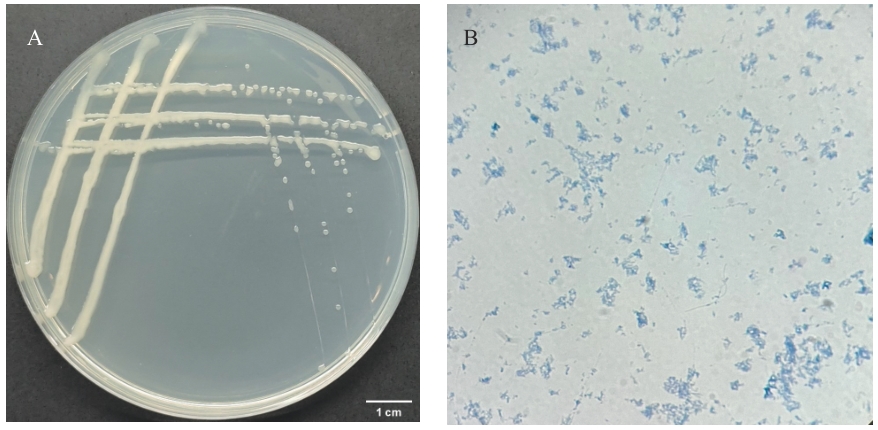
图1 菌株zp-4245的形态鉴定A:菌落形态;B:革兰氏染色
Fig. 1 Morphological identification of strain zp-4245A: Colonial morphology; B: gram stain
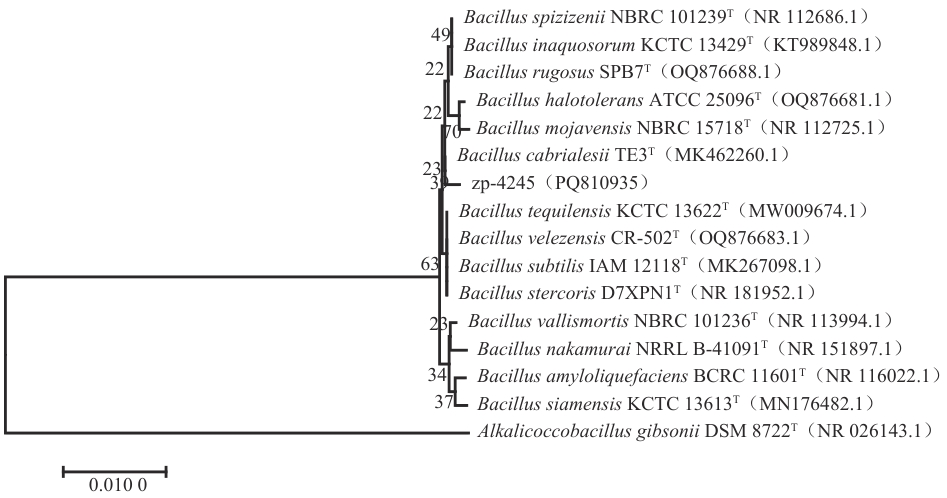
图2 基于16S rRNA基因序列构建的菌株zp-4245 的系统发育树括号内编号为菌株的 GenBank 登录号。分支上的数字为bootstrap值,代表分类单位被聚在一起的概率
Fig. 2 Phylogenetic tree of strain zp-4245 based on 16S rRNA gene sequencesGenBank accession numbers are shown in parentheses. Bootstrap values (shown at the branches) represent the probability of the taxa being clustered together
测定指标 Test indicators | 结果 Results |
|---|---|
| 葡萄糖Glucose | + |
| 木糖Xylose | - |
| 果糖Fructose | + |
| 阿拉伯糖Arabinose | - |
| 蔗糖Sucrose | + |
| 半乳糖Galactose | - |
| 过氧化氢酶Catalase | + |
| 氧化酶Oxidase | - |
| 明胶液化Gelatin liquefaction | + |
表1 菌株zp-4245生理生化测定结果
Table 1 Physiological and biochemical analysis of strain zp-4245
测定指标 Test indicators | 结果 Results |
|---|---|
| 葡萄糖Glucose | + |
| 木糖Xylose | - |
| 果糖Fructose | + |
| 阿拉伯糖Arabinose | - |
| 蔗糖Sucrose | + |
| 半乳糖Galactose | - |
| 过氧化氢酶Catalase | + |
| 氧化酶Oxidase | - |
| 明胶液化Gelatin liquefaction | + |
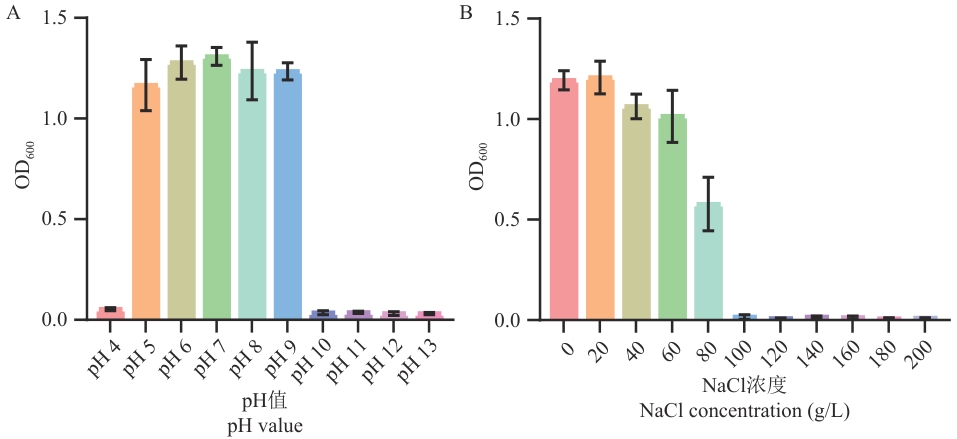
图3 菌株zp-4245的盐碱耐受能力测定
Fig. 3 Salt-alkali tolerance of strain zp-4245
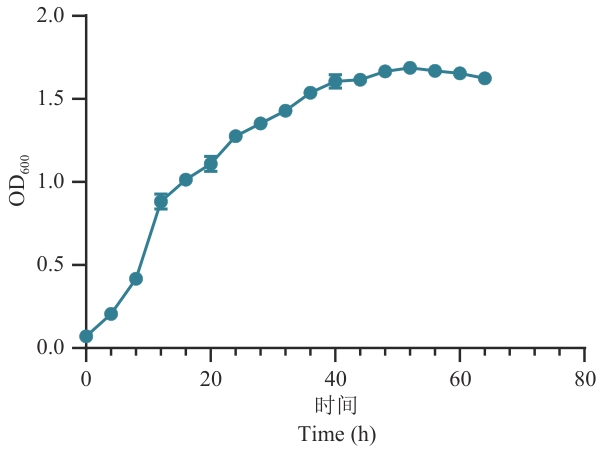
图4 菌株zp-4245的生长曲线
Fig. 4 Growth curve of strain zp-4245
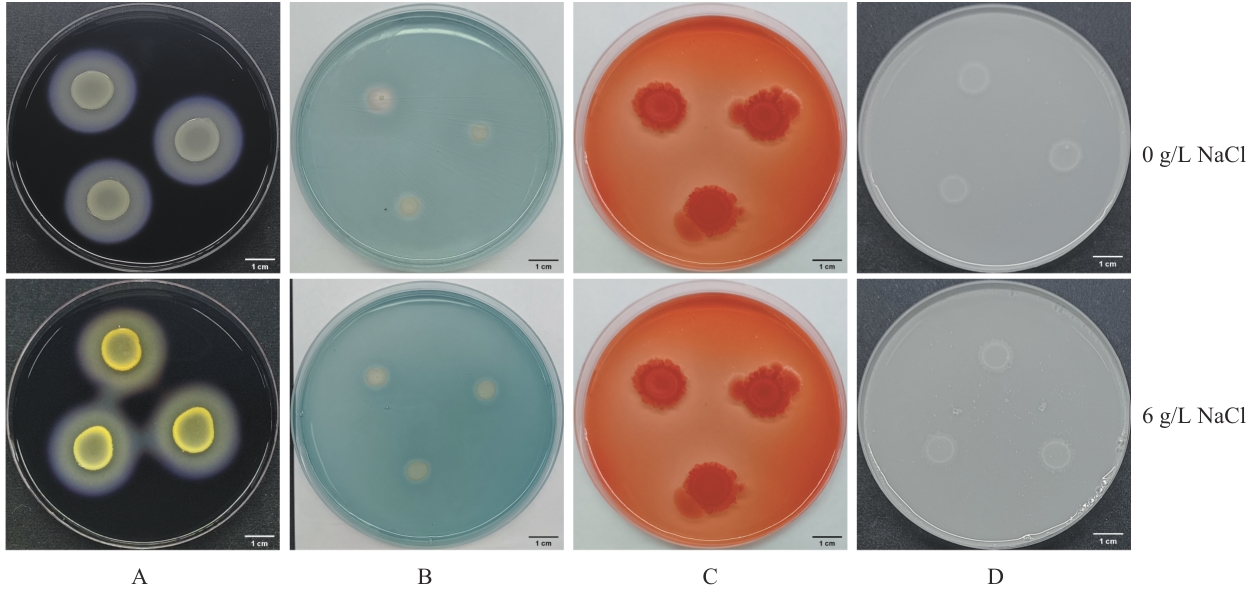
图5 菌株zp-4245 的促生特性A:产淀粉酶能力;B:产铁载体能力;C:产纤维素酶能力;D:固氮能力。标尺=1 cm
Fig. 5 Growth-promoting characteristics of strain zp-4245A: Amylase-producing ability. B: Siderophore-producing ability. C: Cellulase-producing ability. D: Nitrogen-fixing ability. Bar=1 cm
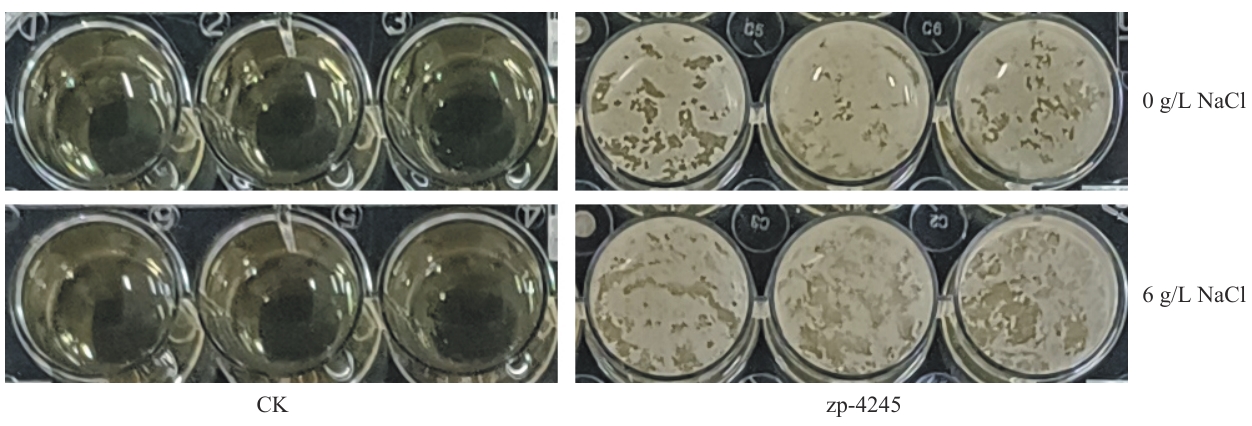
图6 菌株zp-4245的产生物膜能力检测结果CK:未接种菌株的LB液体培养基培养3 d后的结果;zp-4245:接种菌株zp-4245的LB液体培养基培养3 d后的结果
Fig. 6 Test results of biofilm formation ability of the strain zp-4245CK: Liquid LB medium without bacterial inoculation after 3 days of culture. zp-4245: Liquid LB medium inoculated with strain zp-4245 after 3 days of culture
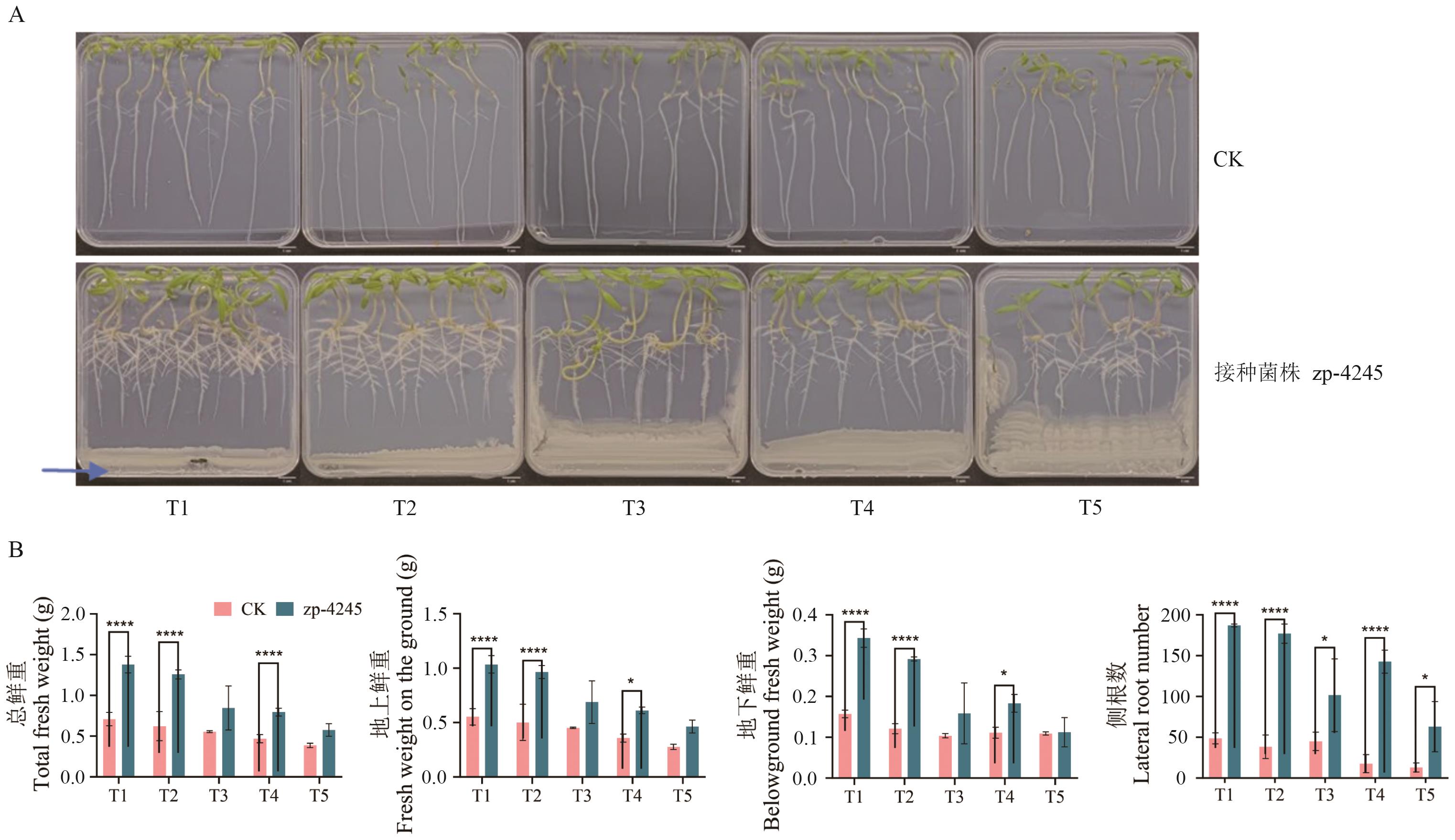
图7 培养皿上菌株zp-4245对番茄的促生作用A:菌株zp-4245对番茄的促生效果;B:番茄侧根数和鲜重的统计结果
Fig. 7 Growth-promoting effect of strain zp-4245 on tomato in plate assaysA: Growth-promoting effect of strain zp-4245 on tomato. B: Lateral root number and fresh weight of tomato. T1: pH 5.8, T2: pH 8.0, T3: pH 8.0+0.168 g/L NaHCO3, T4: pH 8.0+2.925 g/L NaCl, T5: pH 8.0+0.168 g/L NaHCO3+2.925 g/L NaCl. * P<0.05, **** P<0.000 1
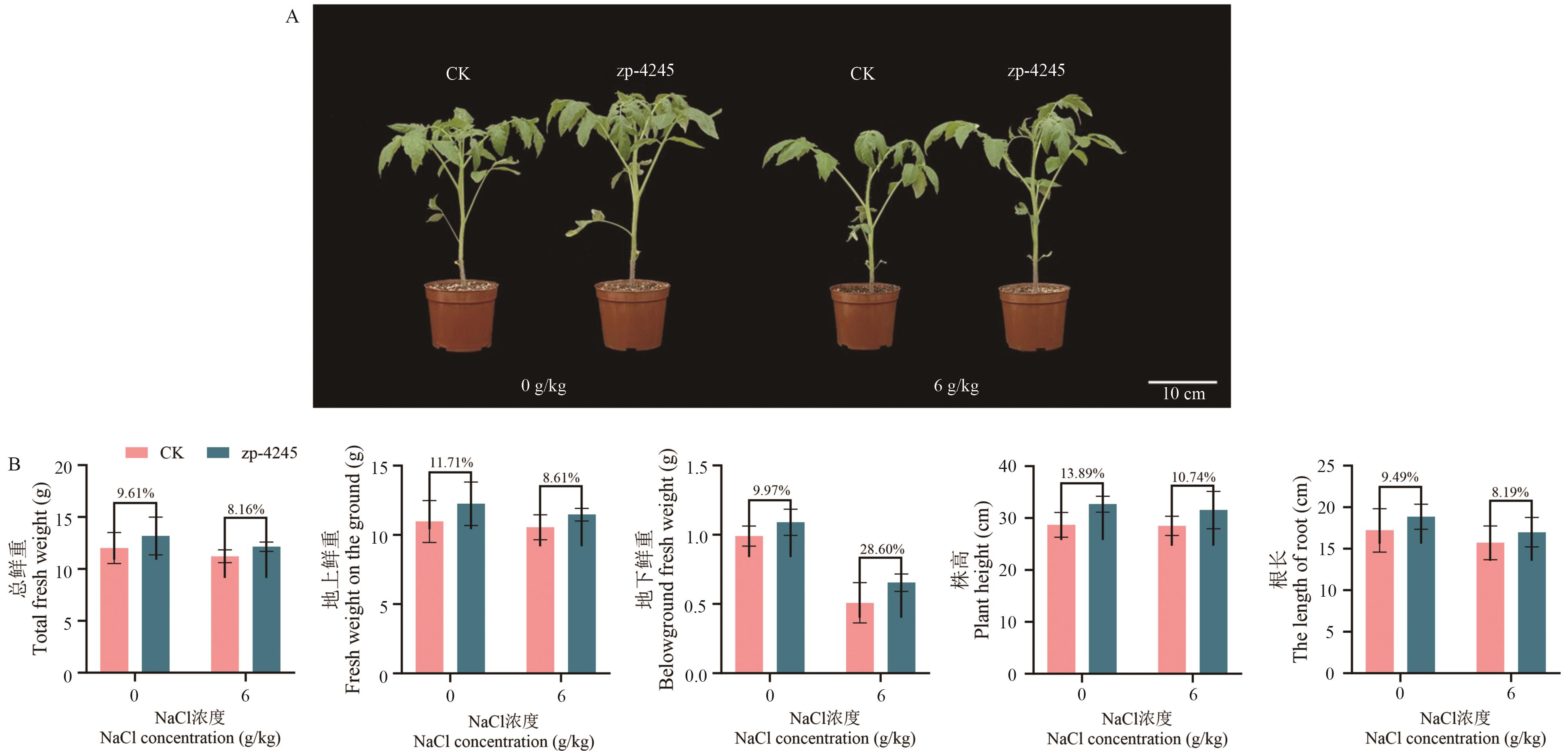
图8 菌株zp-4245在不同盐胁迫条件下对番茄幼苗的促生作用A:菌株zp-4245对番茄的促生效果;B:番茄的鲜重、株高和根长的统计结果。图中百分数表示各处理组与CK组相比的增长率
Fig. 8 Growth-promoting effect of strain zp-4245 on tomato seedlings under different salt stress conditionsA: Growth-promoting effect of strain zp-4245 on tomato. B: Fresh weight, plant height, and root length of tomato. The percentages in the figure indicate the growth rate of each treatment group compared to the CK group
| [1] | 王佳丽, 黄贤金, 钟太洋, 等. 盐碱地可持续利用研究综述 [J]. 地理学报, 2011, 66(5): 673-684. |
| Wang JL, Huang XJ, Zhong TY, et al. Review on sustainable utilization of salt-affected land [J]. Acta Geogr Sin, 2011, 66(5): 673-684. | |
| [2] | 韩斌. 我国盐碱地改良技术发展研究概况 [J]. 吉林农业, 2013, 7: 9. |
| Han B. General situation of research on improvement technology of saline-alkali land in China [J]. Jilin Agric, 2013, 7: 9. | |
| [3] | 光明日报. 国内外专家学者共话中国-中亚盐碱地科技创新与合作[EB/OL]. (2025-08-27). . |
| Daily Guangming. Domestic and international experts and scholars discuss technological innovation and cooperation on saline-alkali land between China and Central Asia [EB/OL]. (2025-08-27). . | |
| [4] | 张翼夫, 李问盈, 胡红, 等. 盐碱地改良研究现状及展望 [J]. 江苏农业科学, 2017, 45(18): 7-10. |
| Zhang YF, Li WY, Hu H, et al. Present situation and prospect of saline-alkali land improvement research [J]. Jiangsu Agric Sci, 2017, 45(18): 7-10. | |
| [5] | 冯玉倩, 米俊珍, 赵宝平, 等. 秸秆配施微生物菌肥对盐碱地土壤理化性质及作物产量和品质的影响 [J]. 中国土壤与肥料, 2023(9): 96-104. |
| Feng YQ, Mi JZ, Zhao BP, et al. Effects of straw combined with microbial fertilizer on soil physical and chemical properties and crop yield and quality in saline-alkali soil [J]. Soil Fertil Sci China, 2023(9): 96-104. | |
| [6] | Kloepper JW, Leong J, Teintze M, et al. Enhanced plant growth by siderophores produced by plant growth-promoting rhizobacteria [J]. Nature, 1980, 286(5776): 885-886. |
| [7] | Vacheron J, Desbrosses G, Bouffaud ML, et al. Plant growth-promoting rhizobacteria and root system functioning [J]. Front Plant Sci, 2013, 4: 356. |
| [8] | 张美珍. 耐盐碱溶磷菌对大豆生长和根际微生态的影响 [D]. 大庆: 黑龙江八一农垦大学, 2023. |
| Zhang MZ. Effects of saline-alkali-tolerant phosphate-solubilizing bacteria on growth and rhizosphere microecology of soybean [D]. Daqing: Heilongjiang Bayi Agricultural University, 2023. | |
| [9] | 吴东明, 徐靖, 袁佳美, 等. 一株根际促生菌Myroides odoratimimus PJ-3的分离、鉴定及其耐盐碱和玉米促生性能评价 [J]. 中国农业科学, 2025, 58(20): 4131-4143. |
| Wu DM, Xu J, Yuan JM, et al. Isolation and identification of rhizosphere growth-promoting bacteria of Myroides odoratimimus PJ-3 and their salt/alkali-tolerance and growth-promoting effects on maize [J]. Sci Agric Sin, 2025, 58(20): 4131-4143. | |
| [10] | 张明霞, 赵萌萌, 郭紫煊, 等. 枯草芽胞杆菌L5的促生机理及其修复盐碱土壤效果研究 [J]. 兰州交通大学学报, 2025, 44(5): 136-148. |
| Zhang MX, Zhao MM, Guo ZX, et al. Study on the growth-promoting mechanism of Bacillus subtilis L5 and its effect on the remediation of saline-alkali soil [J]. J Lanzhou Jiaotong Univ, 2025, 44(5): 136-148. | |
| [11] | 唐璐. PGPR对盐碱胁迫下紫花苜蓿根际土壤微生态的影响研究 [D]. 哈尔滨: 哈尔滨师范大学, 2023. |
| Tang L. Effect of PGPR on the rhizosphere soil microecology of alfalfa under saline-alkali stress [D]. Harbin: Harbin Normal University, 2023. | |
| [12] | 李江, 靳艳玲, 赵海. 根际促生菌对植物生长的影响及其作用机制 [J]. 黑龙江农业科学, 2023(10): 132-137. |
| Li J, Jin YL, Zhao H. Effects of plant growth promoting rhizobacteria (PGPR) on plant growth and its mechanism [J]. Heilongjiang Agric Sci, 2023(10): 132-137. | |
| [13] | 刘娜. 解磷解钾促生微生物肥料用菌株的分离 [D]. 沈阳: 沈阳农业大学, 2020. |
| Liu N. The separation of microbial fertilizer strains was promoted by the hydrolysis of phosphorus and potassium [D]. Shenyang: Shenyang Agricultural University, 2020. | |
| [14] | 张芳明, 姜侃, 郭晔红, 等. 一株肉苁蓉内生细菌(Pseudalkali bacillus sp.A8)的耐盐碱探究 [J/OL]. 甘肃农业大学学报, 2025. . |
| Zhang FM, Jiang K, Guo YH, et al. Study on the salt and alkali tolerance of an endophytic bacterium from Cistanche deserticola (Pseudalkali bacillus sp. A8) [J/OL]. J Gansu Agric Univ, 2025. . | |
| [15] | 陆宝金, 田生昌, 左忠, 等. 盐渍化土地可持续利用研究综述及展望 [J]. 宁夏大学学报: 自然科学版, 2023, 44(1): 79-88. |
| Lu BJ, Tian SC, Zuo Z, et al. Review and prospect on sustainable utilization of salinized land [J]. J Ningxia Univ Nat Sci Ed, 2023, 44(1): 79-88. | |
| [16] | 胡一, 韩霁昌, 张扬. 盐碱地改良技术研究综述 [J]. 陕西农业科学, 2015, 61(2): 67-71. |
| Hu Y, Han JC, Zhang Y. Summary of research on improvement technology of saline-alkali land [J]. Shaanxi J Agric Sci, 2015, 61(2): 67-71. | |
| [17] | 张小霞, 陈筱玥, 王秋云, 等. 柽柳根际一株盐单胞菌Bachu 26的分离、鉴定及其盐胁迫下的促生作用研究 [J]. 微生物学报, 2024, 64(2): 607-622. |
| Zhang XX, Chen XY, Wang QY, et al. Isolation and identification of Halomonas sp. Bachu 26 with plant growth-promoting effect from rhizosphere of Tamarix chinensis under salt stress [J]. Acta Microbiol Sin, 2024, 64(2): 607-622. | |
| [18] | 马雪晴, 冀傲冉, 郑娇莉, 等. 植物根际促生菌促生机制及其应用研究进展 [J]. 中国农业科技导报, 2025, 27(2): 13-23. |
| Ma XQ, Ji AR, Zheng JL, et al. Research progress on growth-promoting mechanism and application of plant growth-promoting rhizobacteria [J]. J Agric Sci Technol, 2025, 27(2): 13-23. | |
| [19] | Sen S, Ghosh D, Mohapatra S. Modulation of polyamine biosynthesis in Arabidopsis thaliana by a drought mitigating Pseudomonas putida strain [J]. Plant Physiol Biochem, 2018, 129: 180-188. |
| [20] | 崔冬明, 单晨, 史利桦, 等. 生物源新型铁螯合剂研究进展及其应用 [J]. 华中农业大学学报, 2023, 42(6): 59-72. |
| Cui DM, Shan C, Shi LH, et al. Progress and application of novel iron biochelates [J]. J Huazhong Agric Univ, 2023, 42(6): 59-72. | |
| [21] | 吴昕劢, 栗晗, 王经邦, 等. 耐盐菌株筛选及其对盐胁迫下番茄种子萌发促进效应解析 [J]. 南京农业大学学报, 2026, 49(1): 103-113. |
| Wu XM, Li H, Wang JB, et al. Screening of salt-tolerant strains and analysis of its promoting effect on tomato seed germination under salt stress [J]. J Nanjing Agric Univ, 2026, 49(1): 103-113. | |
| [22] | Dechorgnat J, Francis KL, Dhugga KS, et al. Tissue and nitrogen-linked expression profiles of ammonium and nitrate transporters in maize [J]. BMC Plant Biology, 2019, 19(1):1-13. |
| [23] | 程功, 焦洁洁, 蒋建潮, 等. 植物对氮磷亏缺的生长及生理、分子响应研究进展 [J]. 湖北林业科技, 2024, 53(5): 65-72. |
| Cheng G, Jiao JJ, Jiang JC, et al. Research progress on growth, physiology, and molecular response of plants to nitrogen and phosphorus deficiency [J]. Hubei For Sci Technol, 2024, 53(5): 65-72. | |
| [24] | 马士杰. 参与氮循环的生物作用总结 [J]. 生物学教学, 2021, 46(8): 67-68. |
| Ma SJ. A summary of biological functions involved in nitrogen cycle [J]. Biol Teach, 2021, 46(8): 67-68. | |
| [25] | 刘美. 山农17小麦种子萌发期间呼吸代谢相关酶活性及其基因表达量的变化 [D]. 泰安: 山东农业大学, 2014. |
| Liu M. Changes of enzyme activity and gene expression related to espiratory metabolism during Shannong l7 Wheat seed germination [D]. Taian: Shandong Agricultural University, 2014. | |
| [26] | 凌明亮, 黄仁术, 黄继宝. 不同处理的秸秆对大别山黄牛后期集中肥育的影响 [J]. 黄牛杂志, 2004(6): 9-11. |
| Ling ML, Huang RS, Huang JB. Effects of rice straws treated with different methods on finishing of Dabieshan yellow cattle [J]. J Yellow Cattle Sci, 2004(6): 9-11. | |
| [27] | Robledo M, Jiménez-Zurdo JI, Soto MJ, et al. Development of functional symbiotic white clover root hairs and nodules requires tightly regulated production of rhizobial cellulase CelC2 [J]. Mol Plant Microbe Interact, 2011, 24(7): 798-807. |
| [28] | 韩松, 张守村, 林天兴, 等. 一株拮抗棉花枯萎病菌产铁载体内生细菌的筛选 [J]. 安徽农业科学, 2011, 39(21): 12712-12713, 12729. |
| Han S, Zhang SC, Lin TX, et al. Screening for siderophore-producing endophytic bacteria against Fusarium oxysporum [J]. J Anhui Agric Sci, 2011, 39(21): 12712-12713, 12729. | |
| [29] | Altaf MM, Ahmad I. In vitro and in vivo biofilm formation by Azotobacter isolates and its relevance to rhizosphere colonization [J]. Rhizosphere, 2017, 3: 138-142. |
| [30] | Ahmad Ansari F, Ahmad I, Pichtel J, et al. Pantoea agglomerans FAP10: a novel biofilm-producing PGPR strain improves wheat growth and soil resilience under salinity stress [J]. Environ Exp Bot, 2024, 222: 105759. |
| [31] | Figueroa-Brambila KM, Escalante-Beltrán A, Montoya-Martínez AC, et al. Bacillus cabrialesii: five years of research on a novel species of biological control and plant growth-promoting bacteria [J]. Plants, 2023, 12(13): 2419. |
| [32] | Masmoudi F, Al Naimi L, Trigui M, et al. Novel thermo-halotolerant bacteria Bacillus cabrialesii native to Qatar Desert: enhancing seedlings’ growth, halotolerance, and antifungal defense in tomato [J]. J Plant Growth Regul, 2025, 44(2): 587-604. |
| [33] | Campos-Avelar I, García Jaime MF, Morales Sandoval PH, et al. Bacillus cabrialesii subsp. cabrialesii strain TE5: a promising biological control bacterium against the causal agent of spot blotch in wheat [J]. Plants, 2025, 14(2): 209. |
| [34] | 李焕梅, 彭柏文, 胡靖, 等. 湖北多花黄精根腐病致病菌的分离鉴定及卡氏芽胞杆菌对其抑菌作用研究 [J]. 中药材, 2025, 48(3): 553-560. |
| Li HM, Peng BW, Hu J, et al. Isolation and identification of pathogen causing root rot of Polygonatum cyrtonema in Hubei Province and inhibitory activity of Bacillus cabrialesii [J]. J Chin Med Mater, 2025, 48(3): 553-560. | |
| [35] | 唐笛森, 邓丽莎, 付静霞, 等. Bacillus cabrialesii BCH除臭功能分析及在猪粪堆肥中应用 [J]. 农业环境科学学报, 2024, 43(11): 2701-2711. |
| Tang DS, Deng LS, Fu JX, et al. Analysis of the deodorization function of Bacillus cabrialesii BCH and its application in pig manure composting [J]. J Agro Environ Sci, 2024, 43(11): 2701-2711. | |
| [36] | Vessey JK. Plant growth promoting rhizobacteria as biofertilizers [J]. Plant and Soil, 2003, 255: 571-586. |
| [37] | 赵青云, 赵秋芳, 王辉, 等. 根际促生菌Bacillus subtilis Y-IVI在香草兰上的应用效果研究 [J]. 植物营养与肥料学报, 2015, 21(2): 535-540. |
| Zhao QY, Zhao QF, Wang H, et al. Beneficial effects of plant growth promoter rhizobacteria on Vanilla (Vanilla planifolia Ames.) growth [J]. J Plant Nutr Fertil, 2015, 21(2): 535-540. | |
| [38] | 赵茂杰. 化肥减量配施微生物肥料对农田黑土养分与细菌群落多样性的影响 [D]. 哈尔滨: 黑龙江大学, 2025. |
| Zhao MJ. Effects of chemical fertilizer reduction combined with microbial fertilizer on nutrient and bacterial community diversity in farmland black soil [D]. Harbin: Heilongjiang University, 2025. |
| [1] | 王宇, 廖永琴, 贾健鹏, 刘鑫, 施竹丽, 施竹凤, 普特, 何飞飞, 杨佩文. 酚酸降解菌耐盐芽胞杆菌YNK-FB0022对番茄枯萎病罹病土壤微生物多样性的影响[J]. 生物技术通报, 2026, 42(5): 101-112. |
| [2] | 冯成蒿, 党雨乐, 王志泽, 聂蔚丹, 杨中敏, 杜崇. 基于RNA-seq筛选番茄防御南方根结线虫病的差异基因与RPP13的表达特征分析[J]. 生物技术通报, 2026, 42(4): 141-152. |
| [3] | 刘淼, 林涛, 贾乐松, 胡丰, 李涛, 李志万, 刘美芳, 郑方燕, 崔龙. 从野生到栽培:番茄果实色泽的演化与调控机制[J]. 生物技术通报, 2026, 42(3): 187-202. |
| [4] | 李亚妮, 韩鸿宇, 耿梦爽, 米若兰, 王韦琪, 于文静, 孟宪文, 李传友. ChiC基因调控番茄灰霉病抗性的机制研究[J]. 生物技术通报, 2026, 42(3): 255-262. |
| [5] | 程云霞, 张俊红, 叶杰. 番茄果实可溶性固形物积累的遗传调控研究进展[J]. 生物技术通报, 2026, 42(3): 145-155. |
| [6] | 颜晨琳, 李凡, 闫春婷, 程蛟文, 胡开林, 叶志彪, 宋建文. 番茄果实形态发育相关基因研究进展[J]. 生物技术通报, 2026, 42(3): 172-186. |
| [7] | 刘娜, 曾宝珍, 贾兆星, 祝英方. 表观遗传调控番茄果实发育及成熟的研究进展[J]. 生物技术通报, 2026, 42(3): 37-47. |
| [8] | 杜丹, 郭翔, 胡鑫, 潘宇. 质体发育调控果实成熟与品质的研究进展[J]. 生物技术通报, 2026, 42(3): 48-59. |
| [9] | 姜喆卉, 王小龙, 王守创, 周科. 番茄风味物质代谢途径解析与分子育种研究进展[J]. 生物技术通报, 2026, 42(3): 60-78. |
| [10] | 王潇奕, 李金焱, 邢醒, 朱鸿亮. 基于乙烯响应筛选调控番茄成熟且影响呼吸的基因及其功能分析[J]. 生物技术通报, 2026, 42(3): 275-282. |
| [11] | 李迎辉, 王杨博涵, 周浩博, 卢心如, 张珂欣, 于洋, 李传友, 孙传龙. 番茄VPE基因家族鉴定和抗逆功能分析[J]. 生物技术通报, 2026, 42(3): 263-274. |
| [12] | 苏秀敏, 韩文清, 王佼, 李鹏, 王秋兰, 李万星, 曹晋军. 哈茨木霉M408的分离鉴定、生物学特性及对番茄早疫病的生防效果[J]. 生物技术通报, 2025, 41(9): 277-288. |
| [13] | 侯亚涛, 李迎辉, 邓磊, 李常保, 李传友, 孙传龙. 番茄果重基因功能型分子标记的开发及群体基因型分析[J]. 生物技术通报, 2025, 41(4): 98-105. |
| [14] | 刘洁, 王飞, 陶婷, 张玉静, 陈浩婷, 张瑞星, 石玉, 张毅. 过表达SlWRKY41提高番茄幼苗抗旱性[J]. 生物技术通报, 2025, 41(2): 107-118. |
| [15] | 陈慧婷, 夏一楠, 颜伟, 张梦菲, 陈周梅, 侯丽霞, 刘新. 外源绿原酸处理对设施番茄果实品质的影响[J]. 生物技术通报, 2025, 41(2): 119-126. |
| 阅读次数 | ||||||
|
全文 |
|
|||||
|
摘要 |
|
|||||
