







Biotechnology Bulletin ›› 2026, Vol. 42 ›› Issue (9): 1-13.doi: 10.13560/j.cnki.biotech.bull.1985.2025-0924
WANG Xin, CHEN Wei, SUN Bo( )
)
Received:2025-08-26
Online:2026-09-26
Published:2026-09-16
Contact:
SUN Bo
E-mail:sunbo@nju.edu.cn
WANG Xin, CHEN Wei, SUN Bo. Regulatory Mechanism of Plant Floral Meristem Activity[J]. Biotechnology Bulletin, 2026, 42(9): 1-13.
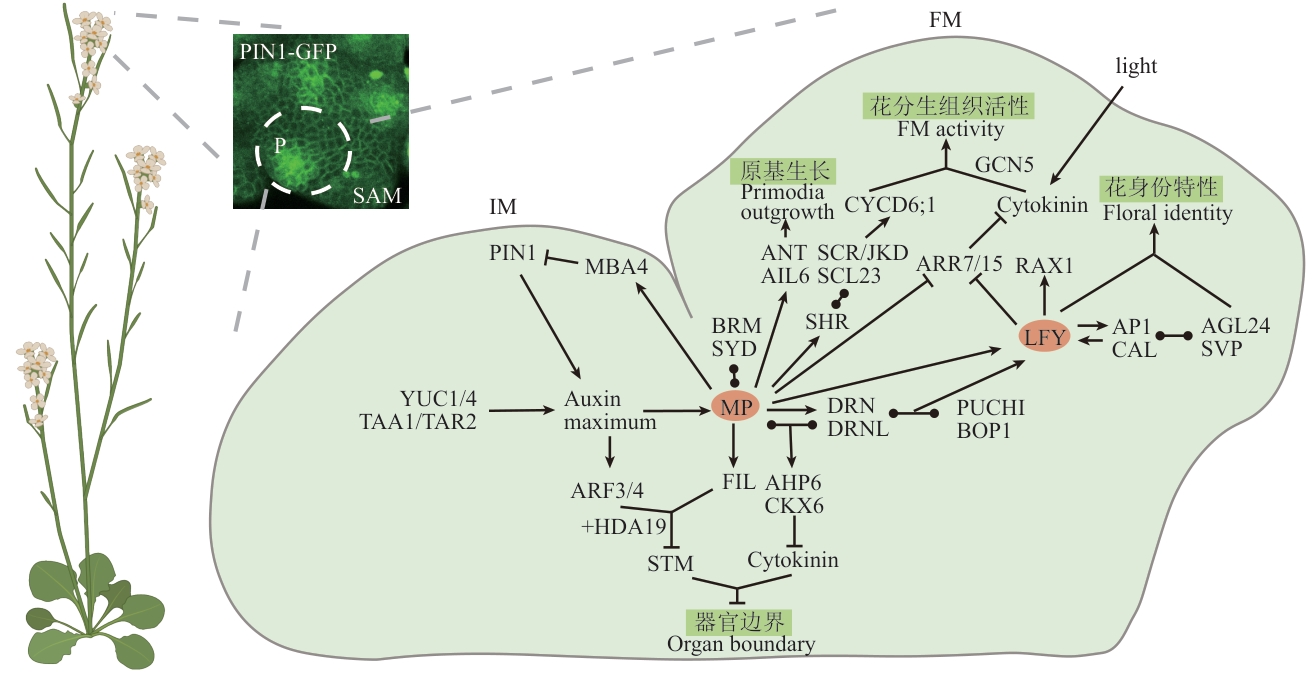
Fig. 1 Regulatory network for the establishment of floral primordium and floral meristem in ArabidopsisThe establishment of floral primordia initiation and meristem activity is determined by a complex regulatory network formed by environmental signals, hormones, and endogenous gene expression. Auxin maxima formed in the peripheral zone (PZ) of the inflorescence meristem (IM) leads to floral primordia initiation through the activation of downstream transcription factor MP. MP, together with its target gene LFY, regulate the expressions of numerous targeted genes and activate cytokinin signaling in an epigenetic modification-dependent manner, thereby defining floral identities, delimiting organ boundaries, promoting floral primordia growth, and establishing FM activity
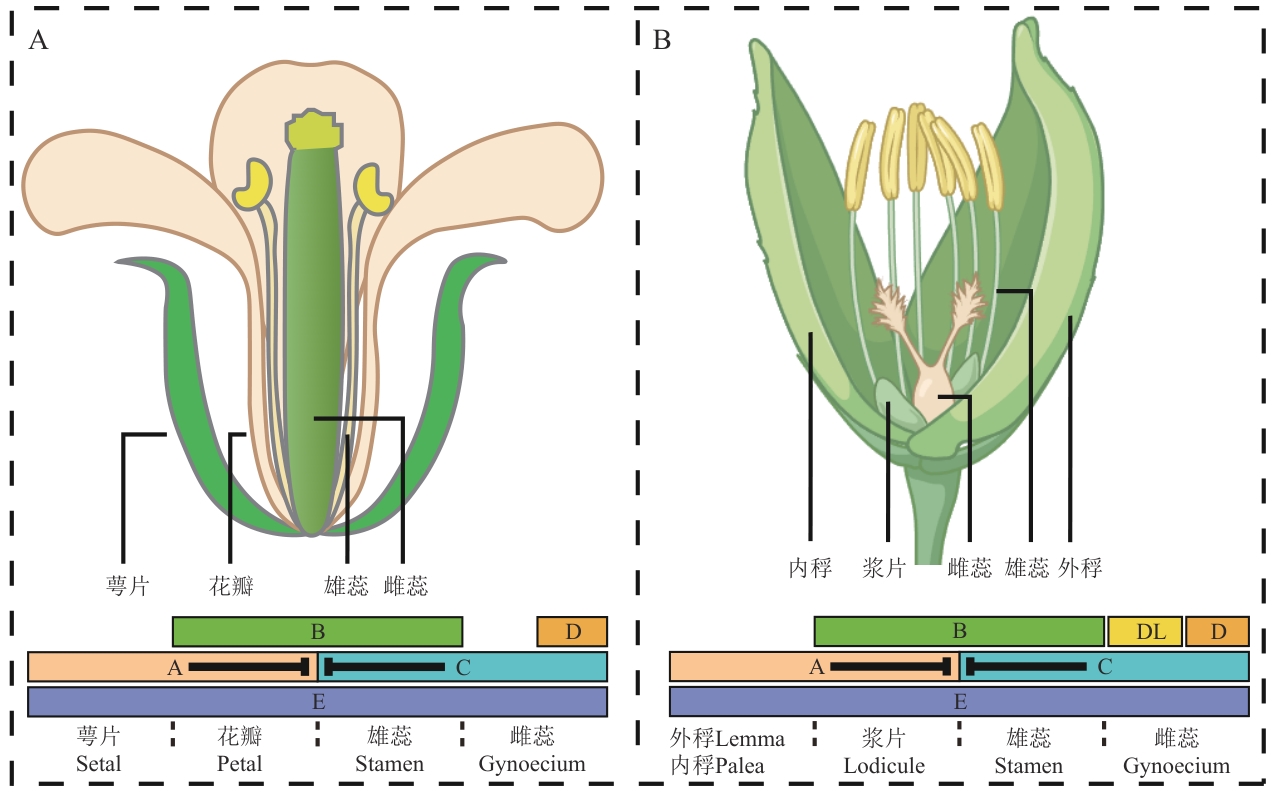
Fig. 2 The ABCDE model of floral organ identity specificationA: The ABCDE model of floral organ identity specification in the dicot Arabidopsis thaliana. From the outermost to the innermost whorl, the flower consists of four sepals, four petals, six stamens, and one fused gynoecium. B: The ABCDE model of floral organ identity specification in the monocot rice (Oryza sativa). From the outermost to the innermost whorl, the floret consists of one lemma, one palea, two lodicules, six stamens, and a single pistil
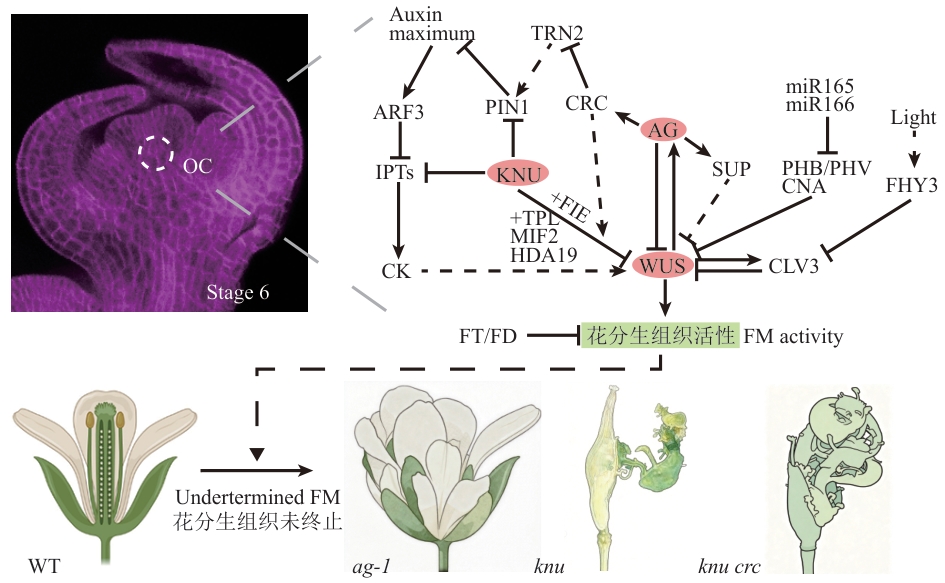
Fig. 3 Molecular regulatory mechanisms underlying the inhibition and timely termination of FM termination in ArabidopsisFine-tuned regulatory networks exist in plants to suppress excessive FM activity and to timely terminate FM activity for gynoecium differentiation and development. In the early phases of floral development, phytohormonal regulation (encompassing auxin and cytokinin) and the function of the stem cell identity gene WUS together act as key regulators to constrain hyperactivation of the floral meristem (FM). In Arabidopsis, the MADS-domain protein AG not only could directly repress WUS at floral stage 3, but also activates the C2H2-type zinc finger transcription repressor KNU at floral stage 6. KNU subsequently initiates the epigenetic-dependent transcriptional repression, and rapidly suppresses the expressions of WUS and the stem cell marker gene CLV3, thereby timely terminates the FM activity. Unterminated FM activity in ag, knu, and knu crc mutants produces additional whorls of floral organs [72-74]
| [1] | Denay G, Chahtane H, Tichtinsky G, et al. A flower is born: an update on Arabidopsis floral meristem formation [J]. Curr Opin Plant Biol, 2017, 35: 15-22. |
| [2] | Wang CY, Yang XJ, Li G. Molecular insights into inflorescence meristem specification for yield potential in cereal crops [J]. Int J Mol Sci, 2021, 22(7): 3508. |
| [3] | Yadav S, Kumar H, Mahajan M, et al. Local auxin biosynthesis promotes shoot patterning and stem cell differentiation in Arabidopsis shoot apex [J]. Development, 2023, 150(23): dev202014. |
| [4] | Benková E, Michniewicz M, Sauer M, et al. Local, efflux-dependent auxin gradients as a common module for plant organ formation [J]. Cell, 2003, 115(5): 591-602. |
| [5] | Bahafid E, Bradtmöller I, Thies AM, et al. The Arabidopsis SHORTROOT network coordinates shoot apical meristem development with auxin-dependent lateral organ initiation [J]. eLife, 2023, 12: e83334. |
| [6] | Wójcikowska B, Belaidi S, Robert HS. Game of thrones among AUXIN RESPONSE FACTORs-over 30 years of MONOPTEROS research [J]. J Exp Bot, 2023, 74(22): 6904-6921. |
| [7] | Chung Y, Zhu Y, Wu MF, et al. Auxin Response Factors promote organogenesis by chromatin-mediated repression of the pluripotency gene SHOOTMERISTEMLESS [J]. Nat Commun, 2019, 10: 886. |
| [8] | Dai YQ, Luo LJ, Zhao Z. Genetic robustness control of auxin output in priming organ initiation [J]. Proc Natl Acad Sci USA, 2023, 120(28): e2221606120. |
| [9] | Chandler JW, Werr W. DORNRÖSCHEN, DORNRÖSCHEN-LIKE, and PUCHI redundantly control floral meristem identity and organ initiation in Arabidopsis [J]. J Exp Bot, 2017, 68(13): 3457-3472. |
| [10] | Manuela D, Xu ML. AINTEGUMENTA and redundant AINTEGUMENTA-LIKE6 are required for bract outgrowth in Arabidopsis [J]. J Exp Bot, 2024, 75(13): 3920-3931. |
| [11] | Chahtane H, Vachon G, Le Masson M, et al. A variant of LEAFY reveals its capacity to stimulate meristem development by inducing RAX1 [J]. Plant J, 2013, 74(4): 678-689. |
| [12] | Yoshida S, Mandel T, Kuhlemeier C. Stem cell activation by light guides plant organogenesis [J]. Genes Dev, 2011, 25(13): 1439-1450. |
| [13] | Furutani M, Nakano Y, Tasaka M. MAB4-induced auxin sink generates local auxin gradients in Arabidopsis organ formation [J]. Proc Natl Acad Sci USA, 2014, 111(3): 1198-1203. |
| [14] | Hawar A, Chen W, Zhu T, et al. The histone acetyltransferase GCN5 regulates floral meristem activity and flower development in Arabidopsis [J]. Plant Cell, 2025, 37(6): koaf135. |
| [15] | Thomson B, Wellmer F. Molecular regulation of flower development [J]. Curr Top Dev Biol, 2019, 131: 185-210. |
| [16] | Winter CM, Yamaguchi N, Wu MF, et al. Transcriptional programs regulated by both LEAFY and APETALA1 at the time of flower formation [J]. Physiol Plant, 2015, 155(1): 55-73. |
| [17] | Hu TQ, Li XH, Du LR, et al. LEAFY and APETALA1 down-regulate ZINC FINGER PROTEIN 1 and 8 to release their repression on class B and C floral homeotic genes [J]. Proc Natl Acad Sci USA, 2023, 120(22): e2221181120. |
| [18] | Thoris K, Correa Marrero M, Fiers M, et al. Uncoupling FRUITFULL’s functions through modification of a protein motif identified by co-ortholog analysis [J]. Nucleic Acids Res, 2024, 52(21): 13290-13304. |
| [19] | Sims K, Abedi-Samakush F, Szulc N, et al. OsARF11 promotes growth, meristem, seed, and vein formation during rice plant development [J]. Int J Mol Sci, 2021, 22(8): 4089. |
| [20] | Liu JJ, Shi XA, Chang ZY, et al. Auxin efflux transporters OsPIN1c and OsPIN1d function redundantly in regulating rice (Oryza sativa L.) panicle development [J]. Plant Cell Physiol, 2022, 63(3): 305-316. |
| [21] | Liu JJ, Song Y, Mei M, et al. Gene editing unlocks superior mutants from once detrimental RFL for enhanced rice yield traits [J]. Plant J, 2025, 123(5): e70454. |
| [22] | Liu YX, Chen NN, Fan XW, et al. SP3 and DEP1 orchestrate panicle architecture by jointly regulating APO2 expression in rice [J]. Adv Sci, 2025: e08230. |
| [23] | Coen ES, Meyerowitz EM. The war of the whorls: genetic interactions controlling flower development [J]. Nature, 1991, 353(6339): 31-37. |
| [24] | Maio KA, Moubayidin L. ‘Organ’ising floral organ development [J]. Plants, 2024, 13(12): 1595. |
| [25] | Bowman JL, Moyroud E. Reflections on the ABC model of flower development [J]. Plant Cell, 2024, 36(5): 1334-1357. |
| [26] | Bowman JL, Smyth DR, Meyerowitz EM. Genetic interactions among floral homeotic genes of Arabidopsis [J]. Development, 1991, 112(1): 1-20. |
| [27] | Kramer EM, Jaramillo MA, Di Stilio VS. Patterns of gene duplication and functional evolution during the diversification of the AGAMOUS subfamily of MADS box genes in angiosperms [J]. Genetics, 2004, 166(2): 1011-1023. |
| [28] | Dreni L. The ABC of flower development in monocots: the model of rice spikelet [J]. Methods Mol Biol, 2023, 2686: 59-82. |
| [29] | Cai ZZ, Li JQ, Su YY, et al. The MADS6, JAGGED, and YABBY proteins synergistically determine floral organ development in rice [J]. Plant Physiol, 2025, 197(3): kiaf076. |
| [30] | Min Y. Position and identity, two separable but inseparable processes in floral meristem patterning [J]. Curr Opin Plant Biol, 2025, 88: 102785. |
| [31] | Prunet N, Yang WB, Das P, et al. SUPERMAN prevents class B gene expression and promotes stem cell termination in the fourth whorl of Arabidopsis thaliana flowers [J]. Proc Natl Acad Sci USA, 2017, 114(27): 7166-7171. |
| [32] | Takeda S, Hamamura Y, Sakamoto T, et al. Non-cell-autonomous regulation of petal initiation in Arabidopsis thaliana [J]. Development, 2022, 149(17): dev200684. |
| [33] | Roque E, Rodas AL, Beltrán JP, et al. SUPERMAN genes: uncovering a new function in the development of complex inflorescences [J]. Physiol Plant, 2024, 176(5): e14496. |
| [34] | Lampugnani ER, Kilinc A, Smyth DR. Auxin controls petal initiation in Arabidopsis [J]. Development, 2013, 140(1): 185-194. |
| [35] | Xu YF, Prunet N, Gan ES, et al. SUPERMAN regulates floral whorl boundaries through control of auxin biosynthesis [J]. EMBO J, 2018, 37(11): e97499. |
| [36] | Hong L, Fletcher JC. Stem cells: engines of plant growth and development [J]. Int J Mol Sci, 2023, 24(19): 14889. |
| [37] | Yadav RK, Perales M, Gruel J, et al. WUSCHEL protein movement mediates stem cell homeostasis in the Arabidopsis shoot apex [J]. Genes Dev, 2011, 25(19): 2025-2030. |
| [38] | Rodriguez K, Do A, Senay-Aras B, et al. Concentration-dependent transcriptional switching through a collective action of cis-elements [J]. Sci Adv, 2022, 8(32): eabo6157. |
| [39] | Je BI, Gruel J, Lee YK, et al. Signaling from maize organ primordia via FASCIATED EAR3 regulates stem cell proliferation and yield traits [J]. Nat Genet, 2016, 48(7): 785-791. |
| [40] | Brand U, Fletcher JC, Hobe M, et al., Dependence of stem cell fate in Arabidopsis an a feedback loop regulated by CLV3 activity [J]. Science, 2000, 289 (5479): 617-619. |
| [41] | Xu YY, Wang XM, Li J, et al. Activation of the WUS gene induces ectopic initiation of floral meristems on mature stem surface in Arabidopsis thaliana [J]. Plant Mol Biol, 2005, 58(6): 915. |
| [42] | Muños S, Ranc N, Botton E, et al. Increase in tomato locule number is controlled by two single-nucleotide polymorphisms located near WUSCHEL [J]. Plant Physiol, 2011, 156(4): 2244-2254. |
| [43] | Aguirre L, Hendelman A, Hutton SF, et al. Idiosyncratic and dose-dependent epistasis drives variation in tomato fruit size [J]. Science, 2023, 382(6668): 315-320. |
| [44] | Chen ZL, Li W, Gaines C, et al. Structural variation at the maize WUSCHEL1 locus alters stem cell organization in inflorescences [J]. Nat Commun, 2021, 12: 2378. |
| [45] | Zhang D, Tang SY, Chen JY, et al. Chromosomal inversion at the DG1 promoter drives double-grain spikelets and enhances grain yield in sorghum [J]. Nat Plants, 2025, 11(3): 453-467. |
| [46] | Tanaka W, Ohmori Y, Ushijima T, et al. Axillary meristem formation in rice requires the WUSCHEL ortholog TILLERS ABSENT1 [J]. Plant Cell, 2015, 27(4): 1173-1184. |
| [47] | Ohmori Y, Tanaka W, Kojima M, et al. WUSCHEL-RELATED HOMEOBOX4 is involved in meristem maintenance and is negatively regulated by the CLE gene FCP1 in rice [J]. Plant Cell, 2013, 25(1): 229-241. |
| [48] | Fletcher JC. The CLV-WUS stem cell signaling pathway: a roadmap to crop yield optimization [J]. Plants, 2018, 7(4): 87. |
| [49] | Liu L, Gallagher J, Arevalo ED, et al. Enhancing grain-yield-related traits by CRISPR-Cas9 promoter editing of maize CLE genes [J]. Nat Plants, 2021, 7(3): 287-294. |
| [50] | Meng WJ, Cheng ZJ, Sang YL, et al. Type-B ARABIDOPSIS RESPONSE REGULATORs specify the shoot stem cell niche by dual regulation of WUSCHEL [J]. Plant Cell, 2017, 29(6): 1357-1372. |
| [51] | Higuchi M, Pischke MS, Mähönen AP, et al. In planta functions of the Arabidopsis cytokinin receptor family [J]. Proc Natl Acad Sci USA, 2004, 101(23): 8821-8826. |
| [52] | Kurakawa T, Ueda N, Maekawa M, et al. Direct control of shoot meristem activity by a cytokinin-activating enzyme [J]. Nature, 2007, 445(7128): 652-655. |
| [53] | Takei K, Ueda N, Aoki K, et al. AtIPT3 is a key determinant of nitrate-dependent cytokinin biosynthesis in Arabidopsis [J]. Plant Cell Physiol, 2004, 45(8): 1053-1062. |
| [54] | Werner T, Motyka V, Laucou V, et al. Cytokinin-deficient transgenic Arabidopsis plants show multiple developmental alterations indicating opposite functions of cytokinins in the regulation of shoot and root meristem activity [J]. Plant Cell, 2003, 15(11): 2532-2550. |
| [55] | Vernoux T, Besnard F, Traas J. Auxin at the shoot apical meristem [J]. Cold Spring Harb Perspect Biol, 2010, 2(4): a001487. |
| [56] | Bhatia N, Bozorg B, Larsson A, et al. Auxin acts through MONOPTEROS to regulate plant cell polarity and pattern phyllotaxis [J]. Curr Biol, 2016, 26(23): 3202-3208. |
| [57] | Hawar A, Xiong SQ, Yang Z, et al. Histone acetyltransferase SlGCN5 regulates shoot meristem and flower development in Solanum lycopersicum [J]. Front Plant Sci, 2022, 12: 805879. |
| [58] | Wang SW, Liu M, Hu DP, et al. Control of DNA demethylation by superoxide anion in plant stem cells [J]. Nat Chem Biol, 2025, 21: 567-576. |
| [59] | Fletcher JC. CLAVATA3 signaling buffers Arabidopsis shoot apical meristem activity in response to photoperiod [J]. Int J Mol Sci, 2024, 25(17): 9357. |
| [60] | Wu JQ, Sun WR, Sun C, et al. Cold stress induces malformed tomato fruits by breaking the feedback loops of stem cell regulation in floral meristem [J]. New Phytol, 2023, 237(6): 2268-2283. |
| [61] | Cerbantez-Bueno VE, Reddy GV. Temperature regulation of CLAVATA3 arabinosylation [J]. Mol Plant, 2025, 18(8): 1262-1264. |
| [62] | Arshad MS, Farooq M, Asch F, et al. Thermal stress impacts reproductive development and grain yield in rice [J]. Plant Physiol Biochem, 2017, 115: 57-72. |
| [63] | Li G, Kuijer HNJ, Yang XJ, et al. MADS1 maintains barley spike morphology at high ambient temperatures [J]. Nat Plants, 2021, 7(8): 1093-1107. |
| [64] | Zhang K, Zhang H, Pan YY, et al. Cell- and noncell-autonomous AUXIN RESPONSE FACTOR3 controls meristem proliferation and phyllotactic patterns [J]. Plant Physiol, 2022, 190(4): 2335-2349. |
| [65] | Rodas AL, Roque E, Hamza R, et al. MtSUPERMAN plays a key role in compound inflorescence and flower development in Medicago truncatula [J]. Plant J, 2021, 105(3): 816-830. |
| [66] | Xu W, Zhu WW, Yang L, et al. SMALL REPRODUCTIVE ORGANS, a SUPERMAN-like transcription factor, regulates stamen and pistil growth in rice [J]. New Phytol, 2022, 233(4): 1701-1718. |
| [67] | Lee C, Clark SE. A WUSCHEL-independent stem cell specification pathway is repressed by PHB, PHV and CNA in Arabidopsis [J]. PLoS One, 2015, 10(5): e0126006. |
| [68] | Nie J, Shan N, Liu H, et al. Transcriptional control of local auxin distribution by the CsDFB1-CsPHB module regulates floral organogenesis in cucumber [J]. Proc Natl Acad Sci USA, 2021, 118(8): e2023942118. |
| [69] | Tezuka T, Sato R, Itoh JI, et al. Adaxial-abaxial bipolar leaf genes encode a putative cytokinin receptor and HD-Zip III and control the formation of ectopic shoot meristems in rice [J]. Development, 2024, 151(16): dev202607. |
| [70] | Li DM, Fu X, Guo L, et al., FAR-RED ELONGATED HYPOCOTYL3 activates SEPALLATA2 but inhibits CLAVATA3 to regulate meristem determinacy and maintenance in Arabidopsis [J]. Proc Natl Acad Sci USA, 2016, 113(33): 9375-9380. |
| [71] | Romera-Branchat M, Pocard C, Vincent C, et al. FD and FDP bZIP transcription factors and FT florigen regulate floral development and control homeotic gene expression in Arabidopsis floral meristems [J]. Development, 2025, 152(10): dev204241. |
| [72] | Sun B, Xu YF, Ng KH, et al. A timing mechanism for stem cell maintenance and differentiation in the Arabidopsis floral meristem [J]. Genes Dev, 2009, 23(15): 1791-1804. |
| [73] | Yamaguchi N, Huang JB, Xu YF, et al. Fine-tuning of auxin homeostasis governs the transition from floral stem cell maintenance to gynoecium formation [J]. Nat Commun, 2017, 8: 1125. |
| [74] | Payne T, Johnson SD, Koltunow AM. KNUCKLES (KNU) encodes a C2H2 zinc-finger protein that regulates development of basal pattern elements of the Arabidopsis gynoecium [J]. Development, 2004, 131(15): 3737-3749. |
| [75] | Lenhard M, Bohnert A, Jürgens G, et al. Termination of stem cell maintenance in Arabidopsis floral meristems by interactions between WUSCHEL and AGAMOUS [J]. Cell, 2001, 105(6): 805-814. |
| [76] | Liu XG, Kim YJ, Müller R, et al. AGAMOUSterminates floral stem cell maintenance in Arabidopsis by directly repressing WUSCHELthrough recruitment of polycomb group proteins [J]. Plant Cell, 2011, 23(10): 3654-3670. |
| [77] | Chen XM. A microRNA as a translational repressor of APETALA2 in Arabidopsis flower development [J]. Science, 2004, 303(5666): 2022-2025. |
| [78] | Huang ZG, Shi T, Zheng BL, et al. APETALA2 antagonizes the transcriptional activity of AGAMOUS in regulating floral stem cells in Arabidopsis thaliana [J]. New Phytol, 2017, 215(3): 1197-1209. |
| [79] | Sun B, Looi LS, Guo SY, et al. Timing mechanism dependent on cell division is invoked by polycomb eviction in plant stem cells [J]. Science, 2014, 343(6170): 1248559. |
| [80] | Sun B, Zhou YY, Cai J, et al. Integration of transcriptional repression and polycomb-mediated silencing of WUSCHEL in floral meristems [J]. Plant Cell, 2019, 31(7): 1488-1505. |
| [81] | Bollier N, Sicard A, Leblond J, et al. At- MINI ZINC FINGER 2 and Sl- INHIBITOR OF MERISTEM ACTIVITY, a conserved missing link in the regulation of floral meristem termination in Arabidopsis and tomato [J]. Plant Cell, 2018, 30(1): 83-100. |
| [82] | Shang EL, Wang X, Li TH, et al. Robust control of floral meristem determinacy by position-specific multifunctions of KNUCKLES [J]. Proc Natl Acad Sci USA, 2021, 118(36): e2102826118. |
| [83] | Wang GL, Wu ZY, Sun B. KNUCKLES regulates floral meristem termination by controlling auxin distribution and cytokinin activity [J]. Plant Cell, 2024, 37(1): koae312. |
| [84] | Li DB, Yang W, Wu ZY, et al. SlKNUCKLES regulates floral meristem activity and controls fruit size in Solanum lycopersicum [J]. Hortic Res, 2025, 12(3): uhae331. |
| [85] | Uemura A, Yamaguchi N, Xu YF, et al. Regulation of floral meristem activity through the interaction of AGAMOUS, SUPERMAN, and CLAVATA3 in Arabidopsis [J]. Plant Reprod, 2018, 31(1): 89-105. |
| [86] | Castañeda L, Giménez E, Pineda B, et al. Tomato CRABS CLAW paralogues interact with chromatin remodelling factors to mediate carpel development and floral determinacy [J]. New Phytol, 2022, 234(3): 1059-1074. |
| [87] | Wu JQ, Li PX, Li M, et al. Heat stress impairs floral meristem termination and fruit development by affecting the BR-SlCRCa cascade in tomato [J]. Plant Commun, 2024, 5(4): 100790. |
| [88] | Sugiyama SH, Yasui Y, Ohmori S, et al. Rice flower development revisited: regulation of carpel specification and flower meristem determinacy [J]. Plant Cell Physiol, 2019, 60(6): 1284-1295. |
| [89] | Cai ZZ, Su YY, Kong L, et al. JAGGED and DROOPING LEAF synergistically establish sexual organs and terminate floral meristem in rice [J]. Plant J, 2025, 123(1): e70346. |
| [90] | Paraiso F, Lin HQ, Li CX, et al. LEAFY and WAPO1 jointly regulate spikelet number per spike and floret development in wheat [J]. Development, 2024, 151(15): dev202803. |
| [91] | Rambaud-Lavigne L, Chatterjee A, Bovio S, et al. Heterogeneous identity, stiffness and growth characterise the shoot apex of Arabidopsis stem cell mutants [J]. Development, 2024, 151(11): dev202810. |
| [92] | Yang WB, Cortijo S, Korsbo N, et al. Molecular mechanism of cytokinin-activated cell division in Arabidopsis [J]. Science, 2021, 371(6536): 1350-1355. |
| [93] | Xu XS, Passalacqua M, Rice B, et al. Large-scale single-cell profiling of stem cells identifies redundant regulators of shoot development and yield trait variation [J]. Dev Cell, 2025. . |
| [94] | Lee TA, Illouz-Eliaz N, Nobori T, et al. A single-cell, spatial transcriptomic atlas of the Arabidopsis life cycle [J]. Nat Plants, 2025, 11(9): 1960-1975. |
| [95] | Li XH, Wan YM, Wang DZ, et al. Spatiotemporal transcriptomics reveals key gene regulation for grain yield and quality in wheat [J]. Genome Biol, 2025, 26(1): 93. |
| [96] | You C, Yang H, Zhao YY, et al. Spatiotemporal transcriptomic atlas reveals the regulatory mechanisms underlying early inflorescence development and sex differentiation in spinach [J]. Adv Sci, 2025, 12(36): e07818. |
| [97] | Wang YB, Luo Y, Guo X, et al. A spatial transcriptome map of the developing maize ear [J]. Nat Plants, 2024, 10(5): 815-827. |
| [98] | Xue HC, Xu ZG, Liu YJ, et al. A unified cell atlas of vascular plants reveals cell-type foundational genes and accelerates gene discovery [J]. Cell, 2025. . |
| [99] | Wang XY, Huang HW, Jiang SJ, et al. A single-cell multi-omics atlas of rice [J]. Nature, 2025, 644(8077): 722-730. |
| [1] | QIN Juan, LU Wei-Wen, LI Jia-Hui, LI Chen, LI Bin, WANG Zhi-ye. Cloning and Expression Analysis of Two G6PDH Genes from Safflower [J]. Biotechnology Bulletin, 2026, 42(8): 217-228. |
| [2] | DU Dan, GUO Xiang, HU Xin, PAN Yu. Advances in the Regulatory Mechanisms of Plastid Development on Fruit Ripening and Quality [J]. Biotechnology Bulletin, 2026, 42(3): 48-59. |
| [3] | WANG Shang-feng, CHENG Bin, WANG Ruo-ruo, DING Yan-qing, XU Jian-xia, CAO Ning, GAO Xu, LI Wen-zhen, ZHANG Li-yi. Gene Mapping of Sorghum Flowering Time and Prediction of Candidate Genes Based on BSA-seq [J]. Biotechnology Bulletin, 2026, 42(2): 197-206. |
| [4] | YANG Juan, FENG Hui, JI Nai-zhe, SUN Li-ping, WANG Yun, ZHANG Jia-nan, ZHAO Shi-wei. Cloning and Functional Analysis of AP2/ERF Transcription Factors RcERF4 and RcRAP2-12 in Rose [J]. Biotechnology Bulletin, 2026, 42(1): 150-160. |
| [5] | LONG Lin-xi, ZENG Yin-ping, WANG Qian, DENG Yu-ping, GE Min-qian, CHEN Yan-zhuo, LI Xin-juan, YANG Jun, ZOU Jian. Identification of Sunflower GH3 Gene Family and Analysis of Their Function in Flower Development [J]. Biotechnology Bulletin, 2026, 42(1): 125-138. |
| [6] | ZHANG Chao-chao, HAN Kai-yuan, WANG Tong, CHEN Zhong. Cloning and Functional Analysis of PtoYABBY2 and PtoYABBY12 in Populus tomentosa [J]. Biotechnology Bulletin, 2025, 41(9): 256-264. |
| [7] | SHI Fa-chao, JIANG Yong-hua, LIU Hai-lun, WEN Ying-jie, YAN Qian. Cloning and Functional Analysis of LcTFL1 Gene in Litchi chinensis Sonn. [J]. Biotechnology Bulletin, 2025, 41(9): 159-167. |
| [8] | DONG Xiang-xiang, MIAO Bai-ling, XU He-juan, CHEN Juan-juan, LI Liang-jie, GONG Shou-fu, ZHU Qing-song. Bioinformatics Analysis and Flowering Regulation Function of FveBBX20 Gene in Woodland Strawberry [J]. Biotechnology Bulletin, 2025, 41(9): 115-123. |
| [9] | LI Kai-jie, WU Yao, LI Dan-dan. Cloning of Gene CtbHLH128 in Safflower and Response Function Regulating Drought Stress [J]. Biotechnology Bulletin, 2025, 41(8): 234-241. |
| [10] | GUO Tao, AI Li-jiao, ZOU Shi-hui, ZHOU Ling, LI Xue-mei. Functional Study of CjRAV1 from Camellia japonica in Regulating Flowering Delay [J]. Biotechnology Bulletin, 2025, 41(6): 208-217. |
| [11] | PENG Shao-zhi, WANG Deng-ke, ZHANG Xiang, DAI Xiong-ze, XU Hao, ZOU Xue-xiao. Cloning, Expression Characteristics and Functional Verification of the Pepper CaFD1 Gene [J]. Biotechnology Bulletin, 2025, 41(5): 153-164. |
| [12] | YANG Chen-xin, LI Meng-xiu, JIANG Tang, ZHANG Wen-e, PAN Xue-jun. Identification and Expression Analysis of Anthocyanin-associated R2R3-MYB Genes in Canna indica [J]. Biotechnology Bulletin, 2025, 41(12): 201-213. |
| [13] | WANG Ya-ping, JIN Lan, HAO Jin-feng, CHANG Ming, WANG Yan-dan, GAO Feng. Identification and Expression Characteristics Analysis of CmRGLG Gene Family in Melon [J]. Biotechnology Bulletin, 2025, 41(12): 156-167. |
| [14] | JIANG Tian-wei, LI Ya-jiao, MA Pei-jie, CHEN Cai-jun, LIU Xiao-xia, CHEN Ying, WANG Xiao-li. Whole-genome DNA Methylation Analysis during the Flowering Processof Medicago truncatula [J]. Biotechnology Bulletin, 2025, 41(11): 301-310. |
| [15] | MIAO Bai-ling, WANG Yuan-yuan, HOU Wei-wei, ZHANG Yi-ru, CHEN Juan-juan, LI Liang-jie, ZHANG He, ZHU Qing-song, DONG Xiang-xiang. Hetero-overexpression of Fragaria vescaFveBBX32 Negatively Regulates the Chlorophyll Content and Flowering Time in Arabidopsis thaliana [J]. Biotechnology Bulletin, 2025, 41(11): 293-300. |
| Viewed | ||||||
|
Full text |
|
|||||
|
Abstract |
|
|||||
