







生物技术通报 ›› 2026, Vol. 42 ›› Issue (10): 98-107.doi: 10.13560/j.cnki.biotech.bull.1985.2025-1388
• 研究报告 • 上一篇
王亦学, 刘佳慧, 许帆, 胡鑫, 王育川, 侯丽媛, 吴慎杰, 郝曜山( ), 董艳辉()
收稿日期:2025-12-20
出版日期:2026-10-26
发布日期:2026-10-15
通讯作者:
郝曜山haoyaoshan@163.com基金资助:
WANG Yi-xue, LIU Jia-hui, XU Fan, HU Xin, WANG Yu-chuan, HOU Li-yuan, WU Shen-jie, HAO Yao-shan(), DONG Yan-hui()
Received:2025-12-20
Published:2026-10-26
Online:2026-10-15
摘要:
目的 基于藜麦基因组和转录组数据,鉴定藜麦G6PDH基因家族成员,并探究候选基因CqG6PDH1在耐盐方面的功能,为藜麦耐盐机制的研究提供理论依据和基因资源。 方法 根据拟南芥AtG6PDH和水稻OsG6PDH基因家族成员的蛋白序列和G6PDH对应的隐马尔可夫文件PF02781和PF00479,对CqG6PDH基因家族成员进行鉴定。利用TBtools、MEGA、MEME和WoLF PSORT等工具分析基因家族成员的理化性质、进化关系、基因结构、保守基序、染色体定位、亚细胞定位和表达模式。运用RT-qPCR分析CqG6PDH1在不同组织和盐胁迫下的表达模式,通过转化拟南芥对其耐盐性进行功能验证。 结果 鉴定获得6个CqG6PDH基因家族成员,编码蛋白的氨基酸数目为519-722,预测蛋白分子量为59.30-79.58 kD,理论等电点为5.24-8.69。CqG6PDHs在第4、5、11、12和14染色体上均有分布,预测其编码的蛋白定位于细胞质和叶绿体。RNA-Seq数据和RT-qPCR表明,CqG6PDH1响应盐胁迫。转基因结果显示,分别用175和250 mmol/L NaCl处理转基因拟南芥种子和幼苗,过表达CqG6PDH1拟南芥的萌发率和存活率均显著提高,失水速率和丙二醛含量降低,SOD和POD活性及细胞膜稳定性增强。 结论 从藜麦基因组中鉴定到6个CqG6PDH基因家族成员,其中,过表达CqG6PDH1增强转基因拟南芥的耐盐性,其在应答盐胁迫的调控过程中具有重要作用,是改良作物耐盐性的重要候选基因。
王亦学, 刘佳慧, 许帆, 胡鑫, 王育川, 侯丽媛, 吴慎杰, 郝曜山, 董艳辉. 藜麦G6PDH基因家族的鉴定及CqG6PDH1耐盐性分析[J]. 生物技术通报, 2026, 42(10): 98-107.
WANG Yi-xue, LIU Jia-hui, XU Fan, HU Xin, WANG Yu-chuan, HOU Li-yuan, WU Shen-jie, HAO Yao-shan, DONG Yan-hui. Identification of G6PDH Gene Family in Chenopodium quinoa and Functional Analysis of CqG6PDH1 in Salt Tolerance[J]. Biotechnology Bulletin, 2026, 42(10): 98-107.
基因 Gene | 基因ID Gene ID | 染色体位置 Chromosome distribution | 长度 Length (aa) | 分子量 MW (kD) | 等电点pI | 不稳定系数 Instability index | 总平均亲水性 GRAVY | 亚细胞定位 Subcellular location |
|---|---|---|---|---|---|---|---|---|
| CqG6PDH1 | AUR62018096-RA | Chr.04,36190960-36202858 | 519 | 59.42 | 6.71 | 42.68 | -0.419 | 细胞质Cytoplasm |
| CqG6PDH2 | AUR62006786-RA | Chr.05,76135361-76150678 | 722 | 79.58 | 7.24 | 43.99 | -0.266 | 叶绿体Chloroplast |
| CqG6PDH3 | AUR62031998-RA | Chr.11,28856918-28875861 | 578 | 65.58 | 5.24 | 43.16 | -0.537 | 细胞质Cytoplasm |
| CqG6PDH4 | AUR62000441-RA | Chr.12,4929849-4939869 | 652 | 72.92 | 6.18 | 47.43 | -0.129 | 叶绿体Chloroplast |
| CqG6PDH5 | AUR62005655-RA | Chr.14,55157363-55161143 | 569 | 64.48 | 8.04 | 43.28 | -0.380 | 叶绿体Chloroplast |
| CqG6PDH6 | AUR62029100-RA | Chr.00,39600961-39607326 | 527 | 59.30 | 8.69 | 46.13 | -0.237 | 叶绿体Chloroplast |
表1 藜麦G6PDH基因家族成员信息
Table 1 Information about G6PDH gene family members of quinoa (Chenopodium quinoa Willd.)
基因 Gene | 基因ID Gene ID | 染色体位置 Chromosome distribution | 长度 Length (aa) | 分子量 MW (kD) | 等电点pI | 不稳定系数 Instability index | 总平均亲水性 GRAVY | 亚细胞定位 Subcellular location |
|---|---|---|---|---|---|---|---|---|
| CqG6PDH1 | AUR62018096-RA | Chr.04,36190960-36202858 | 519 | 59.42 | 6.71 | 42.68 | -0.419 | 细胞质Cytoplasm |
| CqG6PDH2 | AUR62006786-RA | Chr.05,76135361-76150678 | 722 | 79.58 | 7.24 | 43.99 | -0.266 | 叶绿体Chloroplast |
| CqG6PDH3 | AUR62031998-RA | Chr.11,28856918-28875861 | 578 | 65.58 | 5.24 | 43.16 | -0.537 | 细胞质Cytoplasm |
| CqG6PDH4 | AUR62000441-RA | Chr.12,4929849-4939869 | 652 | 72.92 | 6.18 | 47.43 | -0.129 | 叶绿体Chloroplast |
| CqG6PDH5 | AUR62005655-RA | Chr.14,55157363-55161143 | 569 | 64.48 | 8.04 | 43.28 | -0.380 | 叶绿体Chloroplast |
| CqG6PDH6 | AUR62029100-RA | Chr.00,39600961-39607326 | 527 | 59.30 | 8.69 | 46.13 | -0.237 | 叶绿体Chloroplast |
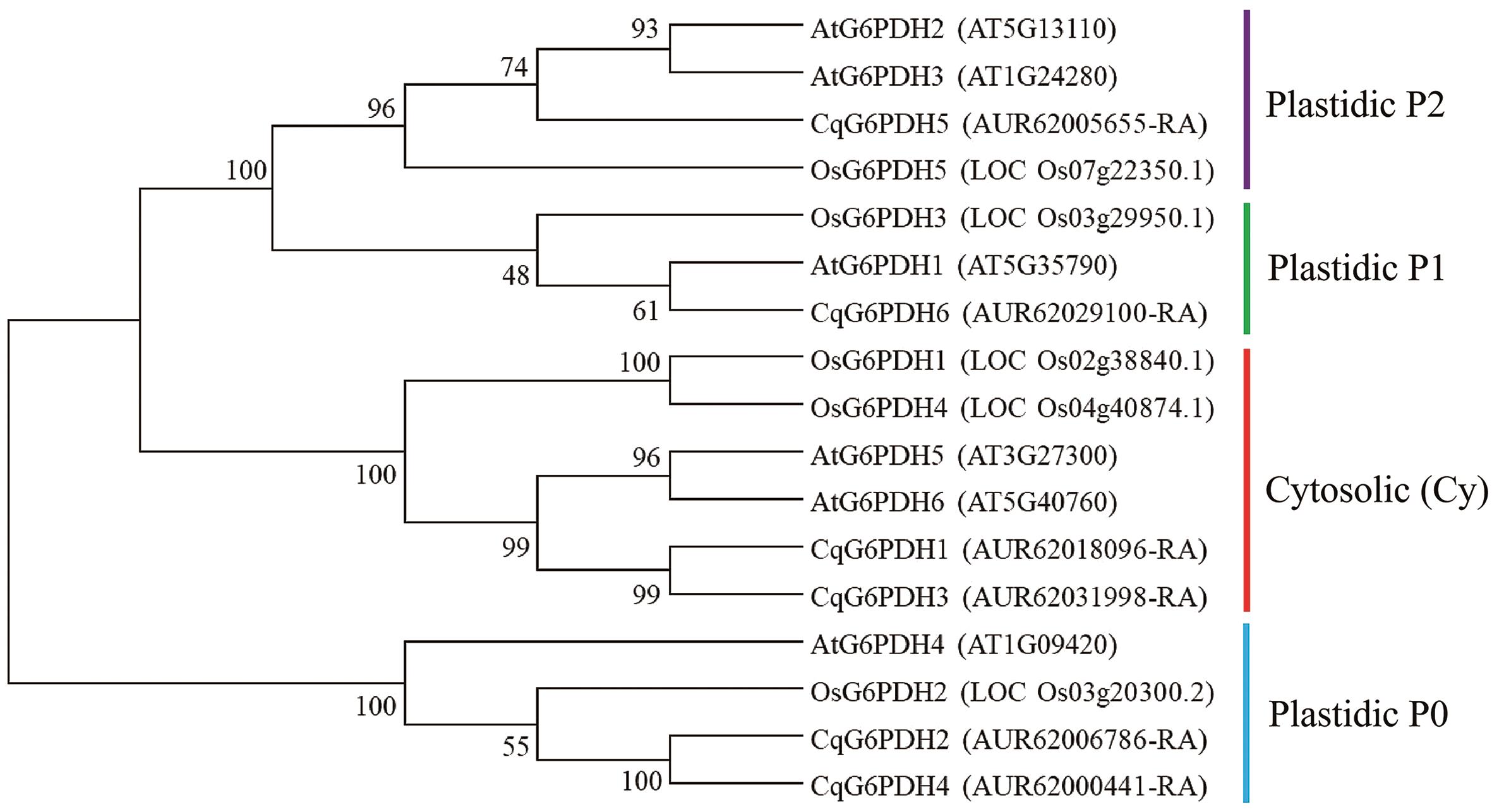
图1 藜麦、拟南芥和水稻G6PDH基因家族的系统发育进化树
Fig. 1 Phylogenetic tree of G6PDH gene family in Chenopodium quinoa, Arabidopsis thaliana and Oryza sativa
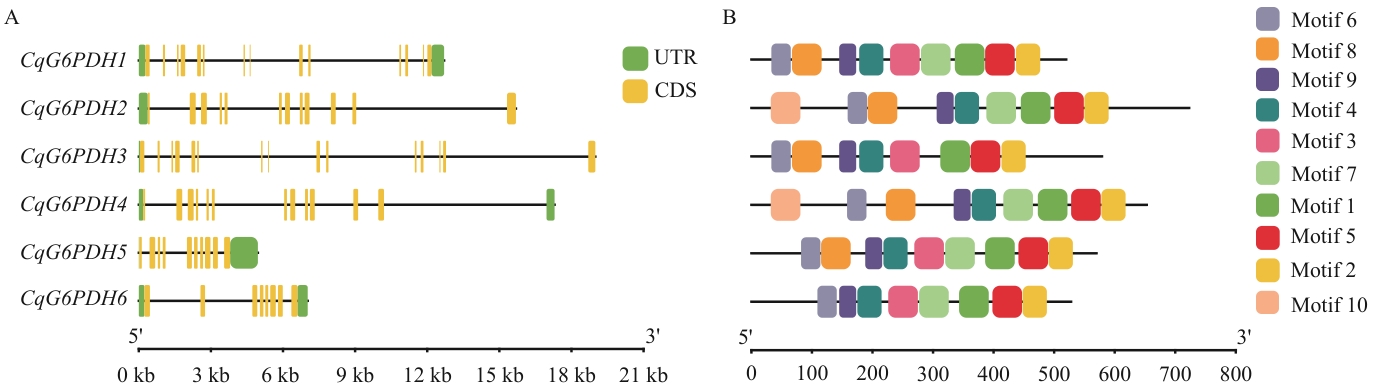
图2 藜麦G6PDH基因家族的基因结构(A)和保守基序(B)
Fig. 2 Gene structures (A) and conserved domains (B) of G6PDH gene family in C. quinoa
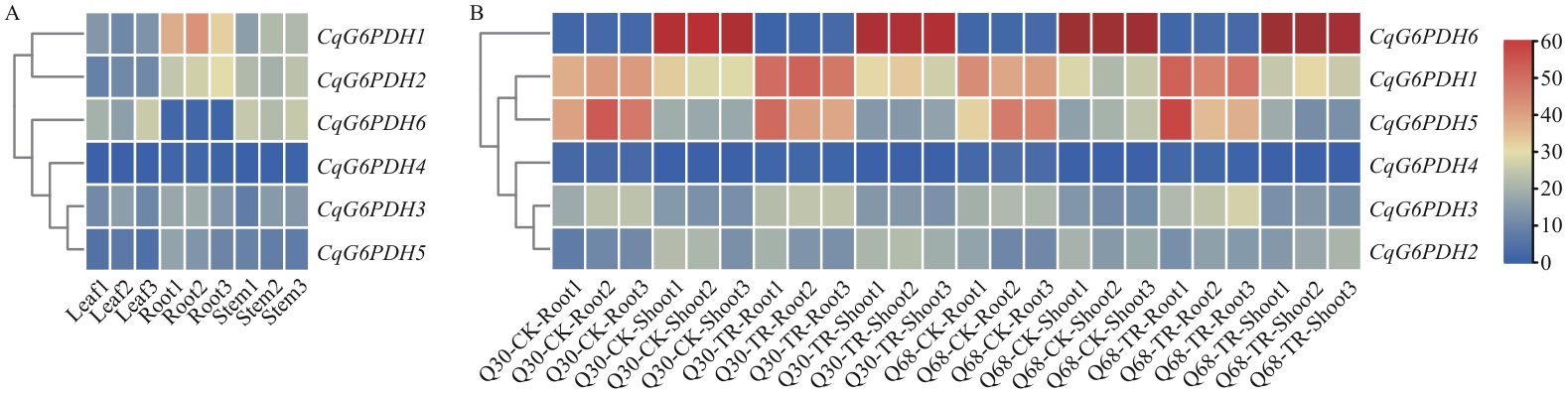
图3 藜麦G6PDH基因家族在不同组织(A)和盐胁迫(B)的表达热图
Fig. 3 Expression heat map of CqG6PDH gene familyin different tissues (A) and salt stress (B) in C. quinoa
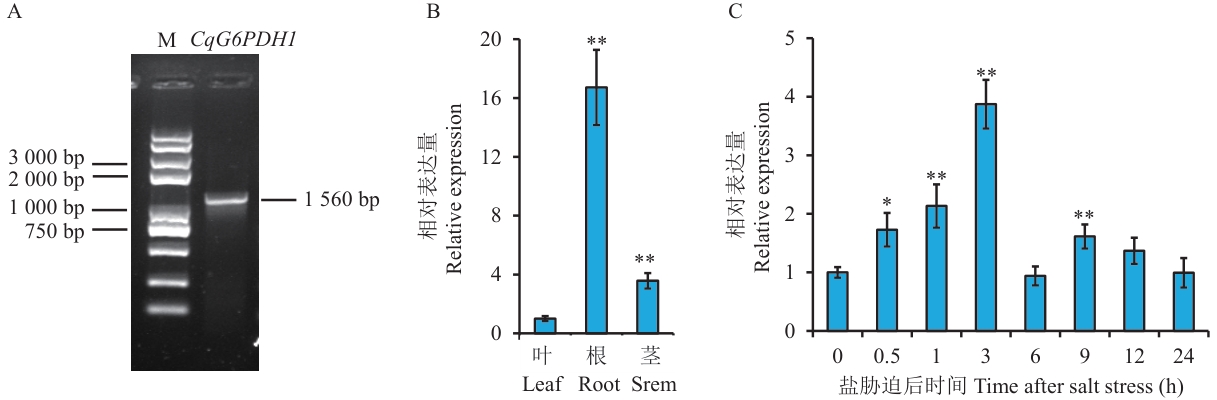
图4 藜麦CqG6PDH1的克隆(A)及组织(B)和盐胁迫(C)表达分析* P<0.05, ** P<0.01. The same below
Fig. 4 Gene cloning of CqG6PDH1 in quinoa (A), and expression analysis in different tissues (B) and salt stress (C)
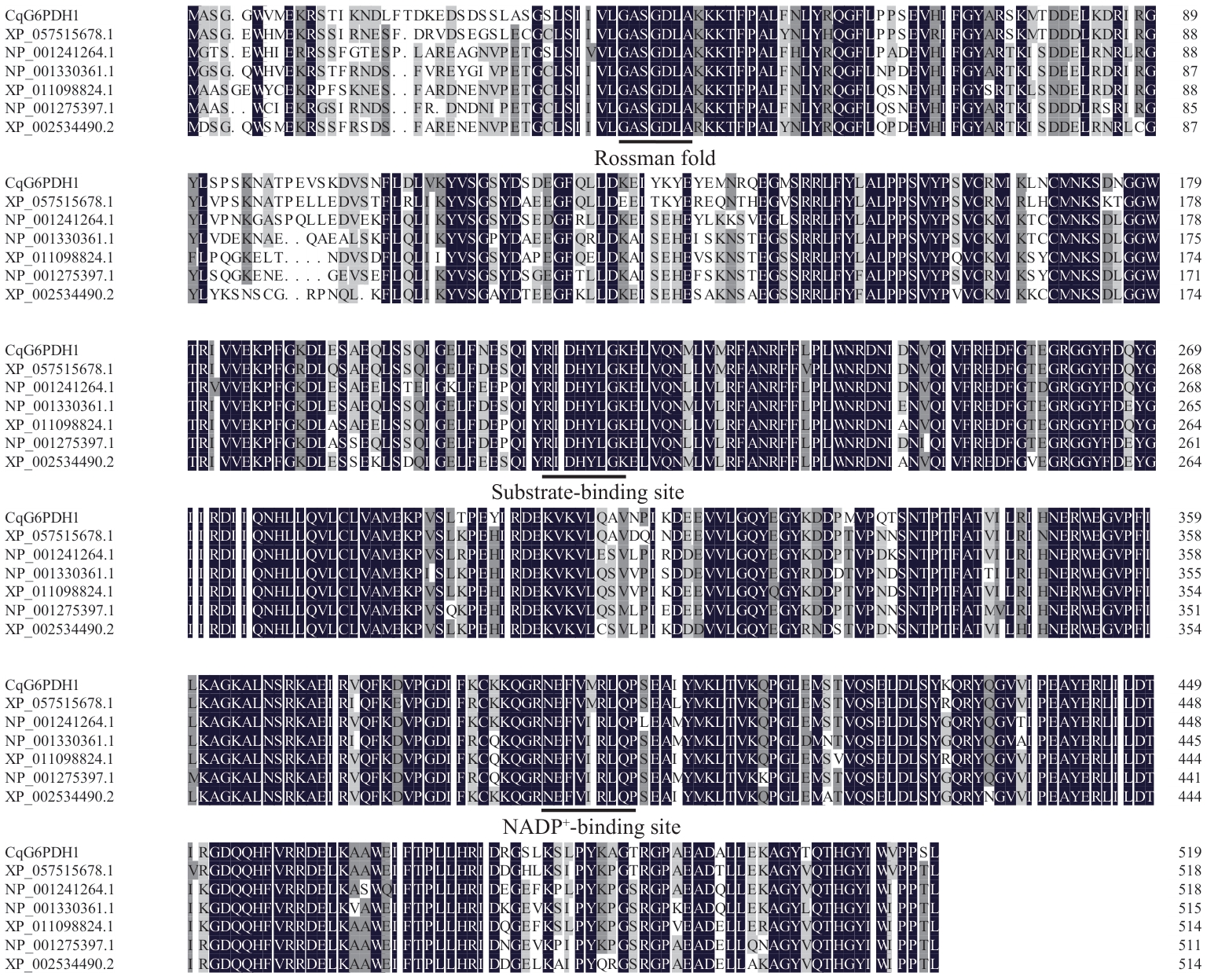
图5 CqG6PDH1与其他物种的氨基酸序列比对XP_057515678.1:苋菜;NP_001241264.1:大豆;NP_001330361.1:拟南芥;XP_011098824.1:芝麻;NP_001275397.1:马铃薯;XP_002534490.2:蓖麻
Fig. 5 Amino acid sequence alignment of CqG6PDH1 with other speciesXP_057515678.1: Amaranthus tricolor; NP_001241264.1: Glycine max; NP_001330361.1: Arabidopsis thaliana; XP_011098824.1: Sesamum indicum; NP_001275397.1: Solanum tuberosum; XP_002534490.2: Ricinus communis
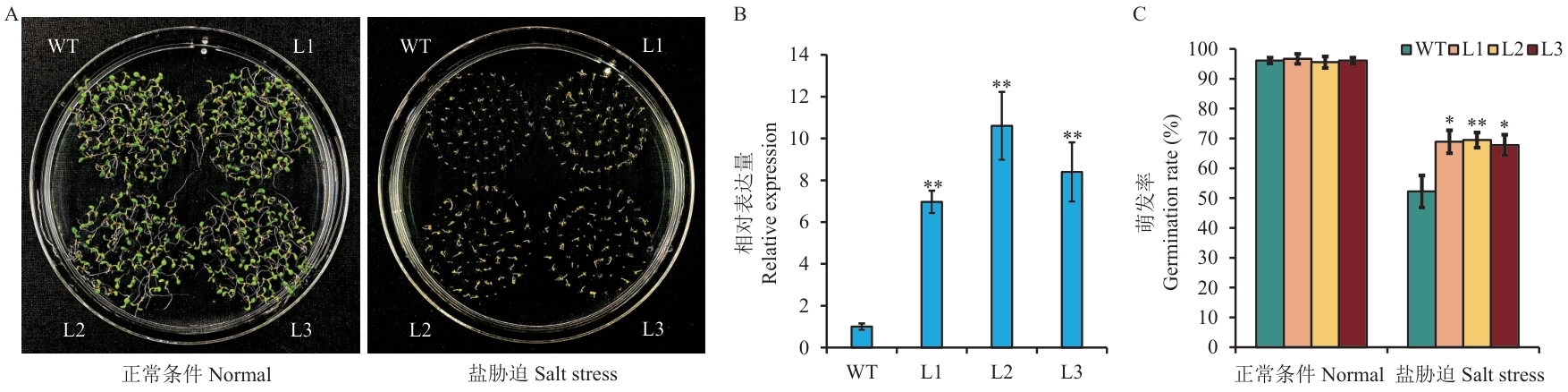
图6 过表达CqG6PDH1拟南芥种子在NaCl处理下的表型分析A:萌发表型;B:CqG6PDH1的表达分析;C:萌发率统计
Fig. 6 Phenotype analysis of Arabidopsis seeds with over-expressing CqG6PDH1 under NaCl treatmentA: Germination phenotype. B: Expression analysis of CqG6PDH1. C: Statistics of germination rate
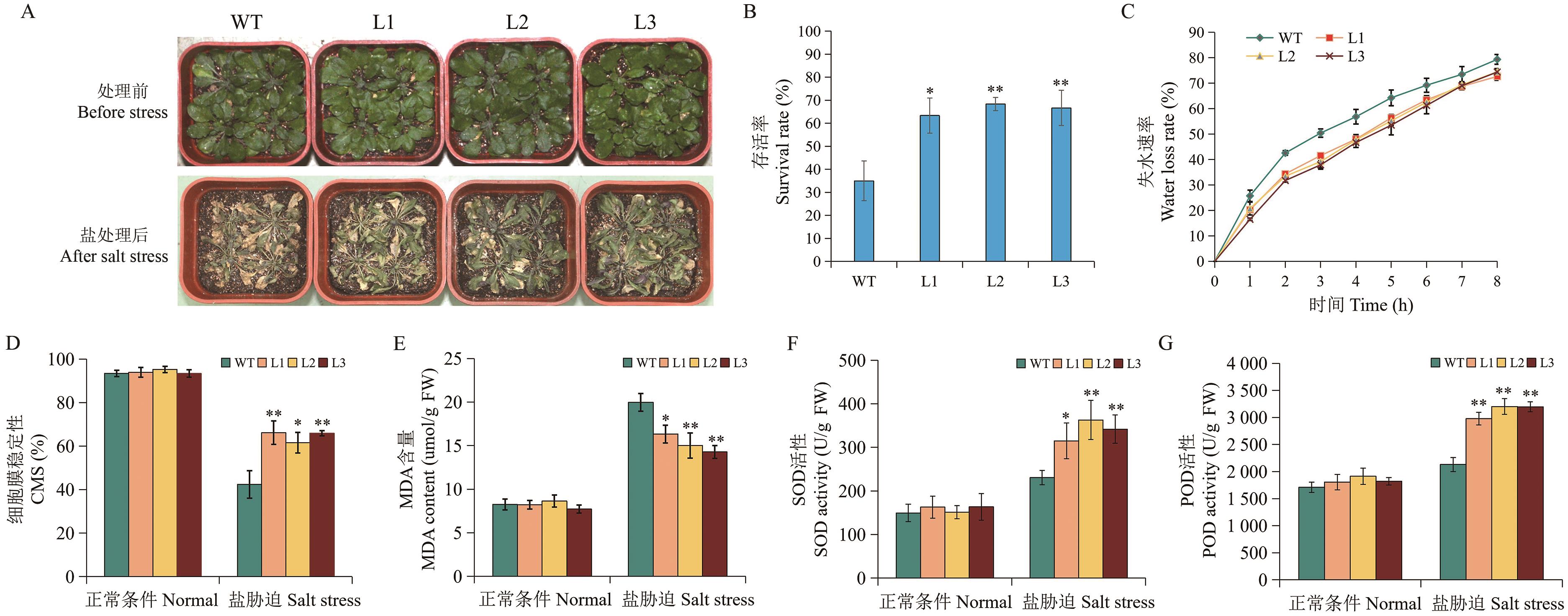
图7 过表达CqG6PDH1拟南芥幼苗在NaCl处理下的表型(A)及生理指标测定(B-G)
Fig. 7 Phenotypes (A) of Arabidopsis seedlings with over-expressing CqG6PDH1 under NaCl treatment and determination of physiological indexes (B-G)
| [1] | Jacobsen SE. The worldwide potential for quinoa (Chenopodium quinoa Willd.) [J]. Food Rev Int, 2003, 19(1/2): 167-177. |
| [2] | Angeli V, Miguel Silva P, Crispim Massuela D, et al. Quinoa (Chenopodium quinoa Willd.): an overview of the potentials of the “golden grain” and socio-economic and environmental aspects of its cultivation and marketization [J]. Foods, 2020, 9(2): 216. |
| [3] | 胡一晨, 赵钢, 秦培友, 等. 藜麦活性成分研究进展 [J]. 作物学报, 2018, 44(11): 1579-1591. |
| Hu YC, Zhao G, Qin PY, et al. Research progress on bioactive components of quinoa (Chenopodium quinoa Willd.) [J]. Acta Agron Sin, 2018, 44(11): 1579-1591. | |
| [4] | 于定群, 汤浩茹, 张勇, 等. 高等植物葡萄糖-6-磷酸脱氢酶的研究进展 [J]. 生物工程学报, 2012, 28(7): 800-812. |
| Yu DQ, Tang HR, Zhang Y, et al. Research progress in glucose-6-phosphate dehydrogenase in higher plants [J]. Chin J Biotechnol, 2012, 28(7): 800-812. | |
| [5] | Wang XM, Ma YY, Huang CH, et al. Involvement of glucose-6-phosphate dehydrogenase in reduced glutathione maintenance and hydrogen peroxide signal under salt stress [J]. Plant Signal Behav, 2008, 3(6): 394-395. |
| [6] | Scharte J, Schön H, Tjaden Z, et al. Isoenzyme replacement of glucose-6-phosphate dehydrogenase in the cytosol improves stress tolerance in plants [J]. Proc Natl Acad Sci U S A, 2009, 106(19): 8061-8066. |
| [7] | Tian Y, Peng KK, Bao YZ, et al. Glucose-6-phosphate dehydrogenase and 6-phosphogluconate dehydrogenase genes of winter wheat enhance the cold tolerance of transgenic Arabidopsis [J]. Plant Physiol Biochem, 2021, 161: 86-97. |
| [8] | Li X, Cai Q, Yu T, et al. ZmG6PDH1 in glucose-6-phosphate dehydrogenase family enhances cold stress tolerance in maize [J]. Front Plant Sci, 2023, 14: 1116237. |
| [9] | Jin J, Li KK, Qin J, et al. The response mechanism to salt stress in Arabidopsis transgenic lines over-expressing of GmG6PD [J]. Plant Physiol Biochem, 2021, 162: 74-85. |
| [10] | Yang YT, Fu ZW, Su YC, et al. A cytosolic glucose-6-phosphate dehydrogenase gene, ScG6PDH, plays a positive role in response to various abiotic stresses in sugarcane [J]. Sci Rep, 2014, 4: 7090. |
| [11] | Lin YZ, Lin SZ, Guo H, et al. Functional analysis of PsG6PDH, a cytosolic glucose-6-phosphate dehydrogenase gene from Populus suaveolens, and its contribution to cold tolerance improvement in tobacco plants [J]. Biotechnol Lett, 2013, 35(9): 1509-1518. |
| [12] | Wakao S, Benning C. Genome-wide analysis of glucose-6-phosphate dehydrogenases in Arabidopsis [J]. Plant J, 2005, 41(2): 243-256. |
| [13] | 宋兵芳, 柳宁, 程新艳, 等. 马铃薯G6PDH基因家族鉴定及其在损伤块茎的表达分析 [J]. 生物技术通报, 2024, 40(9): 104-112. |
| Song BF, Liu N, Cheng XY, et al. Identification of potato G6PDH gene family and its expression analysis in damaged tubers [J]. Biotechnol Bull, 2024, 40(9): 104-112. | |
| [14] | Zhao Y, Cui YF, Huang SY, et al. Genome-wide analysis of the glucose-6-phosphate dehydrogenase family in soybean and functional identification of GmG6PDH2 involvement in salt stress [J]. Front Plant Sci, 2020, 11: 214. |
| [15] | 车卓, 张沛沛, 陈涛, 等. 小麦G6PDH基因家族的鉴定与表达分析 [J]. 麦类作物学报, 2023, 43(8): 947-957. |
| Che Z, Zhang PP, Chen T, et al. Identification and expression analysis of G6PDH gene family in wheat [J]. J Triticeae Crops, 2023, 43(8): 947-957. | |
| [16] | Long XY, He B, Fang YJ, et al. Identification and characterization of the glucose-6-phosphate dehydrogenase gene family in the para rubber tree, Hevea brasiliensis [J]. Front Plant Sci, 2016, 7: 215. |
| [17] | Zhang YT, Luo MW, Cheng LJ, et al. Identification of the cytosolic glucose-6-phosphate dehydrogenase gene from strawberry involved in cold stress response [J]. Int J Mol Sci, 2020, 21(19): 7322. |
| [18] | Ding PC, Tang P, Li XF, et al. Genome-wide identification, phylogeny and expression analysis of the R2R3-MYB gene family in quinoa (Chenopodium quinoa) under abiotic stress [J]. Funct Plant Biol, 2024, 51: FP23261. |
| [19] | Clough SJ, Bent AF. Floral dip: a simplified method for Agrobacterium-mediated transformation of Arabidopsis thaliana [J]. Plant J, 1998, 16(6): 735-743. |
| [20] | Xu QF, Mao XG, Wang YX, et al. A wheat gene TaSAP17-D encoding an AN1/AN1 zinc finger protein improves salt stress tolerance in transgenic Arabidopsis [J]. J Integr Agric, 2018, 17(3): 507-516. |
| [21] | Smaili FZ, Tian SY, Roy A, et al. QAUST: protein function prediction using structure similarity, protein interaction, and functional motifs [J]. Genom Proteom Bioinform, 2021, 19(6): 998-1011. |
| [22] | 李丽丽, 姜奇彦, 牛风娟, 等. 藜麦耐盐机制研究进展 [J]. 中国农业科技导报, 2016, 18(2): 31-40. |
| Li LL, Jiang QY, Niu FJ, et al. Research progress on salt tolerance mechanisms in quinoa [J]. J Agric Sci Technol, 2016, 18(2): 31-40. | |
| [23] | 鲍庆晗, 王洋. 藜麦响应盐碱胁迫的基因家族功能与信号通路研究进展 [J]. 吉林师范大学学报: 自然科学版, 2025, 46(4): 96-100. |
| Bao QH, Wang Y. Research progress on gene family functions and signaling pathways of quinoa in response to saline-alkali stress [J]. Jilin Norm Univ J Nat Sci Ed, 2025, 46(4): 96-100. | |
| [24] | 王洋, 潘晓为, 杜会石, 等. 藜麦植物资源开发利用与抗逆性研究进展 [J]. 吉林师范大学学报: 自然科学版, 2023, 44(4): 118-122. |
| Wang Y, Pan XW, Du HS, et al. Research progress in the utilization and stress resistance on the plant resource of quinoa [J]. J Jilin Norm Univ Nat Sci Ed, 2023, 44(4): 118-122. | |
| [25] | Feng RJ, Wang XM, He L, et al. Identification, characterization, and stress responsiveness of glucose-6-phosphate dehydrogenase genes in highland barley [J]. Plants, 2020, 9(12): 1800. |
| [26] | Munns R, Tester M. Mechanisms of salinity tolerance [J]. Annu Rev Plant Biol, 2008, 59: 651-681. |
| [27] | Liu Y, Wu R, Wan Q, et al. Glucose-6-phosphate dehydrogenase plays a pivotal role in nitric oxide-involved defense against oxidative stress under salt stress in red kidney bean roots [J]. Plant Cell Physiol, 2007, 48(3): 511-522. |
| [28] | Wang HH, Yang LD, Li Y, et al. Involvement of ABA- and H2O2-dependent cytosolic glucose-6-phosphate dehydrogenase in maintaining redox homeostasis in soybean roots under drought stress [J]. Plant Physiol Biochem, 2016, 107: 126-136. |
| [29] | Liu J, Wang XM, Hu YF, et al. Glucose-6-phosphate dehydrogenase plays a pivotal role in tolerance to drought stress in soybean roots [J]. Plant Cell Rep, 2013, 32(3): 415-429. |
| [30] | Dal Santo S, Stampfl H, Krasensky J, et al. Stress-induced GSK3 regulates the redox stress response by phosphorylating glucose-6-phosphate dehydrogenase in Arabidopsis [J]. Plant Cell, 2012, 24(8): 3380-3392. |
| [1] | 桑志鹏, 侯栋, 王慧婷, 岳宏忠, 李亚莉, 颉建明, 路雯, 许照泰. 黄瓜CsHXKs基因家族鉴定及CsHKL1.2调控花器官糖积累[J]. 生物技术通报, 2026, 42(9): 157-168. |
| [2] | 董向向, 侯威威, 缪百灵, 陈娟娟, 李亮杰, 翟敏, 朱庆松, 刘松虎. 过表达森林草莓FvBBX22促进拟南芥花青素合成和延迟开花时间[J]. 生物技术通报, 2026, 42(9): 231-237. |
| [3] | 孙常胜, 尉万聪, 王一衡, 张桂霞, 兰青阔, 王永. 黄瓜耐盐种质筛选评价及分子机制研究进展[J]. 生物技术通报, 2026, 42(8): 35-46. |
| [4] | 王建波, 李诗雅, 邢鹤炫, 周瑞金, 李桂荣, 王玲. 海藻糖-6-磷酸合成酶基因VvTPS10在葡萄耐盐和生长发育中的功能分析[J]. 生物技术通报, 2026, 42(8): 188-196. |
| [5] | 辛晴, 郑永杰, 李雨华, 涂白连, 刘新亮, 张月婷, 伍艳芳. 樟树MYC转录因子的全基因组鉴定与表达分析[J]. 生物技术通报, 2026, 42(7): 214-225. |
| [6] | 董亚茹, 修妤, 赵东晓, 朱红, 朱琳, 刘惠芬. 基于转录组的桑树GRAS基因家族鉴定及MnGRAS22盐胁迫响应分析[J]. 生物技术通报, 2026, 42(7): 193-203. |
| [7] | 阎晓光, 杜艳伟, 马志远, 王彬, 王国梁, 胡丹珠. 玉米ZmDIR基因家族的全基因组鉴定与表达模式分析[J]. 生物技术通报, 2026, 42(7): 126-137. |
| [8] | 黄旭升, 周雅莉, 贾峥嵘, 沈珊, 陈锦钗, 周广立, 李鑫鑫, 王计平, 李润植, 贾小云. 紫苏ARF转录因子家族全基因组鉴定及其在非生物胁迫响应中的功能分析[J]. 生物技术通报, 2026, 42(7): 148-162. |
| [9] | 陈义焰, 张冬儿, 张涛, 刘育灏, 唐杰, 盛夏冰, 胡远艺, 艾治勇, 李应将, 刘小林. 水稻OsSULTR2;2基因功能及调控苗期耐盐性分析[J]. 生物技术通报, 2026, 42(7): 116-125. |
| [10] | 李旭龙, 徐世强, 张龙, 李静宇, 何伟贤, 陈立凯, 王继华. 巴戟天萜烯合成酶基因家族鉴定、进化及表达模式分析[J]. 生物技术通报, 2026, 42(6): 314-325. |
| [11] | 金旋, 向芬, 戴翠婷, 杨辉, 李赛君, 刘红艳, 钱思维, 蔺万煌, 李维. 茶树CsTDIFL基因的克隆、表达特性分析及其对氨基酸合成的调控[J]. 生物技术通报, 2026, 42(5): 323-331. |
| [12] | 郭苗, 许家佳, 孙天国, 蔡璨, 曹婉笛, 包纪星, 沙伟, 张梅娟, 彭疑芳, 马天意. 过表达砂藓RcOLEO1基因增强拟南芥的耐旱性及耐高温性[J]. 生物技术通报, 2026, 42(5): 312-322. |
| [13] | 曹海艳, 张子彤, 孟子钰, 宋继策, 郝雪峰, 金竹萍. 谷子SiGeBP基因家族生物信息学及表达分析[J]. 生物技术通报, 2026, 42(10): 67-76. |
| [14] | 吕呈聪, 衡蒙, 陈思琪, 金雪花. 彩色马蹄莲花青素苷转运相关ZhGSTF的克隆及功能分析[J]. 生物技术通报, 2026, 42(1): 161-169. |
| [15] | 杨娟, 冯慧, 吉乃喆, 孙丽萍, 王赟, 张佳楠, 赵世伟. 月季AP2/ERF转录因子RcERF4和RcRAP2-12的克隆及功能分析[J]. 生物技术通报, 2026, 42(1): 150-160. |
| 阅读次数 | ||||||
|
全文 |
|
|||||
|
摘要 |
|
|||||
