







• 研究报告 • 下一篇
沈朝贵1, 肖维强2, 赖瑞联1( ), 韦晓霞1()
收稿日期:2026-01-30
出版日期:2026-09-14
通讯作者:
赖瑞联lairl0618@163.com基金资助:
SHEN Chao-gui1, XIAO Wei-qiang2, LAI Rui-lian1(), WEI Xiao-xia1()
Received:2026-01-30
Published:2026-09-14
摘要:
目的 揭示橄榄(Canarium album Raeusch.)种质间鲜食品质差异形成的影响因素,为优异鲜食种质筛选与品种改良提供理论依据。 方法 通过整合代谢组和转录组分析,研究24份不同类型橄榄种质资源的代谢物谱和基因表达谱差异,同时采用RT-qPCR对候选调控基因进行表达模式验证。 结果 从鲜食与非鲜食橄榄种质资源群体间共鉴定出152种差异富集代谢物(differentially accumulated metabolites, DAMs),主要包括氨基酸、酚酸、萜类、类黄酮、有机酸和糖类等。基于DAMs,共富集到16条氨基酸生物合成或代谢相关的KEGG代谢途径。进一步分析发现,鲜味氨基酸(天冬氨酸和谷氨酸)及芳香族氨基酸(苯丙氨酸)在鲜食与非鲜食橄榄种质资源群体间差异性富集,其中天冬氨酸在‘孔江3号’‘思光种’‘福榄2号’等鲜食种质中显著积累,谷氨酸在‘马坑3号’鲜食种质中特异性富集,苯丙氨酸在‘福榄2号’‘清榄3号’‘棱尖’等鲜食种质中高水平富集。利用转录组分析共鉴定到106个氨基酸相关的差异表达基因(differentially expressed genes, DEGs),其中L-天冬酰胺酶基因(L-asparaginase, L-ASN)、谷氨酸脱羧酶基因(glutamatedecarboxylase, GAD)、莽草酸脱水酶基因(arogenatedehydratase, ADT)和苯丙氨酸解氨酶基因(phenylalanineammonia lyase, PAL)是调控氨基酸生物合成的重要候选基因。基于DEGs,共富集到19条氨基酸相关的KEGG代谢途径。RT-qPCR试验结果表明,L-ASN、GAD、ADT和PAL的表达趋势与转录组测序结果一致。 结论 鲜味或芳香族氨基酸的差异性积累是影响橄榄鲜食品质的潜在因子。
沈朝贵, 肖维强, 赖瑞联, 韦晓霞. 橄榄氨基酸组分差异对鲜食品质的潜在影响[J]. 生物技术通报, doi: 10.13560/j.cnki.biotech.bull.1985.2026-0148.
SHEN Chao-gui, XIAO Wei-qiang, LAI Rui-lian, WEI Xiao-xia. Potential Effect of Differential Amino Acid Composition on Fresh-eating Quality in Chinese Olive (Canarium album)[J]. Biotechnology Bulletin, doi: 10.13560/j.cnki.biotech.bull.1985.2026-0148.
序号 No. | 名称 Name | 代号 Code | 来源 Resource | 类型 Types |
|---|---|---|---|---|
| 1 | 福榄2号 | FL2 | 福建闽侯 | 鲜食 |
| 2 | 国道种 | GDZ | 福建闽侯 | |
| 3 | 孔江3号 | KJ3 | 福建闽清 | |
| 4 | 棱尖 | LJ | 广东饶平 | |
| 5 | 灵峰橄榄 | LF | 福建闽侯 | |
| 6 | 马坑3号 | MK3 | 福建闽清 | |
| 7 | 闽清2号 | MQ2 | 福建闽清 | |
| 8 | 清榄1号 | QL1 | 福建闽清 | |
| 9 | 清榄3号 | QL3 | 福建闽侯 | |
| 10 | 三棱榄 | SLL | 广东潮阳 | |
| 11 | 思光种 | SGZ | 福建闽侯 | |
| 12 | 小美人 | XMR | 福建闽侯 | |
| 13 | 橄榄王 | GLW | 福建闽清 | 非鲜食 |
| 14 | 惠圆 | HY | 福建闽侯 | |
| 15 | 两头尖 | LTJ | 福建闽侯 | |
| 16 | 七粒尺 | QLC | 福建闽侯 | |
| 17 | 青皮长营 | QPCY | 福建闽侯 | |
| 18 | 瑞安3号 | RA3 | 浙江瑞安 | |
| 19 | 瑞安4号 | RA4 | 浙江瑞安 | |
| 20 | 檀头 | TT | 福建闽清 | |
| 21 | 羊矢 | YS | 福建闽清 | |
| 22 | 漳浦11号 | ZP11 | 福建漳浦 | |
| 23 | 猪榄3号 | ZL3 | 广西浦北 | |
| 24 | 自来圆 | ZLY | 福建闽侯 |
表1 试验所用橄榄种质资源样本
Table 1 Germplasm resource samples of Chinese olive used in the experiment
序号 No. | 名称 Name | 代号 Code | 来源 Resource | 类型 Types |
|---|---|---|---|---|
| 1 | 福榄2号 | FL2 | 福建闽侯 | 鲜食 |
| 2 | 国道种 | GDZ | 福建闽侯 | |
| 3 | 孔江3号 | KJ3 | 福建闽清 | |
| 4 | 棱尖 | LJ | 广东饶平 | |
| 5 | 灵峰橄榄 | LF | 福建闽侯 | |
| 6 | 马坑3号 | MK3 | 福建闽清 | |
| 7 | 闽清2号 | MQ2 | 福建闽清 | |
| 8 | 清榄1号 | QL1 | 福建闽清 | |
| 9 | 清榄3号 | QL3 | 福建闽侯 | |
| 10 | 三棱榄 | SLL | 广东潮阳 | |
| 11 | 思光种 | SGZ | 福建闽侯 | |
| 12 | 小美人 | XMR | 福建闽侯 | |
| 13 | 橄榄王 | GLW | 福建闽清 | 非鲜食 |
| 14 | 惠圆 | HY | 福建闽侯 | |
| 15 | 两头尖 | LTJ | 福建闽侯 | |
| 16 | 七粒尺 | QLC | 福建闽侯 | |
| 17 | 青皮长营 | QPCY | 福建闽侯 | |
| 18 | 瑞安3号 | RA3 | 浙江瑞安 | |
| 19 | 瑞安4号 | RA4 | 浙江瑞安 | |
| 20 | 檀头 | TT | 福建闽清 | |
| 21 | 羊矢 | YS | 福建闽清 | |
| 22 | 漳浦11号 | ZP11 | 福建漳浦 | |
| 23 | 猪榄3号 | ZL3 | 广西浦北 | |
| 24 | 自来圆 | ZLY | 福建闽侯 |
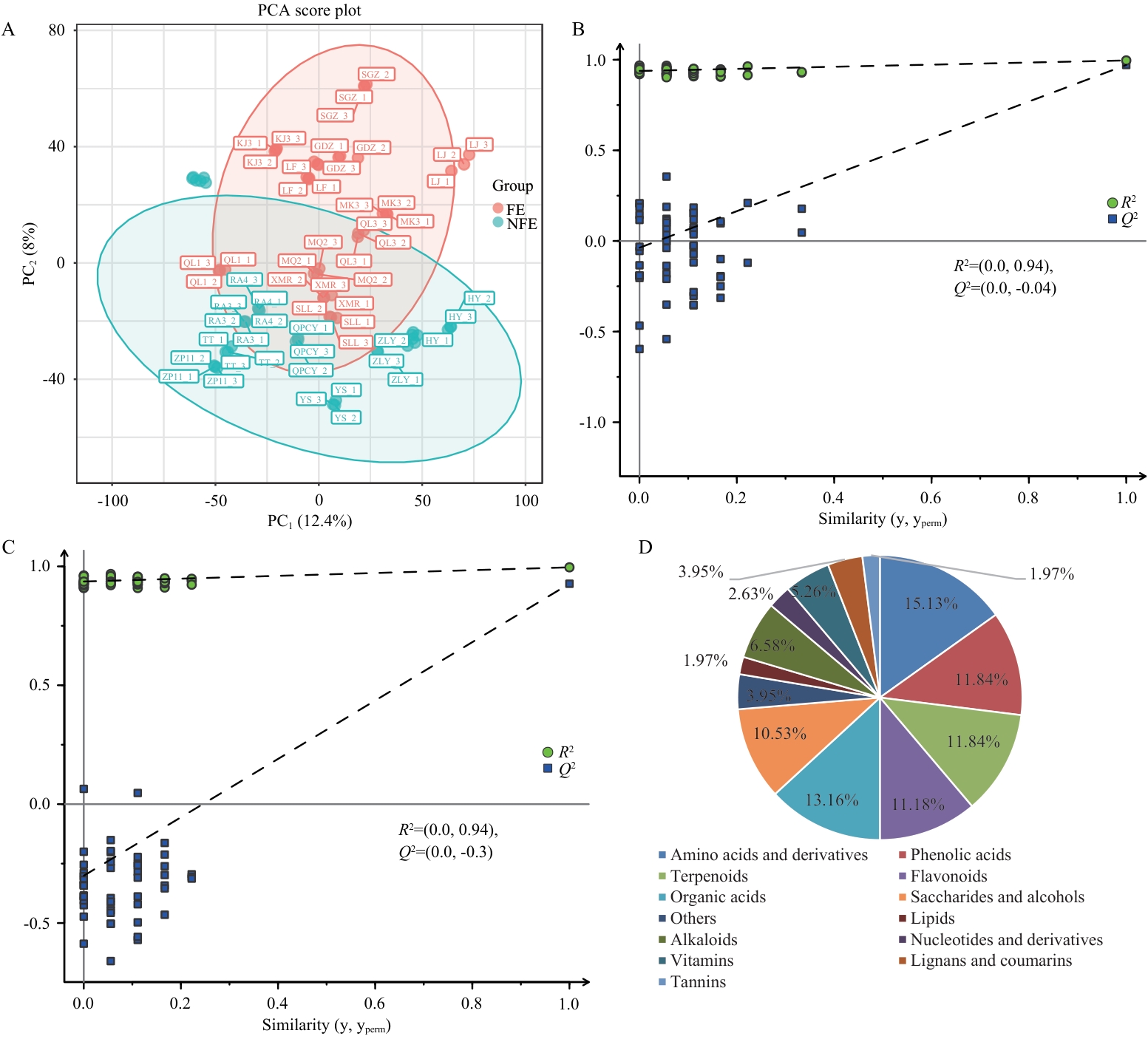
图1 鲜食与非鲜食橄榄间DAMs鉴定A:正离子模式下主成分分析;B:正离子模式下偏最小二乘法‒判别分析;C:正离子模式下正交偏最小二乘法‒判别分析;D:差异积累代谢物分类;FE和NFE分别表示鲜食橄榄和非鲜食橄榄,下同
Fig. 1 DAM identification between fresh edible and non-fresh edible Chinese olivesA: Principal component analysis in positive ion mode. B: Partial least squares-discriminant analysis in positive ion mode. C: Orthogonal partial least squares-discriminant analysis in positive ion mode. D: DAMs classification. FE and NFE indicate fresh edible and non-fresh edible Chinese olives. The same below
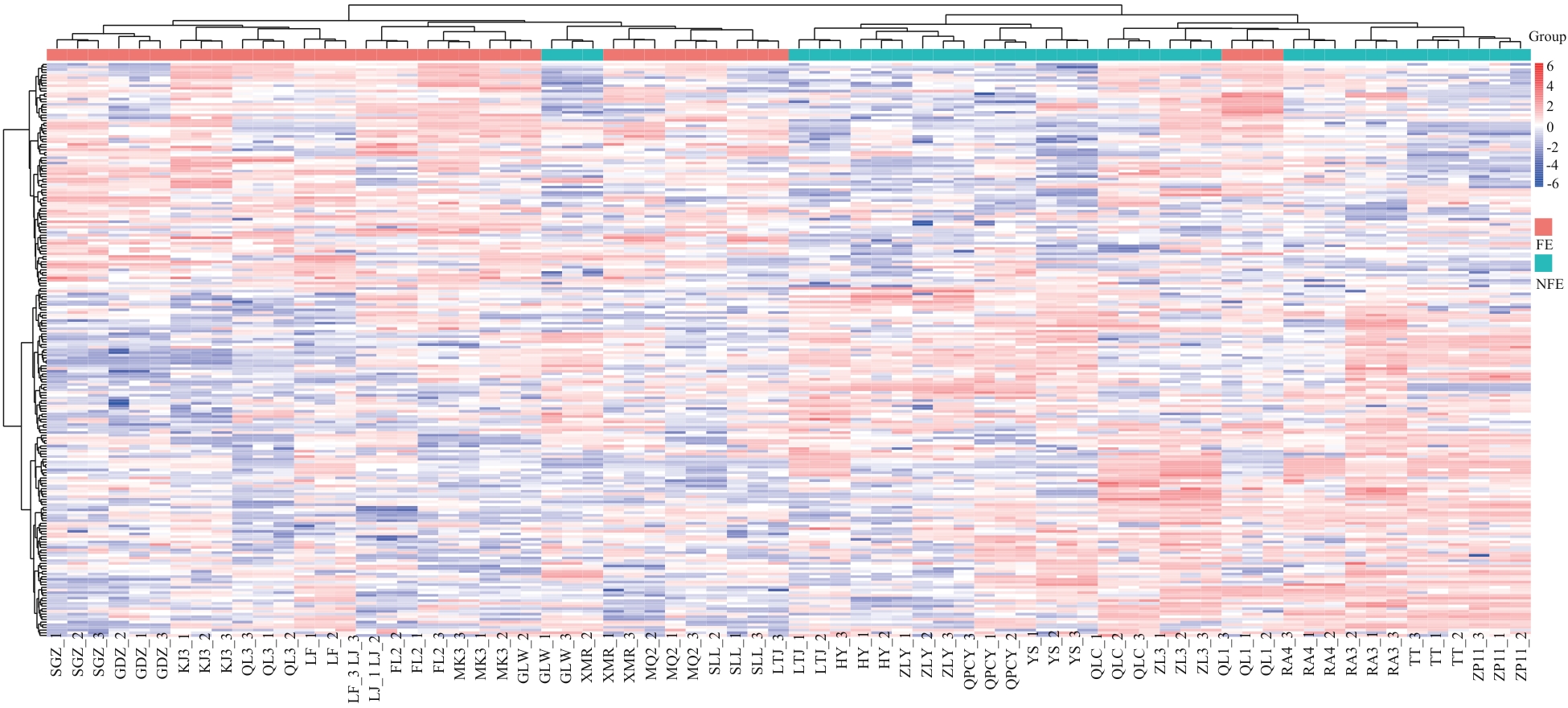
图2 基于差异积累代谢物的聚类分析颜色越接近图例上端表示积累水平越高,而颜色越接近图例下端表示积累水平越低
Fig. 2 Cluster analysis based on DAMsColors closer to the upper end of the legend indicate higher accumulation levels, while colors closer to the lower end of the legend represent lower accumulation levels
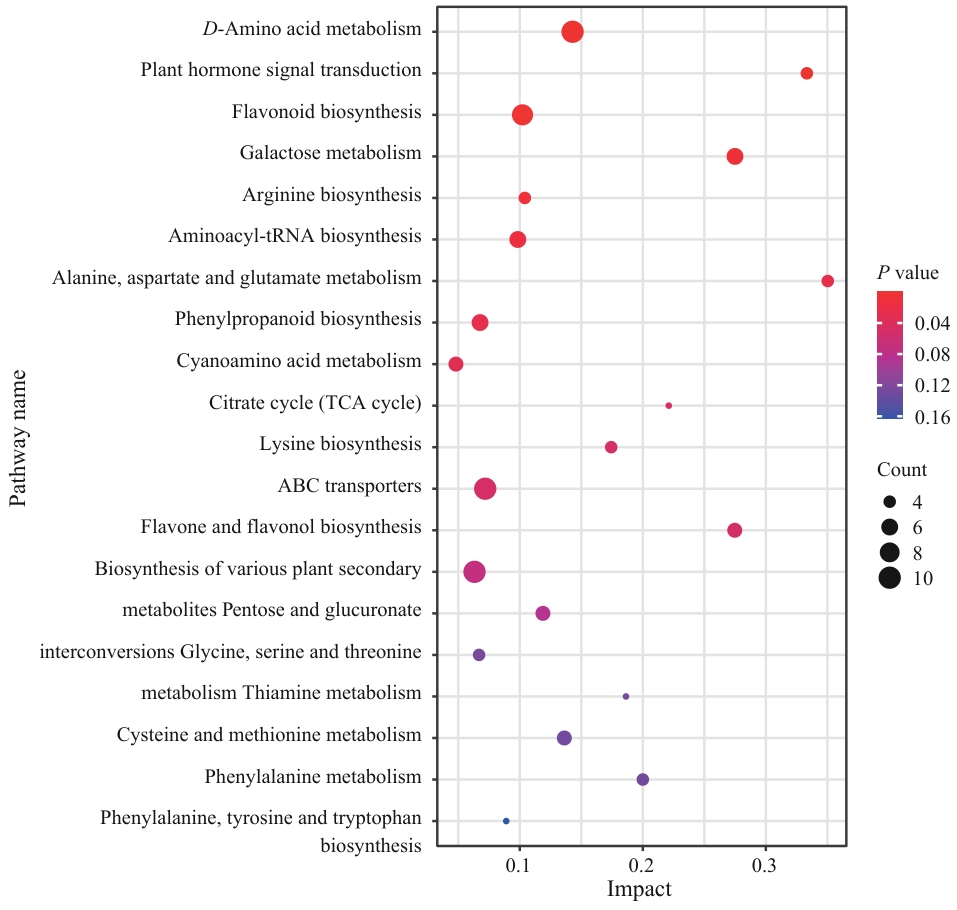
图3 基于NFE vs. FE比较组中DAMs的KEGG前20代谢途径富集分析由红到蓝的颜色梯度表示P值由低到高,点的大小反映了代谢物的数量
Fig. 3 Enrichment of top 20 KEGG metabolic pathways based on DAMs in comparison group of NFE vs. FEColor gradient from red to blue indicates P‑values ranging from low to high, and dot size reflects the number of metabolites
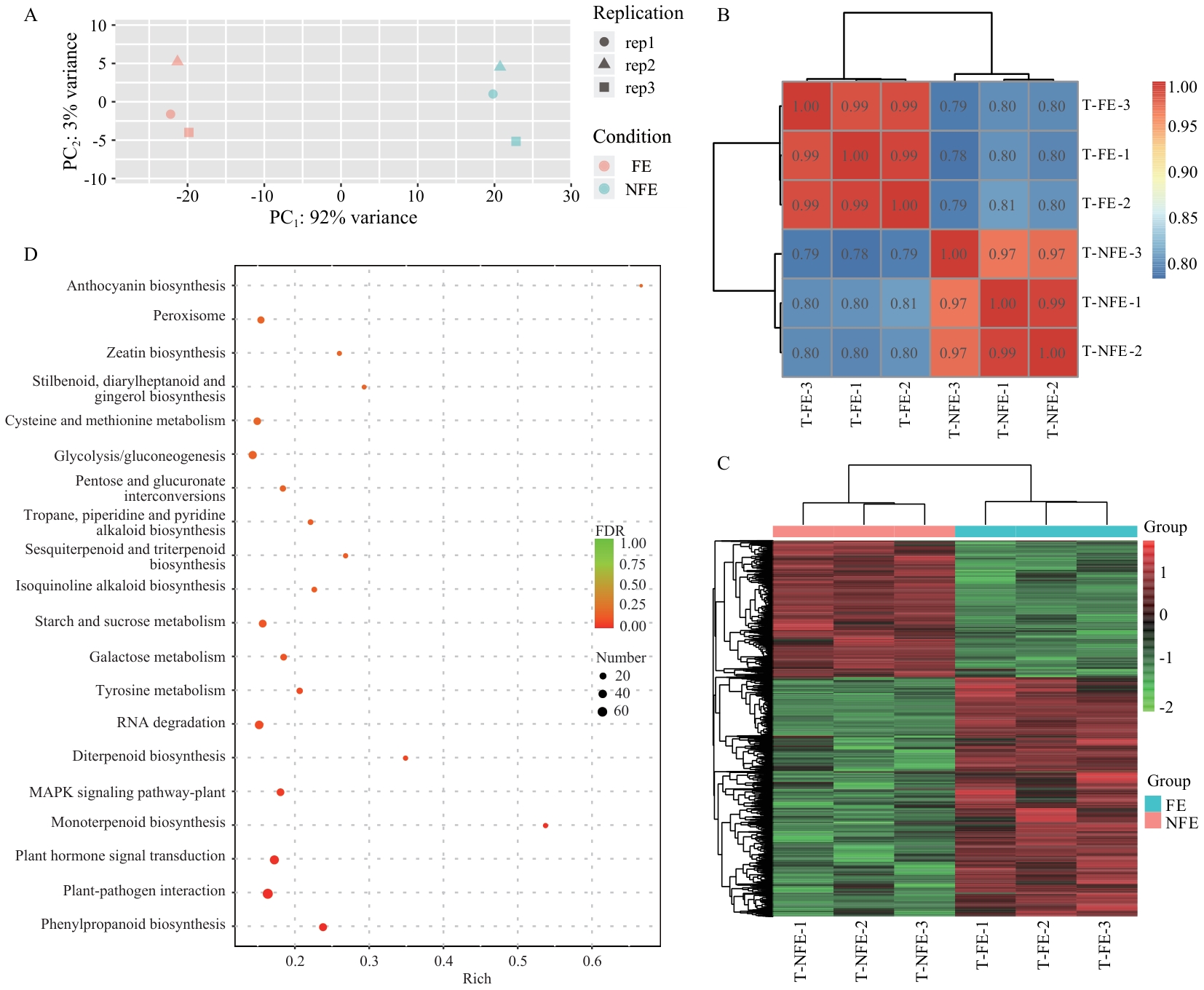
图4 鲜食与非鲜食橄榄转录组分析及DEGs鉴定A:PCA主成分分析;B:相关性分析;C:聚类分析;D:KEGG代谢途径富集分析;颜色越接近图例上端表示相关性或表达水平越高,颜色越接近图例下端表示相关性或表达水平越低
Fig. 4 Transcriptomic analysis and DEGs identification of fresh edible and non-fresh edible types of Chinese oliveA: PCA analysis. B: Correlation analysis. C: Cluster analysis. D: KEGG metabolic pathway enrichment analysis. Colors closer to the upper end of the legend indicate higher correlation or expression levels, while colors closer to the lower end of the legend represent lower correlation or expression levels
代谢通路ID Pathway ID | 代谢通路 Pathway | 代谢组学 Metabolome | 转录组学 Transcriptome | ||||
|---|---|---|---|---|---|---|---|
| DAMs | P-value | Impact | DEGs | P-value | FDR | ||
| ko00350 | Tyrosine metabolism | 5 | 0.200 | 0.090 | 16 | 0.005 | 0.072 |
| ko00270 | Cysteine and methionine metabolism | 5 | 0.128 | 0.136 | 29 | 0.023 | 0.166 |
| ko00330 | Arginine and proline metabolism | 3 | 0.526 | 0.124 | 19 | 0.035 | 0.187 |
| ko00380 | Tryptophan metabolism | 3 | 0.653 | 0.168 | 12 | 0.040 | 0.201 |
| ko00360 | Phenylalanine metabolism | 4 | 0.131 | 0.200 | 11 | 0.056 | 0.251 |
| ko00400 | Phenylalanine, tyrosine and tryptophan biosynthesis | 3 | 0.163 | 0.089 | 12 | 0.081 | 0.323 |
| ko00290 | Valine, leucine and isoleucine biosynthesis | — | — | — | 5 | 0.108 | 0.388 |
| ko00280 | Valine, leucine and isoleucine degradation | — | — | — | 15 | 0.253 | 0.656 |
| ko00250 | Alanine, aspartate and glutamate metabolism | 4 | 0.024 | 0.350 | 11 | 0.444 | 0.897 |
| ko00260 | Glycine, serine and threonine metabolism | 4 | 0.124 | 0.067 | 11 | 0.589 | 0.942 |
| ko00310 | Lysine degradation | 3 | 0.390 | 0.044 | 7 | 0.607 | 0.942 |
| ko00220 | Arginine biosynthesis | 4 | 0.012 | 0.104 | 5 | 0.698 | 0.959 |
| ko00340 | Histidine metabolism | 2 | 0.567 | 0.008 | 3 | 0.714 | 0.959 |
| ko00300 | Lysine biosynthesis | 4 | 0.049 | 0.174 | 2 | 0.800 | 0.996 |
| ko00430 | Taurine and hypotaurine metabolism | 1 | 0.626 | 0.031 | 5 | 0.032 | 0.183 |
| ko00410 | β-Alanine metabolism | 2 | 0.368 | 0.073 | 14 | 0.163 | 0.525 |
| ko00460 | Cyanoamino acid metabolism | 5 | 0.032 | 0.048 | 7 | 0.320 | 0.749 |
| ko00480 | Glutathione metabolism | 1 | 0.790 | 0.005 | 12 | 0.657 | 0.955 |
| ko00450 | Selenocompound metabolism | — | — | — | 2 | 0.856 | 1.000 |
表2 基于DAMs与DEGs的氨基酸相关KEGG代谢途径变化
Table 2 Changes in amino acid-related KEGG metabolic pathways based on DAMs and DEGs
代谢通路ID Pathway ID | 代谢通路 Pathway | 代谢组学 Metabolome | 转录组学 Transcriptome | ||||
|---|---|---|---|---|---|---|---|
| DAMs | P-value | Impact | DEGs | P-value | FDR | ||
| ko00350 | Tyrosine metabolism | 5 | 0.200 | 0.090 | 16 | 0.005 | 0.072 |
| ko00270 | Cysteine and methionine metabolism | 5 | 0.128 | 0.136 | 29 | 0.023 | 0.166 |
| ko00330 | Arginine and proline metabolism | 3 | 0.526 | 0.124 | 19 | 0.035 | 0.187 |
| ko00380 | Tryptophan metabolism | 3 | 0.653 | 0.168 | 12 | 0.040 | 0.201 |
| ko00360 | Phenylalanine metabolism | 4 | 0.131 | 0.200 | 11 | 0.056 | 0.251 |
| ko00400 | Phenylalanine, tyrosine and tryptophan biosynthesis | 3 | 0.163 | 0.089 | 12 | 0.081 | 0.323 |
| ko00290 | Valine, leucine and isoleucine biosynthesis | — | — | — | 5 | 0.108 | 0.388 |
| ko00280 | Valine, leucine and isoleucine degradation | — | — | — | 15 | 0.253 | 0.656 |
| ko00250 | Alanine, aspartate and glutamate metabolism | 4 | 0.024 | 0.350 | 11 | 0.444 | 0.897 |
| ko00260 | Glycine, serine and threonine metabolism | 4 | 0.124 | 0.067 | 11 | 0.589 | 0.942 |
| ko00310 | Lysine degradation | 3 | 0.390 | 0.044 | 7 | 0.607 | 0.942 |
| ko00220 | Arginine biosynthesis | 4 | 0.012 | 0.104 | 5 | 0.698 | 0.959 |
| ko00340 | Histidine metabolism | 2 | 0.567 | 0.008 | 3 | 0.714 | 0.959 |
| ko00300 | Lysine biosynthesis | 4 | 0.049 | 0.174 | 2 | 0.800 | 0.996 |
| ko00430 | Taurine and hypotaurine metabolism | 1 | 0.626 | 0.031 | 5 | 0.032 | 0.183 |
| ko00410 | β-Alanine metabolism | 2 | 0.368 | 0.073 | 14 | 0.163 | 0.525 |
| ko00460 | Cyanoamino acid metabolism | 5 | 0.032 | 0.048 | 7 | 0.320 | 0.749 |
| ko00480 | Glutathione metabolism | 1 | 0.790 | 0.005 | 12 | 0.657 | 0.955 |
| ko00450 | Selenocompound metabolism | — | — | — | 2 | 0.856 | 1.000 |
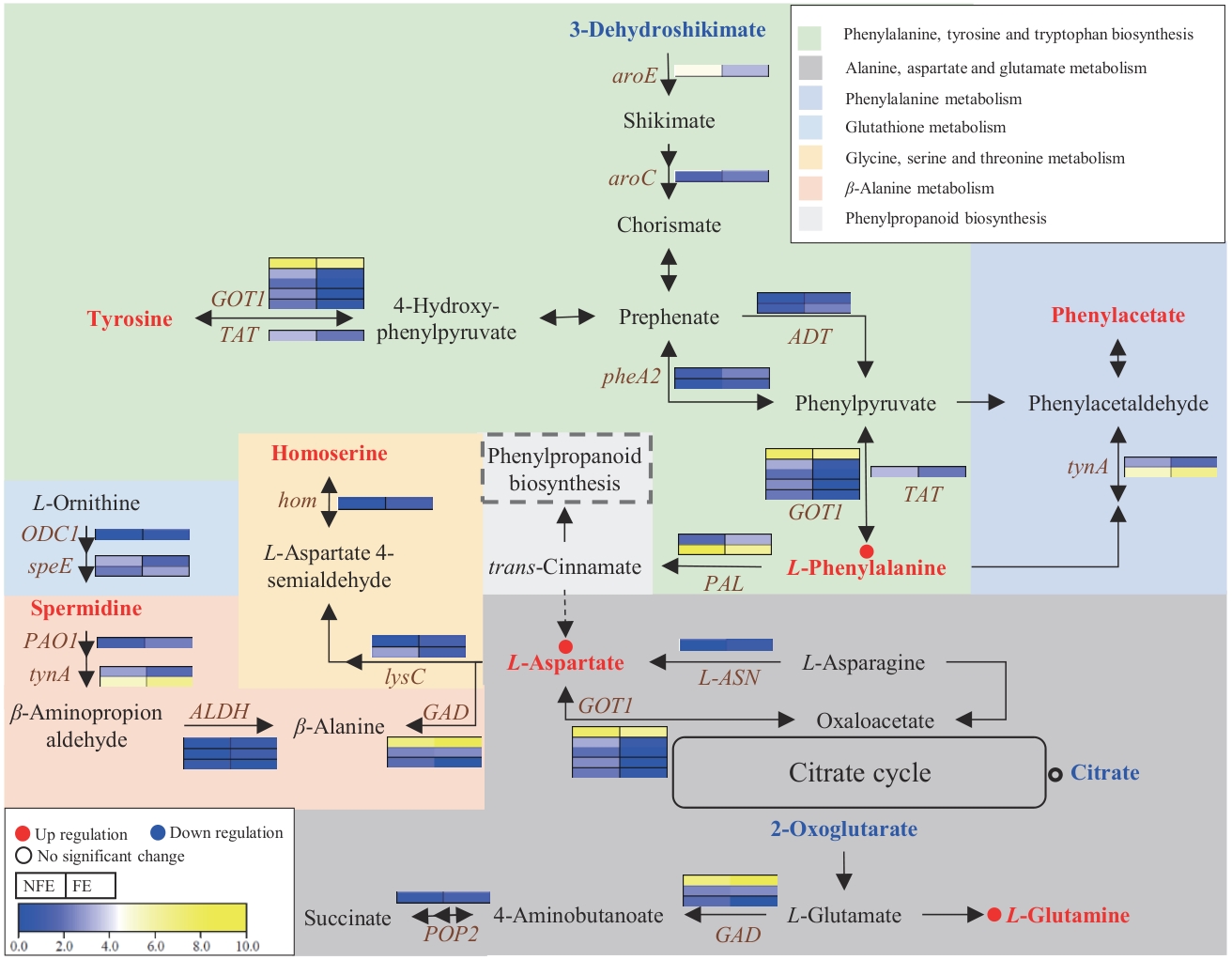
图5 鲜食与非鲜食橄榄间氨基酸相关代谢途径中DAMs与DEGs的变化红色和蓝色分别表示代谢物的上调与下调积累。颜色越接近图例右端表示基因表达水平越高,颜色越接近图例左端则表示基因表达水平越低
Fig. 5 Changes in DAMs and DEGs in amino acid‑related metabolic pathways between fresh edible and non‑fresh edible types of Chinese oliveRed and blue colors indicate up‑accumulation and down‑accumulation of metabolites, respectively. Colors closer to the right end of the legend indicate higher gene expression levels, while colors closer to the left end of the legend represent lower gene expression levels
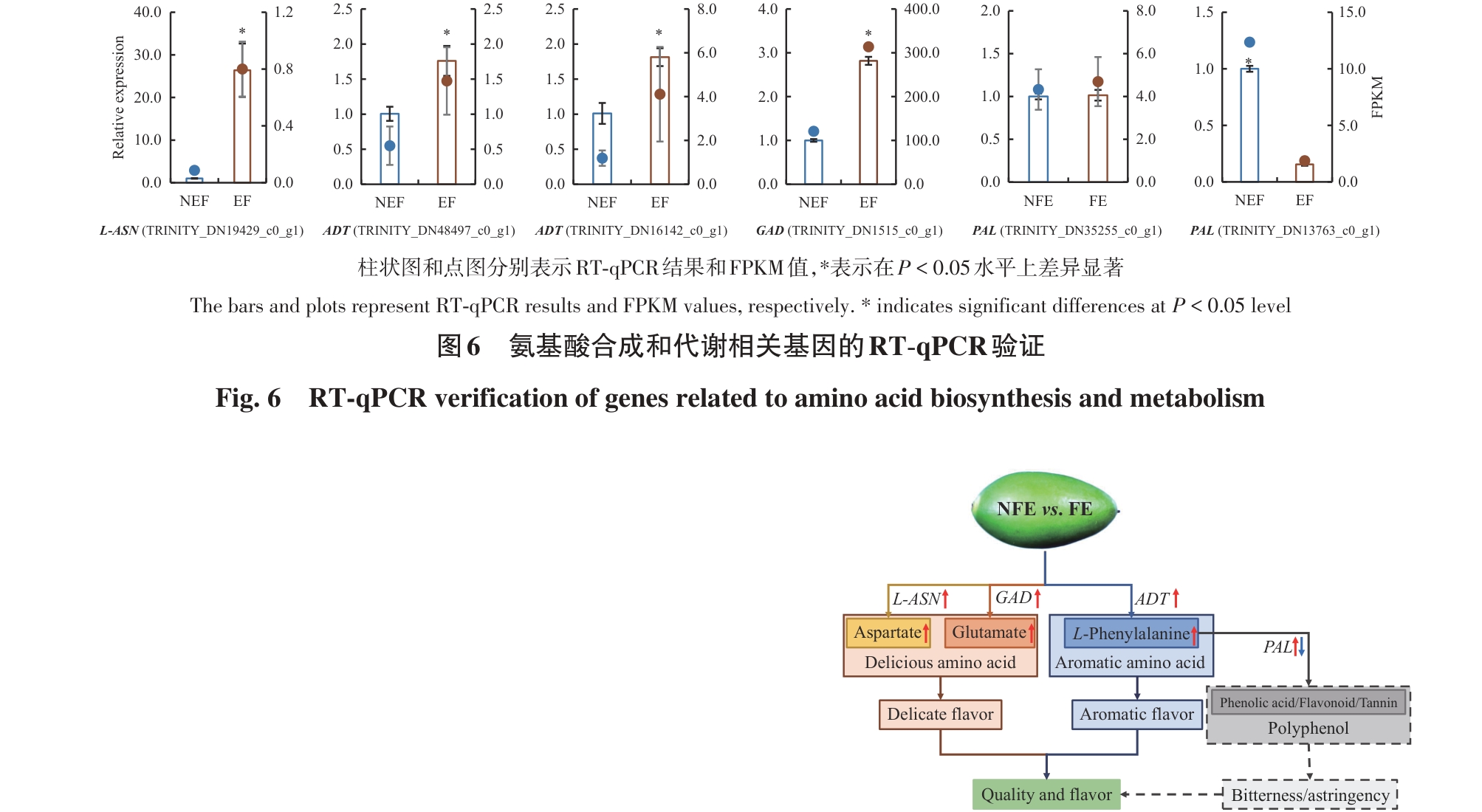
图7 氨基酸影响橄榄鲜食品质的潜在作用网络红色箭头代表上调,蓝色箭头表示下调。实线表示基于本研究中揭示的互作关系,虚线表示通过多组学整合分析推测的潜在关联
Fig. 7 Potential network of amino acids affecting fresh edible quality of Chinese oliveRed- and blue-arrows indicate up- and down-regulation. Solid lines represent interactions revealed in this study, while dashed lines suggest potential interactions
| [1] | Yu K, Wang Y, Hu WJ, et al. Chinese olive (Canarium album Rauesch.): a critical review on its nutritional value, phytochemical composition, health benefits, and practical applications [J]. Front Pharmacol, 2023, 14: 1275113. |
| [2] | Yan JH, Peng C, Chen PT, et al. In-vitro anti-Helicobacter pylori activity and preliminary mechanism of action of Canarium album Raeusch. fruit extracts [J]. J Ethnopharmacol, 2022, 283: 114578. |
| [3] | Li JM, Wang R, Wang YH, et al. Anti-inflammatory benzofuran neolignans from the fruits of Canarium album (Chinese olive) [J]. J Agric Food Chem, 2022, 70(4): 1122-1133. |
| [4] | Xiao MJ, Lim-Ho Kong B, Zhang YH, et al. Anti-influenza mechanism of phenolic phytochemicals from Canarium album (Lour.) DC. leaf extract [J]. J Ethnopharmacol, 2022, 292: 115175. |
| [5] | Yeh YT, Lu TJ, Lian GT, et al. Chinese olive (Canarium album L.) fruit regulates glucose utilization by activating AMP-activated protein kinase [J]. FASEB J, 2020, 34(6): 7866-7884. |
| [6] | Yeh YT, Chen CK, Liao YC, et al. Analysis and identification of phenolic compounds with antiproliferative activity from Chinese olive (Canarium album L.) fruit extract by HPLC-DAD-SPE-TT-NMR [J]. J Food Drug Anal, 2023, 31(4): 639-648. |
| [7] | 谢倩, 李易易, 张诗艳, 等. 基于模糊数学感官评价、理化特性与电子舌的橄榄鲜食品质分析 [J]. 食品科学, 2023, 44(3): 69-78. |
| Xie Q, Li YY, Zhang SY, et al. Quality analysis of table Cauarium album L. based on fuzzy mathematics sensory evaluation, physicochemical properties and electronic tongue [J]. Food Sci, 2023, 44(3): 69-78. | |
| [8] | 邱志浩. 橄榄果实发育过程中细胞壁代谢及相关基因的研究 [D]. 福州: 福建农林大学, 2019. |
| Qiu ZH. Cell wall metabolism and related genes during the development process of Chinese olive fruit [D]. Fuzhou: Fujian Agriculture and Forestry University, 2019. | |
| [9] | 张向争. 不同类型橄榄(Canarium album)果实品质与木质素组分研究 [D]. 福州: 福建农林大学, 2023. |
| Zhang XZ. Study on the quality and lignin components of different types of Chinese olive (Canarium album) fruit [D]. Fuzhou: Fujian Agriculture and Forestry University, 2023. | |
| [10] | 谢倩. 橄榄(Canarium album)鲜食品质差异代谢组研究及酚类调控候选基因关联分析 [D]. 福州: 福建农林大学, 2023. |
| Xie Q. Metabonomics study on differences in fresh eating quality of Canarium album L. and association analysis of candidate genes for phenolic regulation [D]. Fuzhou: Fujian Agriculture and Forestry University, 2023. | |
| [11] | 赵金星. 橄榄果实发育过程风味物质变化及相关基因的表达分析 [D]. 福州: 福建农林大学, 2018. |
| Zhao JX. Changes of flavor substances and expressions of related genes in the development process of Chinese olive fruit [D]. Fuzhou: Fujian Agriculture and Forestry University, 2018. | |
| [12] | 彭真汾. 清橄榄与普通橄榄果实差异氨基酸及其相关酶活性研究 [D]. 福州: 福建农林大学, 2018. |
| Peng ZF. Study on the fruit differential amino acids and its related enzyme activity between sweet olive and common olive [D]. Fuzhou: Fujian Agriculture and Forestry University, 2018. | |
| [13] | 池毓斌. 橄榄果实品质特性及其代谢组学的初步研究 [D]. 福州: 福建农林大学, 2017. |
| Chi YB. A preliminary study on the fruit quality characteristics and metabolism of Canarium album [D]. Fuzhou: Fujian Agriculture and Forestry University, 2017. | |
| [14] | Lai RL, Shen CG, Feng X, et al. Integrated metabolomic and transcriptomic analysis reveals differential flavonoid accumulation and its underlying mechanism in fruits of distinct Canarium album cultivars [J]. Foods, 2022, 11(16): 2527. |
| [15] | Lai RL, Guan QX, Shen CG, et al. Integrated SRNA-seq and RNA-seq analysis reveals the regulatory roles of miRNAs in the low-temperature responses of Canarium album [J]. Horticulturae, 2022, 8(7): 667. |
| [16] | Long Y, Shen CG, Lai RL, et al. Transcriptomic and metabolomic analysis reveals the potential roles of polyphenols and flavonoids in response to sunburn stress in Chinese olive (Canarium album) [J]. Plants, 2024, 13(17): 2369. |
| [17] | Lai RL, Long Y, Wang Z, et al. Integrated metabolomic and transcriptomic analysis reveals the molecular basis of flavor formation in fresh edible Chinese olive (Canarium album): Insights into flavonoid and amino acid metabolism [J]. LWT, 2025, 228: 118145. |
| [18] | 孔祥佳, 林河通, 周鹤, 等. 鲜食橄榄果实的适宜采收期及其品质评价参数的研究 [J]. 保鲜与加工, 2016, 16(2): 6-14. |
| Kong XJ, Lin HT, Zhou H, et al. Study on the optimum harvesting date of fresh-eating Chinese olive fruit and its quality assessment parameters [J]. Storage Process, 2016, 16(2): 6-14. | |
| [19] | Thévenot EA, Roux A, Xu Y, et al. Analysis of the human adult urinary metabolome variations with age, body mass index, and gender by implementing a comprehensive workflow for univariate and OPLS statistical analyses [J]. J Proteome Res, 2015, 14(8): 3322-3335. |
| [20] | Kieffer DA, Piccolo BD, Vaziri ND, et al. Resistant starch alters gut microbiome and metabolomic profiles concurrent with amelioration of chronic kidney disease in rats [J]. Am J Physiol Renal Physiol, 2016, 310(9): F857-F871. |
| [21] | Xia JG, Wishart DS. Web-based inference of biological patterns, functions and pathways from metabolomic data using MetaboAnalyst [J]. Nat Protoc, 2011, 6(6): 743-760. |
| [22] | Love MI, Huber W, Anders S. Moderated estimation of fold change and dispersion for RNA-seq data with DESeq2 [J]. Genome Biol, 2014, 15(12): 550. |
| [23] | 黄敏杰. 橄榄(Canarium album (lour.reausch).)金丝桃苷的测定及生物合成相关基因的克隆与表达分析 [D]. 福州: 福建农林大学, 2017. |
| HuangMJ. Measurement of hyperoside content, cloning and expression of the synthesis genes in Canarium album [D]. Fuzhou: Fujian Agriculture and Forestry University, 2017. | |
| [24] | Harada K, Osumi Y, Fukuda N, et al. Changes of amino acid compositions of ‘Nori’, Porphyra spp. during storage [J]. NIPPON SUISAN GAKKAISHI, 1990, 56(4): 607-612. |
| [25] | San Gabriel A, Maekawa T, Uneyama H, et al. Metabotropic glutamate receptor type 1 in taste tissue [J]. Am J Clin Nutr, 2009, 90(3): 743S-746S. |
| [26] | Zhang JC, Yan WJ, Zhang QC, et al. Umami-BERT: an interpretable BERT-based model for umami peptides prediction [J]. Food Res Int, 2023, 172: 113142. |
| [27] | Batool T, Makky EA, Jalal M, et al. A comprehensive review on L-asparaginase and its applications [J]. Appl Biochem Biotechnol, 2016, 178(5): 900-923. |
| [28] | Astegno A, Capitani G, Dominici P. Functional roles of the hexamer organization of plant glutamate decarboxylase [J]. Biochim Biophys Acta Proteins Proteom, 2015, 1854(9): 1229-1237. |
| [29] | Maoz I, Lewinsohn E, Gonda I. Amino acids metabolism as a source for aroma volatiles biosynthesis [J]. Curr Opin Plant Biol, 2022, 67: 102221. |
| [30] | Guan J, Zhu J, Liu H, et al. Arogenate dehydratase isoforms strategically deregulate phenylalanine biosynthesis in Akebia trifoliata [J]. Int J Biol Macromol, 2024, 271(Pt 1): 132587. |
| [31] | Yoo H, Shrivastava S, Lynch JH, et al. Overexpression of arogenate dehydratase reveals an upstream point of metabolic control in phenylalanine biosynthesis [J]. Plant J, 2021, 108(3): 737-751. |
| [32] | Zhang XB, Liu CJ. Multifaceted regulations of gateway enzyme phenylalanine ammonia-lyase in the biosynthesis of phenylpropanoids [J]. Mol Plant, 2015, 8(1): 17-27. |
| [1] | 孙常胜, 尉万聪, 王一衡, 张桂霞, 兰青阔, 王永. 黄瓜耐盐种质筛选评价及分子机制研究进展[J]. 生物技术通报, 2026, 42(8): 35-46. |
| [2] | 游欣, 王淅, 张新妤, 魏绪英, 程华, 蔡军火. 基于非靶向代谢组解析红花石蒜叶片对高温胁迫的响应[J]. 生物技术通报, 2026, 42(7): 173-181. |
| [3] | 张初署, 曹世宁, 王发明, 周海翔, 胡晓君, 唐月异, 周晓燕, 王冕, 陈静, 张建成. 乳酸菌发酵花生衣提取物过程中的代谢物特征分析[J]. 生物技术通报, 2026, 42(5): 340-352. |
| [4] | 魏丽娜, 蒋景龙, 邓茜茜, 李岩, 李丽, 邓家锐, 丁德宽. 基于表型性状与SSR标记的香橼种质资源遗传多样性分析[J]. 生物技术通报, 2026, 42(4): 202-215. |
| [5] | 张建霞, 姜成英, 吴文俊, 金高明, 张聪聪, 姚玉芳, 张荣, 戚建莉. 不同土壤条件下油橄榄园根际土壤理化性质及细菌群落特征[J]. 生物技术通报, 2026, 42(4): 287-296. |
| [6] | 王亚乐, 李雪君, 孙计平, 孙焕. 烟草豫浓香201对低温胁迫的生理响应及转录组分析[J]. 生物技术通报, 2026, 42(2): 228-238. |
| [7] | 王雅南, 魏立民, 王峰, 晁哲, 任钰为, 刘海隆, 黄丽丽, 孙瑞萍. 基于代谢组学筛选五指山猪与杜长大猪脂肪沉积差异代谢物的比较研究[J]. 生物技术通报, 2026, 42(2): 325-337. |
| [8] | 陈静欢, 房国楠, 朱文豪, 叶广继, 苏旺, 贺苗苗, 杨生龙, 周云. 马铃薯种质资源淀粉表征及相关基因表达分析[J]. 生物技术通报, 2026, 42(1): 170-183. |
| [9] | 刘语诗, 李镇, 邹宇琛, 汤维维, 李彬. 药用植物空间代谢组学研究进展[J]. 生物技术通报, 2025, 41(9): 22-31. |
| [10] | 张雅祺, 王芹芹, 沈夏, 李旭苗, 高敏, 李军, 李辰, 王慧. 食管鳞状细胞癌早期进展风险的代谢物预警模型[J]. 生物技术通报, 2025, 41(9): 335-344. |
| [11] | 蒋天威, 马培杰, 李亚娇, 陈才俊, 刘晓霞, 王小利. 二穗短柄草对光周期的代谢响应分析[J]. 生物技术通报, 2025, 41(7): 237-247. |
| [12] | 张越, 毕钰, 慕雪男, 郑子薇, 王志刚, 徐伟慧. 小麦赤霉病拮抗菌JB7的生防特性[J]. 生物技术通报, 2025, 41(7): 261-271. |
| [13] | 段永红, 杨欣, 于冠群, 夏俊俊, 宋陆帅, 白小东, 彭锁堂. 125份马铃薯种质资源遗传多样性及主成分分析[J]. 生物技术通报, 2025, 41(6): 130-143. |
| [14] | 牛若宇, 高瞻, 熊显鹏, 祝德, 罗皓天, 马学远, 胡冠菁. 棉花野生种质资源的育种应用研究与前景[J]. 生物技术通报, 2025, 41(4): 21-32. |
| [15] | 韩梦荞, 吴疆, 李丽华, 王昭懿, 邓习, 韦凤杰, 任民, 孙洋洋, 李富欣. 烟草染色体制备体系的建立与优化[J]. 生物技术通报, 2025, 41(3): 44-50. |
| 阅读次数 | ||||||
|
全文 |
|
|||||
|
摘要 |
|
|||||
