







• 研究报告 • 下一篇
王丽红, 崔璐瑶, 薛萍红, 邓运鸿, 高睿( ), 胡志宏()
收稿日期:2026-03-19
出版日期:2026-08-28
通讯作者:
胡志宏huzhihong426@163.com基金资助:
WANG Li-hong, CUI Lu-yao, XUE Ping-hong, DENG Yun-hong, GAO Rui(), HU Zhi-hong()
Received:2026-03-19
Published:2026-08-28
摘要:
目的 Egt1和Egt2是麦角硫因(ergothioneine)生物合成途径中的关键酶。通过在蛹虫草(Cordyceps militaris)中过表达麦角硫因生物合成基因Egt1和Egt2,构建高效合成麦角硫因的工程菌株。 方法 以蛹虫草尿苷/尿嘧啶和组氨酸双营养缺陷型菌株CmΔpyrGΔhisB为背景菌株,通过农杆菌转化法(Agrobacterium tumefaciens-mediated transformation, ATMT)在蛹虫草中过表达内源和异源麦角硫因合成途径的关键基因,并测定转基因蛹虫草中麦角硫因和虫草素含量。 结果 蛹虫草内源基因过表达菌株的麦角硫因含量提高至7.62 mg/g,是野生型菌株的14倍;同时虫草素的含量提高至6.81 mg/g,约为野生型菌株的5倍。异源过表达菌株中麦角硫因的产量进一步提高到8.45 mg/g,是野生型菌株的15倍。此外,添加前体甲硫氨酸不能有效提高异源过表达菌株中麦角硫因的含量。 结论 利用农杆菌转化法构建蛹虫草工程菌株可实现麦角硫因和虫草素高效协同生产。
王丽红, 崔璐瑶, 薛萍红, 邓运鸿, 高睿, 胡志宏. 高效合成麦角硫因的蛹虫草工程菌株构建[J]. 生物技术通报, doi: 10.13560/j.cnki.biotech.bull.1985.2026-0314.
WANG Li-hong, CUI Lu-yao, XUE Ping-hong, DENG Yun-hong, GAO Rui, HU Zhi-hong. Construction of an Engineered Cordyceps militaris Strain for Efficient Ergothioneine Synthesis[J]. Biotechnology Bulletin, doi: 10.13560/j.cnki.biotech.bull.1985.2026-0314.

图1 麦角硫因真菌生物合成途径
Fig. 1 Fungal biosynthetic pathway of ergothioneine
| 分析软件 Analysis software | 用途 Application | 网址 Web site |
|---|---|---|
| NCBI-Blast | 基因同源性分析Gene homology analysis | https://blast.ncbi.nlm.nih.gov/Blast.cgi |
| SignalP 4.1 | 信号肽预测Prediction of signal peptide | https://services.healthtech.dtu.dk/service.php SignalP-4.1 |
| PSORT Ⅱ | 亚细胞定位Subcellular localization | https://www.genscript.com/psort.html |
| MEGA 11.0 | 系统进化树分析Phylogenetic analysis | https://www.megasoftware.net/ |
| TBtools-Ⅱ | 绘制基因结构Gene structure drawing | https://github.com/CJ-Chen/TBtools-Ⅱ/releases |
表1 本研究所用生物信息学软件
Table 1 Bioinformatics software used in this study
| 分析软件 Analysis software | 用途 Application | 网址 Web site |
|---|---|---|
| NCBI-Blast | 基因同源性分析Gene homology analysis | https://blast.ncbi.nlm.nih.gov/Blast.cgi |
| SignalP 4.1 | 信号肽预测Prediction of signal peptide | https://services.healthtech.dtu.dk/service.php SignalP-4.1 |
| PSORT Ⅱ | 亚细胞定位Subcellular localization | https://www.genscript.com/psort.html |
| MEGA 11.0 | 系统进化树分析Phylogenetic analysis | https://www.megasoftware.net/ |
| TBtools-Ⅱ | 绘制基因结构Gene structure drawing | https://github.com/CJ-Chen/TBtools-Ⅱ/releases |
| 引物名称 Primer name | 引物序列 Primer sequence (5΄-3΄) | 大小 Size (bp) |
|---|---|---|
| IF-pEX2D-CmEgt1-DsRed-F | CAAACACCTTCAAACACGTGATGCCTGCCGTCAAGGAGGC | 3 241 |
| IF-pEX2D-CmEgt1-DsRed-R | ATGATATCCTTAAGCACGTGAGCGACATCGCGCACAAGGC | |
| IF-pEX1-CmEgt2-GFP-F | CTCGAGTACGTAGGTACCATGACCGTTACCAATCAGAC | 1 371 |
| IF-pEX1-CmEgt2-GFP-R | CCCTTGCTCACCATGGTACCAATCTTATACTCCCCATTGG | |
| IF-pEX2D-NcEgt1-DsRed-F | CAAACACCTTCAAACACGTGATGCCGAGTGCCGAATCCAT | 2 631 |
| IF-pEX2D-NcEgt1-DsRed-R | ATGATATCCTTAAGCACGTGCAAATCCCTAACAACTCTCG | |
| IF-pEX1-NcEgt2-GFP-F | CTCGAGTACGTAGGTACCATGGTCGCCACCACCGTC | 1 422 |
| IF-pEX1-NcEgt2-GFP-R | CTTGCTCACCATGGTACCGGCGCTCTCCTTGTACTC | |
| IF-pEX2D-CmEgt2-DsRed-F | CAAACACCTTCAAACACGTGATGACCGTTACCAATCAGAC | 1 371 |
| IF-pEX2D-CmEgt2-DsRed-R | ATGATATCCTTAAGCACGTGAATCTTATACTCCCCATTGG | |
| IF-pEX2D-NcEgt2-DsRed-F | CAAACACCTTCAAACACGTGATGGTCGCCACCACCGTC | 1 422 |
| IF-pEX2D-NcEgt2-DsRed-R | ATGATATCCTTAAGCACGTGGGCGCTCTCCTTGTACTC |
表2 构建载体所用引物
Table 2 Primers used for vector construction
| 引物名称 Primer name | 引物序列 Primer sequence (5΄-3΄) | 大小 Size (bp) |
|---|---|---|
| IF-pEX2D-CmEgt1-DsRed-F | CAAACACCTTCAAACACGTGATGCCTGCCGTCAAGGAGGC | 3 241 |
| IF-pEX2D-CmEgt1-DsRed-R | ATGATATCCTTAAGCACGTGAGCGACATCGCGCACAAGGC | |
| IF-pEX1-CmEgt2-GFP-F | CTCGAGTACGTAGGTACCATGACCGTTACCAATCAGAC | 1 371 |
| IF-pEX1-CmEgt2-GFP-R | CCCTTGCTCACCATGGTACCAATCTTATACTCCCCATTGG | |
| IF-pEX2D-NcEgt1-DsRed-F | CAAACACCTTCAAACACGTGATGCCGAGTGCCGAATCCAT | 2 631 |
| IF-pEX2D-NcEgt1-DsRed-R | ATGATATCCTTAAGCACGTGCAAATCCCTAACAACTCTCG | |
| IF-pEX1-NcEgt2-GFP-F | CTCGAGTACGTAGGTACCATGGTCGCCACCACCGTC | 1 422 |
| IF-pEX1-NcEgt2-GFP-R | CTTGCTCACCATGGTACCGGCGCTCTCCTTGTACTC | |
| IF-pEX2D-CmEgt2-DsRed-F | CAAACACCTTCAAACACGTGATGACCGTTACCAATCAGAC | 1 371 |
| IF-pEX2D-CmEgt2-DsRed-R | ATGATATCCTTAAGCACGTGAATCTTATACTCCCCATTGG | |
| IF-pEX2D-NcEgt2-DsRed-F | CAAACACCTTCAAACACGTGATGGTCGCCACCACCGTC | 1 422 |
| IF-pEX2D-NcEgt2-DsRed-R | ATGATATCCTTAAGCACGTGGGCGCTCTCCTTGTACTC |
基因 Gene | 序列一致性 Sequence identity (%) | 蛋白质长度 Protein length (aa) | 蛋白质分子量 Molecular weight (kD) | 等电点 Isoelectric point (pI) | 总平均亲水系数 Grand average of hydropathicity (GRAVY) | 信号肽 Signal peptide | 亚细胞定位预测 Subcellular localization prediction |
|---|---|---|---|---|---|---|---|
| NcEgt1 | 100.00 | 876 | 99.02 | 5.52 | -0.460 | 无No | 细胞质Cytoplasm |
| NcEgt2 | 100.00 | 473 | 53.01 | 5.55 | -0.121 | 无No | 细胞质Cytoplasm |
| CmEgt1 | 57.10 | 890 | 99.40 | 5.81 | -0.395 | 无No | 细胞质Cytoplasm |
| CmEgt2 | 48.78 | 456 | 51.66 | 5.83 | -0.235 | 无No | 细胞质Cytoplasm |
表3 2个物种Egt1和Egt2理化性质分析
Table 3 Physicochemical property analysis of Egt1 and Egt2 in two species
基因 Gene | 序列一致性 Sequence identity (%) | 蛋白质长度 Protein length (aa) | 蛋白质分子量 Molecular weight (kD) | 等电点 Isoelectric point (pI) | 总平均亲水系数 Grand average of hydropathicity (GRAVY) | 信号肽 Signal peptide | 亚细胞定位预测 Subcellular localization prediction |
|---|---|---|---|---|---|---|---|
| NcEgt1 | 100.00 | 876 | 99.02 | 5.52 | -0.460 | 无No | 细胞质Cytoplasm |
| NcEgt2 | 100.00 | 473 | 53.01 | 5.55 | -0.121 | 无No | 细胞质Cytoplasm |
| CmEgt1 | 57.10 | 890 | 99.40 | 5.81 | -0.395 | 无No | 细胞质Cytoplasm |
| CmEgt2 | 48.78 | 456 | 51.66 | 5.83 | -0.235 | 无No | 细胞质Cytoplasm |
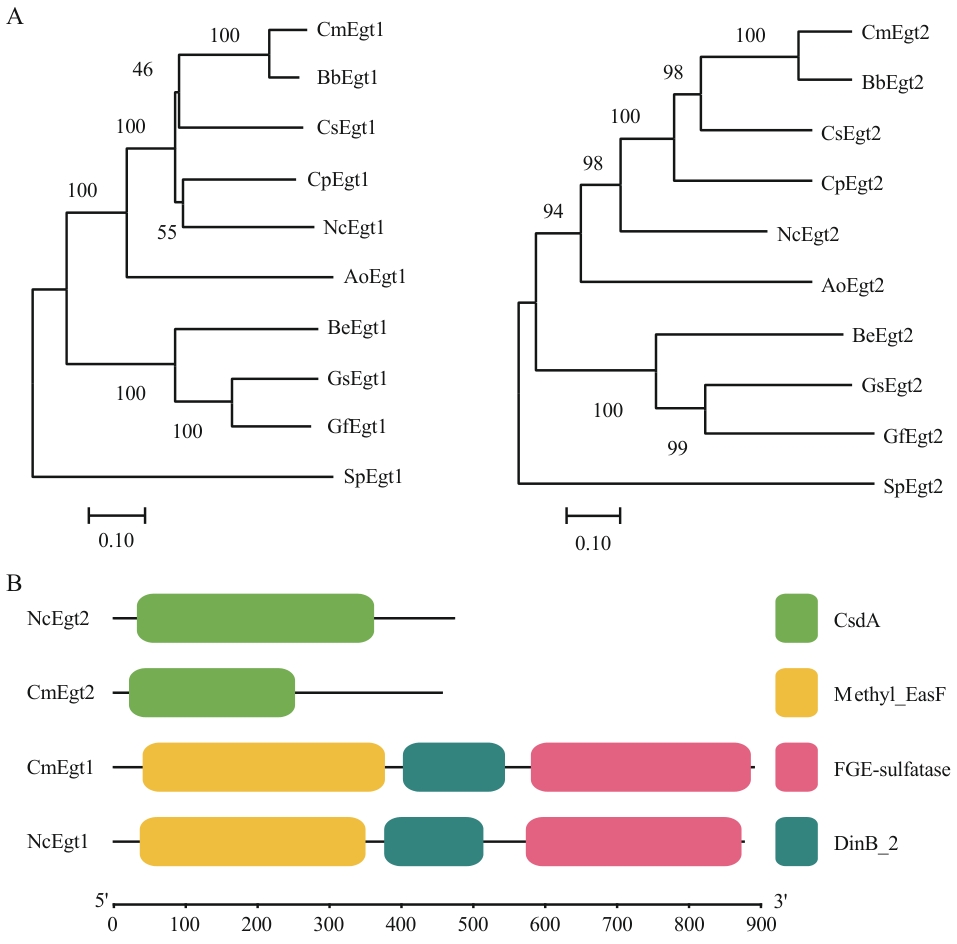
图2 不同物种Egt1和Egt2的系统发育树(A)及结构域(B)分析A:蛹虫草、白僵菌、冬虫夏草、麦角菌、粗糙脉孢菌、米曲霉、美味牛肝菌、灵芝、灰树花和裂殖酵母的Egt1和Egt2系统进化树分析;B:蛹虫草和粗糙脉孢菌的Egt1和Egt2主要蛋白质结构域
Fig. 2 Phylogenetic tree (A) and domains (B) analysis of Egt1 and Egt2 in different speciesA: Phylogenetic tree analysis of Egt1 and Egt2 in Cordyceps militaris, Beauveria bassiana, Cordyceps sinensis, Claviceps purpurea, Neurospora crassa, Aspergillus oryzae, Boletus edulis, Ganoderma sinense, Grifola frondosa and Schizosaccharomyces pombe. B: The main protein domains of Egt1 and Egt2 in C. militaris and N. crassa
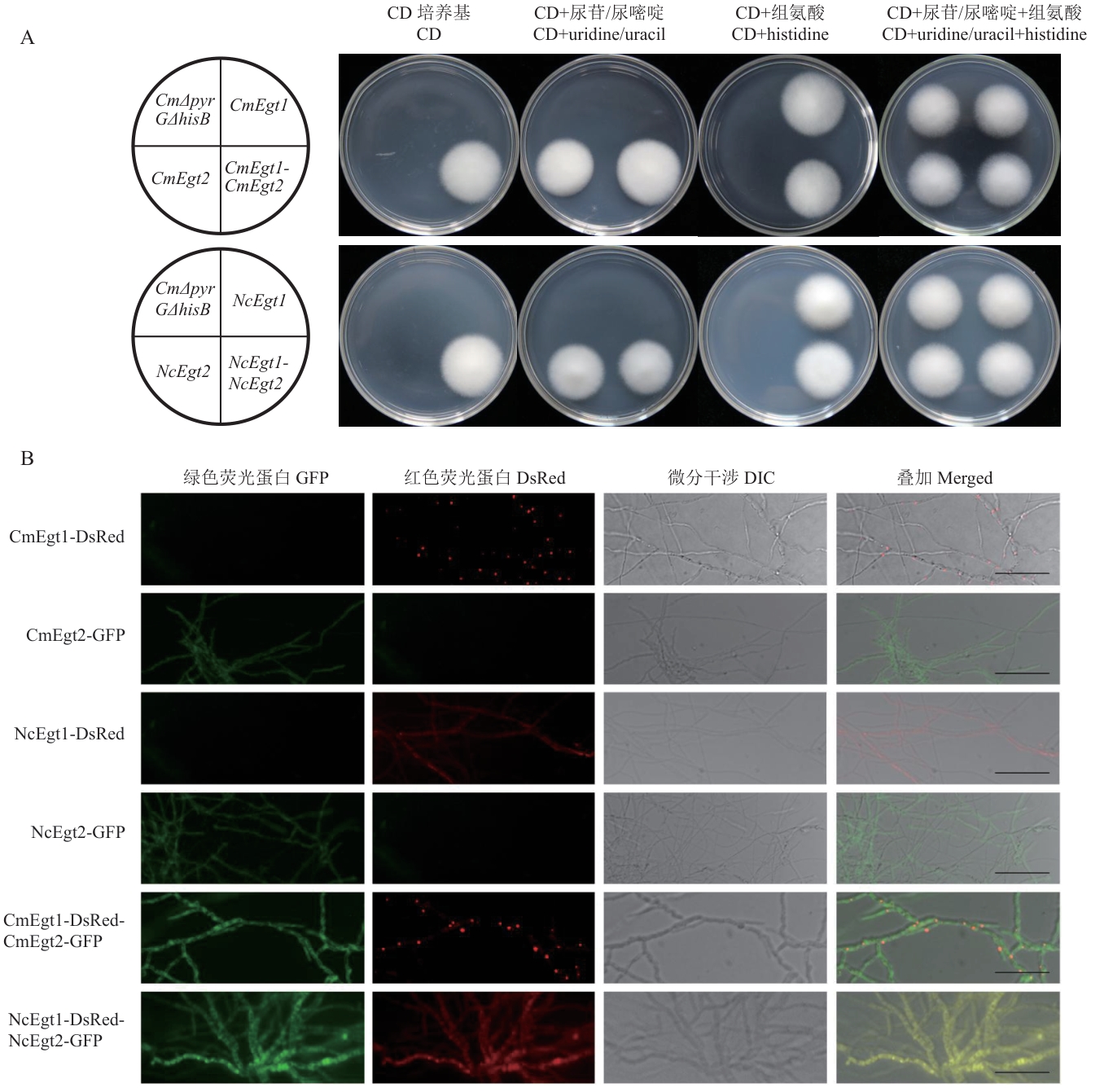
图3 蛹虫草过表达菌株的表型及荧光观察A:将蛹虫草双营养缺陷型菌株CmΔpyrGΔhisB、蛹虫草转化子CmEgt1/CmΔpyrGΔhisB、CmEgt2/CmΔpyrGΔhisB、CmEgt1-CmEgt2/CmΔpyrGΔhisB、NcEgt1/CmΔpyrGΔhisB、NcEgt2/CmΔpyrGΔhisB和NcEgt1-NcEgt2/CmΔpyrGΔhisB在CD、CD+Uri/Ura、CD+His和CD+Uri/Ura+His四种培养基上22 ℃培养7 d的表型;B:从上到下依次是用20倍物镜观察蛹虫草过表达菌株CmEgt1/CmΔpyrGΔhisB、CmEgt2/CmΔpyrGΔhisB、NcEgt1/CmΔpyrGΔhisB、NcEgt2/CmΔpyrGΔhisB、CmEgt1-CmEgt2/CmΔpyrGΔhisB、NcEgt1-NcEgt2/CmΔpyrGΔhisB的荧光图,从左到右分别为GFP荧光、DsRed荧光、微分干涉(DIC),以及DIC、DsRed和GFP合并图像,比例尺=50 μm
Fig. 3 Phenotypic and fluorescence observation of overexpressed strains of C. militarisA: Dual auxotrophic strain CmΔpyrGΔhisB, transformants CmEgt1/CmΔpyrGΔhisB, CmEgt2/CmΔpyrGΔhisB, CmEgt1-CmEgt2/CmΔpyrGΔhisB, NcEgt1/CmΔpyrGΔhisB, NcEgt2/CmΔpyrGΔhisB, and NcEgt1-NcEgt2/CmΔpyrGΔhisB were phenotyped in CD, CD+Uri/Ura, CD+His, and CD+Uri/Ura+His medium at 22 ℃ for 7 d. B: From top to bottom: Fluorescence images of CmEgt1/CmΔpyrGΔhisB, CmEgt2/CmΔpyrGΔhisB, NcEgt1/CmΔpyrGΔhisB, NcEgt2/CmΔpyrGΔhisB, CmEgt1-CmEgt2/CmΔpyrGΔhisB, NcEgt1-NcEgt2/CmΔpyrGΔhisB under 20-fold microscope. Left to right: GFP fluorescence and DsRed fluorescence, differential interference contrast (DIC), merged images of DIC, DsRed, and GFP. Scale bar=50 μm
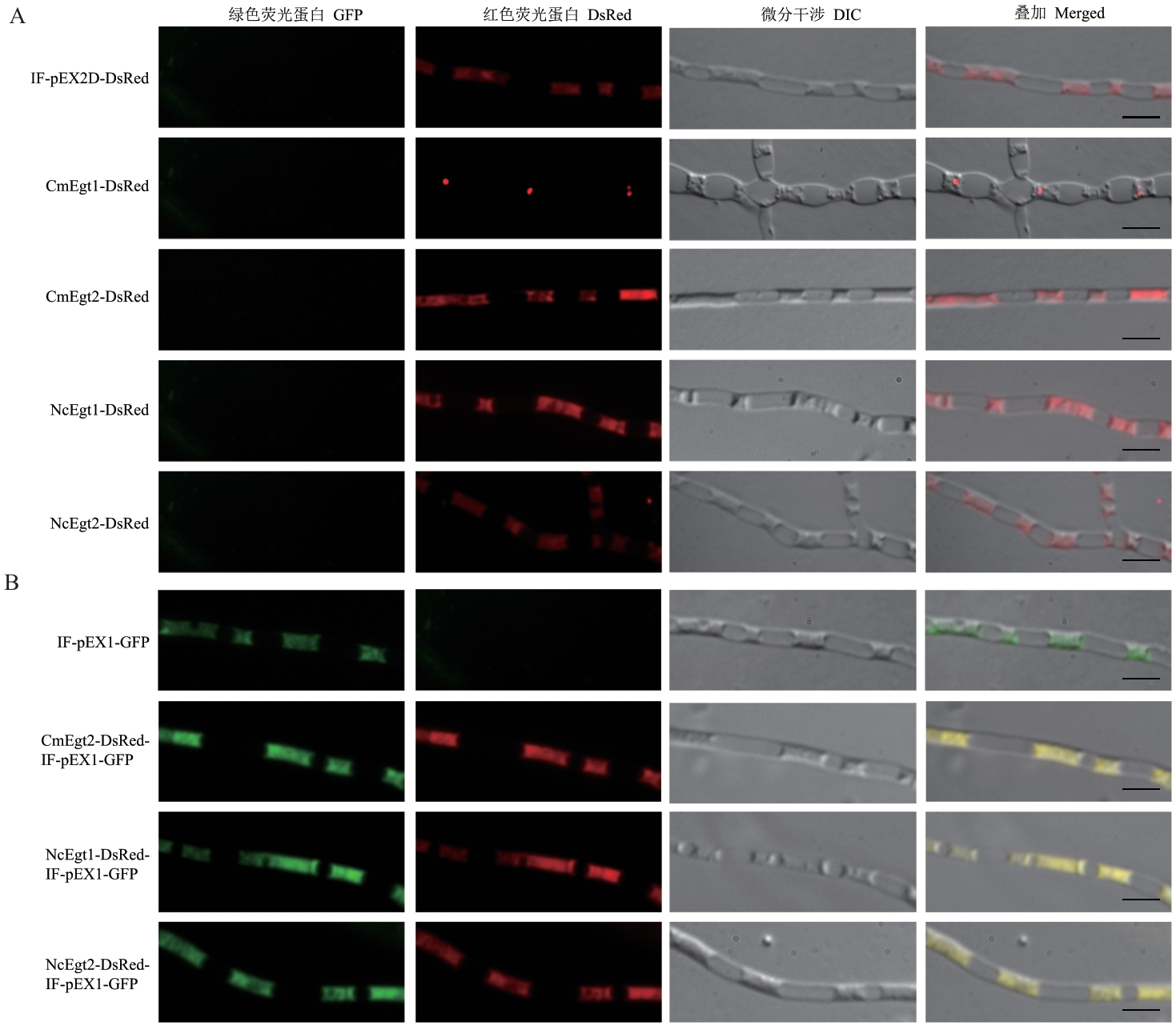
图4 CmEgt2、NcEgt1和NcEgt2在蛹虫草中的亚细胞定位A:转化子荧光观察,从上到下依次是对照菌株IF-pEX2D-DsRed、转化子CmEgt1/CmΔpyrGΔhisB、CmEgt2/CmΔpyrGΔhisB、NcEgt1/CmΔpyrGΔhisB和NcEgt2/CmΔpyrGΔhisB在63倍镜下菌丝体的显微镜观察;B:CmEgt2、NcEgt1和NcEgt2在蛹虫草中的亚细胞定位,从上到下依次是对照菌株IF-pEX1-GFP、转化子CmEgt2/CmΔpyrGΔhisB与IF-pEX1/CmΔpyrGΔhisB共定位,NcEgt1/CmΔpyrGΔhisB与IF-pEX1/CmΔpyrGΔhisB共定位,以及NcEgt2/CmΔpyrGΔhisB与IF-pEX1/CmΔpyrGΔhisB共定位在63倍镜下菌丝体的显微镜观察,从左至右:GFP荧光、DsRed荧光、DIC,以及DIC、DsRed和GFP合并图像,比例尺=10 μm
Fig. 4 Subcellular localization of CmEgt2, NcEgt1 and NcEgt2 in C. militarisA: Fluorescence observation of transformants, from top to bottom: fluorescence microscopy images of mycelia from the control strain IF‑pEX2D‑DsRed and the transformants CmEgt1/CmΔpyrGΔhisB, CmEgt2/CmΔpyrGΔhisB, NcEgt1/CmΔpyrGΔhisB, and NcEgt2/CmΔpyrGΔhisB under 63-fold microscope. B: Subcellular localization of CmEgt2, NcEgt1, and NcEgt2 in C. militaris, from top to bottom: the mycelium of the control strain IF-pEX1-GFP, co‑localization of transformant CmEgt2/CmΔpyrGΔhisB with IF-pEX1/CmΔpyrGΔhisB, co‑localization of transformant NcEgt1/CmΔpyrGΔhisB with IF-pEX1/CmΔpyrGΔhisB, and co‑localization of transformant NcEgt2/CmΔpyrGΔhisB with IF-pEX1/CmΔpyrGΔhisB under 63-fold microscope. Left to right: GFP fluorescence; DsRed fluorescence; DIC; DIC, DsRed, and GFP merged image, scale bar=10 μm
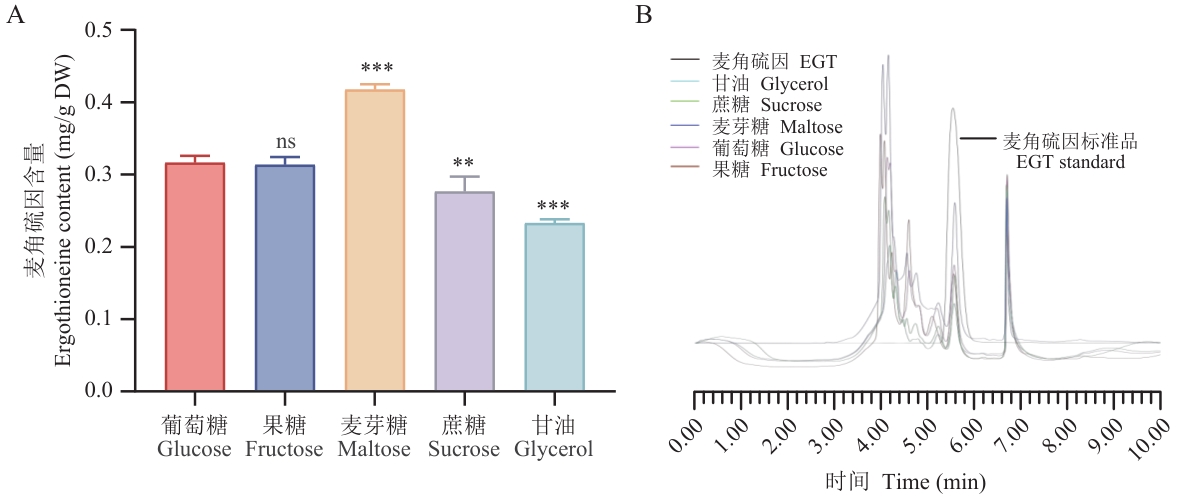
图5 不同碳源对麦角硫因含量的影响A:蛹虫草野生型菌株在不同碳源培养下麦角硫因的产量;B:蛹虫草野生型菌株在不同碳源培养下麦角硫因的液相色谱峰。DW:干重;EGT: 麦角硫因。显著性差异分析采用one-way ANOVA (*P<0.05, ** P<0.01, *** P<0.001),下同
Fig. 5 Effect of different carbon sources on ergothioneine productionA: The ergothioneine production of the wild-type strain of C. militaris in different carbon sources. B: The chromatogram peaks of ergothioneine in the wild-type strain of C. militaris. DW: Dry weight; EGT: ergothioneine. Statistical analyses were performed using one-way ANOVA (*P<0.05, ** P<0.01, *** P<0.001). The same below
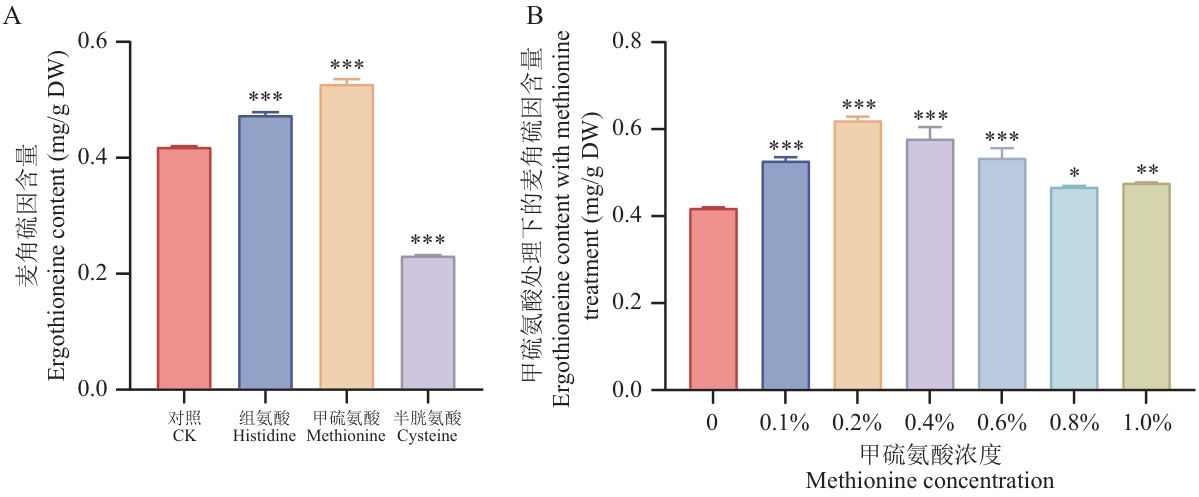
图6 不同前体对麦角硫因含量的影响A:蛹虫草野生型菌株在DPY培养基(CK),以及分别添加0.1%的组氨酸、甲硫氨酸、半胱氨酸的麦角硫因含量;B:不同浓度甲硫氨酸处理下麦角硫因的含量
Fig. 6 Effects of different precursors on ergothioneine contentA: Ergothioneine contents of the wild-type strain of C. militaris in DPY medium (CK) and with 0.1% histidine, methionine, and cysteine in the medium, respectively. B: Ergothioneine content under different concentrations of methionine treatment
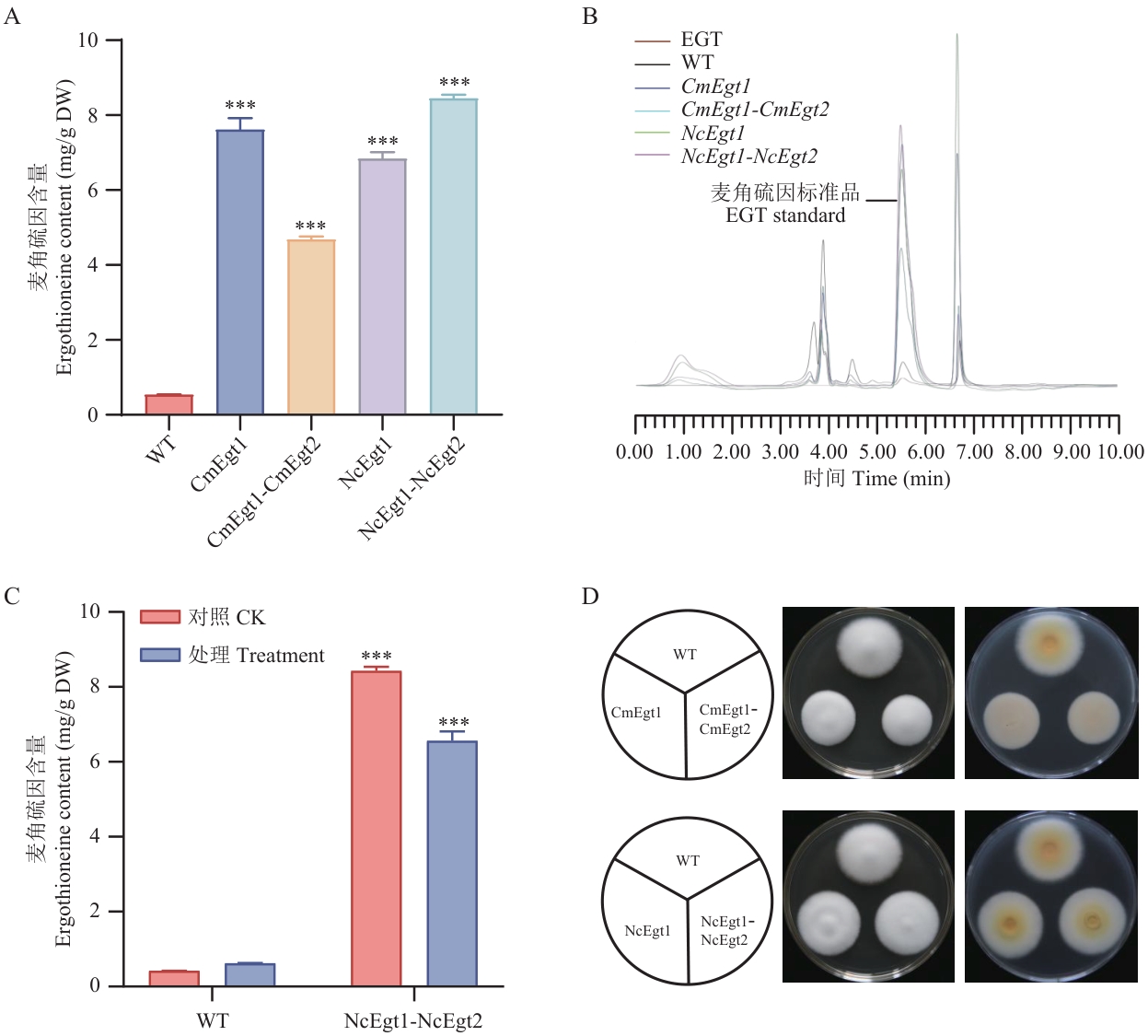
图7 蛹虫草过表达菌株麦角硫因含量A:蛹虫草野生型和转化子CmEgt1/CmΔpyrGΔhisB、CmEgt1-CmEgt2/CmΔpyrGΔhisB、NcEgt1/CmΔpyrGΔhisB、NcEgt1-NcEgt2/CmΔpyrGΔhisB中麦角硫因含量;B:蛹虫草中麦角硫因的液相色谱峰;C:蛹虫草野生型和转化子NcEgt1-NcEgt2/CmΔpyrGΔhisB在DPY培养基以及添加0.2%甲硫氨酸培养基中的麦角硫因含量;D:蛹虫草CmΔpyrGΔhisB、转化子Cmegt1/CmΔpyrGΔhisB, CmEgt1-CmEgt2/CmΔpyrGΔhisB, Ncegt1/CmΔpyrGΔhisB和NcEgt1-NcEgt2/CmΔpyrGΔhisB在22 ℃使用DPY+Uri/Ura+His培养7 d的表型
Fig. 7 Ergothioneine content of overexpressed strains in C. militarisA: Ergothioneine content in the wild-type and transformants CmEgt1/CmΔpyrGΔhisB, CmEgt1-CmEgt2/CmΔpyrGΔhisB, NcEgt1/CmΔpyrGΔhisB and NcEgt1-NcEgt2/CmΔpyrGΔhisB. B: Chromatogram peaks of ergothioneine in C. militaris. C: Ergothioneine content of the wild-type and transformants NcEgt1-NcEgt2/CmΔpyrGΔhisB in DPY medium and with 0.2% Met in the medium, respectively. D: Phenotypes of CmΔpyrGΔhisB, Cmegt1/CmΔpyrGΔhisB, CmEgt1-CmEgt2/CmΔpyrGΔhisB, Ncegt1/CmΔpyrGΔhisB, NcEgt1-NcEgt2/CmΔpyrGΔhisB cultured on DPY+Uri/Ura + His medium at 22 ℃ for 7 days
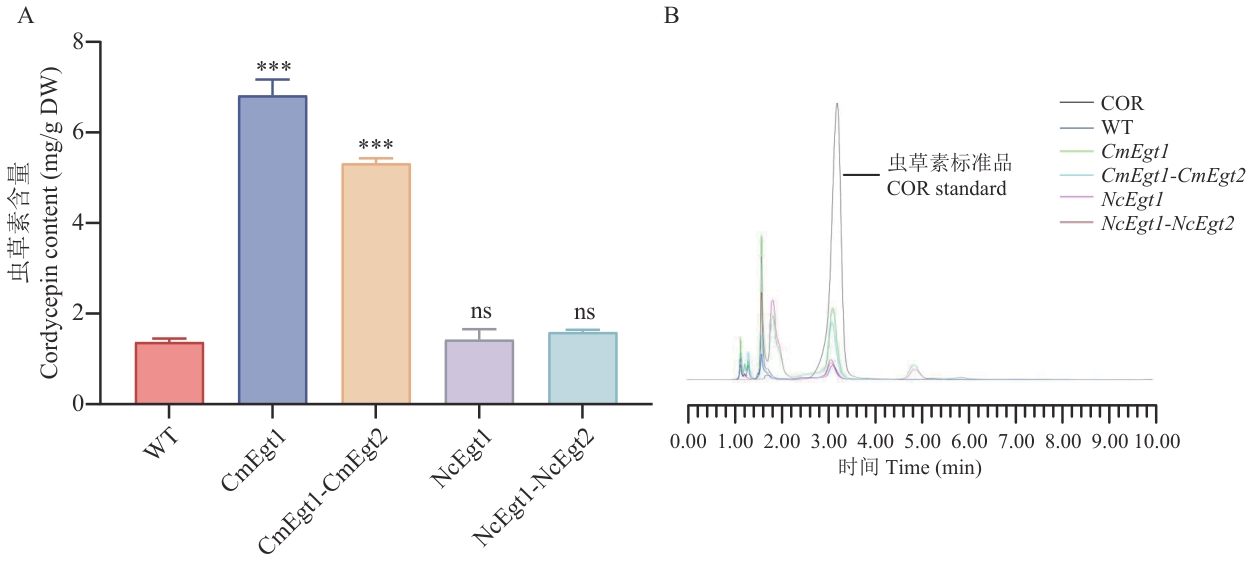
图8 蛹虫草过表达菌株虫草素含量A:蛹虫草野生型和转化子CmEgt1/CmΔpyrGΔhisB、CmEgt1-CmEgt2/CmΔpyrGΔhisB、NcEgt1/CmΔpyrGΔhisB、NcEgt1-NcEgt2/CmΔpyrGΔhisB中虫草素含量;B:蛹虫草中虫草素的液相色谱峰。COR:虫草素
Fig. 8 Cordycepin content of overexpressed strains in C. militarisA: Cordycepin content in the wild-type and transformants CmEgt1/CmΔpyrGΔhisB, CmEgt1-CmEgt2/CmΔpyrGΔhisB, NcEgt1/CmΔpyrGΔhisB, NcEgt1-NcEgt2/CmΔpyrGΔhisB. B: Chromatogram peaks of cordycepin in C. militaris. COR: Cordycepin
| [1] | Pfeiffer C, Bauer T, Surek B, et al. Cyanobacteria produce high levels of ergothioneine [J]. Food Chem, 2011, 129(4): 1766-1769. |
| [2] | Turck D, Bresson JL, Burlingame B, et al. Statement on the safety of synthetic L-ergothioneine as a novel food-supplementary dietary exposure and safety assessment for infants and young children, pregnant and breastfeeding women [J]. EFSA J, 2017, 15(11): e05060. |
| [3] | Liu HM, Tang W, Wang XY, et al. Safe and effective antioxidant: the biological mechanism and potential pathways of ergothioneine in the skin [J]. Molecules, 2023, 28(4): 1648. |
| [4] | Han YW, Tang XY, Zhang YT, et al. The current status of biotechnological production and the application of a novel antioxidant ergothioneine [J]. Crit Rev Biotechnol, 2021, 41(4): 580-593. |
| [5] | Cheah IK, Halliwell B. Ergothioneine; antioxidant potential, physiological function and role in disease [J]. BBA Mol Basis Dis, 2012, 1822(5): 784-793. |
| [6] | Katsube M, Ishimoto T, Fukushima Y, et al. Ergothioneine promotes longevity and healthy aging in male mice [J]. GeroScience, 2024, 46(4): 3889-3909. |
| [7] | Meng XS, Meng HW, Hou SZ, et al. L-Ergothioneine ameliorates 1-methyl-4-phenyl-1, 2, 3, 6-tetrahydropyridine-induced Parkinson’s disease in C57BL/6J mice by activating DJ-1 [J]. Food Sci Hum Wellness, 2025, 14(3): 9250068. |
| [8] | Cheah IK, Halliwell B. Could ergothioneine aid in the treatment of coronavirus patients? [J]. Antioxidants, 2020, 9(7): 595. |
| [9] | 冯路路, 鄂恒超, 张艳梅, 等. 食用菌中麦角硫因提取分离和检测方法研究进展 [J]. 食用菌学报, 2021, 28(1): 115-123. |
| Feng LL, E HC, Zhang YM, et al. Research progress on extraction, separation and detection of ergothionine in edible fungi [J]. Acta Edulis Fungi, 2021, 28(1): 115-123. | |
| [10] | Li Z, Ding JJ, Huang W, et al. The catalytic mechanism of key enzymes involved in the synthesis of ergothioneine in Lentinula edodes [J]. Molecules, 2024, 29(24): 6005. |
| [11] | Villalobos-Pezos M, Muñoz-Fariña O, Ah-Hen KS, et al. Optimization of phenolic content extraction and effects of drying treatments on physicochemical characteristics and antioxidant properties of edible mushroom Pleurotus ostreatus (Jacq.) P. kumm (oyster mushroom) [J]. Antioxidants, 2024, 13(12): 1581. |
| [12] | Beelman RB, Phillips AT, Richie JP Jr, et al. Health consequences of improving the content of ergothioneine in the food supply [J]. FEBS Lett, 2022, 596(10): 1231-1240. |
| [13] | Bello MH, Barrera-Perez V, Morin D, et al. The Neurospora crassa mutant NcΔEgt-1 identifies an ergothioneine biosynthetic gene and demonstrates that ergothioneine enhances conidial survival and protects against peroxide toxicity during conidial germination [J]. Fungal Genet Biol, 2012, 49(2): 160-172. |
| [14] | Hu W, Song H, Sae Her A, et al. Bioinformatic and biochemical characterizations of C-S bond formation and cleavage enzymes in the fungus Neurospora crassa ergothioneine biosynthetic pathway [J]. Org Lett, 2014, 16(20): 5382-5385. |
| [15] | Seebeck FP. In vitro reconstitution of mycobacterial ergothioneine biosynthesis [J]. J Am Chem Soc, 2010, 132(19): 6632-6633. |
| [16] | Chen BX, Xue LN, Wei T, et al. Enhancement of ergothioneine production by discovering and regulating its metabolic pathway in Cordyceps militaris [J]. Microb Cell Fact, 2022, 21: 169. |
| [17] | Osawa R, Kamide T, Satoh Y, et al. Heterologous and high production of ergothioneine in Escherichia coli [J]. J Agric Food Chem, 2018, 66(5): 1191-1196. |
| [18] | Tanaka N, Kawano Y, Satoh Y, et al. Gram-scale fermentative production of ergothioneine driven by overproduction of cysteine in Escherichia coli [J]. Sci Rep, 2019, 9: 1895. |
| [19] | Chen ZH, He YZ, Wu XY, et al. Toward more efficient ergothioneine production using the fungal ergothioneine biosynthetic pathway [J]. Microb Cell Fact, 2022, 21: 76. |
| [20] | Kamide T, Takusagawa S, Tanaka N, et al. High production of ergothioneine in Escherichia coli using the sulfoxide synthase from Methylobacterium strains [J]. J Agric Food Chem, 2020, 68(23): 6390-6394. |
| [21] | Yu YH, et al. Highly efficient production of ergothioneine from glycerol through gene mining and CRISPR-Cas9 synthetic biology technology in Saccharomyces cerevisiae [J]. ACS Sustainable Chem Eng, 2024, 12(43): 15901-15912. |
| [22] | Takusagawa S, Satoh Y, Ohtsu I, et al. Ergothioneine production with Aspergillus oryzae [J]. Biosci Biotechnol Biochem, 2019, 83(1): 181-184. |
| [23] | Liu K, Xiang GD, Li LK, et al. Engineering non-conventional yeast Rhodotorula toruloides for ergothioneine production [J]. Biotechnol Biofuels, 2024, 17: 65. |
| [24] | Zhu M, Han YW, Hu XC, et al. Ergothioneine production by submerged fermentation of a medicinal mushroom Panus conchatus [J]. Fermentation, 2022, 8(9): 431. |
| [25] | Xia YL, Luo FF, Shang YF, et al. Fungal cordycepin biosynthesis is coupled with the production of the safeguard molecule pentostatin [J]. Cell Chem Biol, 2017, 24(12): 1479-1489.e4. |
| [26] | Zhang YH, Liu MY, Liu SD, et al. Optimization of ultrasonic-microwave synergistic extraction of cordycepin and antioxidant activity from Cordyceps militaris mycelial symbiont [J]. Chem Pap, 2025, 79(5): 3107-3119. |
| [27] | Phull AR, Ahmed M, Park HJ. Cordyceps militaris as a bio functional food source: pharmacological potential, anti-inflammatory actions and related molecular mechanisms [J]. Microorganisms, 2022, 10(2): 405. |
| [28] | Lee SC, Alaali L, Kwon H, et al. Cordycepin (3′-deoxyadenosine) suppresses heat shock protein 90 function and targets tumor growth in an adenosine deaminase-dependent manner [J]. Cancers, 2022, 14(13): 3122. |
| [29] | Chellapandi P, Saranya S. Cordycepin and its nucleoside analogs for the treatment of systemic COVID-19 infection [J]. Coronaviruses, 2022, 3: e221221196360. |
| [30] | 闫欢欢, 尚怡彤, 王丽红, 等. 蛹虫草磷酸甲羟戊酸激酶和焦磷酸甲羟戊酸脱羧酶基因的功能分析 [J]. 微生物学报, 2024, 64(2): 461-472. |
| Yan HH, Shang YT, Wang LH, et al. Functions of genes encoding phosphomevalonate kinase and mevalonate diphosphate decarboxylase in Cordyceps militaris [J]. Acta Microbiol Sin, 2024, 64(2): 461-472. | |
| [31] | Yan HH, Shang YT, Wang LH, et al. Construction of a new Agrobacterium tumefaciens-mediated transformation system based on a dual auxotrophic approach in Cordyceps militaris [J]. J Microbiol Biotechnol, 2024, 34(5): 1178-1187. |
| [32] | Nguyen KT, Ho QN, Pham TH, et al. The construction and use of versatile binary vectors carrying pyrG auxotrophic marker and fluorescent reporter genes for Agrobacterium-mediated transformation of Aspergillus oryzae [J]. World J Microbiol Biotechnol, 2016, 32(12): 204. |
| [33] | 王立, 黄慧, 刘新平, 等. 农杆菌介导的蛹虫草营养缺陷型菌株和遗传转化体系的构建 [J]. 微生物学通报, 2022, 49(8): 3373-3386. |
| Wang L, Huang H, Liu XP, et al. Construction of Agrobacterium-mediated auxotrophic strain and genetic transformation system of Cordyceps militaris [J]. Microbiol China, 2022, 49(8): 3373-3386. | |
| [34] | Sun YL, Niu YL, He B, et al. A dual selection marker transformation system using Agrobacterium tumefaciens for the industrial Aspergillus oryzae 3.042 [J]. J Microbiol Biotechnol, 2019, 29(2): 230-234. |
| [35] | Yamada T, Iwasawa T, Tsuchiya R, et al. Ergothioneine attenuates oxaliplatin-induced peripheral neuropathy without compromising antitumor efficacy [J]. Int J Mol Sci, 2025, 26(21): 10263. |
| [36] | Naowarojna N, Irani S, Hu WY, et al. Crystal structure of the ergothioneine sulfoxide synthase from Candidatus chloracidobacterium thermophilum and structure-guided engineering to modulate its substrate selectivity [J]. ACS Catal, 2019, 9(8): 6955-6961. |
| [37] | 李鸿宇, 霍春红, 李倩, 等. 谷胱甘肽促进液体发酵体系中蛹虫草合成虫草素 [J]. 菌物学报, 2021(6): 1498-1510. |
| Li HY, Huo CH, Li Q, et al. Enhancement of cordycepin biosynthesis by glutathione supplementation during liquid fermentation of Cordyceps militaris [J]. Mycosystema, 2021(6): 1498-1510. |
| [1] | 张驰昊, 刘晋囡, 董家乐, 晁跃辉. 紫花苜蓿酵母表达文库的构建及候选耐盐基因的筛选与鉴定[J]. 生物技术通报, 2026, 42(2): 239-249. |
| [2] | 张驰昊, 刘晋囡, 晁跃辉. 蒺藜苜蓿bZIP转录因子MtbZIP29的克隆及功能分析[J]. 生物技术通报, 2026, 42(1): 241-250. |
| [3] | 饶峻, 赵晨, 李端华, 廖豪, 黄加雨, 王辂. 自诱导策略在麦角硫因生物合成中的应用[J]. 生物技术通报, 2025, 41(1): 333-346. |
| [4] | 沈真辉, 曹瑶, 杨林雷, 罗祥英, 子灵山, 陆青青, 李荣春. 金耳和毛韧革菌麦角硫因生物合成基因的克隆及生物信息学分析[J]. 生物技术通报, 2024, 40(7): 259-272. |
| [5] | 闫欢欢, 尚怡彤, 王丽红, 田学琴, 廖海艳, 曾斌, 胡志宏. 米曲霉异源表达合成虫草素[J]. 生物技术通报, 2024, 40(6): 290-298. |
| [6] | 熊心怡, 刘利平, 冯杰, 张劲松, 李德顺, 刘朋, 刘艳芳. 蛹虫草提取物对高尿酸血症大鼠的降尿酸作用及机制[J]. 生物技术通报, 2024, 40(11): 34-46. |
| [7] | 李亮, 徐姗姗, 姜艳军. 生物合成法生产麦角硫因的研究进展[J]. 生物技术通报, 2024, 40(1): 86-99. |
| [8] | 高苏, 马婕馨, 刘警鞠, 赵国柱. 虫草素的抑菌活性及机理研究[J]. 生物技术通报, 2021, 37(4): 137-144. |
| [9] | 郭玉峰, 汪乔, 王祥锋, 周婷, 杨晓君, 王庆佶, 王丽. 泰山野生蛹虫草优良菌株的筛选[J]. 生物技术通报, 2021, 37(11): 125-133. |
| [10] | 黄海辰, 吴文雅, 戚梦, 薛帆正, 吴小平, 张君丽, 傅俊生. 虫草素抗三阴性乳腺癌的转录组学分析[J]. 生物技术通报, 2021, 37(11): 72-80. |
| [11] | 王佩, 刘文, 沈祥陵. CRISPR/Cas9系统在丝状真菌中的研究进展[J]. 生物技术通报, 2018, 34(4): 1-8. |
| [12] | 刘建兵, 戚梦, 杜苑如, 傅俊生, 胡开辉. 拆分网络分析22株蛹虫草亲缘关系及高产虫草素菌株初筛[J]. 生物技术通报, 2018, 34(4): 133-138. |
| [13] | 侯若琳, 刘鑫, 项凯凯, 陈磊, 郑明锋, 傅俊生. 响应面法优化蛹虫草蛋白超声波辅助提取工艺及其营养评价[J]. 生物技术通报, 2018, 34(11): 198-204. |
| [14] | 马燕, 余晓斌. 丝状真菌生物富集重金属废水的研究进展[J]. 生物技术通报, 2017, 33(10): 59-63. |
| [15] | 林艳梅, 李瑞杰, 张慧杰, 秦秀林, 冯家勋. 纤维素酶高产菌株Trichoderma atroviride HP35-3原生质体制备及转化[J]. 生物技术通报, 2016, 32(9): 225-231. |
| 阅读次数 | ||||||
|
全文 |
|
|||||
|
摘要 |
|
|||||
