







• 综述与专论 • 下一篇
黄效贤1, 何轶洋1, 刘梦月1, 石佳1, 李文阳1, 任兰天1,2, 王冠军3, 王东1( ), 郑甲成1,2()
收稿日期:2026-01-21
出版日期:2026-08-21
通讯作者:
王东wangd@nwafu.edu.cn基金资助:
HUANG Xiao-xian1, HE Yi-yang1, LIU Meng-yue1, SHI Jia1, LI Wen-yang1, REN Lan-tian1,2, WANG Guan-jun3, WANG Dong1(), ZHENG Jia-cheng1,2()
Received:2026-01-21
Published:2026-08-21
摘要:
小麦遗传转化长期受限于显著的基因型依赖性,愈伤组织再生效率偏低,核心瓶颈在于受体细胞全能性重获机制及基因重编程的分子调控机制尚未完全明确。本文聚焦小麦遗传转化领域核心科学问题,系统阐述当前主流转化技术的特征与应用局限,通过对比小麦幼胚与成熟胚转化体系差异,明确两类体系的优势与短板,剖析限制转化的分子屏障及潜在突破路径。在此基础上,分析农杆菌菌株类型、受体材料生长状态,以及筛选标记与启动子元件等关键因子对农杆菌介导小麦转化效率的调控效应,同时围绕小麦愈伤组织分化再生过程,从激素信号转导调控、形态建成关键基因功能解析、细胞壁结构重塑机制及染色质可及性调控等维度,系统阐明遗传转化中植株再生的分子调控网络。基于上述分析,最后提出挖掘并利用具有广谱调控效应的再生关键因子、精细优化组织培养与转化体系参数以及开发不依赖组织培养的新型转化技术,是突破小麦遗传转化基因型限制与提升转化效率的核心策略。本文旨在为构建“基因型非依赖性”小麦通用转化平台提供理论支撑,助推小麦分子育种技术的规模化与精准化应用。
黄效贤, 何轶洋, 刘梦月, 石佳, 李文阳, 任兰天, 王冠军, 王东, 郑甲成. 小麦幼胚与成熟胚遗传转化体系研究进展[J]. 生物技术通报, doi: 10.13560/j.cnki.biotech.bull.1985.2026-0095.
HUANG Xiao-xian, HE Yi-yang, LIU Meng-yue, SHI Jia, LI Wen-yang, REN Lan-tian, WANG Guan-jun, WANG Dong, ZHENG Jia-cheng. Progress in Genetic Transformation Systems Using Immature versus Mature Embryos in Bread Wheat[J]. Biotechnology Bulletin, doi: 10.13560/j.cnki.biotech.bull.1985.2026-0095.
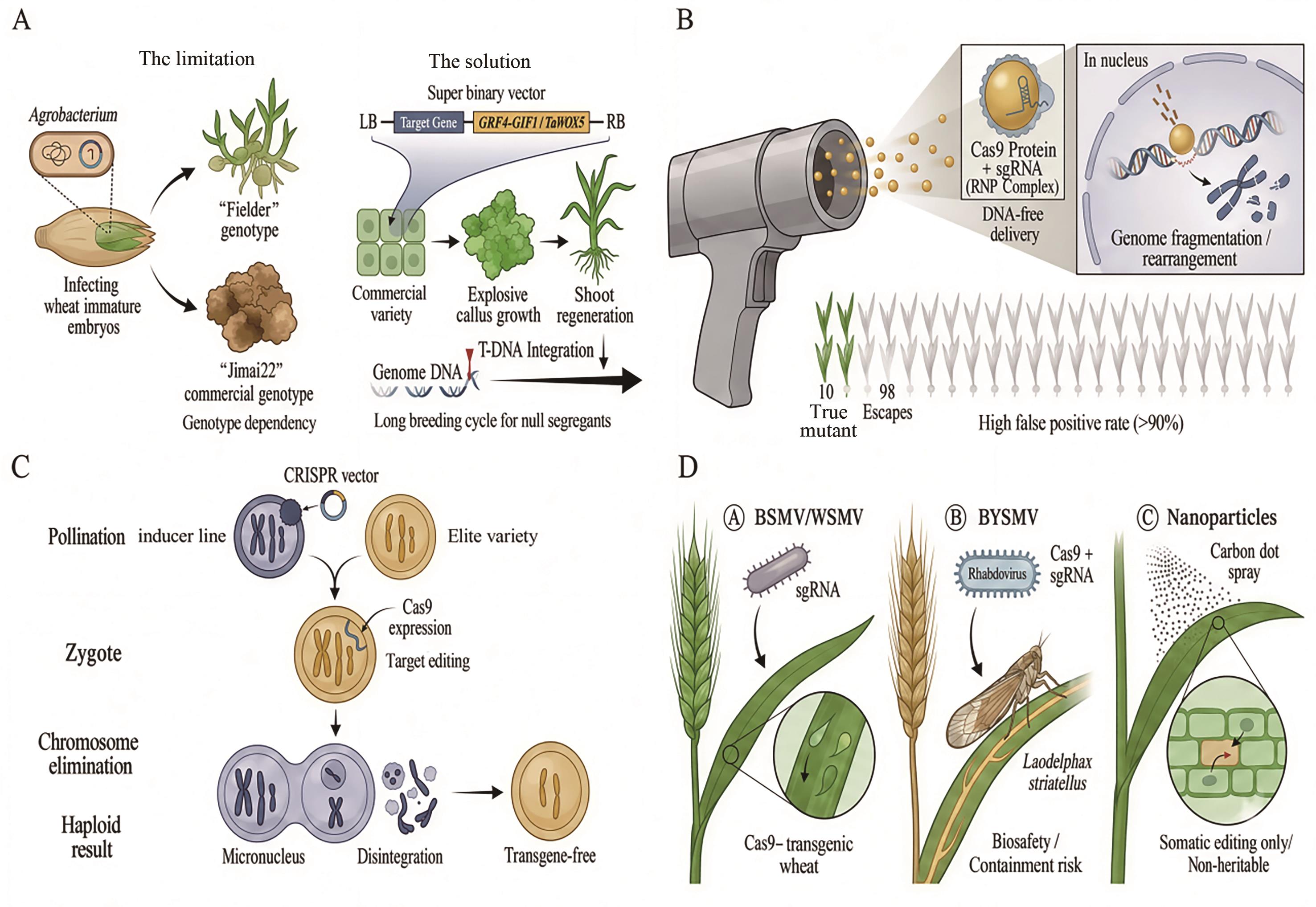
图1 小麦遗传转化主流递送系统的演进与比较分析A:农杆菌介导法。共转GRF4-GIF1、TaWOX5等形态发生基因可克服小麦转化的基因型依赖性;B:基因枪介导法。递送RNP复合物可实现无外源DNA的编辑,但假阳性率高;C:HI-Edit单倍体诱导法。携带基因编辑元件的诱导系与目标品种杂交,完成编辑,获得无转基因成分的编辑单倍体;D:病毒与纳米载体递送。病毒载体受限于装载量,存在生物安全逃逸风险,纳米颗粒递送难以获得稳定后代
Fig. 1 Evolution and comparative analysis of mainstream delivery systems for wheat genetic transformationA: Agrobacterium-mediated transformation, co-transformation of morphogenic genes could overcome genotype dependence in wheat transformation, such as GRF4-GIF1 and TaWOX5. B: Particle bombardment transformation, delivery of RNP complexes enables DNA-free genome editing, but suffers from a high false-positive rate. C: HI-Edit haploid induction. An inducer line, carrying gene-editing elements, is crossed with a target variety, to accomplish editing and obtain edited haploids free of transgenic components. D: Viral and nanocarrier-mediated delivery. Viral vectors are limited by cargo capacity and pose a biosafety risk of escape, nanoparticle-mediated delivery struggles to achieve stable progeny
比较维度 Comparison dimension | 幼胚转化 Immature embryo transformation | 成熟胚转化 Mature embryo transformation |
|---|---|---|
| 取材便利性 | 受季节、发育期(花后12-15 d)严格限制,需田间或温室种植 | 干种子全年可用,易储存,来源极其广泛,无需特殊种植管理 |
| 生理状态 | 代谢旺盛,分化程度低,细胞全能性高 | 处于休眠状态,高度分化,需打破休眠并逆转分化状态 |
| 再生潜力 | 易诱导产生致密的胚性愈伤组织,分化率高 | 传统路径诱导愈伤困难,多为非胚性,新型直接器官发生率可达5%-10%以上 |
| 转化效率 | 模式品种可达40%-70%,最新优化可达66.8%[ | 传统方法低于2%,直接器官发生路径有望新突破[ |
| 基因型依赖性 | 仅少数模式品种转化高效 | 新型物理处理和直接再生方法可有效缓解基因型限制 |
| 主要应用场景 | 基因功能验证、高通量功能基因组学研究 | 规模化、工厂化转基因育种,商业化品种直接改良 |
| 最新技术进展 | 形态基因辅助,如BBM/WUS2、TaLAX1等 | 离心辅助直接器官发生[ |
表1 幼胚与成熟胚转化体系比较
Table 1 Comparison of transformation systems between immature embryos and mature embryos
比较维度 Comparison dimension | 幼胚转化 Immature embryo transformation | 成熟胚转化 Mature embryo transformation |
|---|---|---|
| 取材便利性 | 受季节、发育期(花后12-15 d)严格限制,需田间或温室种植 | 干种子全年可用,易储存,来源极其广泛,无需特殊种植管理 |
| 生理状态 | 代谢旺盛,分化程度低,细胞全能性高 | 处于休眠状态,高度分化,需打破休眠并逆转分化状态 |
| 再生潜力 | 易诱导产生致密的胚性愈伤组织,分化率高 | 传统路径诱导愈伤困难,多为非胚性,新型直接器官发生率可达5%-10%以上 |
| 转化效率 | 模式品种可达40%-70%,最新优化可达66.8%[ | 传统方法低于2%,直接器官发生路径有望新突破[ |
| 基因型依赖性 | 仅少数模式品种转化高效 | 新型物理处理和直接再生方法可有效缓解基因型限制 |
| 主要应用场景 | 基因功能验证、高通量功能基因组学研究 | 规模化、工厂化转基因育种,商业化品种直接改良 |
| 最新技术进展 | 形态基因辅助,如BBM/WUS2、TaLAX1等 | 离心辅助直接器官发生[ |
关键因素 Key factors | 作用机制 Mechanism of action | 优化建议 Optimization strategies | 代表性研究成效 Representative research outcomes |
|---|---|---|---|
| 农杆菌菌株 | 决定T-DNA转移效率及Vir基因诱导能力 | 首选菌株C58C1,其次为EHA105,并优化菌液密度 | 菌株C58C1的GFP瞬时表达率达12%,显著优于GV3101 |
| 愈伤生理状态 | 影响T-DNA整合及细胞再生能力 | 诱导时间3周左右,继代次数小于2次 | 避免胚性退化,保证基因整合发生在细胞分裂期 |
| 预处理措施 | 破坏细胞壁屏障,抑制防御反应 | 辅助离心、真空渗透、热激等方法,并添加甘露醇及抗氧化剂防止褐化 | 显著提高侵染率,将褐化率降至10% |
| 筛选标记系统 | 区分转化与非转化细胞组织 | Bar优于HPT,因后者毒性过大易致细胞死亡 | Bar筛选再生率达43%,而HPT筛选仅20% |
表2 农杆菌介导转化的关键影响因素及优化
Table 2 Key influencing factors and optimization of Agrobacterium-mediated transformation
关键因素 Key factors | 作用机制 Mechanism of action | 优化建议 Optimization strategies | 代表性研究成效 Representative research outcomes |
|---|---|---|---|
| 农杆菌菌株 | 决定T-DNA转移效率及Vir基因诱导能力 | 首选菌株C58C1,其次为EHA105,并优化菌液密度 | 菌株C58C1的GFP瞬时表达率达12%,显著优于GV3101 |
| 愈伤生理状态 | 影响T-DNA整合及细胞再生能力 | 诱导时间3周左右,继代次数小于2次 | 避免胚性退化,保证基因整合发生在细胞分裂期 |
| 预处理措施 | 破坏细胞壁屏障,抑制防御反应 | 辅助离心、真空渗透、热激等方法,并添加甘露醇及抗氧化剂防止褐化 | 显著提高侵染率,将褐化率降至10% |
| 筛选标记系统 | 区分转化与非转化细胞组织 | Bar优于HPT,因后者毒性过大易致细胞死亡 | Bar筛选再生率达43%,而HPT筛选仅20% |
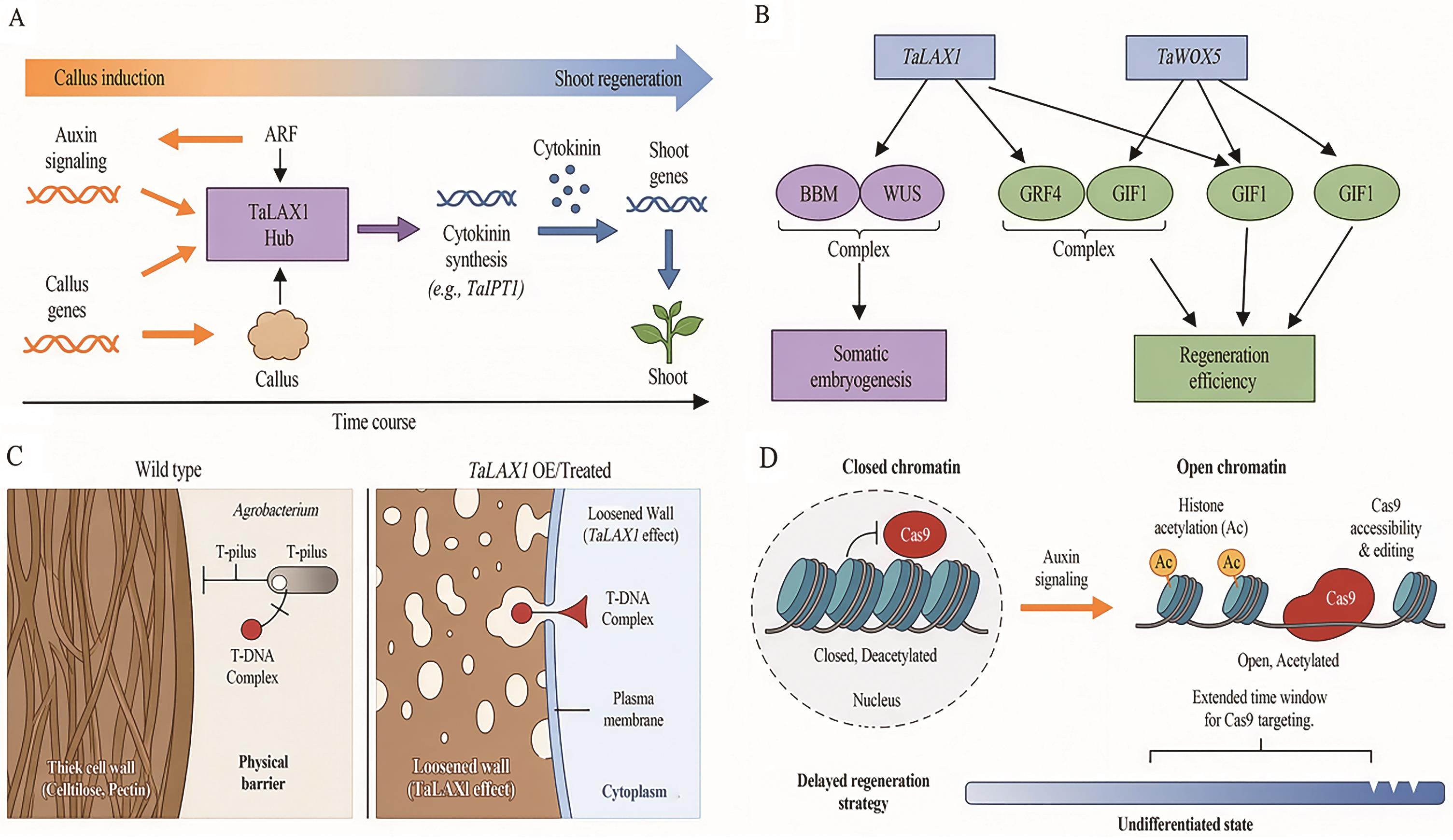
图2 调控小麦体细胞再生与转化效率的多维分子框架A:激素平衡与TaLAX1基因,TaLAX1响应上游生长素信号并激活细胞分裂素合成基因TaIPT1,从而促进芽再生;B:基因调控网络,TaLAX1和TaWOX5因子激活BBM-WUS模块以促进体细胞胚发生,同时激活GRF4-GIF1模块以提升器官发生效率;C:细胞壁重塑,过表达TaLAX1基因或经化学处理可使细胞壁疏松化,增加T-DNA的穿透率;D:染色质重塑,生长素促进组蛋白乙酰化使染色质保持开放状态,增加Cas9对靶点的可及性
Fig. 2 Multidimensional molecular framework regulating somatic cell regeneration and transformation efficiency of wheatA: Hormone balance and TaLAX1 gene. TaLAX1 responds to upstream auxin signaling and activates the cytokinin biosynthesis gene TaIPT1, thereby promoting shoot regeneration. B: Gene regulatory network. TaLAX1 and TaWOX5 factors activate the BBM-WUS module to promote somatic embryogenesis, while simultaneously activating the GRF4-GIF1 module to enhance organogenesis efficiency. C: Cell wall remodeling. Overexpression of the TaLAX1 gene or chemical treatment loosens the cell wall, increasing the penetration efficiency of T-DNA. D: Chromatin remodeling. Auxin promotes histone acetylation to maintain an open chromatin state, increasing the accessibility of Cas9 to its target sites
| [1] | Bukhari SA, Mustafa G, Bashir S, et al. Genetic transformation of Sr22 gene in a high yielding susceptible cultivar of commercial wheat (Triticum aestivum L.) [J]. 3 Biotech, 2020, 10(5): 197. |
| [2] | Shah MM, Khalid Q, Khan UW, et al. Variation in genotypic responses and biochemical analysis of callus induction in cultivated wheat [J]. Genet Mol Res, 2009, 8(3): 783-793. |
| [3] | Vasil V, Castillo AM, Fromm ME, et al. Herbicide resistant fertile transgenic wheat plants obtained by microprojectile bombardment of regenerable embryogenic callus [J]. Nat Biotechnol, 1992, 10(6): 667-674. |
| [4] | Zhou H, Arrowsmith JW, Fromm ME, et al. Glyphosate-tolerant CP4 and GOX genes as a selectable marker in wheat transformation [J]. Plant Cell Rep, 1995, 15(3/4): 159-163. |
| [5] | Jordan MC. Green fluorescent protein as a visual marker for wheat transformation [J]. Plant Cell Rep, 2000, 19(11): 1069-1075. |
| [6] | Sparks CA, Doherty A. Genetic transformation of common wheat (Triticum aestivum L.) using biolistics [M]//Rustgi S, Luo H. Biolistic DNA Delivery in Plants: Methods and Protocols. New York, NY: Springer US, 2020: 229-250. |
| [7] | Hiei Y, Ishida Y, Komari T. Progress of cereal transformation technology mediated by Agrobacterium tumefaciens [J]. Front Plant Sci, 2014, 5: 628. |
| [8] | Cheng M, Fry JE, Pang S, et al. Genetic transformation of wheat mediated by Agrobacterium tumefaciens [J]. Plant Physiol, 1997, 115(3): 971-980. |
| [9] | Ishida Y, Tsunashima M, Hiei Y, et al. Wheat (Triticum aestivum L.) transformation using immature embryos [M]//Wang K. Agrobacterium Protocols: Volume 1. New York, NY: Springer New York, 2015: 189-198. |
| [10] | Wang K, Liu HY, Du LP, et al. Generation of marker-free transgenic hexaploid wheat via an Agrobacterium-mediated co-transformation strategy in commercial Chinese wheat varieties [J]. Plant Biotechnol J, 2017, 15(5): 614-623. |
| [11] | Zhang ZZ, Hua L, Gupta A, et al. Development of an Agrobacterium-delivered CRISPR/Cas9 system for wheat genome editing [J]. Plant Biotechnol J, 2019, 17(8): 1623-1635. |
| [12] | Debernardi JM, Tricoli DM, Ercoli MF, et al. A GRF-GIF chimeric protein improves the regeneration efficiency of transgenic plants [J]. Nat Biotechnol, 2020, 38(11): 1274-1279. |
| [13] | Wang K, Shi L, Liang XN, et al. The gene TaWOX5 overcomes genotype dependency in wheat genetic transformation [J]. Nat Plants, 2022, 8(2): 110-117. |
| [14] | Zhang K, Liu JX, Zhang Y, et al. Biolistic genetic transformation of a wide range of Chinese elite wheat (Triticum aestivum L.) varieties [J]. J Genet Genom, 2015, 42(1): 39-42. |
| [15] | Zhang Y, Liang Z, Zong Y, et al. Efficient and transgene-free genome editing in wheat through transient expression of CRISPR/Cas9 DNA or RNA [J]. Nat Commun, 2016, 7: 12617. |
| [16] | Liang Z, Chen KL, Li TD, et al. Efficient DNA-free genome editing of bread wheat using CRISPR/Cas9 ribonucleoprotein complexes [J]. Nat Commun, 2017, 8: 14261. |
| [17] | Kelliher T, Starr D, Su XJ, et al. One-step genome editing of elite crop germplasm during haploid induction [J]. Nat Biotechnol, 2019, 37(3): 287-292. |
| [18] | Liu CX, Zhong Y, Qi XL, et al. Extension of the in vivo haploid induction system from diploid maize to hexaploid wheat [J]. Plant Biotechnol J, 2020, 18(2): 316-318. |
| [19] | Li TD, Hu JC, Sun Y, et al. Highly efficient heritable genome editing in wheat using an RNA virus and bypassing tissue culture [J]. Mol Plant, 2021, 14(11): 1787-1798. |
| [20] | Wang W, Yu ZT, He F, et al. Multiplexed promoter and gene editing in wheat using a virus-based guide RNA delivery system [J]. Plant Biotechnol J, 2022, 20(12): 2332-2341. |
| [21] | Qiao JH, Zang Y, Gao Q, et al. Transgene- and tissue culture-free heritable genome editing using RNA virus-based delivery in wheat [J]. Nat Plants, 2025, 11(7): 1252-1259. |
| [22] | She LW, Cheng XJ, Jiang P, et al. Modified carbon dot-mediated transient transformation for genomic and epigenomic studies in wheat [J]. Plant Biotechnol J, 2025, 23(4): 1139-1152. |
| [23] | Shimada T. Plant regeneration from the callus induced from wheat embryo [J]. Jpn J Genet, 1978, 53(5): 371-374. |
| [24] | Tao LL, Yin GX, Du LP, et al. Improvement of plant regeneration from immature embryos of wheat infected by Agrobacterium tumefaciens [J]. Agric Sci China, 2011, 10(3): 317-326. |
| [25] | 刘录祥, 郑企成, 赵林姝, 等. 小麦遗传转化无基因型障碍受体系统的研究 [J]. 核农学报, 2001, 15(5): 308-311. |
| Liu LX, Zheng QC, Zhao LS, et al. Study on receptor system for wheat genetic transformation without genotype dependence [J]. J Nucl Agric Sci, 2001, 15(5): 308-311. | |
| [26] | 王宇宏, 张彬, 王玉国. 小麦幼胚离体培养再生体系的建立 [J]. 山西农业科学, 2016, 44(7): 900-906. |
| Wang YH, Zhang B, Wang YG. Establishment of regeneration system of wheat immature embryos culture in vitro [J]. J Shanxi Agric Sci, 2016, 44(7): 900-906. | |
| [27] | Tek MI, Budak Tek K, Sarikaya P, et al. Choosing the best route: Comparative optimization of wheat transformation methods for improving yield by targeting TaARE1-D with CRISPR/Cas9 [J]. PLoS One, 2026, 21(2): e0342491. |
| [28] | 崔明珠, 李云玲, 田保明, 等. 小麦幼胚生长点转化的研究初报 [J]. 分子植物育种, 2015, 13(4): 781-786. |
| Cui MZ, Li YL, Tian BM, et al. Transformation of apical meristem derived from immature embryos in wheat [J]. Mol Plant Breed, 2015, 13(4): 781-786. | |
| [29] | 于惠敏, 夏光敏, 侯丙凯. 提高农杆菌介导小麦遗传转化效率的几个因素 [J]. 山东大学学报: 理学版, 2005, 40(6): 120-124. |
| Yu HM, Xia GM, Hou BK. Factors improving the efficiency of wheat transformation mediated by Agrobacterium tumefaciens [J]. J Shandong Univ Nat Sci, 2005, 40(6): 120-124. | |
| [30] | 张磊, 李国领, 张建周, 等. 农杆菌介导小麦遗传转化方法的优化与应用 [J]. 河南农业大学学报, 2017, 51(6): 781-785. |
| Zhang L, Li GL, Zhang JZ, et al. Improvement and application of Agrobacterium mediated genetic transformation of wheat [J]. J Henan Agric Univ, 2017, 51(6): 781-785. | |
| [31] | Johnson K, Cao Chu U, Anthony G, et al. Rapid and highly efficient morphogenic gene-mediated hexaploid wheat transformation [J]. Front Plant Sci, 2023, 14: 1151762. |
| [32] | 李朝炜, 刘颖, 王丹娜, 等. 农杆菌介导小麦成熟胚遗传转化的几个影响因素研究 [J]. 江苏农业科学, 2017, 45(12): 45-47. |
| Li CW, Liu Y, Wang DN, et al. Study on several influencing factors of genetic transformation of mature wheat embryos mediated by Agrobacterium tumefaciens [J]. Jiangsu Agric Sci, 2017, 45(12): 45-47. | |
| [33] | Patnaik D, Khurana P. Genetic transformation of Indian bread (T. aestivum) and Pasta (T. durum) wheat by particle bombardment of mature embryo-derived calli [J]. BMC Plant Biol, 2003, 3: 5. |
| [34] | Ye XD, Shrawat A, Moeller L, et al. Agrobacterium-mediated direct transformation of wheat mature embryos through organogenesis [J]. Front Plant Sci, 2023, 14: 1202235. |
| [35] | Delporte F, Mostade O, Jacquemin JM. Plant regeneration through callus initiation from thin mature embryo fragments of wheat [J]. Plant Cell Tissue Organ Cult, 2001, 67(1): 73-80. |
| [36] | Kshirsagar PR, Chavan JJ, Umdale SD, et al. Highly efficient in vitro regeneration, establishment of callus and cell suspension cultures and RAPD analysis of regenerants of Swertia lawii Burkill [J]. Biotechnol Rep, 2015, 6: 79-84. |
| [37] | 张小红, 赵雪晶, 李波, 等. 小麦成熟胚离体培养及植株再生技术优化 [J]. 草业学报, 2013, 22(4): 334-339. |
| Zhang XH, Zhao XJ, Li B, et al. Optimization of a regeneration system for mature embryo culture of wheat [J]. Acta Prataculturae Sin, 2013, 22(4): 334-339. | |
| [38] | 马兰兰, 邓西平, 杨淑慎, 等. 小麦成熟胚愈伤组织的诱导及分化 [J]. 西北农业学报, 2011, 20(8): 62-65. |
| Ma LL, Deng XP, Yang SS, et al. Callus induction and differentiation of mature embryos of wheat [J]. Acta Agric Boreali Occidentalis Sin, 2011, 20(8): 62-65. | |
| [39] | 彭亚博, 田保明, 崔明珠, 等. 农杆菌介导的小麦成熟胚遗传转化影响因素分析 [J]. 麦类作物学报, 2017, 37(4): 458-464. |
| Peng YB, Tian BM, Cui MZ, et al. Factors influencing Agrobacterium mediated transformation in mature embryo of wheat (Triticum aestivum) [J]. J Triticeae Crops, 2017, 37(4): 458-464. | |
| [40] | 高荧. 农杆菌介导小麦幼胚愈伤组织转化体系的建立 [D]. 泰安: 山东农业大学, 2022. |
| Gao Y. Establishment of Agrobacterium-mediated transformation system using wheat immature embryo callus [D]. Taian: Shandong Agricultural University, 2022. | |
| [41] | 温睿婷, 王汉宁, 杨如涛, 等. 降低玉米成熟胚愈伤组织褐化的初步研究 [J]. 分子植物育种, 2010, 8(3): 483-487. |
| Wen RT, Wang HN, Yang RT, et al. Primary study on reducing browning of callus induced from maize embryos [J]. Mol Plant Breed, 2010, 8(3): 483-487. | |
| [42] | Zhou HP, Biest N, Chen G, et al. Agrobacterium-mediated large-scale transformation of wheat (Triticum aestivum L.) using glyphosate selection [J]. Plant Cell Rep, 2003, 21(10): 1010-1019. |
| [43] | Bińka A, Orczyk W, Nadolska-Orczyk A. The Agrobacterium-mediated transformation of common wheat (Triticum aestivum L.) and Triticale (x Triticosecale Wittmack): role of the binary vector system and selection cassettes [J]. J Appl Genetics, 2012, 53(1): 1-8. |
| [44] | Prusty MR, Shatil-Cohen A, Kumar R, et al. Pigments to precision: RUBY aiding genetic transformation and genome editing in wheat and barley [J]. Physiol Mol Biol Plants, 2025, 31(4): 545-554. |
| [45] | Liu QB, Zhang X, Su YH, et al. Genetic mechanisms of cold signaling in wheat (Triticum aestivum L.) [J]. Life, 2022, 12(5): 700. |
| [46] | Long Y, Yang Y, Pan GT, et al. New insights into tissue culture plant-regeneration mechanisms [J]. Front Plant Sci, 2022, 13: 926752. |
| [47] | Ikeuchi M, Sugimoto K, Iwase A. Plant callus: mechanisms of induction and repression [J]. Plant Cell, 2013, 25(9): 3159-3173. |
| [48] | Sugimoto K, Temman H, Kadokura S, et al. To regenerate or not to regenerate: factors that drive plant regeneration [J]. Curr Opin Plant Biol, 2019, 47: 138-150. |
| [49] | 黄晓倩. 生长素IAA家族对小麦遗传转化效率的影响 [D]. 泰安: 山东农业大学, 2025. |
| Huang XQ. Effects of auxin IAA family on genetic transformation efficiency of wheat [D]. Tai’an: Shandong Agricultural University, 2025. | |
| [50] | 于洋. TaLAX1基因提高小麦芽再生及遗传转化效率的研究 [D]. 泰安: 山东农业大学, 2023. |
| Yu Y. TaLAX1 gene improves shoot regeneration and transformation efficiency in wheat [D]. Tai’an: Shandong Agricultural University, 2023. | |
| [51] | Yu Y, Yu HX, Peng J, et al. Enhancing wheat regeneration and genetic transformation through overexpression of TaLAX1 [J]. Plant Commun, 2024, 5(5): 100738. |
| [52] | Boutilier K, Offringa R, Sharma VK, et al. Ectopic expression of BABY BOOM triggers a conversion from vegetative to embryonic growth [J]. Plant Cell, 2002, 14(8): 1737-1749. |
| [53] | Lowe K, Wu E, Wang N, et al. Morphogenic regulators Baby boom and wuschel improve monocot transformation [J]. Plant Cell, 2016, 28(9): 1998-2015. |
| [54] | Liu JC, Sheng LH, Xu YQ, et al. WOX11 and 12 are involved in the first-step cell fate transition during de novo root organogenesis in Arabidopsis [J]. Plant Cell, 2014, 26(3): 1081-1093. |
| [55] | Mookkan M, Nelson-Vasilchik K, Hague J, et al. Selectable marker independent transformation of recalcitrant maize inbred B73 and sorghum P898012 mediated by morphogenic regulators BABY BOOM and WUSCHEL2 [J]. Plant Cell Rep, 2017, 36(9): 1477-1491. |
| [56] | Hinz JM, Laughery MF, Wyrick JJ. Nucleosomes inhibit Cas9 endonuclease activity in vitro [J]. Biochemistry, 2015, 54(48): 7063-7066. |
| [57] | Liu GW, Yin KQ, Zhang QW, et al. Modulating chromatin accessibility by transactivation and targeting proximal dsgRNAs enhances Cas9 editing efficiency in vivo [J]. Genome Biol, 2019, 20: 145. |
| [58] | Lian ZY, Jiang T, Liang YF, et al. Auxin affects gene editing efficiency through regulating chromatin accessibility and plant regeneration process [J]. Hortic Res, 2025, 12(12): uhaf240. |
| [59] | Nguyen CT, Tran GB, Nguyen NH. Homeostasis of histone acetylation is critical for auxin signaling and root morphogenesis [J]. Plant Mol Biol, 2020, 103(1/2): 1-7. |
| [60] | Powers SK, Strader LC. Regulation of auxin transcriptional responses [J]. Dev Dyn, 2020, 249(4): 483-495. |
| [61] | Wang WX, Huang PP, Dai WS, et al. Application of nicotinamide to culture medium improves the efficiency of genome editing in hexaploid wheat [J]. Int J Mol Sci, 2023, 24(5): 4416. |
| [62] | Krogan NT, Hogan K, Long JA. APETALA2 negatively regulates multiple floral organ identity genes in Arabidopsis by recruiting the co-repressor TOPLESS and the histone deacetylase HDA19 [J]. Development, 2012, 139(22): 4180-4190. |
| [63] | Yamamuro C, Zhu JK, Yang ZB. Epigenetic modifications and plant hormone action [J]. Mol Plant, 2016, 9(1): 57-70. |
| [64] | Sebiani-Calvo A, Hernández-Soto A, Hensel G, et al. Crop genome editing through tissue-culture-independent transformation methods [J]. Front Genome Ed, 2024, 6: 1490295. |
| [65] | Zhong H, Li CB, Yu WJ, et al. A fast and genotype-independent in planta Agrobacterium-mediated transformation method for soybean [J]. Plant Commun, 2024, 5(12): 101063. |
| [66] | Wang ZP, Zhang ZB, Zheng DY, et al. Efficient and genotype independent maize transformation using pollen transfected by DNA-coated magnetic nanoparticles [J]. J Integr Plant Biol, 2022, 64(6): 1145-1156. |
| [1] | 吕正, 连如赢, 刘怡德, 刘易科, 宁强, 王书平. 小麦HD-Zip基因家族的鉴定及对禾谷镰刀菌的响应[J]. 生物技术通报, 2026, 42(8): 123-132. |
| [2] | 吕红珍, 徐莉莉, 张琳, 高敏, 谭镇炜, 王亚雯, 张秀格, 王硕, 马爱军, 王承民. 高效解磷菌筛选优化及其对弱碱土小麦促生效应[J]. 生物技术通报, 2026, 42(8): 263-275. |
| [3] | 黄旭升, 周雅莉, 贾峥嵘, 沈珊, 陈锦钗, 周广立, 李鑫鑫, 王计平, 李润植, 贾小云. 紫苏ARF转录因子家族全基因组鉴定及其在非生物胁迫响应中的功能分析[J]. 生物技术通报, 2026, 42(7): 148-162. |
| [4] | 赵文娟, 李辉, 杨雪莹, 王朝露, 祝建波. 马铃薯‘新疆2号’遗传转化体系的建立[J]. 生物技术通报, 2026, 42(6): 87-97. |
| [5] | 王欣悦, 邵庆一, 陈宇姝, 胡昳凡, 赵楠, 王嫱, 王敏丽, 王雪松, 金忠民, 刘丽杰. 冬小麦TaMYBS1-like基因的克隆及功能分析[J]. 生物技术通报, 2026, 42(6): 218-226. |
| [6] | 袁梦博, 赵光伟, 贺玉花, 黄祥, 徐永阳, 张健, 孔维虎, 田小琴, 户克云, 唐伶俐. CmCRC基因影响甜瓜性别分化的功能研究[J]. 生物技术通报, 2026, 42(3): 294-301. |
| [7] | 张月, 戴月华, 张莹莹, 李奥辉, 李楚慧, 薛金爱, 秦慧彬, 陈妍, 聂萌恩, 张海平. 大豆烯酰辅酶A还原酶ECR14基因的克隆与功能分析[J]. 生物技术通报, 2026, 42(1): 95-104. |
| [8] | 胡璐, 王凯, 徐婧仪, 叶丽慧, 王永飞, 王丽华, 李杰勤. 玉米和高粱遗传转化技术研究进展[J]. 生物技术通报, 2025, 41(9): 32-43. |
| [9] | 邓美壁, 严浪, 詹志田, 朱敏, 和玉兵. RUBY辅助的水稻高效CRISPR基因编辑[J]. 生物技术通报, 2025, 41(8): 65-73. |
| [10] | 豆飞飞, 任毓昭, 王石磊, 刘春颖, 王晓东, 王昭懿, 刘彩霞, 刘凤楼, 王掌军, 李清峰. 宁春4号小麦EMS突变体库的构建及表型变异分析[J]. 生物技术通报, 2025, 41(8): 92-101. |
| [11] | 张越, 毕钰, 慕雪男, 郑子薇, 王志刚, 徐伟慧. 小麦赤霉病拮抗菌JB7的生防特性[J]. 生物技术通报, 2025, 41(7): 261-271. |
| [12] | 李成花, 豆飞飞, 任毓昭, 刘彩霞, 刘凤楼, 王掌军, 李清峰. 外施水杨酸对白粉菌侵染小麦的影响及白粉菌转录组分析[J]. 生物技术通报, 2025, 41(7): 272-280. |
| [13] | 裴景琪, 赵梦然, 黄晨阳, 邬向丽. 一个影响糙皮侧耳生长发育的功能基因的发现与验证[J]. 生物技术通报, 2025, 41(6): 327-334. |
| [14] | 王伟伟, 赵振杰, 王志, 邹景伟, 罗政辉, 张玉杰, 钮力亚, 于亮, 杨学举. 盐胁迫下与小麦生理响应相关的耐盐基因研究进展[J]. 生物技术通报, 2025, 41(5): 14-22. |
| [15] | 王轶民, 李莹, 董海涛, 张恒瑞, 常璐, 高田甜, 韩德俊, 吴建辉. SRO家族蛋白在小麦多倍化进程中的演化规律[J]. 生物技术通报, 2025, 41(5): 70-81. |
| 阅读次数 | ||||||
|
全文 |
|
|||||
|
摘要 |
|
|||||
