







生物技术通报 ›› 2026, Vol. 42 ›› Issue (11): 230-239.doi: 10.13560/j.cnki.biotech.bull.1985.2026-0097
• 研究报告 • 上一篇
李瑾琪1,2, 姚经武1, 袁勤峰1, 刘瑜3, 曹春霞1, 尹飞虎3( ), 黄大野1()
收稿日期:2026-01-21
出版日期:2026-11-26
发布日期:2026-11-03
通讯作者:
黄大野xiaohuangdaye@126.com基金资助:
LI Jin-qi1,2, YAO Jing-wu1, YUAN Qin-feng1, LIU Yu3, CAO Chun-xia1, YIN Fei-hu3(), HUANG Da-ye1()
Received:2026-01-21
Published:2026-11-26
Online:2026-11-03
摘要:
目的 探究贝莱斯芽胞杆菌(Bacillus velezensis)MH24对辣椒疫病的防控效果及分子机制,为该菌株在生物防治领域的应用提供理论依据。 方法 通过离体与活体试验相结合探究菌株MH24抑菌活性及辣椒抗性机制。采用平板对峙、电镜观察及水解酶活性测定解析体外抑菌作用;通过盆栽试验验证活体防病效果;利用转录组测序筛选抗病差异基因,并结合RT-qPCR验证关键基因表达,揭示其抑菌及诱导植株抗病的分子机理。 结果 离体抑菌试验表明,MH24对辣椒疫霉(Phytophthora capsici)菌丝生长抑制率达75.64%,扫描电镜观察可见菌丝表面出现皱缩、断裂及塌陷等典型超微结构损伤,同时该菌株能高效分泌淀粉酶、蛋白酶等多种胞外水解酶。盆栽防效试验结果表明,MH24发酵液灌根处理能显著降低辣椒疫病病情指数,防效达88.23%。与对照组相比,MH24处理后辣椒叶片共鉴定出146个显著差异表达基因,其中114个上调表达,32个下调表达;这些差异基因主要富集于信号识别、信号传导、次生代谢及直接抗病四大功能模块,涉及LRR-RLK类受体激酶、MAPK级联信号通路组分以及PR-5家族病程相关蛋白等关键抗性基因。进一步抗性诱导试验证实,经MH24发酵液预处理的辣椒叶片在接种病原菌后病斑直径显著缩小,诱导防效达41.20%,进一步验证了该菌株激活植株防御反应的能力。 结论 贝莱斯芽胞杆菌MH24通过分泌抗菌活性物质及水解酶直接抑制病原菌生长,同时激活植株系统获得性抗性途径,实现对辣椒疫病的协同防控。
李瑾琪, 姚经武, 袁勤峰, 刘瑜, 曹春霞, 尹飞虎, 黄大野. 贝莱斯芽胞杆菌MH24防控辣椒疫病及诱导辣椒转录组学的研究[J]. 生物技术通报, 2026, 42(11): 230-239.
LI Jin-qi, YAO Jing-wu, YUAN Qin-feng, LIU Yu, CAO Chun-xia, YIN Fei-hu, HUANG Da-ye. Control of Pepper Blight by Bacillus velezensis MH24 and Induction of Pepper Transcriptomic Responses[J]. Biotechnology Bulletin, 2026, 42(11): 230-239.
处理 Treatments | 病情指数 Disease index | 防效 Control effect (%) |
|---|---|---|
MH24菌剂20倍 MH24 bioagent diluted 20 times | 8.33±0.32c | 88.23a |
MH24菌剂40倍 MH24 bioagent diluted 40 times | 17.50±0.20b | 75.30c |
烯酰吗啉 Dimethomorph (500 μg/mL) | 8.33±0.17c | 88.23a |
| 对照 CK | 70.83±0.51a | — |
表1 MH24防控辣椒疫霉的盆栽效果
Table 1 Efficacy of strain MH24 against Phytophthora capsici in pot experiments
处理 Treatments | 病情指数 Disease index | 防效 Control effect (%) |
|---|---|---|
MH24菌剂20倍 MH24 bioagent diluted 20 times | 8.33±0.32c | 88.23a |
MH24菌剂40倍 MH24 bioagent diluted 40 times | 17.50±0.20b | 75.30c |
烯酰吗啉 Dimethomorph (500 μg/mL) | 8.33±0.17c | 88.23a |
| 对照 CK | 70.83±0.51a | — |
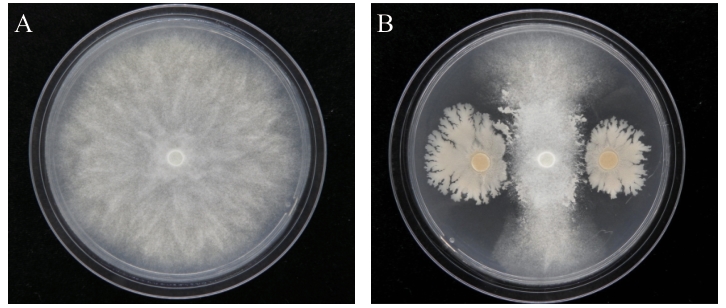
图1 辣椒疫霉单菌落CK组(A)与MH24处理组(B)
Fig. 1 Single colony of Phytophthora capsici in the CK group (A) and the MH24-treated group (B)
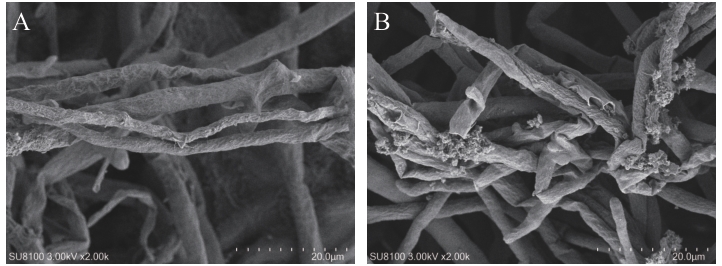
图2 MH24对辣椒疫霉菌丝作用的扫描电镜观察A:CK组;B:处理组
Fig. 2 SEM observation of the effect of MH24 on mycelia of Phytophthora capsiciA: CK group. B: Treatment group
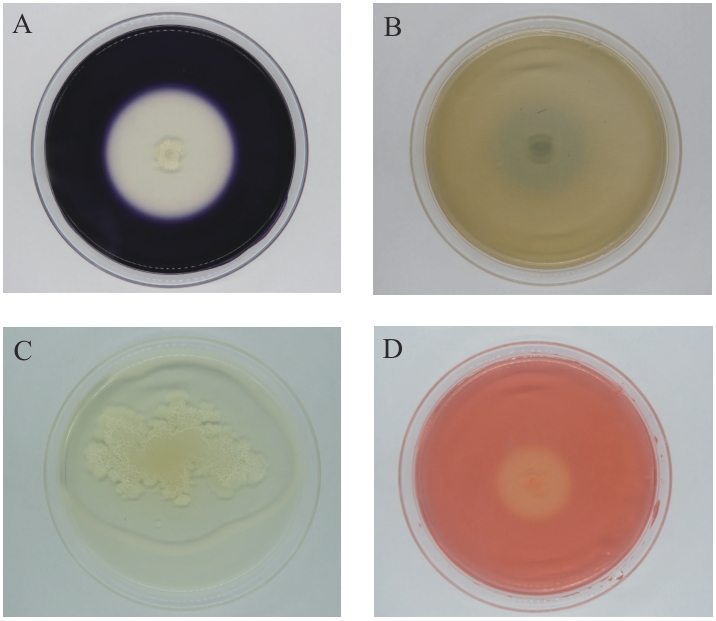
图3 MH24水解酶活性测定A:淀粉培养基;B:β-1,3-葡聚糖培养基;C:蛋白质培养基;D:羧甲基纤维素培养基
Fig. 3 Assay of hydrolase activity of MH24A: Starch medium. B: β-1,3-glucan medium. C: Protein medium. D: Carboxymethyl cellulose medium
样品 Sample | 原始读长 Raw reads number (bp) | 过滤读长 Clean reads number (bp) | 有效碱基数 Clean bases (G) | Q20 (%) | Q30 (%) | GC含量 GC content (%) | 总读段对数 Total read pairs |
|---|---|---|---|---|---|---|---|
| CK-1 | 41 389 232 | 41 212 371 | 12.19 | 99.34 | 96.45 | 42.81 | 41 212 371 |
| CK-2 | 42 273 359 | 42 085 611 | 12.47 | 99.33 | 96.45 | 42.62 | 42 085 611 |
| CK-3 | 36 156 617 | 35 989 458 | 10.65 | 99.37 | 96.71 | 42.60 | 35 989 458 |
| MH24-1 | 39 076 275 | 38 873 625 | 11.52 | 99.34 | 96.46 | 42.59 | 38 873 625 |
| MH24-2 | 31 481 578 | 31 312 465 | 9.26 | 99.21 | 96.93 | 42.52 | 31 312 465 |
| MH24-3 | 41 502 293 | 41 310 245 | 12.22 | 99.32 | 96.29 | 42.58 | 41 310 245 |
表2 RNA-seq数据质量分析
Table 2 Statistics of RNA-seq data quality
样品 Sample | 原始读长 Raw reads number (bp) | 过滤读长 Clean reads number (bp) | 有效碱基数 Clean bases (G) | Q20 (%) | Q30 (%) | GC含量 GC content (%) | 总读段对数 Total read pairs |
|---|---|---|---|---|---|---|---|
| CK-1 | 41 389 232 | 41 212 371 | 12.19 | 99.34 | 96.45 | 42.81 | 41 212 371 |
| CK-2 | 42 273 359 | 42 085 611 | 12.47 | 99.33 | 96.45 | 42.62 | 42 085 611 |
| CK-3 | 36 156 617 | 35 989 458 | 10.65 | 99.37 | 96.71 | 42.60 | 35 989 458 |
| MH24-1 | 39 076 275 | 38 873 625 | 11.52 | 99.34 | 96.46 | 42.59 | 38 873 625 |
| MH24-2 | 31 481 578 | 31 312 465 | 9.26 | 99.21 | 96.93 | 42.52 | 31 312 465 |
| MH24-3 | 41 502 293 | 41 310 245 | 12.22 | 99.32 | 96.29 | 42.58 | 41 310 245 |
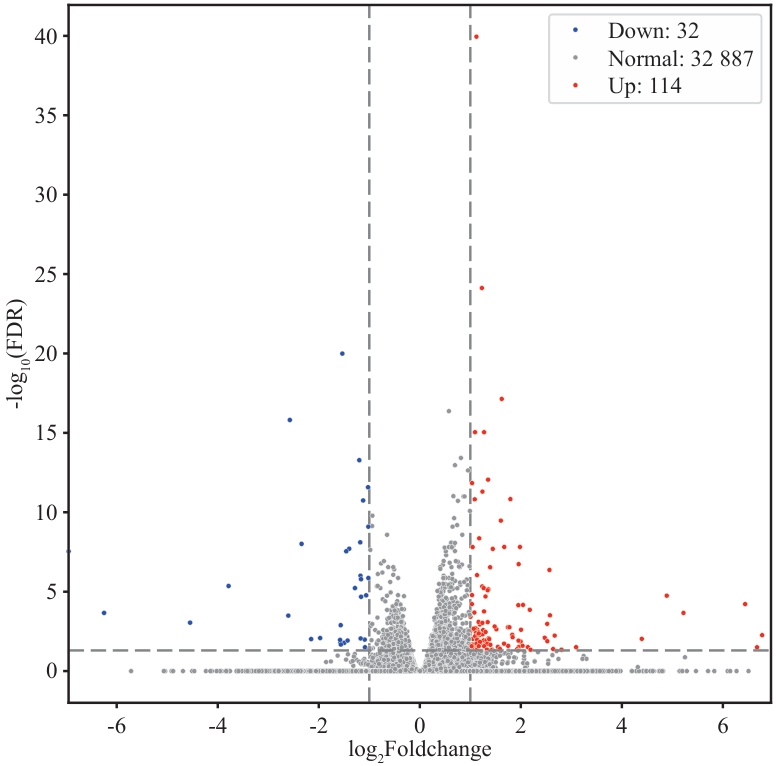
图4 差异表达基因火山图
Fig. 4 Volcano plot of differentially expressed genes
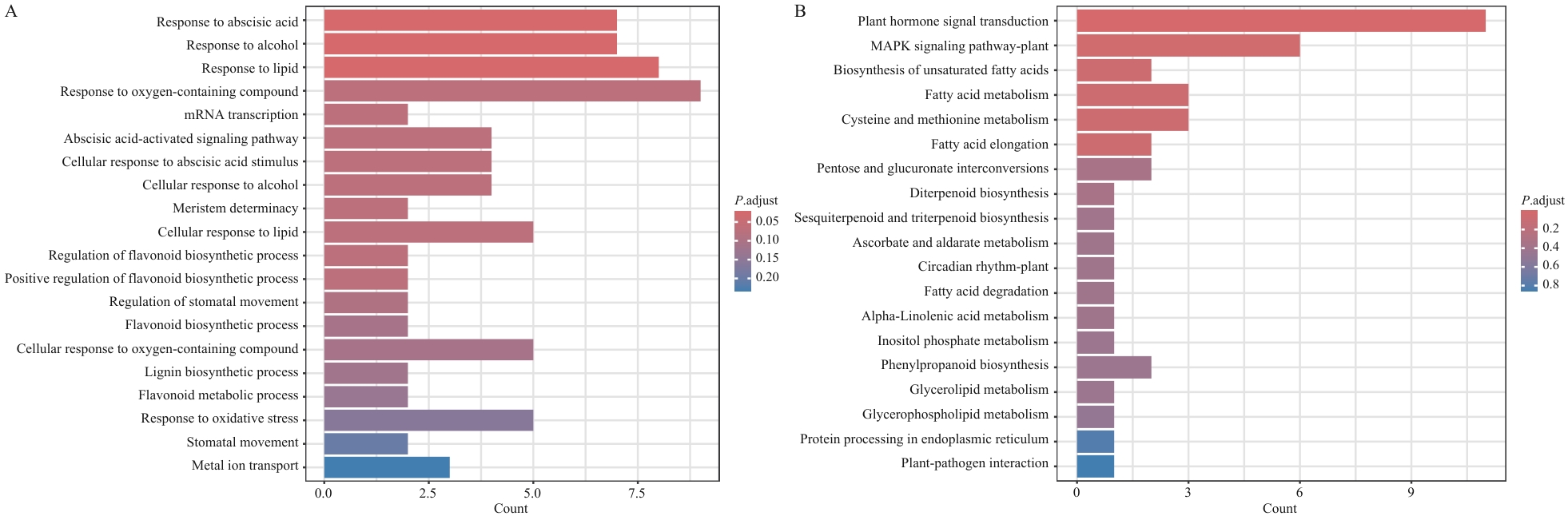
图5 差异表达基因的GO(A)和KEGG(B)富集分析
Fig. 5 GO (A) and KEGG (B) enrichment analysis of differentially expressed genes
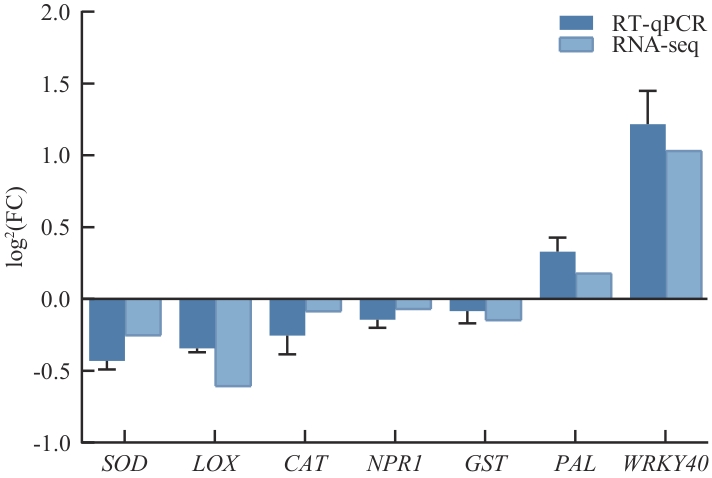
图6 RNA-seq和RT-qPCR基因表达结果比较
Fig. 6 Comparison of gene expression results between RNA-seq and RT-qPCR
处理 Treatments | 病原菌直径 Diameter of pathogenic bacteria (cm) | 防效 Control effect (%) |
|---|---|---|
MH24 菌剂20倍 MH24 bioagent diluted 20 times | 1.57±0.49c | 41.20 |
MH24 菌剂40倍 MH24 bioagent diluted 40 times | 2.30±0.63b | 13.86 |
| 对照 CK | 2.67±0.71a | — |
表3 MH24诱导辣椒抗性的盆栽验证
Table 3 Potted plant validation of MH24-induced resistance in chili plants
处理 Treatments | 病原菌直径 Diameter of pathogenic bacteria (cm) | 防效 Control effect (%) |
|---|---|---|
MH24 菌剂20倍 MH24 bioagent diluted 20 times | 1.57±0.49c | 41.20 |
MH24 菌剂40倍 MH24 bioagent diluted 40 times | 2.30±0.63b | 13.86 |
| 对照 CK | 2.67±0.71a | — |
| [1] | Quesada-Ocampo LM, Parada-Rojas CH, Hansen Z, et al. Phytophthora capsici: recent progress on fundamental biology and disease management 100 years after its description [J]. Annu Rev Phytopathol, 2023, 61: 185-208. |
| [2] | Tian S, Peng Q, Du XR, et al. Phytophthora effector exploits WY module truncation to manipulate Nt-acetylation-mediated AtMBP-1 turnover and suppress plant immunity [J]. Sci Adv, 2025, 11(50): eady1482. |
| [3] | Bowers JH. Effect of soil temperature and soil-water matric potential on the survival of Phytophthora capsici in natural soil [J]. Plant Dis, 1990, 74(10): 771. |
| [4] | 王锐, 张正海, 曹亚从, 等. 辣椒疫病的发生规律及综合防治技术 [J]. 辣椒杂志, 2025, 23(4): 12-21. |
| Wang R, Zhang ZH, Cao YC, et al. The occurrence pattern and comprehensive control technology of Phytophthora blight in pepper [J]. J China Capsicum, 2025, 23(4): 12-21. | |
| [5] | 黄大野, 余志斌, 杜公福, 等. 淡紫褐链霉菌NBF715防控辣椒疫病研究 [J]. 北方园艺, 2022(17): 51-56. |
| Huang DY, Yu ZB, Du GF, et al. Control effect of Streptomyces enissocaesilis NBF715 on Phytophthora blight of pepper [J]. North Hortic, 2022(17): 51-56. | |
| [6] | Peng YX, Zhou C, Qiu FY, et al. Acid-resistant Bacillus velezensis effectively controls pathogenic Colletotrichum capsiciand improves plant health through metabolic interactions [J]. Appl Environ Microbiol, 2025, 91(7): e00340-e00325. |
| [7] | 穆晓清, 鲁耀雄, 戴良英, 等. 贝莱斯芽孢杆菌YFB3-1对辣椒疫霉的抑菌效果及其抑菌物质 [J]. 农业生物技术学报, 2024, 32(4): 859-872. |
| Mu XQ, Lu YX, Dai LY, et al. Antibacterial effect of Bacillus velezensis YFB3-1 on Phytophthora capsici and its antibacterial substances [J]. J Agric Biotechnol, 2024, 32(4): 859-872. | |
| [8] | Ma S, Wang YJ, Teng W. Bacillus velezensis K-9 as a potential biocontrol agent for managing potato scab [J]. Plant Dis, 2023, 107(12): 3943-3951. |
| [9] | Wang ZQ, Zhao YK, Shao JH, et al. Rhizosphere domestication enhances root colonization and plant growth promotion performance of Bacillus velezensis SQR9 [J]. Front Microbiol, 2025, 16: 1638130. |
| [10] | 司方洁, 任金瑶, 黄涛祥, 等. 贝莱斯芽孢杆菌5YN8生物被膜在防治番茄灰霉病过程中的功能研究 [J]. 中国生物防治学报, 2022, 38(5): 1223-1230. |
| Si FJ, Ren JY, Huang TX, et al. The function of Bacillus velezensis 5YN8 biofilm in controlling of Botrytis cinerea in tomato [J]. Chin J Biol Control, 2022, 38(5): 1223-1230. | |
| [11] | 祝文慧, 秦溥, 赵岩, 等. 两种芽孢杆菌对苗期土传辣椒疫病的防控作用 [J]. 中国生物防治学报, 2023, 39(5): 1235-1243. |
| Zhu WH, Qin P, Zhao Y, et al. Prevention and control effect of two Bacillus strains on soil-borne Phytophthora capsici in seedling stage [J]. Chin J Biol Control, 2023, 39(5): 1235-1243. | |
| [12] | 周池, 周诗晶, 陶禹, 等. 贝莱斯芽孢杆菌XY40-1: 全基因组特征分析及对辣椒疫病的生物防治效果评价 [J]. 微生物学报, 2024, 64(12): 4882-4901. |
| Zhou C, Zhou SJ, Tao Y, et al. Bacillus velezensis XY40-1: whole genomic characteristics and biocontrol effects on pepper Phytophthora blight [J]. Acta Microbiol Sin, 2024, 64(12): 4882-4901. | |
| [13] | 王芳, 宁丽平, 邓稳桥, 等. 贝莱斯芽孢杆菌C1B1生防活性及促生作用研究 [J]. 中国生物防治学报, 2024, 40(4): 948-957. |
| Wang F, Ning LP, Deng WQ, et al. Biocontrol activity and growth promoting effect of Bacillus velezensis C1B1 [J]. Chin J Biol Control, 2024, 40(4): 948-957. | |
| [14] | 王麒, 许婧霞, 张亚妮, 等. 贝莱斯芽孢杆菌 (Bacillus velezensis) JJYY防控土传病害效果评价及其全基因组测序分析和抗菌成分鉴定 [J]. 微生物学通报, 2024, 51(1): 155-171. |
| Wang Q, Xu JX, Zhang YN, et al. Bacillus velezensis JJYY against soil-borne diseases: biocontrol effect, whole genome sequencing, and antimicrobial components [J]. Microbiol China, 2024, 51(1): 155-171. | |
| [15] | 田淼, 彭玉飞, 吕红, 等. 非洲哈茨木霉LMNS-M9的鉴定、生物学特性及其对藜麦的促生作用 [J]. 微生物学通报, 2023, 50(9): 3848-3865. |
| Tian M, Peng YF, Lü H, et al. Trichoderma afroharzianum LMNS-M9: identification, biological characteristics, and growth-promoting effect on quinoa [J]. Microbiol China, 2023, 50(9): 3848-3865. | |
| [16] | Liu Y, Yao SX, Deng LL, et al. Different mechanisms of action of isolated epiphytic yeasts against Penicillium digitatum and Penicillium italicum on Citrus fruit [J]. Postharvest Biol Technol, 2019, 152: 100-110. |
| [17] | Sang MK, Chun SC, Kim KD. Biological control of Phytophthora blight of pepper by antagonistic rhizobacteria selected from a sequential screening procedure [J]. Biol Control, 2008, 46(3): 424-433. |
| [18] | Chemeltorit PP, Mutaqin KH, Widodo W. Combining Trichoderma hamatum THSW13 and Pseudomonas aeruginosa BJ10-86: a synergistic chili pepper seed treatment for Phytophthora capsici infested soil [J]. Eur J Plant Pathol, 2017, 147(1): 157-166. |
| [19] | Yang MM, Xu LP, Xue QY, et al. Screening potential bacterial biocontrol agents towards Phytophthora capsici in pepper [J]. Eur J Plant Pathol, 2012, 134(4): 811-820. |
| [20] | 赵欣, 郝林. 解淀粉芽孢杆菌HRH317对串珠镰孢菌菌丝形态和超微结构的影响 [J]. 植物保护学报, 2020, 47(1): 110-118. |
| Zhao X, Hao L. Effects of Bacillus amyloliquefaciens HRH317 on mycelial morphology and ultrastructure of Fusarium moniliforme [J]. J Plant Prot, 2020, 47(1): 110-118. | |
| [21] | Lu ZY, Chen ML, Long XY, et al. Biological potential of Bacillus subtilis BS45 to inhibit the growth of Fusarium graminearum through oxidative damage and perturbing related protein synthesis [J]. Front Microbiol, 2023, 14: 1064838. |
| [22] | Haq IU, Kennedy P, Schreiner KM, et al. Gene expression by a model fungus in the ascomycota provides insight into the decay of fungal necromass [J]. Environ Microbiol, 2024, 26(12): e70006. |
| [23] | Podder S, Saha D, Ghosh TC. Deciphering the intrinsic properties of fungal proteases in optimizing phytopathogenic interaction [J]. Gene, 2019, 711: 143934. |
| [24] | Xiong XP, Sun SC, Zhang XY, et al. GhWRKY70D13 regulates resistance to Verticillium dahliae in cotton through the ethylene and jasmonic acid signaling pathways [J]. Front Plant Sci, 2020(11): 69. |
| [25] | 韩威山, 张江一, 方菲菲, 等. 辣椒疫霉致病、抗病和生物防治的分子机制研究进展 [J]. 北方园艺, 2025(10): 118-125. |
| Han WS, Zhang JY, Fang FF, et al. Research progress on the molecular mechanism of pathogenesis, disease resistant and biological control of Phytophthora capsici [J]. North Hortic, 2025(10): 118-125. | |
| [26] | Man J, Gallagher JP, Bartlett M. Structural evolution drives diversification of the large LRR-RLK gene family [J]. New Phytol, 2020, 226(5): 1492-1505. |
| [27] | Van der Does D, Boutrot F, Engelsdorf T, et al. The Arabidopsis Leucine-rich repeat receptor kinase MIK2/LRR-KISS connects cell wall integrity sensing, root growth and response to abiotic and biotic stresses [J]. PLoS Genet, 2017, 13(6): e1006832. |
| [28] | Li P, Xie LZ, Li W, et al. An oomycete effector targets host calmodulin to suppress plant immunity [J]. Plant J, 2025, 123(5): e70457. |
| [29] | Bhagat N, Mansotra R, Patel K, et al. Molecular warfare between pathogenic Fusarium oxysporum R1 and host Crocus sativus L. unraveled by dual transcriptomics [J]. Plant Cell Rep, 2024, 43(2): 42. |
| [30] | Jia CP, Guo B, Wang BK, et al. Integrated metabolomic and transcriptomic analysis reveals the role of phenylpropanoid biosynthesis pathway in tomato roots during salt stress [J]. Front Plant Sci, 2022, 13: 1023696. |
| [31] | Lee SH, Park YJ, Park SU, et al. Expression of genes related to phenylpropanoid biosynthesis in different organs of Ixeris dentata var. albiflora [J]. Molecules, 2017, 22(6): 901. |
| [32] | Han Z, Schneiter R. Dual functionality of pathogenesis-related proteins: defensive role in plants versus immunosuppressive role in pathogens [J]. Front Plant Sci, 2024, 15: 1368467. |
| [33] | Kaur A, Kaur S, Kaur A, et al. Pathogenesis-related proteins and their transgenic expression for developing disease-resistant crops: strategies progress and challenges [M]//Case Studies of Breeding Strategies in Major Plant Species. London: IntechOpen, 2023. |
| [34] | Wang F, Shen SS, Zhao CP, et al. TaPR1 interacts with TaTLP1 via the αIV helix to be involved in wheat defense to Puccinia triticina through the CAPE1 motif [J]. Front Plant Sci, 2022, 13: 874654. |
| [35] | Wang Q, Li MG, Lu M, et al. Expression analysis of pathogenesis-related protein genes revealed the key RrPRs involved in SA- and MeJA-mediated top-rot disease resistance in Rosa roxburghii fruit [J]. Physiol Mol Plant Pathol, 2024, 133: 102345. |
| [36] | Guidetti-Gonzalez S, Carrer H. Putative resistance genes in the CitEST database [J]. Genet Mol Biol, 2007, 30(3 ): 931-942. |
| [37] | Tailor A, Bhatla SC. R gene-mediated resistance in the management of plant diseases [J]. J Plant Biochem Biotechnol, 2024, 33(1): 5-23. |
| [38] | Nabi Z, Manzoor S, Nabi SU, et al. Pattern-Triggered Immunity and Effector-Triggered Immunity: crosstalk and cooperation of PRR and NLR-mediated plant defense pathways during host-pathogen interactions [J]. Physiol Mol Biol Plants, 2024, 30(4): 587-604. |
| [1] | 张文静, 马馨蕊, 徐紫璐, 吕红, 秦楠, 殷辉, 赵晓军, 任璐. 非洲哈茨木霉与贝莱斯芽胞杆菌联用对藜麦茎基腐病防效及根际微生态的影响[J]. 生物技术通报, 2026, 42(9): 327-341. |
| [2] | 崔秀妍, 代春阳, 张谊婷, 田翔, 陈凌, 乔治军, 王海岗, 王君杰. 糜子伪响应调节蛋白PRR基因家族的鉴定及对光周期的响应[J]. 生物技术通报, 2026, 42(8): 133-141. |
| [3] | 危潇, 黎妍妍, 袁勤峰, 姚经武, 曹春霞, 黄大野. 一株分离自烟草根际的生防菌株鉴定及其生防潜力研究[J]. 生物技术通报, 2026, 42(7): 279-291. |
| [4] | 苏艳艳, 左强, 宋志双, 穆琳英, 吕佳音, 肖自敏, 卢志军, 谢华. 贝莱斯芽胞杆菌BPC37的鉴定与防病促生效果分析[J]. 生物技术通报, 2026, 42(7): 269-279. |
| [5] | 刘青媛, 吴洪启, 陈秀娥, 陈剑, 姜远泽, 何燕子, 喻奇伟, 刘仁祥. 转录因子NtMYB96a调控烟草耐旱性的功能研究[J]. 生物技术通报, 2026, 42(4): 239-250. |
| [6] | 张蔓, 党静波, 蒋媛, 位杰, 邢杰, 王哲, 孙黎. 梨火疫病生防菌的筛选、鉴定及防效测定[J]. 生物技术通报, 2026, 42(1): 279-293. |
| [7] | 吕镇, 甘恬, 霍思羽, 赵晨笛, 赵梦瑶, 李亚涛, 马玉超, 耿玉清. 产Surfactin贝莱斯芽胞杆菌C5A-1的鉴定和所产Surfactin对植物的促生效果[J]. 生物技术通报, 2025, 41(9): 265-276. |
| [8] | 刘泽洲, 段乃彬, 岳丽昕, 王清华, 姚行浩, 高莉敏, 孔素萍. 大蒜叶片蜡质成分分析及蜡质缺失基因Ggl-1筛选[J]. 生物技术通报, 2025, 41(9): 219-231. |
| [9] | 任睿斌, 司二静, 万广有, 汪军成, 姚立蓉, 张宏, 马小乐, 李葆春, 王化俊, 孟亚雄. 大麦条纹病菌GH17基因家族的鉴定及表达分析[J]. 生物技术通报, 2025, 41(8): 146-154. |
| [10] | 石艳华, 李朔, 高玉珠, 郑保坤, 朱杰华, 张岱, 杨志辉. 贝莱斯芽胞杆菌NZ-4挥发性有机物的促生作用及其活性成分分析[J]. 生物技术通报, 2025, 41(8): 300-310. |
| [11] | 张津浩, 邓辉, 张清壮, 陶禹, 周池, 李鑫. 贝莱斯芽胞杆菌XY40-1对百合球茎生长、品质及镉含量的调控作用[J]. 生物技术通报, 2025, 41(7): 281-291. |
| [12] | 李成花, 豆飞飞, 任毓昭, 刘彩霞, 刘凤楼, 王掌军, 李清峰. 外施水杨酸对白粉菌侵染小麦的影响及白粉菌转录组分析[J]. 生物技术通报, 2025, 41(7): 272-280. |
| [13] | 安苗苗, 蔺祥淏, 梁瑞娜, 赵国柱. 碳源对产甲烷菌群调控及产甲烷能力的影响[J]. 生物技术通报, 2025, 41(6): 355-366. |
| [14] | 李艳伟, 杨妍妍, 孙亚玲, 霍雨猛, 王振宝, 刘冰江. 基于转录组分析植物激素对洋葱鳞茎膨大发育的调控机制[J]. 生物技术通报, 2025, 41(2): 187-201. |
| [15] | 罗明凯, 张豪杰, 石晖琴, 李亚楠, 封瑞超, 沈硕. 三株马铃薯炭疽病生防菌的分离鉴定及其高抑菌活性培养物发酵参数优化[J]. 生物技术通报, 2025, 41(12): 313-327. |
| 阅读次数 | ||||||
|
全文 |
|
|||||
|
摘要 |
|
|||||
