







生物技术通报 ›› 2026, Vol. 42 ›› Issue (10): 169-176.doi: 10.13560/j.cnki.biotech.bull.1985.2026-0311
• 研究报告 • 上一篇
董向向1, 缪百灵1, 陈娟娟1, 张坤鹏1, 李亮杰1, 周厚成2( ), 朱庆松1()
收稿日期:2026-03-18
出版日期:2026-10-26
发布日期:2026-10-15
通讯作者:
周厚成zhouhoucheng@caas.cn基金资助:
DONG Xiang-xiang1, MIAO Bai-ling1, CHEN Juan-juan1, ZHANG Kun-peng1, LI Liang-jie1, ZHOU Hou-cheng2(), ZHU Qing-song1()
Received:2026-03-18
Published:2026-10-26
Online:2026-10-15
摘要:
目的 TCP转录因子在植物抵御逆境胁迫过程中发挥重要作用,解析森林草莓FveTCP5基因在响应盐胁迫方面的功能,为培育草莓耐盐新品种提供基因资源。 方法 以森林草莓‘Ruegen’为材料,克隆FveTCP5基因,结合生物信息学方法分析其理化性质、结构特征和系统进化关系;利用RT-qPCR技术测定FveTCP5基因在森林草莓不同组织中的表达模式;构建FveTCP5基因的过表达载体,利用花序浸染法获得转基因拟南芥过表达株系;用150 mmol/L NaCl处理转基因拟南芥株系,测定相关生理指标和盐胁迫响应相关基因的表达水平,开展耐盐功能验证。 结果 FveTCP5基因CDS全长1 131 bp,编码376个氨基酸;系统进化分析表明,FveTCP5与蔷薇科其他物种的TCP5蛋白间亲缘关系较近;RT-qPCR结果显示,FveTCP5基因在森林草莓各组织中均普遍表达,在叶片中的表达量最高。在NaCl处理下,过表达FveTCP5拟南芥株系的子叶绿化率和根长均显著高于野生型;测定相关生理指标显示,转基因植株的丙二醛含量较野生型显著降低,而叶绿素、脯氨酸含量和超氧化物歧化酶(SOD)、过氧化物酶(POD)和过氧化氢酶(CAT)活性较野生型均显著升高。此外,盐胁迫响应相关基因AtSOS1、AtSOS2、AtNHX1、AtHKT1、AtCOR15A和AtRD29A的表达水平较野生型均有所提高。 结论 过表达FveTCP5可通过促进盐胁迫响应相关基因的表达来提高拟南芥的耐盐性,推测FveTCP5在草莓盐胁迫响应中发挥重要功能。
董向向, 缪百灵, 陈娟娟, 张坤鹏, 李亮杰, 周厚成, 朱庆松. 森林草莓FveTCP5基因在盐胁迫中的功能分析[J]. 生物技术通报, 2026, 42(10): 169-176.
DONG Xiang-xiang, MIAO Bai-ling, CHEN Juan-juan, ZHANG Kun-peng, LI Liang-jie, ZHOU Hou-cheng, ZHU Qing-song. Functional Analysis of FveTCP5 Gene in Fragaria vesca under Salt Stress[J]. Biotechnology Bulletin, 2026, 42(10): 169-176.
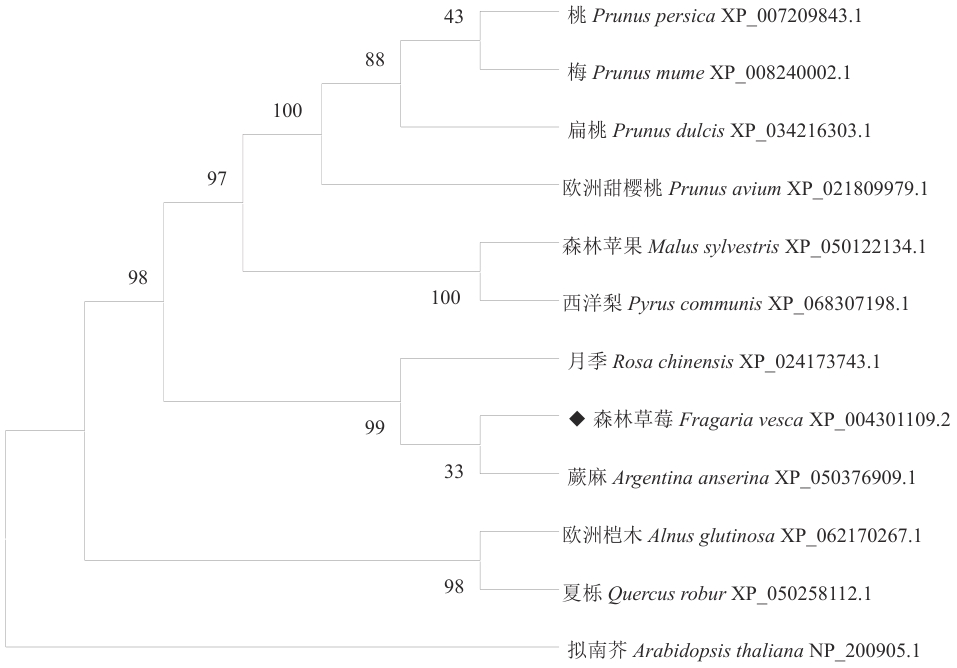
图1 不同物种TCP5蛋白的系统进化分析
Fig. 1 Phylogenetic analysis of TCP5 proteins in different species
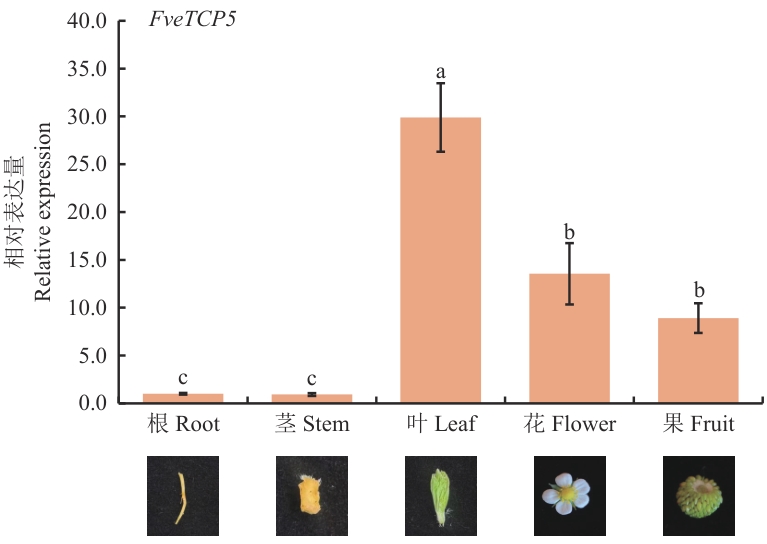
图2 FveTCP5的表达模式分析不同小写字母代表差异显著(P<0.05)。下同
Fig. 2 Expression pattern analysis of FveTCP5Different lowercase letters indicate significant differences at P<0.05. The same below
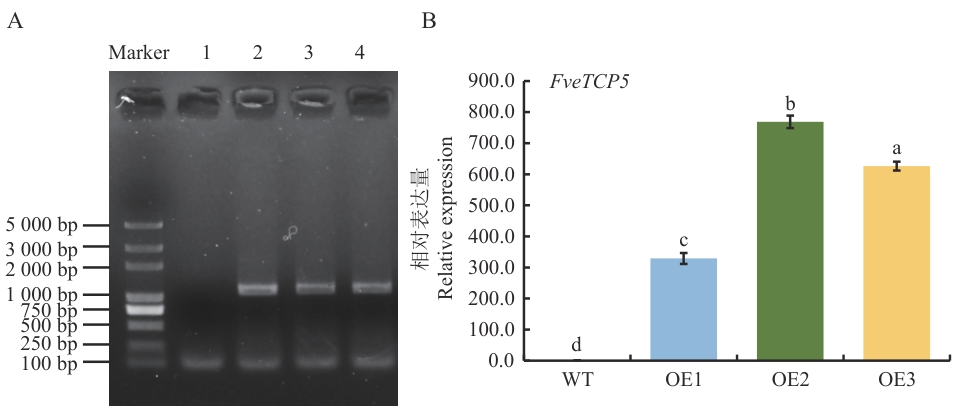
图3 过表达FveTCP5拟南芥的PCR鉴定(A)和基因表达量分析(B)1:野生型拟南芥;2-4:3个转基因株系;WT:野生型拟南芥;OE1-3:3个转基因株系;下同
Fig. 3 PCR identification (A) and gene expression analysis (B) of FveTCP5-overexpressing A. thaliana1: Wild type A. thaliana; 2-4: three transgenic lines. WT: Wild type A. thaliana; OE1-3: three transgenic lines. The same below
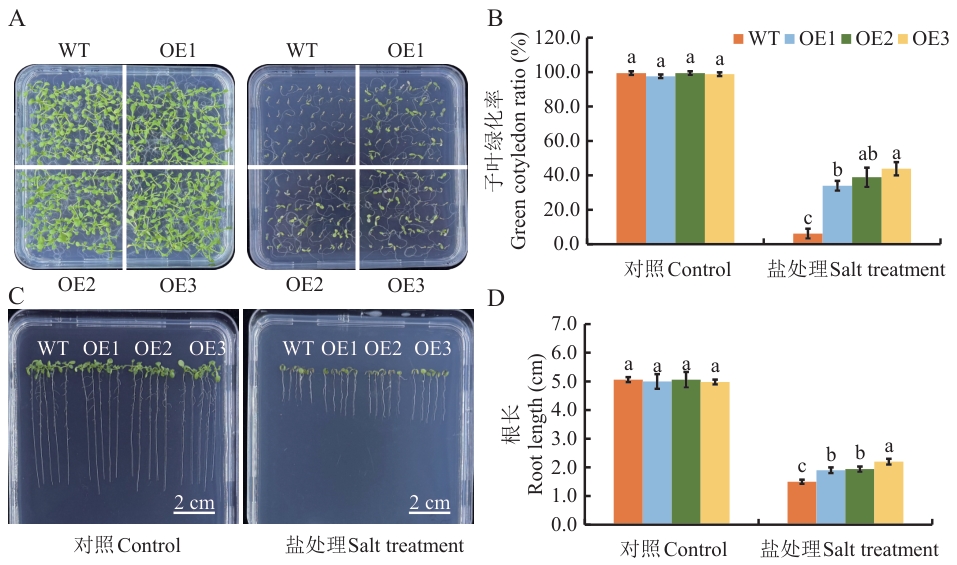
图4 转基因拟南芥的耐盐表型分析
Fig. 4 Analysis of salt tolerance phenotype of transgenic A. thaliana
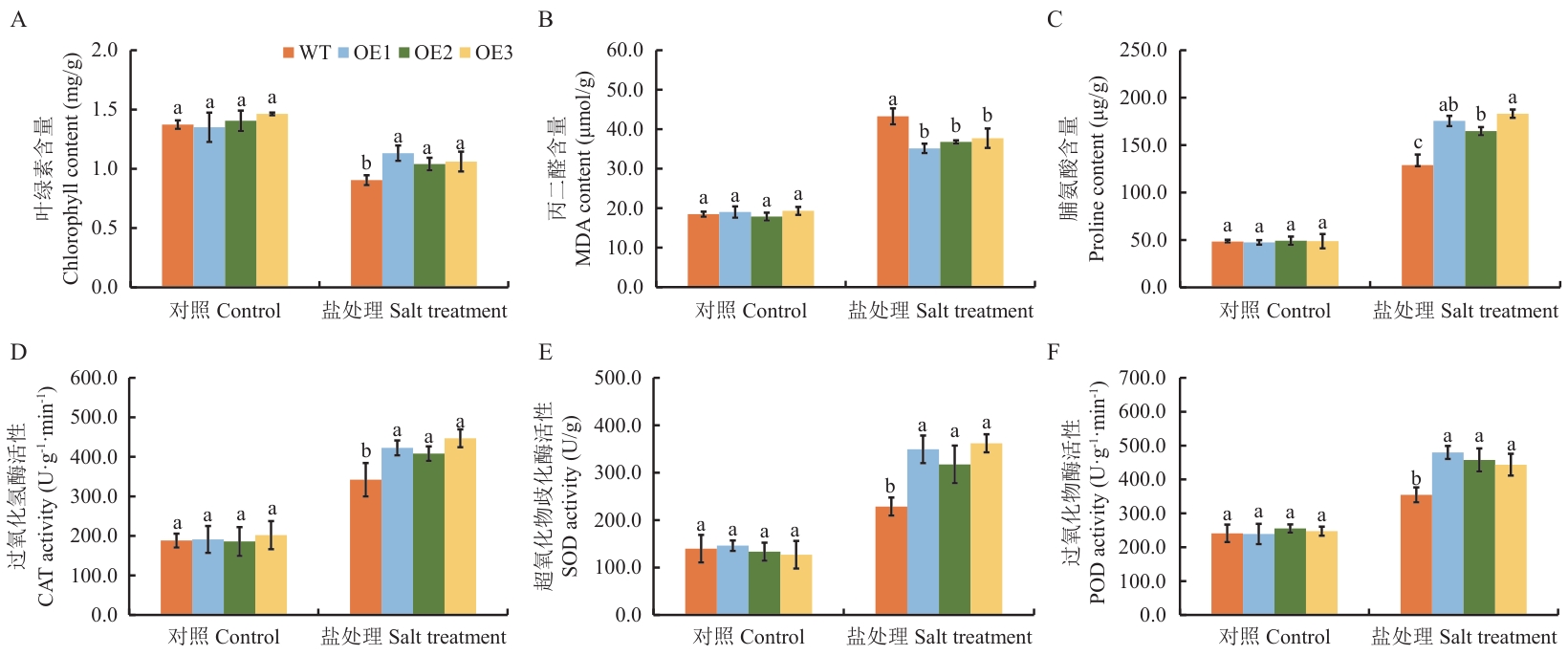
图5 转基因拟南芥在盐胁迫下的生理指标测定
Fig. 5 Determination of physiological indices of transgenic A. thaliana under salt stress
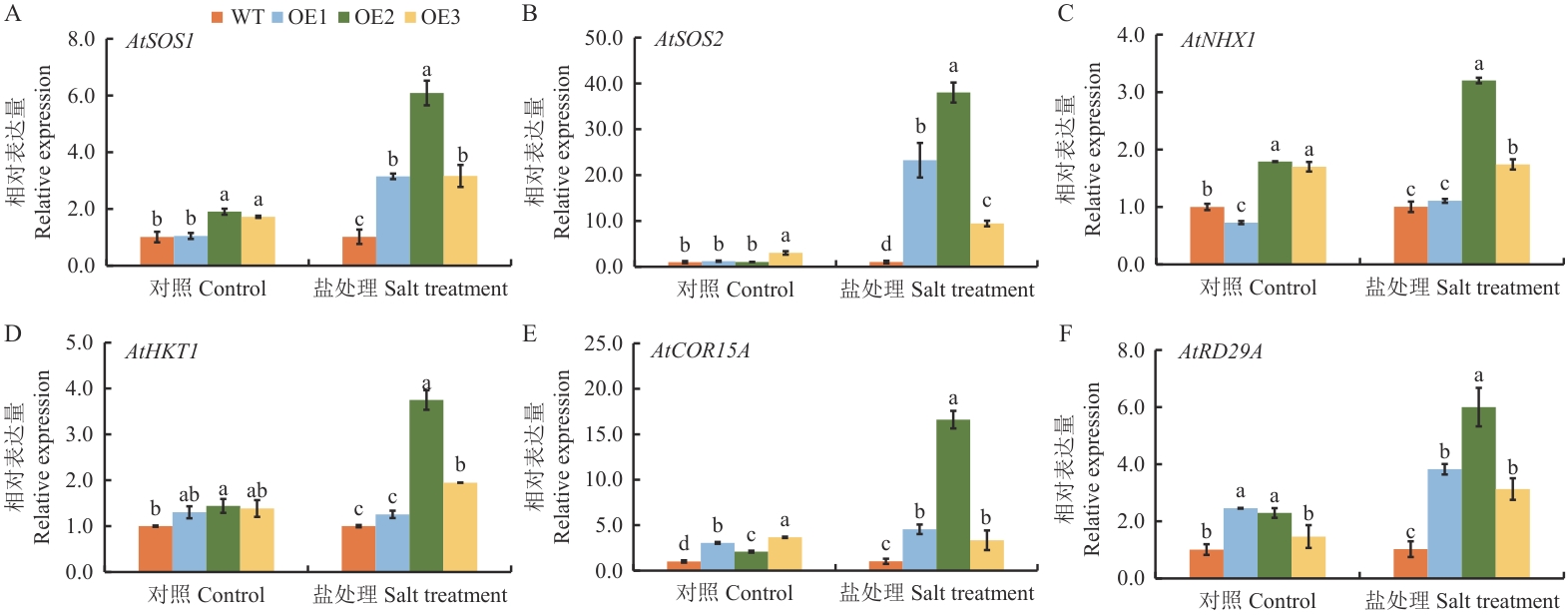
图6 转基因拟南芥中盐胁迫响应基因的表达分析
Fig. 6 Expression analysis of salt stress-response genes in transgenic A. thaliana
| [1] | 卢东升, 刘汉光. 信阳草莓果栖真菌及其多样性研究 [J]. 信阳师范学院学报: 自然科学版, 2017(3): 374-378. |
| Lu DS, Liu HG. Studies on the fruit fungi and their diversity of Fragaria ananassa in Xinyang [J]. J Xinyang Norm Univ Nat Sci Ed, 2017(3): 374-378. | |
| [2] | 景天惠, 雷家军, 李贺, 等. 我国草莓生产现状与展望 [J]. 北方园艺, 2026(9): 154-161. |
| Jing TH, Lei JJ, Li H, et al. The status and prospect of strawberry production in China [J]. North Hortic, 2026(9): 154-161. | |
| [3] | 赵明德, 阴梦琪, 吉云. 盐碱胁迫下高寒牧草幼苗生理指标的响应 [J]. 信阳师范学院学报: 自然科学版, 2024, 37(4): 516-523. |
| Zhao MD, Yin MQ, Ji Y. Response of physiological indexes of alpine herbage seedlings under saline-alkali stress [J]. J Xinyang Norm Univ Nat Sci Ed, 2024, 37(4): 516-523. | |
| [4] | Ferreira JFS, Liu X, Suarez DL. Fruit yield and survival of five commercial strawberry cultivars under field cultivation and salinity stress [J]. Sci Hortic, 2019, 243: 401-410. |
| [5] | He ZM, Zhou XM, Chen JM, et al. Identification of a consensus DNA-binding site for the TCP domain transcription factor TCP2 and its important roles in the growth and development of Arabidopsis [J]. Mol Biol Rep, 2021, 48(3): 2223-2233. |
| [6] | Danisman S, van Dijk AD, Bimbo A, et al. Analysis of functional redundancies within the Arabidopsis TCP transcription factor family [J]. J Exp Bot, 2013, 64(18): 5673-5685. |
| [7] | 梅文宇, 方燕芬, 宫超, 等. 茄子TCP转录因子的鉴定及胁迫处理下的表达分析 [J]. 广东农业科学, 2022, 49(12): 20-33. |
| Mei WY, Fang YF, Gong C, et al. Genome-wide identification and expression analysis in oxidative stress of TCP transcription factor family in eggplant (Solanum melongena L.) [J]. Guangdong Agric Sci, 2022, 49(12): 20-33. | |
| [8] | 周瑾, 李洁, 李晓燕, 等. 芹菜TCP基因家族全基因组鉴定、进化分析和表达研究 [J]. 四川农业大学学报, 2022, 40(2): 145-155. |
| Zhou J, Li J, Li XY, et al. Genome-wide identification, evolution and expression analysis of TCP gene family in celery (Apium graveolens L.) [J]. J Sichuan Agric Univ, 2022, 40(2): 145-155. | |
| [9] | Wei XR, Yuan M, Zheng BQ, et al. Genome-wide identification and characterization of TCP gene family in Dendrobium nobile and their role in perianth development [J]. Front Plant Sci, 2024, 15: 1352119. |
| [10] | Huang LC, Bin J, Zhang YL, et al. Genome-wide characterization of Chrysanthemum indicum TCP genes reveals a positive role for CiTCP23 in salt response tolerance [J]. Ind Crops Prod, 2025, 225: 120567. |
| [11] | 王苗苗, 赵相龙, 王召明, 等. 花苜蓿TCP基因家族的鉴定及其在干旱胁迫下的表达模式分析 [J]. 生物技术通报, 2025, 41(6): 179-190. |
| Wang MM, Zhao XL, Wang ZM, et al. Identification of TCP gene family in Medicago ruthenica and their expression pattern analysis under drought stress [J]. Biotechnol Bull, 2025, 41(6): 179-190. | |
| [12] | 宋姝熠, 蒋开秀, 刘欢艳, 等. ‘红阳’猕猴桃TCP基因家族鉴定及其在果实中的表达分析 [J]. 生物技术通报, 2025, 41(3): 190-201. |
| Song SY, Jiang KX, Liu HY, et al. Identification of the TCP gene family in Actinidia chinensis var. Hongyang and their expression analysis in fruit [J]. Biotechnol Bull, 2025, 41(3): 190-201. | |
| [13] | 林宇清, 朱渊铭, 陈丝雨, 等. 栀子TCP基因家族鉴定及响应盐胁迫表达模式分析 [J]. 江苏农业科学, 2025, 53(4): 126-132. |
| Lin YQ, Zhu YM, Chen SY, et al. Identification of TCP gene family in Gardenia jasminoides and analysis of expression patterns under salt stress [J]. Jiangsu Agric Sci, 2025, 53(4): 126-132. | |
| [14] | Yu SW, Li PH, Zhao XC, et al. CsTCPs regulate shoot tip development and catechin biosynthesis in tea plant (Camellia sinensis) [J]. Hortic Res, 2021, 8(1): 104. |
| [15] | Liu J, Cheng XL, Liu P, et al. microRNA319-regulated TCPs interact with FBHs and PFT1 to activate CO transcription and control flowering time in Arabidopsis [J]. PLoS Genet, 2017, 13(5): e1006833. |
| [16] | 杨慧茹. 苹果MdTCP14/15调控花芽孕育的功能与分子机制 [D]. 杨凌: 西北农林科技大学, 2021. |
| Yang HR. Functional and molecular mechanisms of MdTCP14/15 in regulation of floral induction in apple (Malus domestica) [D]. Yangling: Northwest A & F University, 2021. | |
| [17] | Li J, Wang YZ, Zhang YX, et al. RABBIT EARS regulates the transcription of TCP4 during petal development in Arabidopsis [J]. J Exp Bot, 2016, 67(22): 6473-6480. |
| [18] | 韩新蕊, 袁欣, 高杰, 等. 牡丹TCP基因家族鉴定及TCP15a功能分析 [J]. 植物学报, 2026, 61(1): 37-52. |
| Han XR, Yuan X, Gao J, et al. Identification of TCP gene family and functional analysis of TCP15a of tree peony [J]. Bull Bot, 2026, 61(1): 37-52. | |
| [19] | Peng KK, Ren ZP, Wang SN, et al. TaTCP21-a negatively regulates wheat cold tolerance via repressing expression of TaDREB1C [J]. Plant Physiol Biochem, 2025, 219: 109353. |
| [20] | Qin HY, Zeng JJ, He XR, et al. Salvia miltiorrhiza-derived carbon dots alleviate cadmium stress in flowering Chinese cabbage by suppressing BrTCP9-mediated cadmium transport and reactive oxygen species metabolism [J]. Plant Physiol Biochem, 2025, 228: 110240. |
| [21] | 刘欢龙. 毛竹TCP转录因子的鉴定及PeTCP10基因的功能分析 [D]. 合肥: 安徽农业大学, 2020. |
| Liu HL. Identification of TCP transcription factors in moso bamboo and function analysis of PeTCP10 [D]. Hefei: Anhui Agricultural University, 2020. | |
| [22] | 董炫克, 李映旸, 马豫皖, 等. 月季‘月月红’RcTCP9基因在盐和干旱胁迫中的功能分析 [J]. 园艺学报, 2025, 52(7): 1789-1802. |
| Dong XK, Li YY, Ma YW, et al. The functional analysis of RcTCP9 gene in response to salt and drought stress in Rosa chinensis ‘Yueyuehong’ [J]. Acta Hortic Sin, 2025, 52(7): 1789-1802. | |
| [23] | Li QH, Tang HC, Zhuang LH, et al. AmTCP8 is a negative regulatory factor for salt tolerance in mangrove Avicennia marina by driving AmLOX3 expression to promote ROS accumulation [J]. Ind Crops Prod, 2024, 220: 119170. |
| [24] | 张志强, 卢世雄, 马宗桓, 等. 草莓TCP转录因子家族生物信息学鉴定及基因表达分析 [J]. 西北植物学报, 2020, 40(12): 2031-2043. |
| Zhang ZQ, Lu SX, Ma ZH, et al. Bioinformatics identification and expression analysis of TCP transcription factor family in strawberry [J]. Acta Bot Boreali Occidentalia Sin, 2020, 40(12): 2031-2043. | |
| [25] | Xie YG, Ma YY, Bi PP, et al. Transcription factor FvTCP9 promotes strawberry fruit ripening by regulating the biosynthesis of abscisic acid and anthocyanins [J]. Plant Physiol Biochem, 2020, 146: 374-383. |
| [26] | Pillet J, Yu HW, Chambers AH, et al. Identification of candidate flavonoid pathway genes using transcriptome correlation network analysis in ripe strawberry (Fragaria × ananassa) fruits [J]. J Exp Bot, 2015, 66(15): 4455-4467. |
| [27] | Wei W, Hu Y, Cui MY, et al. Identification and transcript analysis of the TCP transcription factors in the diploid woodland strawberry Fragaria vesca [J]. Front Plant Sci, 2016, 7: 1937. |
| [28] | 刘畅, 张宇, 李梦妤, 等. 菜豆PvLEA基因的克隆及耐盐功能鉴定 [J]. 中国农学通报, 2025, 41(5): 44-49. |
| Liu C, Zhang Y, Li MY, et al. Cloning of PvLEA gene in snap bean and identification of salt tolerance function [J]. Chin Agric Sci Bull, 2025, 41(5): 44-49. | |
| [29] | Wang Y, Yu YH, Wan HN, et al. Sea-island cotton (Gossypium barbadense L.) GbTCP5 improves plant adaptation to drought and salt stress by directly activating GbERD7, GbUBC19, and GbGOLS2 expression [J]. Ind Crops Prod, 2023, 203: 117209. |
| [30] | 许玉增. 毛竹PheTCP9基因的耐盐性功能研究 [D]. 合肥: 安徽农业大学, 2022. |
| Xu YZ. Salt tolerance functional analysis of Phyllostachys edulis PheTCP9 gene [D]. Hefei: Anhui Agricultural University, 2022. | |
| [31] | 张彤彤, 郑登俞, 吴忠义, 等. 玉米NF-Y转录因子基因ZmNF-YB13响应干旱和盐胁迫的功能分析 [J]. 生物技术通报, 2022, 38(10): 115-123. |
| Zhang TT, Zheng DY, Wu ZY, et al. Functional analysis of ZmNF-YB13 responding to drought and salt stress [J]. Biotechnol Bull, 2022, 38(10): 115-123. | |
| [32] | 杨克明, 李海峰, 胡西旦·买买提, 等. 调环酸钙对高温胁迫下甜瓜生理生长及产量品质的影响 [J]. 华北农学报, 2025, 40(4): 85-95. |
| Yang KM, Li HF, Huxidan M, et al. The effect of prohexadione-calcium on physiological growth, yield and quality of cantaloupe under high temperature stress [J]. Acta Agric Boreali Sin, 2025, 40(4): 85-95. | |
| [33] | 钟继亮. 森林草莓FvMYB82基因的克隆与功能分析 [D]. 哈尔滨: 东北农业大学, 2023. |
| Zhong JL. Isolation and functional analysis of FvMYB82 gene in Fragaria vesca L. [D]. Harbin: Northeast Agricultural University, 2023. | |
| [34] | Zhou HP, Shi HF, Yang YQ, et al. Insights into plant salt stress signaling and tolerance [J]. J Genet Genom, 2024, 51(1): 16-34. |
| [35] | Ali A, Petrov V, Yun DJ, et al. Revisiting plant salt tolerance: novel components of the SOS pathway [J]. Trends Plant Sci, 2023, 28(9): 1060-1069. |
| [36] | Liu GY, Yu X, Zeng YL, et al. SOS2-FREE1 regulates SOS1 tonoplast sorting to promote Na+ compartmentalization in vacuole during salt stress response [J]. J Integr Plant Biol, 2025, 67(10): 2545-2560. |
| [37] | 刘坤, 李国婧, 杨杞. 参与植物非生物逆境响应的DREB/CBF转录因子研究进展 [J]. 生物技术通报, 2022, 38(5): 201-214. |
| Liu K, Li GJ, Yang Q. Research progress in DREB/CBF transcription factor involved in responses in plant to abiotic stress [J]. Biotechnol Bull, 2022, 38(5): 201-214. | |
| [38] | Song C, Je J, Hong JK, et al. Ectopic expression of an Arabidopsis dehydration-responsive element-binding factor DREB2C improves salt stress tolerance in crucifers [J]. Plant Cell Rep, 2014, 33(8): 1239-1254. |
| [39] | Narusaka Y, Nakashima K, Shinwari ZK, et al. Interaction between two cis-acting elements, ABRE and DRE in ABA-dependent expression of Arabidopsis rd29A gene in response to dehydration and high-salinity stresses [J]. Plant J, 2003, 34(2): 137-148. |
| [40] | 杨娟博, 郭丽丽, 卢世雄, 等. 草莓FaGH3.17基因的克隆及功能分析 [J]. 园艺学报, 2024, 51(11): 2483-2494. |
| Yang JB, Guo LL, Lu SX, et al. Cloning and functional analysis of FaGH3.17 gene in strawberry [J]. Acta Hortic Sin, 2024, 51(11): 2483-2494. |
| [1] | 桑志鹏, 侯栋, 王慧婷, 岳宏忠, 李亚莉, 颉建明, 路雯, 许照泰. 黄瓜CsHXKs基因家族鉴定及CsHKL1.2调控花器官糖积累[J]. 生物技术通报, 2026, 42(9): 157-168. |
| [2] | 郑淑雅, 苏玉婷, 何玉美, 赵盼, 周心怡, 刘冉, 刘平丽, 郭惠红. 杨树PagRAX2_16G及其启动子的克隆与功能分析[J]. 生物技术通报, 2026, 42(9): 186-195. |
| [3] | 任文斌, 陈登科, 吴翠翠. 花生转录因子AhZHD9的生物信息学分析及耐盐性研究[J]. 生物技术通报, 2026, 42(9): 297-305. |
| [4] | 董向向, 侯威威, 缪百灵, 陈娟娟, 李亮杰, 翟敏, 朱庆松, 刘松虎. 过表达森林草莓FvBBX22促进拟南芥花青素合成和延迟开花时间[J]. 生物技术通报, 2026, 42(9): 231-237. |
| [5] | 李淑婷, 王影, 丁家豪, 胡荣芳, 李琛, 宋亚楠, 薛金爱. 油莎豆FAT家族全基因组鉴定及CeFATA的功能分析[J]. 生物技术通报, 2026, 42(8): 162-172. |
| [6] | 王建波, 李诗雅, 邢鹤炫, 周瑞金, 李桂荣, 王玲. 海藻糖-6-磷酸合成酶基因VvTPS10在葡萄耐盐和生长发育中的功能分析[J]. 生物技术通报, 2026, 42(8): 188-196. |
| [7] | 辛晴, 郑永杰, 李雨华, 涂白连, 刘新亮, 张月婷, 伍艳芳. 樟树MYC转录因子的全基因组鉴定与表达分析[J]. 生物技术通报, 2026, 42(7): 214-225. |
| [8] | 赵静玮, 常娜, 金宵溦, 张立全. 黄花苜蓿MfWRKY22的克隆及抗逆性功能分析[J]. 生物技术通报, 2026, 42(7): 236-245. |
| [9] | 王鸿睿, 赵怡如, 饶书培, 陈金焕. 黑果枸杞 LrCYP78A5 基因在干旱与盐胁迫响应中的功能研究[J]. 生物技术通报, 2026, 42(7): 182-192. |
| [10] | 黄旭升, 周雅莉, 贾峥嵘, 沈珊, 陈锦钗, 周广立, 李鑫鑫, 王计平, 李润植, 贾小云. 紫苏ARF转录因子家族全基因组鉴定及其在非生物胁迫响应中的功能分析[J]. 生物技术通报, 2026, 42(7): 148-162. |
| [11] | 董亚茹, 修妤, 赵东晓, 朱红, 朱琳, 刘惠芬. 基于转录组的桑树GRAS基因家族鉴定及MnGRAS22盐胁迫响应分析[J]. 生物技术通报, 2026, 42(7): 193-203. |
| [12] | 阎晓光, 杜艳伟, 马志远, 王彬, 王国梁, 胡丹珠. 玉米ZmDIR基因家族的全基因组鉴定与表达模式分析[J]. 生物技术通报, 2026, 42(7): 126-137. |
| [13] | 李万, 武亚倩, 吴芳, 赵永平. 马铃薯StDREB4基因响应盐和干旱胁迫的功能研究[J]. 生物技术通报, 2026, 42(6): 53-63. |
| [14] | 安飞飞, 罗秀芹, 蔡杰, 薛晶晶, 朱文丽. 木薯MeMYB106基因克隆及其在叶片花青素合成中的功能[J]. 生物技术通报, 2026, 42(6): 13-21. |
| [15] | 孟洪玉, 刘亚楠, 武峻新, 申琼. 南瓜NAC转录因子基因家族鉴定及生物信息学分析[J]. 生物技术通报, 2026, 42(6): 237-249. |
| 阅读次数 | ||||||
|
全文 |
|
|||||
|
摘要 |
|
|||||
