







生物技术通报 ›› 2025, Vol. 41 ›› Issue (4): 211-226.doi: 10.13560/j.cnki.biotech.bull.1985.2024-0766
• 研究报告 • 上一篇
苏琳( ), 戚雨岑(), 杨艺, 程和丰, 纪思雨, 刘婷, 程堂仁, 王佳, 张启翔, 潘会堂()
收稿日期:2024-08-08
出版日期:2025-04-26
发布日期:2025-04-25
通讯作者:
潘会堂,男,博士,教授,博士生导师,研究方向 :花卉种质资源与育种;E-mail: htpan@bjfu.edu.cn作者简介:苏琳,女,硕士研究生,研究方向 :花卉遗传育种;E-mail: sulin00125@163.com基金资助:
SU Lin(), QI Yu-cen(), YANG Yi, CHENG He-feng, JI Si-yu, LIU Ting, CHENG Tang-ren, WANG Jia, ZHANG Qi-xiang, PAN Hui-tang()
Received:2024-08-08
Published:2025-04-26
Online:2025-04-25
摘要:
目的 由蔷薇盘二孢(Marssonina rosae)侵染引起的黑斑病是庭院栽培月季最常见的真菌性病害,严重影响了月季的观赏价值和经济价值。前期发现木聚糖水解酶RcXYNC在易感和高抗月季株系中差异表达,但其调控机制尚不清晰。拟探究该基因功能,为月季黑斑病抗性机制解析提供依据。 方法 以月季易感株系R12-26和高抗株系R13-54为材料,克隆RcXYNC的编码序列及启动子序列;利用荧光定量PCR技术检测该基因在蔷薇盘二孢侵染月季不同时期的相对表达量;采用瞬时过表达和VIGS技术对RcXYNC进行功能分析;测定过表达/沉默处理后叶片过氧化氢累积,水杨酸、茉莉酸/乙烯通路抗性标志基因的表达水平;利用酵母双杂交技术挖掘与RcXYNC互作的目标蛋白。 结果 RcXYNC的编码序列及启动子序列在高抗/易感株系中一致,均含有1个Glyco-10保守结构域,存在胁迫响应元件。瞬时过表达RcXYNC后,月季叶片的黑斑面积均显著增大;沉默RcXYNC后,黑斑面积均显著减小。瞬时过表达或沉默RcXYNC后,月季叶片中水杨酸、茉莉酸/乙烯通路的大部分抗性标志基因的表达显著上升,其他基因无显著变化。挖掘到20个与RcXYNC互作的蛋白,大多参与植物细胞代谢过程。 结论 RcXYNC是月季黑斑病抗性的负调控因子,可能通过影响水杨酸、茉莉酸/乙烯信号通路降低月季的黑斑病抗性。
苏琳, 戚雨岑, 杨艺, 程和丰, 纪思雨, 刘婷, 程堂仁, 王佳, 张启翔, 潘会堂. 木聚糖水解酶基因RcXYNC调控月季黑斑病抗性的研究[J]. 生物技术通报, 2025, 41(4): 211-226.
SU Lin, QI Yu-cen, YANG Yi, CHENG He-feng, JI Si-yu, LIU Ting, CHENG Tang-ren, WANG Jia, ZHANG Qi-xiang, PAN Hui-tang. Regulating the Resistance to Black Spot Disease by Xylanase Hydrolase Gene RcXYNC in Roses[J]. Biotechnology Bulletin, 2025, 41(4): 211-226.
| 序号 Serial number | 编号 Number | NCBI序列号 NCBI accession | 蛋白注释 Protein annotation |
|---|---|---|---|
| X1 | RC0G0005100 | XM_024324446.2 | 月季RNA结合蛋白MSI同源蛋白2 Rosa chinensis RNA-binding protein MSI homolog 2 |
| X2 | RC0G0013700 | XM_024326448.2 | 月季叶绿体a-b结合蛋白151 Rosa chinensis chlorophyll a-b binding protein 151 |
| X3 | RC0G0171100 | XM_024335925.2 | 月季60S核糖体蛋白L6 Rosa chinensis 60S ribosomal protein L6 |
| X4 | RC1G0312200 | XM_024317775.2 | 月季RING蛋白1a Rosa chinensis RING-box protein 1a |
| X5 | RC1G0321200 | XM_040516491.1 | 月季细胞分裂蛋白FtsY同源蛋白 Rosa chinensis cell division protein FtsY homolog |
| X6 | RC1G0417300 | XM_024334311.2 | 月季叶绿体a-b结合蛋白6A Rosa chinensis chlorophyll a-b binding protein 6A |
| X7 | RC1G0487500 | XM_024308438.1 | 月季未知蛋白 Rosa chinensis uncharacterized |
| X8 | RC2G0046000 | XM_024329020.2 | 月季GTP结合核蛋白Ran-3 Rosa chinensis GTP-binding nuclear protein Ran-3 |
| X9 | RC2G0102900 | XM_040515202.1 | 月季20 kD分子伴侣蛋白 Rosa chinensis 20 kD chaperonin |
| X10 | RC2G0170900 | XM_024327498.2 | 月季放氧增强蛋白1 Rosa chinensis oxygen-evolving enhancer protein 1 |
| X11 | RC2G0252900 | XM_024330212.2 | 月季组蛋白H3.3 Rosa chinensis histone H3.3 |
| X12 | RC2G0273300 | XM_024330385.1 | 月季PLAT结构域蛋白3 Rosa chinensis PLAT domain-containing protein 3 |
| X13 | RC2G0334800 | XM_024326224.2 | 月季转录因子TGA2.3 Rosa chinensis transcription factor TGA2.3 |
| X14 | RC2G0337100 | XM_024329362.2 | 月季核酮糖二磷酸羧化酶小链 Rosa chinensis ribulose bisphosphate carboxylase small chain |
| X15 | RC2G0436200 | XM_024323609.2 | 月季磷脂酶 Rosa chinensis phospholipase D alpha 1 |
| X16 | RC2G0583300 | XM_024324653.2 | 月季蛋白翻译因子SUI1同源蛋白2 Rosa chinensis protein translation factor SUI1 homolog 2 |
| X17 | RC2G0682000 | XM_024324666.2 | 月季50S核糖体蛋白L27 Rosa chinensis 50S ribosomal protein L27 |
| X18 | RC3G0212600 | XR_002933950.2 | 月季未知蛋白 Rosa chinensis uncharacterized |
| X19 | RC3G0287600 | XM_024331350.2 | 月季叶绿体a-b结合蛋白CP29.2 Rosa chinensis chlorophyll a-b binding protein CP29.2 |
| X20 | RC3G0321300 | XM_024335622.2 | 月季未知蛋白 Rosa chinensis uncharacterized |
| X21 | RC4G0025300 | XM_024338987.2 | 月季3-酮酰基辅酶A合成酶11 Rosa chinensis 3-ketoacyl-CoA synthase 11 |
| X22 | RC4G0451500 | XM_024341654.2 | 月季泛素40S核糖体蛋白S27a Rosa chinensis ubiquitin-40S ribosomal protein S27a |
| X23 | RC4G0478900 | XM_024338228.2 | 月季转录因子MYB1R1 Rosa chinensis transcription factor MYB1R1 |
| X24 | RC5G0099800 | XM_024343555.2 | 月季14-3-3型D蛋白 Rosa chinensis 14-3-3-like protein D |
| X25 | RC5G0122400 | XM_024305557.2 | 月季叶绿体a-b结合蛋白LHCII 1型 Rosa chinensis chlorophyll a-b binding protein of LHCII type 1 |
| X26 | RC5G0122500 | XM_024302937.2 | 月季叶绿体a-b结合蛋白LHCII 1型 Rosa chinensis chlorophyll a-b binding protein of LHCII type 1 |
| X27 | RC5G0175700 | XM_024305213.2 | 月季光系统I反应中心亚基Ⅲ Rosa chinensis photosystem I reaction center subunit Ⅲ |
| X28 | RC5G0230100 | XM_024301146.2 | 月季翻译延长因子2 Rosa chinensis elongation factor 2 |
| X29 | RC5G0317100 | XM_024342352.2 | 月季叶绿体a-b结合蛋白3 Rosa chinensis chlorophyll a-b binding protein 3 |
| X30 | RC5G0380400 | XM_024301028.2 | 月季细胞分裂蛋白FtsZ同源蛋白1 Rosa chinensis cell division protein FtsZ homolog 1 |
| X31 | RC5G0648200 | XM_024342978.2 | 月季果糖二磷酸醛缩酶 Rosa chinensis fructose-bisphosphate aldolase |
| X32 | RC6G0082300 | XR_005801236.1 | 月季未知蛋白 Rosa chinensis uncharacterized |
| X33 | RC6G0168800 | XM_024312327.2 | 月季26S蛋白酶体非ATPase调节亚基14同源蛋白 Rosa chinensis 26S proteasome non-ATPase regulatory subunit 14 homolog |
| X34 | RC6G0391500 | XM_024307241.2 | 月季光系统Ⅱ反应中心W蛋白 Rosa chinensis photosystem Ⅱ reaction center W protein |
| X35 | RC6G0394400 | XM_024305667.2 | 月季MPBQ转移酶 Rosa chinensis 2-methyl-6-phytyl-1, 4-hydroquinone methyltransferase |
| X36 | RC6G0457600 | XM_024306392.2 | 月季40S核糖体蛋白S11 Rosa chinensis 40S ribosomal protein S11 |
| X37 | RC6G0524600 | XM_024312257.2 | 月季硫氧还蛋白CDSP32 Rosa chinensis thioredoxin-like protein CDSP32 |
| X38 | RC7G0139800 | XM_024312740.2 | 月季28 kD核糖核蛋白 Rosa chinensis 28 kD ribonucleoprotein |
| X39 | RC7G0322800 | XM_024317397.2 | 月季磷酸核酮糖激酶 Rosa chinensis phosphoribulokinase |
| X40 | RC7G0482200 | XM_024312769.2 | 月季60S核糖体蛋白L13a-4 Rosa chinensis 60S ribosomal protein L13a-4 |
| X41 | RC7G0520700 | XM_024313678.2 | 月季表皮蜡质合成相关蛋白2 Rosa chinensis protein ECERIFERUM 2 |
表1 与RcXYNC互作的候选蛋白
Table 1 Candidate proteins potentially interacting with RcXYNC
| 序号 Serial number | 编号 Number | NCBI序列号 NCBI accession | 蛋白注释 Protein annotation |
|---|---|---|---|
| X1 | RC0G0005100 | XM_024324446.2 | 月季RNA结合蛋白MSI同源蛋白2 Rosa chinensis RNA-binding protein MSI homolog 2 |
| X2 | RC0G0013700 | XM_024326448.2 | 月季叶绿体a-b结合蛋白151 Rosa chinensis chlorophyll a-b binding protein 151 |
| X3 | RC0G0171100 | XM_024335925.2 | 月季60S核糖体蛋白L6 Rosa chinensis 60S ribosomal protein L6 |
| X4 | RC1G0312200 | XM_024317775.2 | 月季RING蛋白1a Rosa chinensis RING-box protein 1a |
| X5 | RC1G0321200 | XM_040516491.1 | 月季细胞分裂蛋白FtsY同源蛋白 Rosa chinensis cell division protein FtsY homolog |
| X6 | RC1G0417300 | XM_024334311.2 | 月季叶绿体a-b结合蛋白6A Rosa chinensis chlorophyll a-b binding protein 6A |
| X7 | RC1G0487500 | XM_024308438.1 | 月季未知蛋白 Rosa chinensis uncharacterized |
| X8 | RC2G0046000 | XM_024329020.2 | 月季GTP结合核蛋白Ran-3 Rosa chinensis GTP-binding nuclear protein Ran-3 |
| X9 | RC2G0102900 | XM_040515202.1 | 月季20 kD分子伴侣蛋白 Rosa chinensis 20 kD chaperonin |
| X10 | RC2G0170900 | XM_024327498.2 | 月季放氧增强蛋白1 Rosa chinensis oxygen-evolving enhancer protein 1 |
| X11 | RC2G0252900 | XM_024330212.2 | 月季组蛋白H3.3 Rosa chinensis histone H3.3 |
| X12 | RC2G0273300 | XM_024330385.1 | 月季PLAT结构域蛋白3 Rosa chinensis PLAT domain-containing protein 3 |
| X13 | RC2G0334800 | XM_024326224.2 | 月季转录因子TGA2.3 Rosa chinensis transcription factor TGA2.3 |
| X14 | RC2G0337100 | XM_024329362.2 | 月季核酮糖二磷酸羧化酶小链 Rosa chinensis ribulose bisphosphate carboxylase small chain |
| X15 | RC2G0436200 | XM_024323609.2 | 月季磷脂酶 Rosa chinensis phospholipase D alpha 1 |
| X16 | RC2G0583300 | XM_024324653.2 | 月季蛋白翻译因子SUI1同源蛋白2 Rosa chinensis protein translation factor SUI1 homolog 2 |
| X17 | RC2G0682000 | XM_024324666.2 | 月季50S核糖体蛋白L27 Rosa chinensis 50S ribosomal protein L27 |
| X18 | RC3G0212600 | XR_002933950.2 | 月季未知蛋白 Rosa chinensis uncharacterized |
| X19 | RC3G0287600 | XM_024331350.2 | 月季叶绿体a-b结合蛋白CP29.2 Rosa chinensis chlorophyll a-b binding protein CP29.2 |
| X20 | RC3G0321300 | XM_024335622.2 | 月季未知蛋白 Rosa chinensis uncharacterized |
| X21 | RC4G0025300 | XM_024338987.2 | 月季3-酮酰基辅酶A合成酶11 Rosa chinensis 3-ketoacyl-CoA synthase 11 |
| X22 | RC4G0451500 | XM_024341654.2 | 月季泛素40S核糖体蛋白S27a Rosa chinensis ubiquitin-40S ribosomal protein S27a |
| X23 | RC4G0478900 | XM_024338228.2 | 月季转录因子MYB1R1 Rosa chinensis transcription factor MYB1R1 |
| X24 | RC5G0099800 | XM_024343555.2 | 月季14-3-3型D蛋白 Rosa chinensis 14-3-3-like protein D |
| X25 | RC5G0122400 | XM_024305557.2 | 月季叶绿体a-b结合蛋白LHCII 1型 Rosa chinensis chlorophyll a-b binding protein of LHCII type 1 |
| X26 | RC5G0122500 | XM_024302937.2 | 月季叶绿体a-b结合蛋白LHCII 1型 Rosa chinensis chlorophyll a-b binding protein of LHCII type 1 |
| X27 | RC5G0175700 | XM_024305213.2 | 月季光系统I反应中心亚基Ⅲ Rosa chinensis photosystem I reaction center subunit Ⅲ |
| X28 | RC5G0230100 | XM_024301146.2 | 月季翻译延长因子2 Rosa chinensis elongation factor 2 |
| X29 | RC5G0317100 | XM_024342352.2 | 月季叶绿体a-b结合蛋白3 Rosa chinensis chlorophyll a-b binding protein 3 |
| X30 | RC5G0380400 | XM_024301028.2 | 月季细胞分裂蛋白FtsZ同源蛋白1 Rosa chinensis cell division protein FtsZ homolog 1 |
| X31 | RC5G0648200 | XM_024342978.2 | 月季果糖二磷酸醛缩酶 Rosa chinensis fructose-bisphosphate aldolase |
| X32 | RC6G0082300 | XR_005801236.1 | 月季未知蛋白 Rosa chinensis uncharacterized |
| X33 | RC6G0168800 | XM_024312327.2 | 月季26S蛋白酶体非ATPase调节亚基14同源蛋白 Rosa chinensis 26S proteasome non-ATPase regulatory subunit 14 homolog |
| X34 | RC6G0391500 | XM_024307241.2 | 月季光系统Ⅱ反应中心W蛋白 Rosa chinensis photosystem Ⅱ reaction center W protein |
| X35 | RC6G0394400 | XM_024305667.2 | 月季MPBQ转移酶 Rosa chinensis 2-methyl-6-phytyl-1, 4-hydroquinone methyltransferase |
| X36 | RC6G0457600 | XM_024306392.2 | 月季40S核糖体蛋白S11 Rosa chinensis 40S ribosomal protein S11 |
| X37 | RC6G0524600 | XM_024312257.2 | 月季硫氧还蛋白CDSP32 Rosa chinensis thioredoxin-like protein CDSP32 |
| X38 | RC7G0139800 | XM_024312740.2 | 月季28 kD核糖核蛋白 Rosa chinensis 28 kD ribonucleoprotein |
| X39 | RC7G0322800 | XM_024317397.2 | 月季磷酸核酮糖激酶 Rosa chinensis phosphoribulokinase |
| X40 | RC7G0482200 | XM_024312769.2 | 月季60S核糖体蛋白L13a-4 Rosa chinensis 60S ribosomal protein L13a-4 |
| X41 | RC7G0520700 | XM_024313678.2 | 月季表皮蜡质合成相关蛋白2 Rosa chinensis protein ECERIFERUM 2 |

图1 RcXYNC基因的生物信息学特征A:基因编码序列克隆凝胶电泳图;B:RcXYNC的编码序列;C:RcXYNC的预测保守结构域;D:RcXYNC与其他物种多序列比对分析;E:RcXYNC系统发育分析(“▲”处标记为RcXYNC所在位置)
Fig. 1 Bioinformatics characteristics of RcXYNC geneA: Electrophoresis map of gene coding sequence cloning. B: Coding sequence of RcXYNC. C: Predicted conservative structure domain of RcXYNC. D: Multiple sequences alignment of RcXYNCwith other species. E: Phylogenetic analysis of RcXYNC (The location of RcXYNC marked with a '▲')
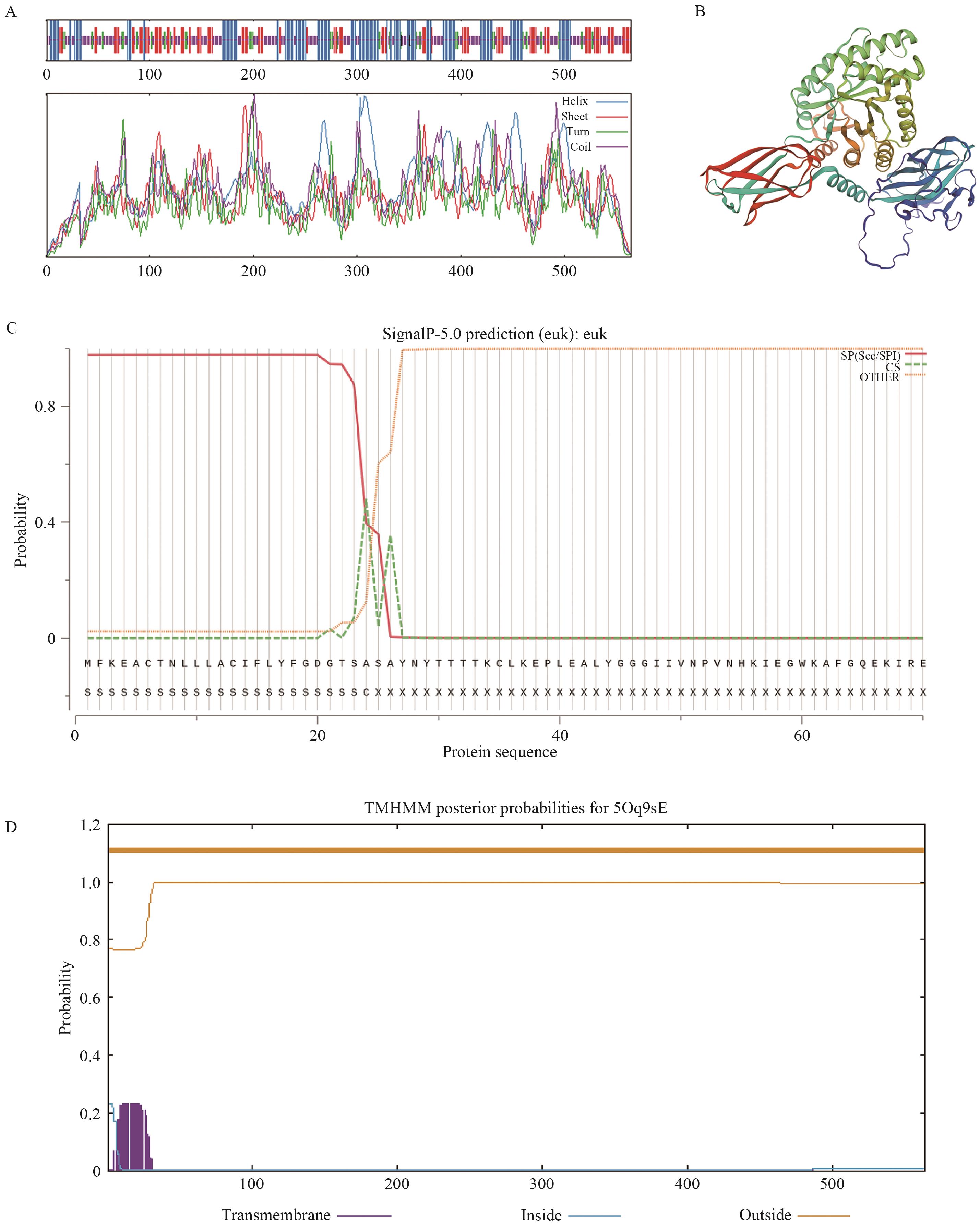
图2 RcXYNC蛋白质二级结构、三级结构、信号肽和跨膜结构域预测A:RcXYNC蛋白质二级结构预测;B:RcXYNC蛋白质三级结构预测;C:RcXYNC信号肽预测;D:RcXYNC跨膜结构域预测
Fig. 2 Predicted secondary structure, tertiary structure, signal peptides and transmembrane domain of RcXYNCproteinA: Predicted secondary structure of RcXYNCprotein. B: Predicted tertiary structure of RcXYNCprotein. C: Predicted signal peptides of RcXYNC. D: Predicted transmembrane domain of RcXYNC
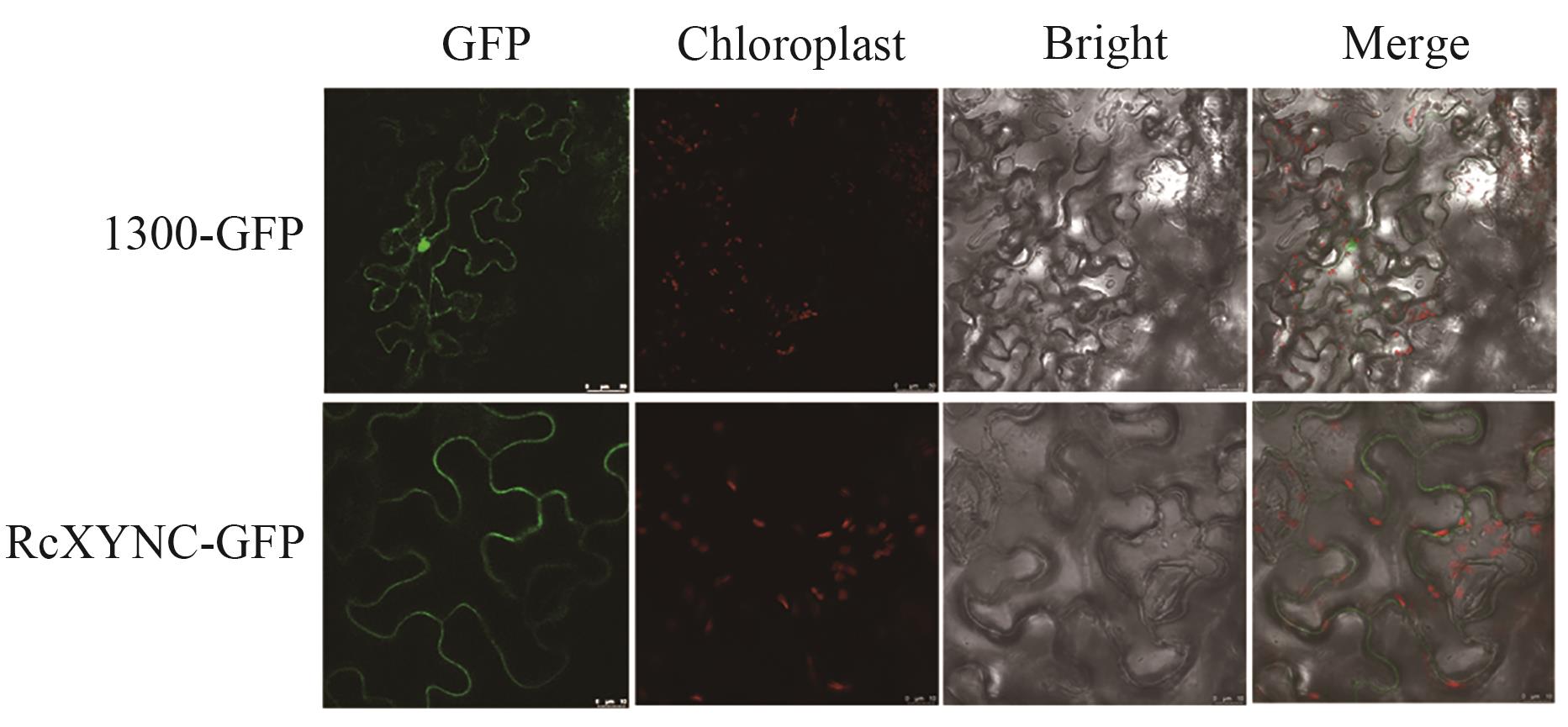
图3 RcXYNC蛋白的亚细胞定位GFP:绿色荧光蛋白;Chloroplast:叶绿体;Bright:明场;Merge:叠加场
Fig. 3 Subcellular localization of RcXYNC proteinGFP: Green fluorescent protein. Bright: Bright field. Merge: Integration of all fields
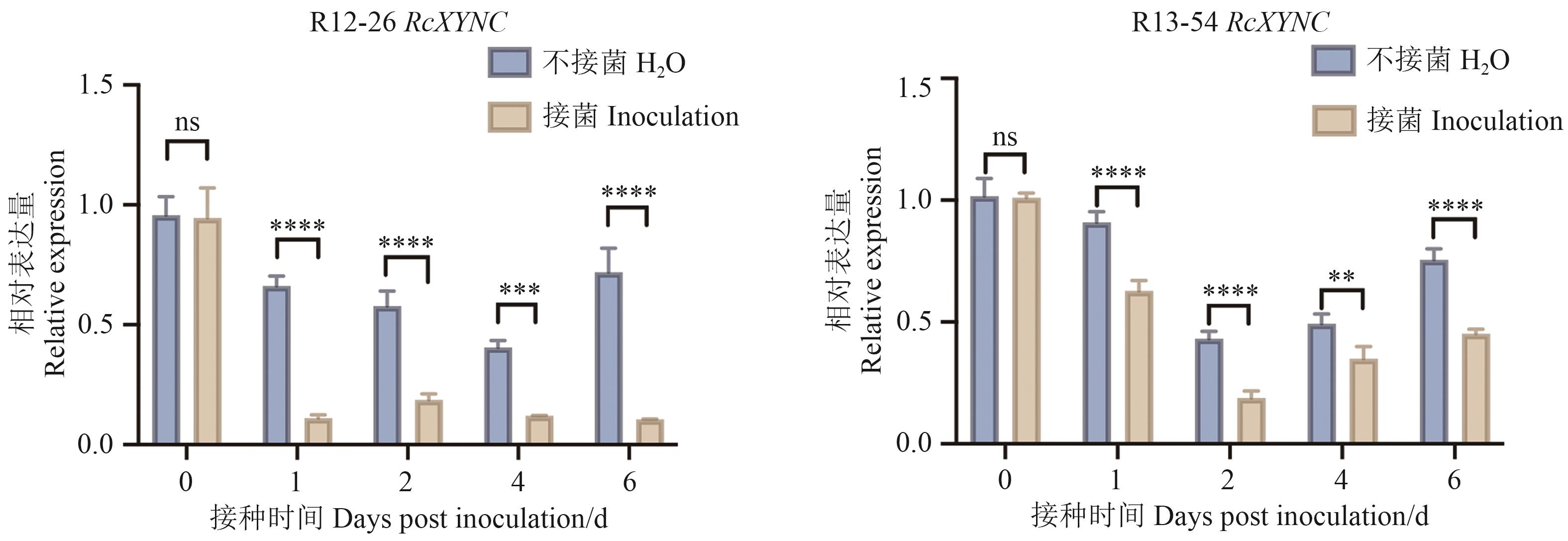
图4 蔷薇盘二孢侵染后RcXYNC的表达模式ns:无显著差异;*,P<0.05;**,P<0.01;***,P<0.001;****,P<0.000 1。下同
Fig. 4 Relative expression of RcXYNC in rose inoculated by H2O or M. rosaens: No significance; *, P<0.05; **, P<0.01; ***, P<0.001; ****, P<0.000 1. The same below

图5 RcXYNC的启动子序列及顺式作用元件分析A:基因启动子克隆凝胶电泳图;B:RcXYNC的启动子序列;C:RcXYNC启动子顺式作用元件示意图
Fig. 5 Analysis of RcXYNC promoter sequence and cis-acting elementsA: Electrophoresis map of gene promoter cloning. B: RcXYNC promoter sequence. C: Diagram of the cis-acting elements of the RcXYNC promoter
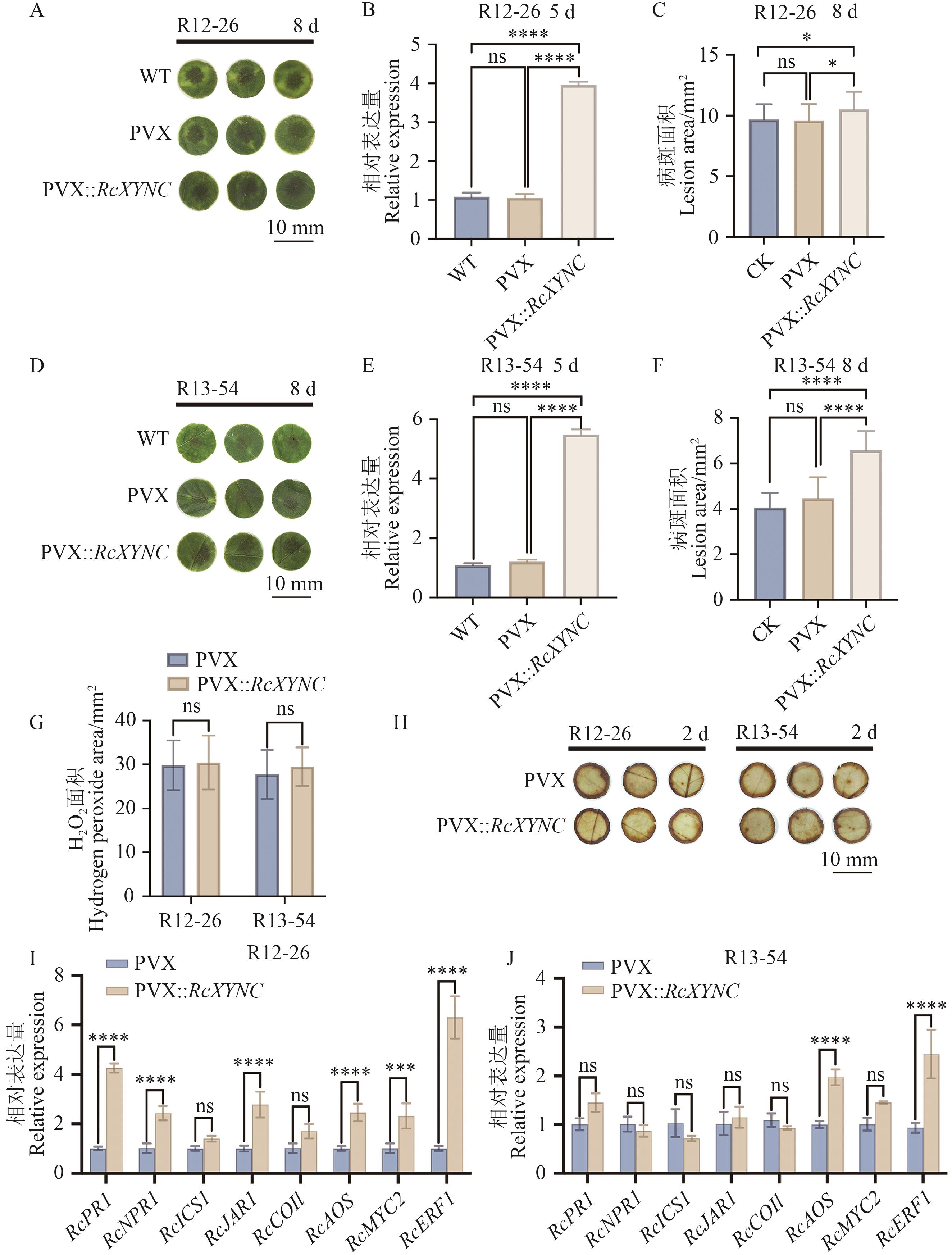
图6 瞬时过表达RcXYNC提高了月季对蔷薇盘二孢的敏感性A:瞬时过表达RcXYNC接种8 d后,R12-26叶盘的黑斑;B:瞬时过表达RcXYNC 接种5 d后,R12-26叶片中RcXYNC的相对表达量;C:瞬时过表达RcXYNC接种8 d后,R12-26叶盘的黑斑面积;D:瞬时过表达RcXYNC接种8 d后,R13-54叶盘的黑斑;E:瞬时过表达RcXYNC接种5 d后,R13-54叶片RcXYNC的相对表达量;F:瞬时过表达RcXYNC接种8 d后,R13-54叶盘的黑斑面积;G:瞬时过表达RcXYNC接种2 d后,R13-54和R12-26叶片的H2O2累积面积;H:瞬时过表达RcXYNC接种2 d后,R12-26和R13-54叶片的H2O2累积面积;I:瞬时过表达RcXYNC接种2 d后,R12-26叶片中抗性标志基因的表达量;J:瞬时过表达RcXYNC接种2 d后,R13-54叶片中抗性标志基因的表达量(WT:接种蔷薇盘二孢的月季叶片;PVX或PVX::RcXYNC,被用携带PVX空载体或PVX::RcXYNC重组载体的农杆菌悬浮液浸润后再接种蔷薇盘二孢的月季叶片)
Fig. 6 Transient overexpression of RcXYNC enhanced the sensitiveness of rose to M. rosaeA: The black spot phenotype of R12-26 infected with M. rosae under RcXYNC overexpression on 8 d. B: Relative expression of RcXYNC of R12-26 infected with M. rosae under RcXYNC overexpression on 5 d. C: The black spot area statistic of R12-26 infected with M. rosae under RcXYNC overexpression on 8 d. D: The black spot phenotype of R13-54 infected with M. rosae under RcXYNC overexpression on 8 d. E: Relative expression of RcXYNC of R13-54 infected with M. rosae under RcXYNC overexpression on 5 d. F: The black spot area statistic of R13-54 infected with M. rosae under RcXYNC overexpression on 8 d. G: The H2O2 accumulation area statistic of R12-26 and R13-54 infected with M. rosae under RcXYNC overexpression on 2 d. H: The H2O2 accumulation phenotype of R12-26 and R13-54 infected with M. rosae under RcXYNC overexpression on 2 d. I: Relative expression of defense genes in R12-26 infected with M. rosae under RcXYNC overexpression on 2 d. J: Relative expression of defense genes in R13-54 infected with M. rosae under RcXYNC overexpression on 2 d (WT: rose leaves inoculated with M. rosae; PVX or PVX::RcXYNC; rose leaves infiltrated with Agrobacterium suspensions carrying PVX empty vector or PVX::RcXYNC recombinant vector and subsequently inoculated with M. rosae)
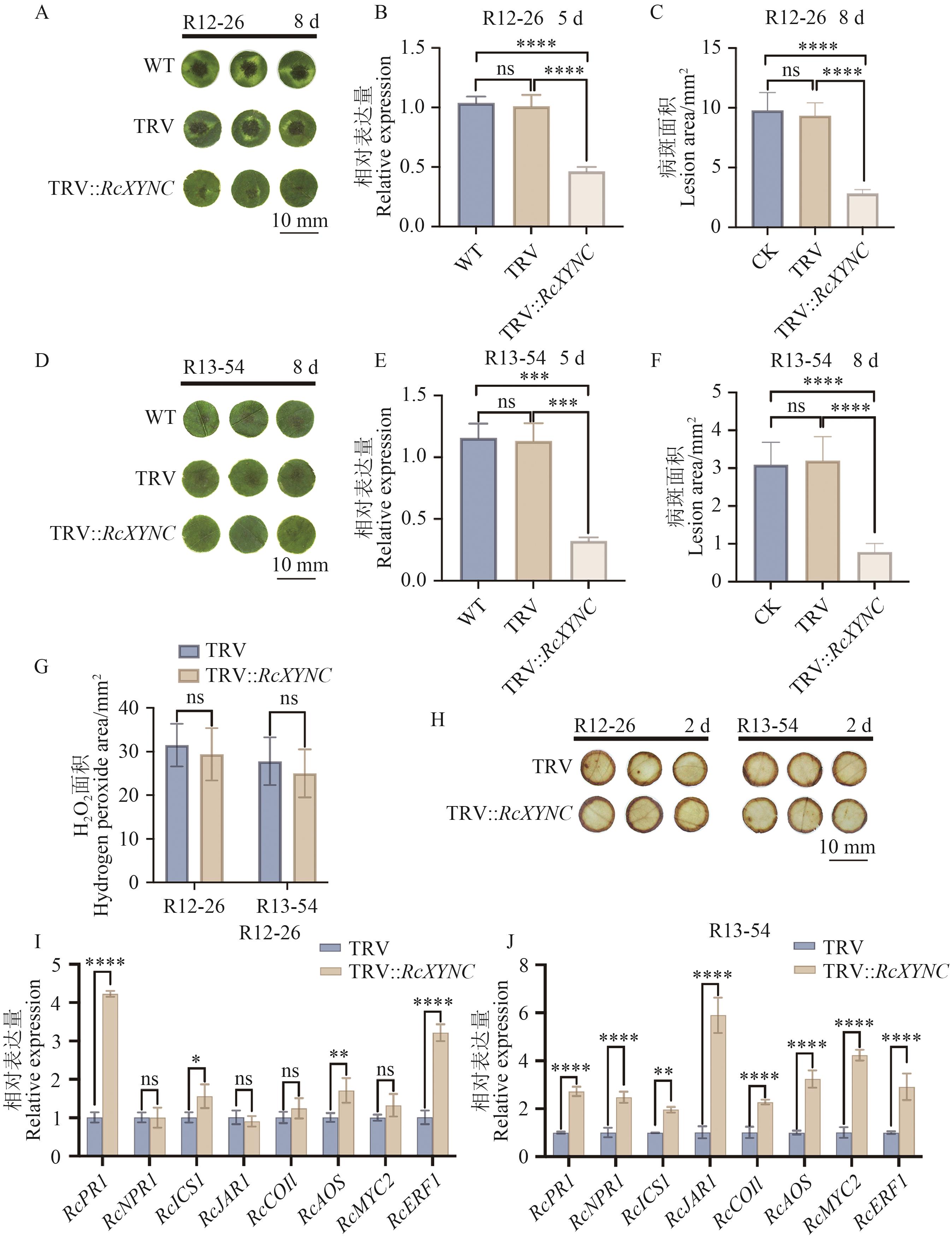
图7 沉默RcXYNC增强了月季对蔷薇盘二孢的抗性A:瞬时沉默RcXYNC接种8 d后,R12-26叶盘上的黑斑;B:瞬时沉默RcXYNC接种5 d后,R12-26叶片RcXYNC的相对表达量;C:瞬时沉默RcXYNC接种8 d后,R12-26叶盘的黑斑面积;D:瞬时沉默RcXYNC接种8 d后,R13-54叶盘上的黑斑;E:瞬时沉默RcXYNC接种5 d后,R13-54叶片RcXYNC的相对表达量;F:瞬时沉默RcXYNC接种8 d后,R13-54叶盘上的黑斑面积;G:瞬时沉默RcXYNC接种2 d后,R13-54和R12-26叶片H2O2的累积面积;H:瞬时沉默RcXYNC 接种2 d后,R12-26和R13-54叶片H2O2的累积情况;I:瞬时沉默RcXYNC接种2 d后,R12-26叶片抗性标志基因的表达量;J:瞬时沉默RcXYNC接种2 d后,R13-54叶片抗性标志基因的表达量(WT:接种蔷薇盘二孢的月季叶片;TRV或TRV::RcXYNC,被用携带TRV空载体或TRV::RcXYNC重组载体的农杆菌悬浮液浸润后再接种蔷薇盘二孢的月季叶片)
Fig. 7 Silencing of RcXYNC enhanced the resistance of rose to M. rosaeA: The black spot phenotype of R12-26 infected with M. rosae under RcXYNC silencing on 8 d. B: Relative expression of RcXYNC of R12-26 infected with M. rosae under RcXYNC silencing on 5 d. C: The black spot area statistic of R12-26 infected with M. rosae under RcXYNC silencing on 8 d. D: The black spot phenotype of R13-54 infected with M. rosae under RcXYNC silencing on 8 d. E: Relative expression of RcXYNC of R13-54 infected with M. rosae under RcXYNC silencing on 5 d. F: The black spot area statistic of R13-54 infected with M. rosae under RcXYNC silencing on 8 d. G: The H2O2 accumulation area statistic of R12-26 and R13-54 infected with M. rosae under RcXYNC silencing on 2 d. H: The H2O2 accumulation phenotype of R12-26 and R13-54 infected with M. rosae under RcXYNC silencing on 2 d. I: Relative expression of defense genes in R12-26 infected with M. rosae under RcXYNC silencing on 2 d. J: Relative expression of defense genes in R13-54 infected with M. rosae under RcXYNC silencing on 2 d (WT: rose leaves inoculated with M. rosae; TRV or TRV::RcXYNC; rose leaves infiltrated with Agrobacterium suspensions carrying TRV empty vector or TRV::RcXYNC recombinant vector and subsequently inoculated with M. rosae)
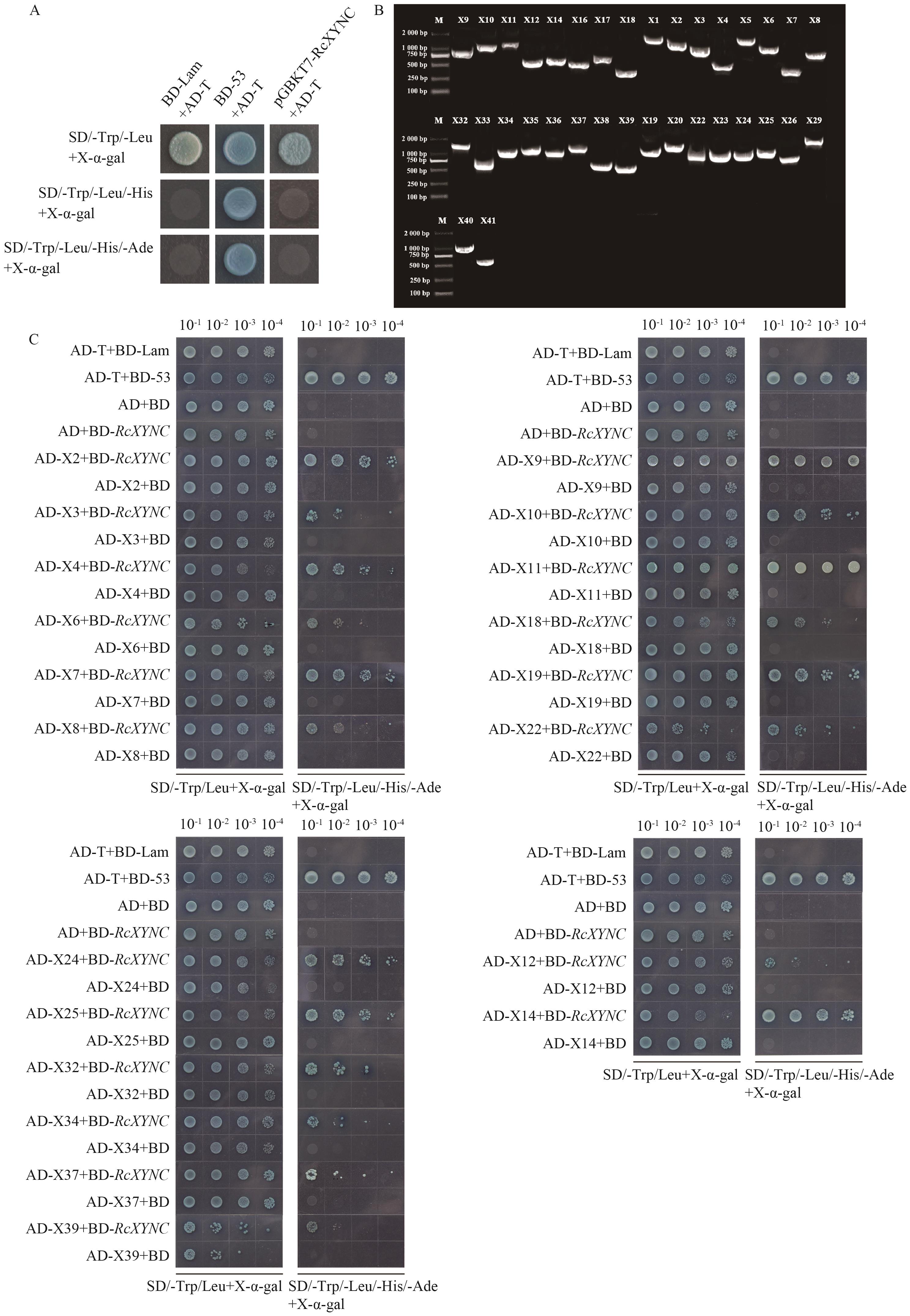
图8 酵母双杂交验证RcXYNC与候选蛋白的互作关系A:诱饵载体自激活活性检测;B:候选蛋白的基因克隆(泳道M:DL2000 marker;其余泳道:候选蛋白基因CDS区域克隆片段);C:酵母一对一验证RcXYNC与候选目标蛋白的互作关系(AD:pGADT7;BD:pGBKT7;AD-T+BD-Lam,AD+BD和AD+BD-RcXYNC:阴性对照;AD-T+BD-53:阳性对照;10-1、10-2、10-3、10-4:菌液的稀释梯度)
Fig. 8 Verifying the interaction between RcXYNC and candidate proteins via yeast two-hybridA: Self-activation identification of bait vector. B: Gene cloning of candidate proteins. (Lane M: DL2000 marker; other lanes: CDS cloning of candidate proteins) C: One-to-one validation of RcXYNC interaction with candidate target proteins in yeast (AD: pGADT7; BD: pGBKT7; AD-T+BD-Lam, AD+BD and AD+BD-RcXYNC: negative control; AD-T+BD-53: positive control; 10-1, 10-2, 10-3, 10-4: the dilution gradients of bacterial solution)
| 1 | 朱杰辉, 张宏志, 陈己任, 等. 月季黑斑病发生和危害及抗性育种的研究进展 [J]. 湖南农业大学学报: 自然科学版, 2017, 43(1): 47-51. |
| Zhu JH, Zhang HZ, Chen JR, et al. Progress in occurrence, harmfulness of rose black spot and resistance breeding technology of Rosa chinensis [J]. J Hunan Agric Univ Nat Sci, 2017, 43(1): 47-51. | |
| 2 | Gachomo EW, Dehne HW, Steiner U. Microscopic evidence for the hemibiotrophic nature of Diplocarpon rosae, cause of black spot disease of rose [J]. Physiol Mol Plant Pathol, 2006, 69(1/2/3): 86-92. |
| 3 | Bi MM, Li XY, Yan X, et al. Chrysanthemum WRKY15-1 promotes resistance to Puccinia horiana Henn. via the salicylic acid signaling pathway [J]. Hortic Res, 2021, 8(1): 6. |
| 4 | Luo D, Sun WH, Cai J, et al. SlBBX20 attenuates JA signalling and regulates resistance to Botrytis cinerea by inhibiting SlMED25 in tomato [J]. Plant Biotechnol J, 2023, 21(4): 792-805. |
| 5 | Wang YF, Duan GH, Li CQ, et al. Application of jasmonic acid at the stage of visible brown necrotic spots in Magnaporthe oryzae infection as a novel and environment-friendly control strategy for rice blast disease [J]. Protoplasma, 2021, 258(4): 743-752. |
| 6 | Xu TL, Zheng XW, Yang Y, et al. Indole-3 acetic acid negatively regulates rose black spot disease resistance through antagonizing the salicylic acid signaling pathway via jasmonic acid [J]. Planta, 2024, 259(6): 129. |
| 7 | Zheng XW, Ying YN, Long Y, et al. Genome wide analysis of the EXP family in Rosa chinensis and negative regulation of black spot disease by RcEXPA8 [J]. Sci Hortic, 2024, 324: 112566. |
| 8 | Lee KP, Li MP, Li MS, et al. Hierarchical regulatory module GENOMES UNCOUPLED1-GOLDEN2-LIKE1/2-WRKY18/40 modulates salicylic acid signaling [J]. Plant Physiol, 2023, 192(4): 3120-3133. |
| 9 | Van Breusegem F, Dat JF. Reactive oxygen species in plant cell death [J]. Plant Physiol, 2006, 141(2): 384-390. |
| 10 | Yang Y, Qi YC, Su L, et al. The Marssonina rosae effector MrSEP43 suppresses immunity in rose by targeting the orphan protein RcBROG [J]. J Exp Bot, 2024, 75(16): 4993-5007. |
| 11 | Cantu D, Vicente AR, Labavitch JM, et al. Strangers in the matrix: plant cell walls and pathogen susceptibility [J]. Trends Plant Sci, 2008, 13(11): 610-617. |
| 12 | Underwood W, Somerville SC. Focal accumulation of defences at sites of fungal pathogen attack [J]. J Exp Bot, 2008, 59(13): 3501-3508. |
| 13 | Hückelhoven R. Cell wall-associated mechanisms of disease resistance and susceptibility [J]. Annu Rev Phytopathol, 2007, 45: 101-127. |
| 14 | Lamb C, Dixon RA. The oxidative burst in plant disease resistance [J]. Annu Rev Plant Physiol Plant Mol Biol, 1997, 48: 251-275. |
| 15 | Bacete L, Mélida H, Miedes E, et al. Plant cell wall-mediated immunity: cell wall changes trigger disease resistance responses [J]. Plant J, 2018, 93(4): 614-636. |
| 16 | Miedes E, Vanholme R, Boerjan W, et al. The role of the secondary cell wall in plant resistance to pathogens [J]. Front Plant Sci, 2014, 5: 358. |
| 17 | López-Cruz J, Finiti I, Fernández-Crespo E, et al. Absence of endo-1, 4-β-glucanase KOR1 alters the jasmonate-dependent defence response to Pseudomonas syringae in Arabidopsis [J]. J Plant Physiol, 2014, 171(16): 1524-1532. |
| 18 | Zheng XW, Long Y, Liu XY, et al. RcWRKY40 regulates the antagonistic SA-JA pathway in response to Marssonina rosae infection [J]. Sci Hortic, 2024, 332: 113178. |
| 19 | 徐明慧, 林绍光. 月季黑斑病生物学特性研究 [J]. 云南农业大学学报, 1989, 4(2): 134-139. |
| Xu MH, Lin SG. Studies on Chinese rose black-spot-lts symptoms, damage, pathogen and biological characteristics [J]. J Yunnan Agric Univ, 1989, 4(2): 134-139. | |
| 20 | 徐东生, 孟志卿. 月季抗黑斑病机理研究 [J]. 安徽农业科学, 2007, 35(27): 8532-8533. |
| Xu DS, Meng ZQ. Research on the resistant mechanism of the rose black spot [J]. J Anhui Agric Sci, 2007, 35(27): 8532-8533. | |
| 21 | 孟志卿. 月季抗黑斑病品种酶活性的研究 [J]. 安徽农业科学, 2007, 35(24): 7454-7455. |
| Meng ZQ. Study on the enzyme activity in different varieties of Chinese roses against black spot disease [J]. J Anhui Agric Sci, 2007, 35(24): 7454-7455. | |
| 22 | 郭艳红, 张颢, 陈宇春, 等. 蔷薇属黑斑病抗性与叶片结构及酶活性研究 [J]. 西南农业学报, 2021, 34(8): 1637-1642. |
| Guo YH, Zhang H, Chen YC, et al. Resistance to black spot of Rosa and its leaf structure and enzyme activity [J]. Southwest China J Agric Sci, 2021, 34(8): 1637-1642. | |
| 23 | Yang SM, Xu TL, Yang Y, et al. H2O2 accumulation plays critical role in black spot disease resistance in roses [J]. Hortic Environ Biotechnol, 2023, 64(1): 1-14. |
| 24 | 徐庭亮. 月季对蔷薇盘二孢(Marssonina rosae)入侵的防御机制研究 [D]. 北京: 北京林业大学, 2020. |
| Xu TL. Study on the defense mechanism of rose against the invasion of Marssonina rosae [D]. Beijing: Beijing Forestry University, 2020. | |
| 25 | 高丽丹. 木聚糖酶基因对菰黑粉菌侵染能力的作用研究 [D]. 杭州: 中国计量大学, 2021. |
| Gao LD. Study on the effect of xylanase gene on the infection ability of ustilaginella Ustilaginoidea [D]. Hangzhou: China University of Metrology, 2021. | |
| 26 | 孙雪滢. 玉米茎腐病菌(Fusarium verticillioides)木聚糖酶FvXyn10的异源表达及酶学性质研究 [D]. 泰安: 山东农业大学, 2023. |
| Sun XY. Heterologous expression and enzymatic properties of xylanase FvXyn10 from Fusarium verticillioides [D]. Tai'an: Shandong Agricultural University, 2023. | |
| 27 | 杨淑敏, 杨艺, 罗乐, 等. 蔷薇属植物响应蔷薇盘二孢侵染内参基因的筛选及茉莉酸相关基因表达分析 [J]. 北京林业大学学报, 2023, 45(4): 114-125. |
| Yang SM, Yang Y, Luo L, et al. Selection and validation of appropriate reference genes and expression analysis of jasmonic acid-related genes responding to Marssonina rosae in Rosa species and cultivars [J]. J Beijing For Univ, 2023, 45(4): 114-125. | |
| 28 | Raymond O, Gouzy J, Just J, et al. The Rosa genome provides new insights into the domestication of modern roses [J]. Nat Genet, 2018, 50(6): 772-777. |
| 29 | 刘颖, 付偲僮, 司未佳, 等. 小报春类钙调素蛋白基因PfCML41的克隆及序列分析 [J]. 分子植物育种, 2021, 19(19): 6356-6364. |
| Liu Y, Fu ST, Si WJ, et al. Cloning and sequence analysis of calmodulin-like gene PfCML41 from Primula forbesii [J]. Mol Plant Breed, 2021, 19(19): 6356-6364. | |
| 30 | Ju YQ, Feng L, Wu JY, et al. Transcriptome analysis of the genes regulating phytohormone and cellular patterning in Lagerstroemia plant architecture [J]. Sci Rep, 2018, 8(1): 15162. |
| 31 | Dong QN, Wang XW, Byrne DH, et al. Characterization of partial resistance to black spot disease of Rosa sp [J]. HortScience, 2017, 52(1): 49-53. |
| 32 | 刘瑞峰, 贾桂霞. 水杨酸和茉莉酸/乙烯信号通路关键基因在月季‒黑斑病菌互作中的表达模式 [J]. 林业科学, 2020, 56(6): 47-58. |
| Liu RF, Jia GX. Expression patterns of key genes of salicylic acid and jasmonic acid/ethylene signaling pathways in the interaction between rose and Diplocarpon rosae [J]. Sci Silvae Sin, 2020, 56(6): 47-58. | |
| 33 | Zhang LS, Ni H, Du X, et al. The Verticillium-specific protein VdSCP7 localizes to the plant nucleus and modulates immunity to fungal infections [J]. New Phytol, 2017, 215(1): 368-381. |
| 34 | Houston K, Tucker MR, Chowdhury J, et al. The plant cell wall: a complex and dynamic structure as revealed by the responses of genes under stress conditions [J]. Front Plant Sci, 2016, 7: 984. |
| 35 | Agabekian IA, Abdulkina LR, Lushnenko AY, et al. Arabidopsis AN3 and OLIGOCELLULA genes link telomere maintenance mechanisms with cell division and expansion control [J]. Res Sq, 2023: rs.3.rs-rs.3438810. |
| 36 | Delgado-Cerezo M, Sánchez-Rodríguez C, Escudero V, et al. Arabidopsis heterotrimeric G-protein regulates cell wall defense and resistance to necrotrophic fungi [J]. Mol Plant, 2012, 5(1): 98-114. |
| 37 | Rogers LA, Dubos C, Surman C, et al. Comparison of lignin deposition in three ectopic lignification mutants [J]. New Phytol, 2005, 168(1): 123-140. |
| 38 | Chowdhury J, Lück S, Rajaraman J, et al. Altered expression of genes implicated in xylan biosynthesis affects penetration resistance against powdery mildew [J]. Front Plant Sci, 2017, 8: 445. |
| 39 | Minic Z. Physiological roles of plant glycoside hydrolases [J]. Planta, 2008, 227(4): 723-740. |
| 40 | Ma FL, Yang XF, Shi ZY, et al. Novel crosstalk between ethylene- and jasmonic acid-pathway responses to a piercing-sucking insect in rice [J]. New Phytol, 2020, 225(1): 474-487. |
| 41 | 屠文燕. 苹果腐烂病菌效应蛋白Vm4797功能分析及其寄主靶标鉴定 [D]. 杨凌: 西北农林科技大学, 2022. |
| Tu WY. Functional analysis and host target identification of effector protein Vm4797 of apple rot fungus [D]. Yangling: Northwest A & F University, 2022. |
| [1] | 张益瑄, 马宇, 王童童, 盛苏奥, 宋家凤, 吕钊彦, 朱晓彪, 侯华兰. 马铃薯DIR家族全基因组鉴定及表达模式分析[J]. 生物技术通报, 2025, 41(3): 123-136. |
| [2] | 韩江涛, 张帅博, 秦雅蕊, 韩硕洋, 张雅康, 王吉庆, 杜清洁, 肖怀娟, 李猛. 甜瓜β-淀粉酶基因家族的鉴定及对非生物胁迫的响应[J]. 生物技术通报, 2025, 41(3): 171-180. |
| [3] | 焦小雨, 吴琼, 刘丹丹, 孙明慧, 阮旭, 王雷刚, 王文杰. 茶树CsWAK8克隆及其在响应冷胁迫过程中的功能分析[J]. 生物技术通报, 2025, 41(2): 210-220. |
| [4] | 匡健华, 程志鹏, 赵永晶, 杨洁, 陈润乔, 陈龙清, 胡慧贞. 激素和非生物胁迫下荷花GH3基因家族的表达分析[J]. 生物技术通报, 2025, 41(2): 221-233. |
| [5] | 葛仕杰, 刘怡德, 张华东, 宁强, 朱展望, 王书平, 刘易科. 小麦蛋白质二硫键异构酶基因家族的鉴定与表达[J]. 生物技术通报, 2025, 41(2): 85-96. |
| [6] | 殷缘, 程爽, 刘定豪, 邓晓霞, 李凯月, 王竞红, 蔺吉祥. 外源过氧化氢(H2O2)影响非生物胁迫下植物生长与生理代谢机制的研究进展[J]. 生物技术通报, 2025, 41(1): 1-13. |
| [7] | 武志健, 刘广洋, 林志豪, 盛彬, 陈鸽, 许晓敏, 王军伟, 徐东辉. 蔬菜种子萌发的纳米调控及其机制研究进展[J]. 生物技术通报, 2025, 41(1): 14-24. |
| [8] | 李禹欣, 李苗, 杜晓芬, 韩康妮, 连世超, 王军. 谷子SiSAP基因家族的鉴定与表达分析[J]. 生物技术通报, 2025, 41(1): 143-156. |
| [9] | 寇焙森, 程萌萌, 郭雪琴, 葛彬, 刘迪, 陆海, 李慧. 组蛋白去乙酰化酶抑制剂TSA处理对杨树茎生长发育的影响[J]. 生物技术通报, 2025, 41(1): 240-251. |
| [10] | 申鹏, 高雅彬, 丁红. 马铃薯SAT基因家族的鉴定和表达分析[J]. 生物技术通报, 2024, 40(9): 64-73. |
| [11] | 满全财, 孟姿诺, 李伟, 蔡心汝, 苏润东, 付长青, 高顺娟, 崔江慧. 马铃薯AQP基因家族鉴定及表达分析[J]. 生物技术通报, 2024, 40(9): 51-63. |
| [12] | 李勇慧, 鲍星星, 段一珂, 赵运霞, 于相丽, 陈尧, 张延召. 灵宝杜鹃bZIP家族全基因组鉴定及表达特征分析[J]. 生物技术通报, 2024, 40(8): 186-198. |
| [13] | 崔原瑗, 王昭懿, 白双宇, 任毓昭, 豆飞飞, 刘彩霞, 刘凤楼, 王掌军, 李清峰. 大麦非特异性磷脂酶C基因家族全基因组鉴定及苗期胁迫表达分析[J]. 生物技术通报, 2024, 40(8): 74-82. |
| [14] | 刘丹丹, 王雷刚, 孙明慧, 焦小雨, 吴琼, 王文杰. 茶树海藻糖-6-磷酸合成酶(TPS)基因家族鉴定与表达分析[J]. 生物技术通报, 2024, 40(8): 152-163. |
| [15] | 余纽, 柳帆, 杨锦昌. 油楠SgTPS7的克隆及其在萜类生物合成和非生物胁迫中的功能[J]. 生物技术通报, 2024, 40(8): 164-173. |
| 阅读次数 | ||||||
|
全文 |
|
|||||
|
摘要 |
|
|||||
