







生物技术通报 ›› 2025, Vol. 41 ›› Issue (8): 311-321.doi: 10.13560/j.cnki.biotech.bull.1985.2024-1281
• 研究报告 • 上一篇
柴军发1( ), 洪波2, 贾彦霞2()
收稿日期:2024-12-31
出版日期:2025-08-26
发布日期:2025-08-14
通讯作者:
贾彦霞,女,教授,研究方向 :昆虫生态学与害虫综合防治;E-mail: helenjia_2006@126.com作者简介:柴军发,男,硕士研究生,研究方向 :农业昆虫与害虫防治;E-mail: chaijf920@163.com
基金资助:
CHAI Jun-fa1(), HONG Bo2, JIA Yan-xia2()
Received:2024-12-31
Published:2025-08-26
Online:2025-08-14
摘要:
目的 研究蜡蚧轮枝菌(Lecanicillium lecanii)不同菌株的毒力差异,结合转录组学和代谢组学数据分析,筛选蜡蚧轮枝菌(L. lecanii)菌株毒力的关键性差异表达基因(DEGs)及次级代谢产物(DEMs)。 方法 采用RNA-seq和LC-MS/MS技术,对培养8 d和液体发酵8 d的3株蜡蚧轮枝菌的基因表达和次级代谢产物进行检测,同时对差异基因进行RT-qPCR验证。 结果 室内毒力结果表明,J-1次级代谢产物对桃蚜的毒力最好,与J-2和V-1存在极显著差异。转录组和代谢组结果表明,J-1_vs_J-2获得225个DEGs和59种DEMs,J-1_vs_V-1获得2 464个DEGs和75种DEMs。差异基因与差异代谢物经KEGG富集分析,主要富集在苯丙氨酸代谢、酪氨酸代谢及ABC转运蛋白中,得到79个DEGs和19种DEMs,高毒力菌株与低毒力菌株间,水杨酸、3-羟基苯乙酸、苯乳酸、马尿酸和Methyl beta-D-galactoside显著上调,去甲肾上腺素极显著下调,c75905.graph_c0、c78027.graph_c0、c77968.graph_c0、c78586.graph_c1、c74779.graph_c0和c78871.graph_c0显著上调。RT-qPCR结果表明,关键差异基因与转录组中表达趋势一致。 结论 转录组和代谢组联合分析发现可能参与调控蜡蚧轮枝菌菌株毒力的6个关键基因和6个显著富集差异代谢物,为构建高毒力菌株提供依据。
柴军发, 洪波, 贾彦霞. 转录组和代谢组联合分析三株蜡蚧轮枝菌菌株毒力差异[J]. 生物技术通报, 2025, 41(8): 311-321.
CHAI Jun-fa, HONG Bo, JIA Yan-xia. Combined Transcriptomic and Metabolomic Analysis of Virulence Differences among Three Lecanicillium lecanii Strains[J]. Biotechnology Bulletin, 2025, 41(8): 311-321.
名称 Name | CAS | 纯度 Purity | 品牌 Brands |
|---|---|---|---|
| 甲醇 | 67-56-1 | ≥99.0% | Thermo |
| 乙腈 | 75-05-8 | ≥99.9% | Thermo |
| 甲酸 | 64-18-6 | LC-MS grade | TCI |
| 甲酸铵 | 540-69-2 | ≥99.9% | Sigma |
| H2O | Millipore | ||
| Succinic acid-2,2,3,3,-d4 | 14493-42-6 | sigma | |
| Cholic acid-2,2,3,4,4,-d5 | 53007-09-3 | sigma | |
| DL-Tryptophan-2,3,3-d3 | 340257-61-6 | CDN | |
| DL-Methionine-3,3,4,4-d4 | 93709-61-6 | CDN | |
| L-PHENYLALANINE (RING-D5) | 63-91-2 | 98% | CIL |
| CHOLINE CHLORIDE(TRIMETHYL-D9) | / | 98% | CIL |
表1 代谢组学检测主要试剂
Table 1 Main reagents for metabolomics assays
名称 Name | CAS | 纯度 Purity | 品牌 Brands |
|---|---|---|---|
| 甲醇 | 67-56-1 | ≥99.0% | Thermo |
| 乙腈 | 75-05-8 | ≥99.9% | Thermo |
| 甲酸 | 64-18-6 | LC-MS grade | TCI |
| 甲酸铵 | 540-69-2 | ≥99.9% | Sigma |
| H2O | Millipore | ||
| Succinic acid-2,2,3,3,-d4 | 14493-42-6 | sigma | |
| Cholic acid-2,2,3,4,4,-d5 | 53007-09-3 | sigma | |
| DL-Tryptophan-2,3,3-d3 | 340257-61-6 | CDN | |
| DL-Methionine-3,3,4,4-d4 | 93709-61-6 | CDN | |
| L-PHENYLALANINE (RING-D5) | 63-91-2 | 98% | CIL |
| CHOLINE CHLORIDE(TRIMETHYL-D9) | / | 98% | CIL |
| 基因ID Gene ID | 正向引物Forward primer (5′-3′) | 反向引物 Reverse primer (5′-3′) |
|---|---|---|
| GAPDH | F: CCCCAAACACCTCATCCTCA | R: ATGCCAACCTTGACGGGAG |
| c78027.graph_c0 | F: CAATCCGGCCCGACTACTTCT | R: TTACATGGCAACAACTGGTGAGG |
| c77500.graph_c2 | F: TCTGAGAGTGTCCCGTCGAT | R: GCGAGACTCGATCCAGAGTG |
| c78385.graph_c0 | F: CGCAGTTCAACTTGTGGTGG | R: AACGAGACGGCAACATGAGT |
| c74339.graph_c0 | F: CATGGGCGGTTCGATACTCA | R: ATAGGTCCAGCGGTCAGAGT |
| c77841.graph_c0 | F: ATCACGCTTCCACATTCACTCAC | R: CTTGAAATCCTGGAGGTTGATGTAG |
| c80667.graph_c0 | F: CGTGGTGATAGTAATGAGAACGGAC | R: GGCGTGTCATGCTACGTTCATAT |
| c71547.graph_c0 | F: GGCCAATCAATGGGACGAAA | R: CACATCGCCGACCAACCAA |
表2 RTqPCR 验证基因及引物设计
Table 2 Gene selection and primer design for RT-qPCR
| 基因ID Gene ID | 正向引物Forward primer (5′-3′) | 反向引物 Reverse primer (5′-3′) |
|---|---|---|
| GAPDH | F: CCCCAAACACCTCATCCTCA | R: ATGCCAACCTTGACGGGAG |
| c78027.graph_c0 | F: CAATCCGGCCCGACTACTTCT | R: TTACATGGCAACAACTGGTGAGG |
| c77500.graph_c2 | F: TCTGAGAGTGTCCCGTCGAT | R: GCGAGACTCGATCCAGAGTG |
| c78385.graph_c0 | F: CGCAGTTCAACTTGTGGTGG | R: AACGAGACGGCAACATGAGT |
| c74339.graph_c0 | F: CATGGGCGGTTCGATACTCA | R: ATAGGTCCAGCGGTCAGAGT |
| c77841.graph_c0 | F: ATCACGCTTCCACATTCACTCAC | R: CTTGAAATCCTGGAGGTTGATGTAG |
| c80667.graph_c0 | F: CGTGGTGATAGTAATGAGAACGGAC | R: GGCGTGTCATGCTACGTTCATAT |
| c71547.graph_c0 | F: GGCCAATCAATGGGACGAAA | R: CACATCGCCGACCAACCAA |
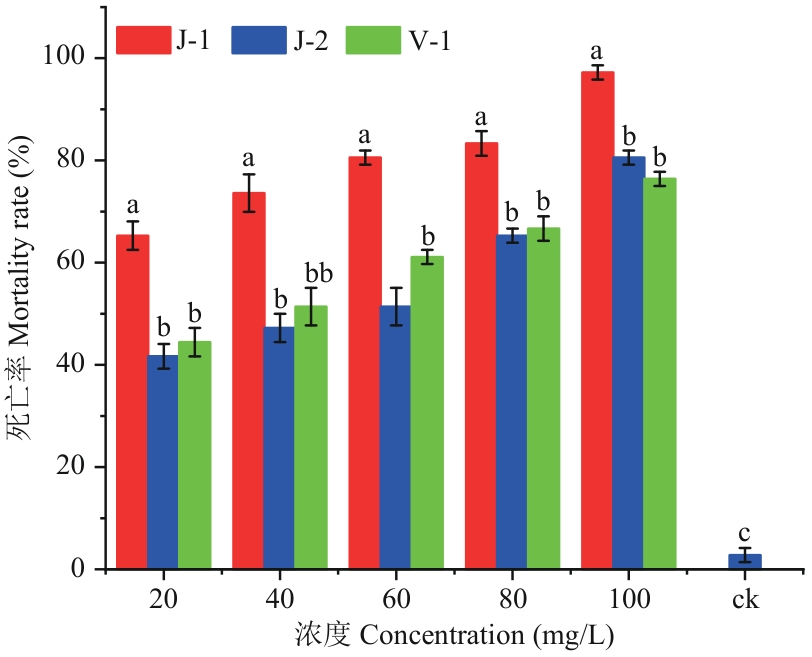
图1 毒力测定不同字母表示同浓度不同菌株间差异达到显著水平(P<0.05)
Fig. 1 Toxicity determinationDifferent letters indicate that the differences among different strains at the same concentration reach a significant level (P<0.05)
样本名称 Sample | Read number | Clean bases | 碱基质量值≥Q30 Base quality value(%) | GC含量 GC content(%) |
|---|---|---|---|---|
| J-1-1 | 19 650 825 | 5 859 575 818 | 94.76 | 55.46 |
| J-1-2 | 22 287 859 | 6 648 086 524 | 95.63 | 55.51 |
| J-1-3 | 21 026 399 | 6 275 725 238 | 95.40 | 55.51 |
| J-2-1 | 22 649 343 | 6 759 978 410 | 95.32 | 55.33 |
| J-2-2 | 19 611 279 | 5 792 883 170 | 96.13 | 54.98 |
| J-2-3 | 20 383 277 | 6 077 510 742 | 95.28 | 55.53 |
| V-1-1 | 20 089 720 | 5 971 239 342 | 94.51 | 55.26 |
| V-1-2 | 19 968 516 | 5 946 912 808 | 95.82 | 55.62 |
| V-1-3 | 24 919 447 | 7 407 074 958 | 95.32 | 54.73 |
表3 蜡蚧轮枝菌转录测序结果
Table 3 Transcriptional sequencing results of L. lecanii
样本名称 Sample | Read number | Clean bases | 碱基质量值≥Q30 Base quality value(%) | GC含量 GC content(%) |
|---|---|---|---|---|
| J-1-1 | 19 650 825 | 5 859 575 818 | 94.76 | 55.46 |
| J-1-2 | 22 287 859 | 6 648 086 524 | 95.63 | 55.51 |
| J-1-3 | 21 026 399 | 6 275 725 238 | 95.40 | 55.51 |
| J-2-1 | 22 649 343 | 6 759 978 410 | 95.32 | 55.33 |
| J-2-2 | 19 611 279 | 5 792 883 170 | 96.13 | 54.98 |
| J-2-3 | 20 383 277 | 6 077 510 742 | 95.28 | 55.53 |
| V-1-1 | 20 089 720 | 5 971 239 342 | 94.51 | 55.26 |
| V-1-2 | 19 968 516 | 5 946 912 808 | 95.82 | 55.62 |
| V-1-3 | 24 919 447 | 7 407 074 958 | 95.32 | 54.73 |

图2 蜡蚧轮枝菌差异表达基因
Fig. 2 Differentially expressed genes of L. lecanii
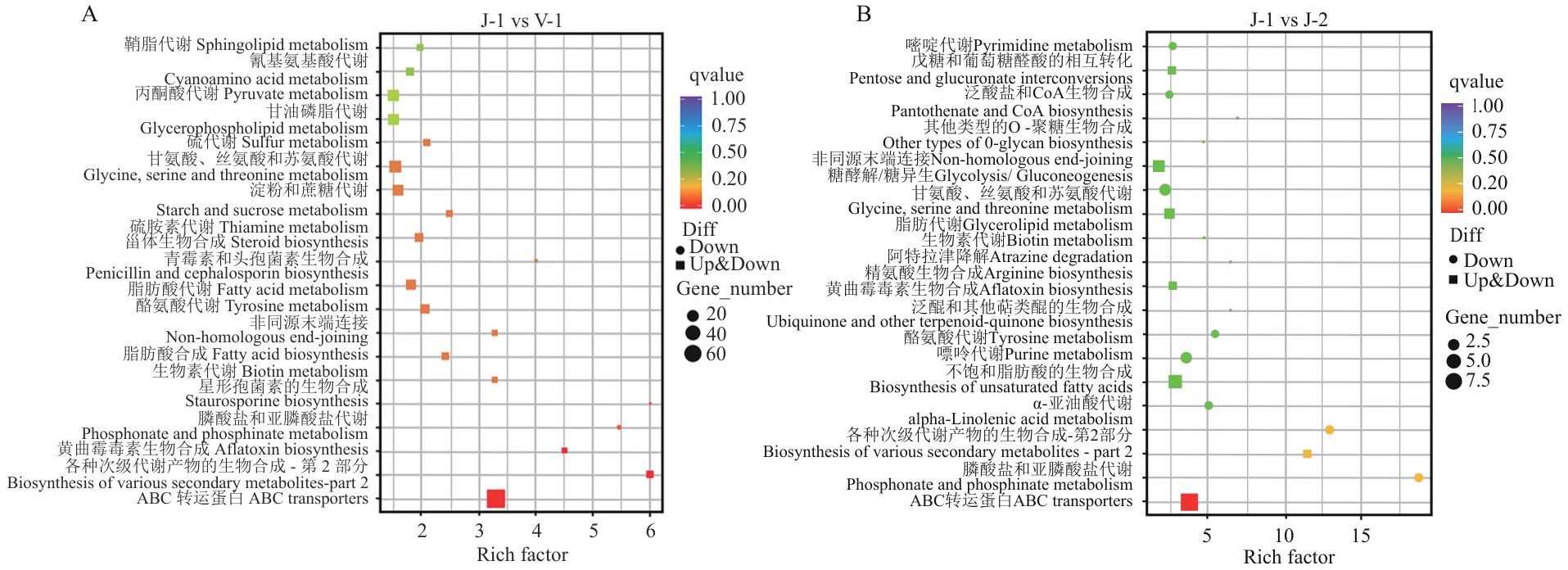
图3 三株蜡蚧轮枝菌差异基因KEGG富集分析
Fig. 3 KEGG enrichment analysis for differential genes in three strains of L. lecanii
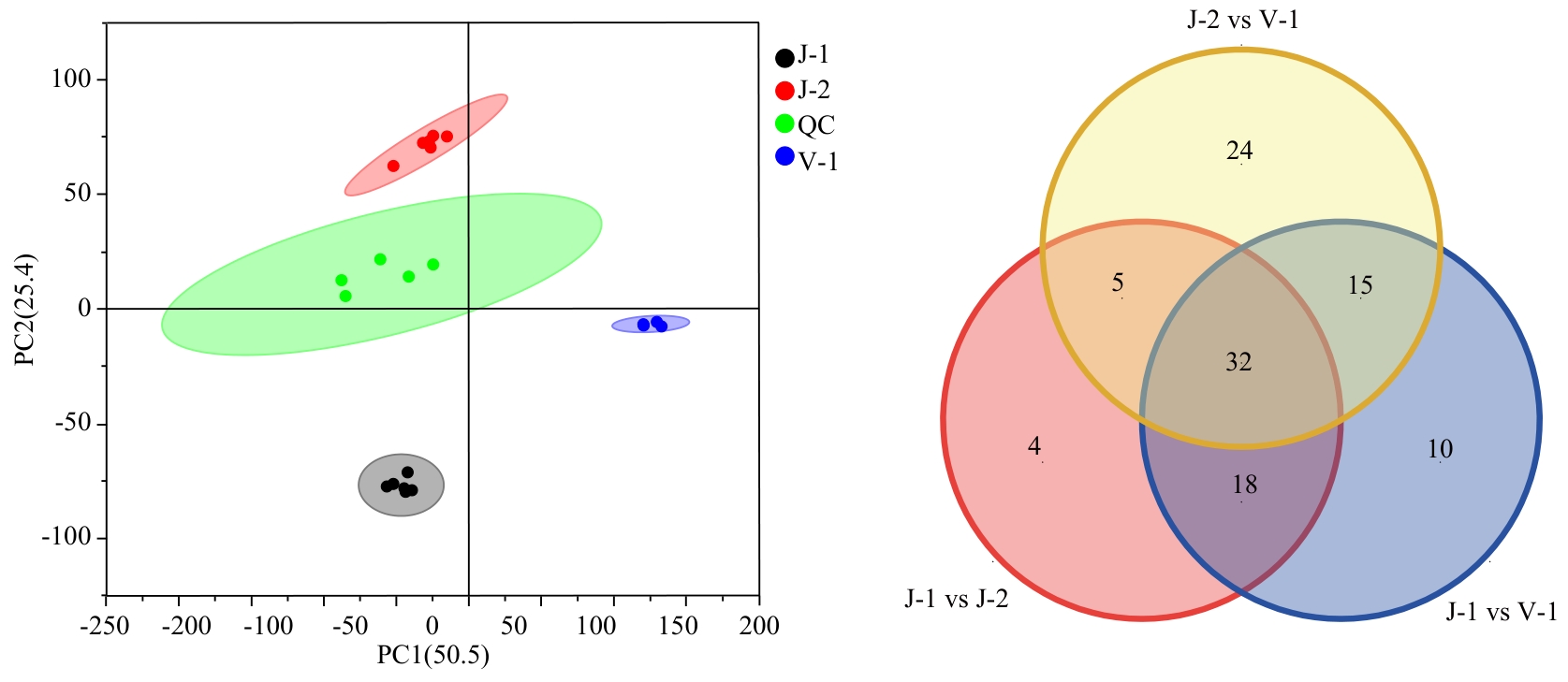
图4 蜡蚧轮枝菌PCA分析及差异代谢物韦恩图
Fig. 4 Venn diagram of PCA analysis and differential metabolite in L. lecanii
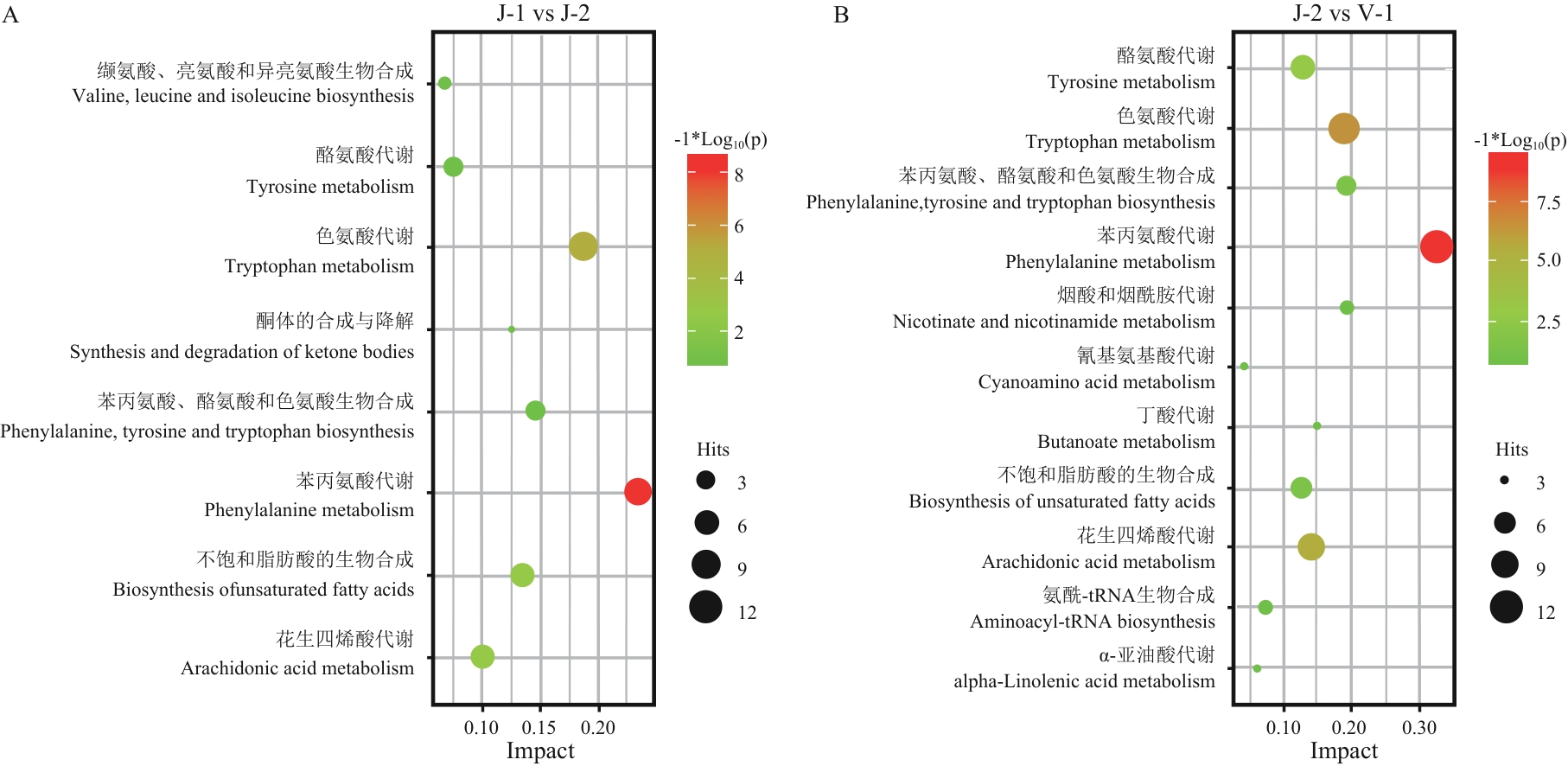
图5 差异代谢物KEGG富集分析
Fig. 5 KEGG enrichment analysis of differential metabolites
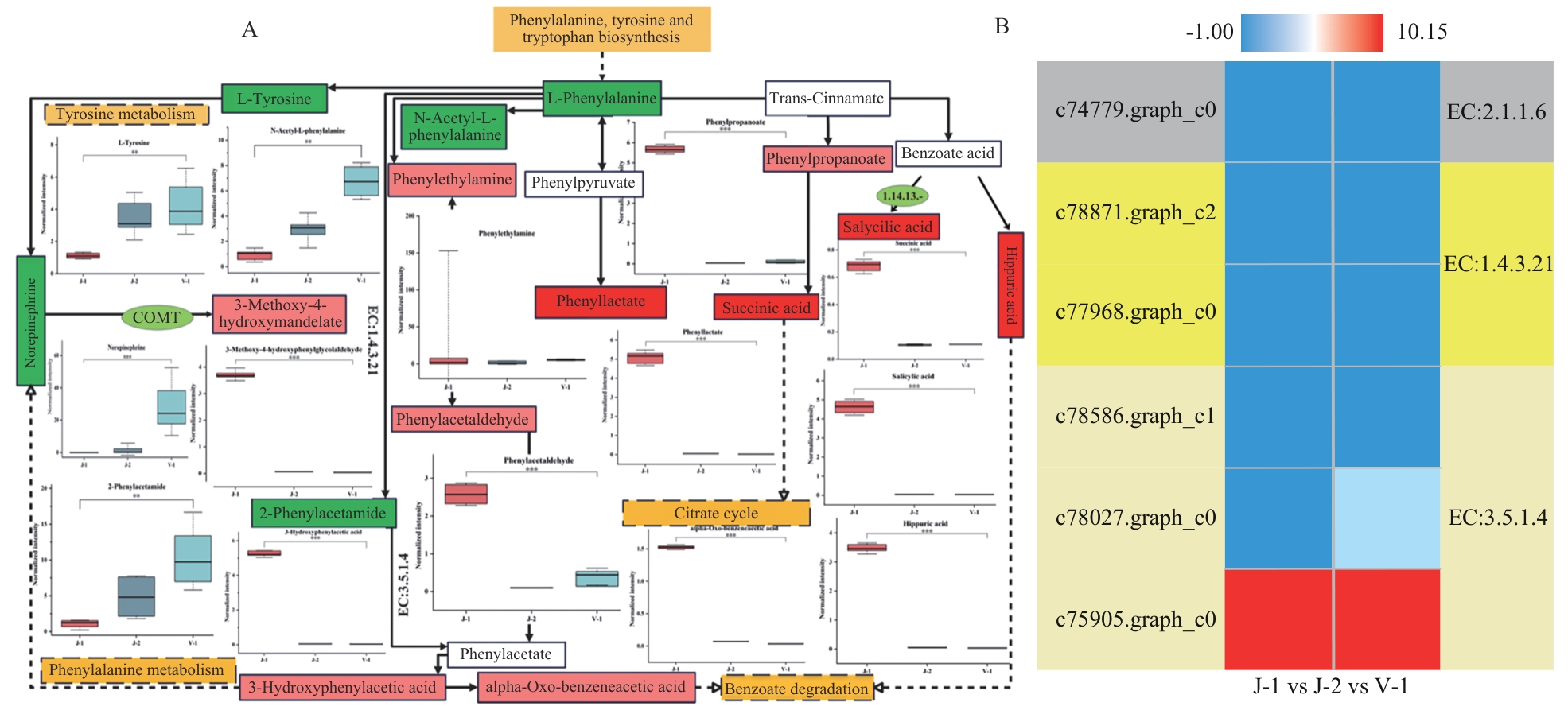
图6 苯丙氨酸、酪氨酸代谢通路中差异代谢物和差异基因红色代表上调基因或代谢物,绿色代表下调基因数目或代谢物
Fig. 6 DEMs and DEGs in the phenylalanine and tyrosine metabolic pathwaysRed indicates up-regulated genes or metabolites, and green indicates the number of down-regulated genes or metabolites
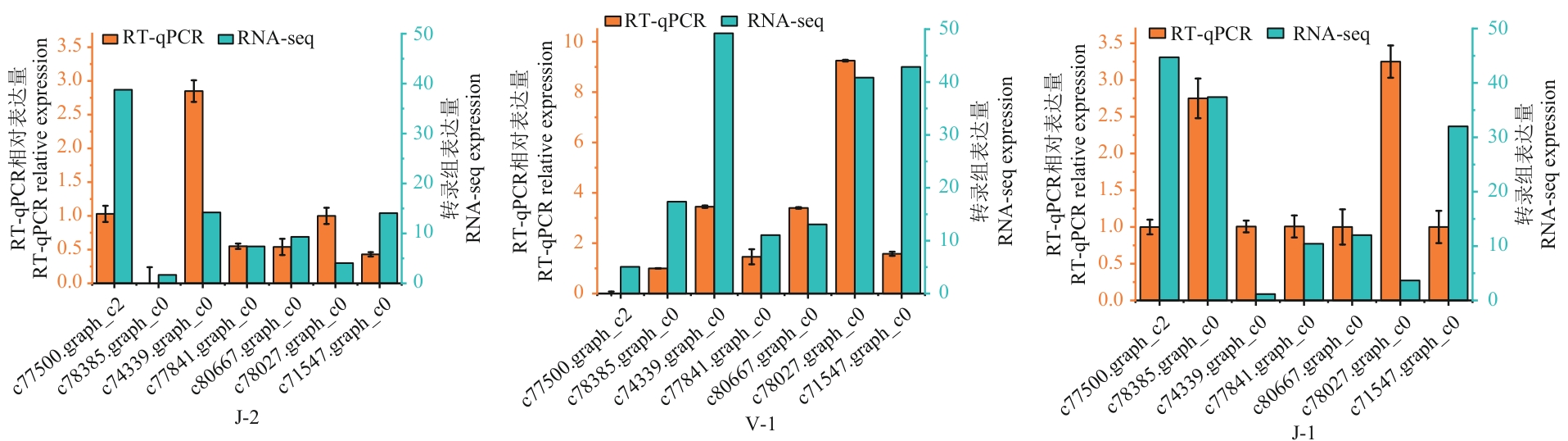
图7 RT-qPCR验证
Fig. 7 RT-qPCR validation
| [1] | 张鹏飞, 张昕然, 张龙. 蜡蚧轮枝菌及其在有害生物防治中的应用研究进展 [J]. 环境昆虫学报, 2023, 45(4): 910-921. |
| Zhang PF, Zhang XR, Zhang L. Lecanicillium spp. and its application research progress in pests control [J]. J Environ Entomol, 2023, 45(4): 910-921. | |
| [2] | 谷祖敏, 周飞, 陈思, 等. 蜡蚧轮枝菌VL17油剂配方筛选及室内毒力评价 [J]. 农药, 2013, 52(5): 337-339. |
| Gu ZM, Zhou F, Chen S, et al. An oil formulation of verticillum lecanii VL17 and its bioassy in labortory [J]. Agrochemicals, 2013, 52(5): 337-339. | |
| [3] | 王联德, 黄建. 蜡蚧轮枝菌高产毒素菌株的筛选[J]. 福建农业大学学报:自然科学版, 2006, 35(2): 134-137. |
| Wang LD, Huang J. Selection of Verticillum lecanii strains for high production of toxin[J]. Journal of Fujian Agriculture and Forestry University: Natural Science Edition, 2006, 35(2): 134-137. | |
| [4] | 吴佳, 李惠中, 邓权清, 等. 甘蔗鞭黑粉菌致病力差异菌株转录组分析 [J]. 华中农业大学学报, 2020, 39(3): 54-59. |
| Wu J, Li HZ, Deng QQ, et al. Analyzing transcriptome of Sporisorium scitamineum strains with different pathogenicity [J]. J Huazhong Agric Univ, 2020, 39(3): 54-59. | |
| [5] | 蒋冬花, 丁曼青, 苏来婧, 等. 不同来源红曲霉菌株的鉴定和代谢产物多样性分析 [J]. 浙江师范大学学报: 自然科学版, 2020, 43(4): 410-416. |
| Jiang DH, Ding MQ, Su LJ, et al. Identification of Monascus strains from different sources and diversity analysis of their metabolites [J]. J Zhejiang Norm Univ Nat Sci, 2020, 43(4): 410-416. | |
| [6] | Zhang YP, Liu XM, Yin T, et al. Comparative transcriptomic analysis of two Saccharopolyspora spinosa strains reveals the relationships between primary metabolism and spinosad production [J]. Sci Rep, 2021, 11(1): 14779. |
| [7] | Koduru UD, Galidevara S, Reineke A, et al. Bioinformatic tools in the analysis of determinants of pathogenicity and ecology of entomopathogenic fungi used as microbial insecticides in crop protection [M]//Agricultural Bioinformatics. New Delhi: Springer India, 2014: 215-234. |
| [8] | 李伟, 吴广畏, 杨玉萍, 等. 后基因组时代的真菌天然产物发现 [J]. 菌物学报, 2015, 34(5): 914-926. |
| Li W, Wu GW, Yang YP, et al. Discovery of fungal natural product in the post‐genomic era [J]. Mycosystema, 2015, 34(5): 914-926. | |
| [9] | 张河山. 两个不同毒力小麦叶锈菌菌株的转录组分析 [D]. 保定: 河北农业大学, 2014. |
| Zhang HS. Transcriptome analysis of two wheat leaf rust strains with different virulence [D]. Baoding: Hebei Agricultural University, 2014. | |
| [10] | Wang JJ, Bai WW, Zhou W, et al. Transcriptomic analysis of two Beauveria bassiana strains grown on cuticle extracts of the silkworm uncovers their different metabolic response at early infection stage [J]. J Invertebr Pathol, 2017, 145: 45-54. |
| [11] | Colvin D, Dhuri V, Verma H, et al. Enterococcus durans with mosquito larvicidal toxicity against Culex quinquefasciatus, elucidated using a proteomic and metabolomic approach [J]. Sci Rep, 2020, 10(1): 4774. |
| [12] | Prosser GA, Larrouy-Maumus G, de Carvalho LPS. Metabolomic strategies for the identification of new enzyme functions and metabolic pathways [J]. EMBO Rep, 2014, 15(6): 657-669. |
| [13] | 汪汉成, 黄艳飞, 陈兴江, 等. 烟草赤星病菌嘧菌酯敏感与抗性菌株的代谢表型差异分析 [J]. 植物病理学报, 2018, 48(6): 822-832. |
| Wang HC, Huang YF, Chen XJ, et al. Difference analysis between azoxystrobin-sensitive and-resistant isolates of Alternaria alternata causing tobacco brown spot in metabolic phenotypic characterization [J]. Acta Phytopathol Sin, 2018, 48(6): 822-832. | |
| [14] | Zhang M, Gao X, Hao KQ, et al. Transcriptome analysis of Verticillium lecanii based on RNA-Seq technology [J]. Journal of biosafety, 2017, 26(3): 236-243. |
| [15] | Zheng P, Xia YL, Xiao GH, et al. Genome sequence of the insect pathogenic fungus Cordyceps militaris, a valued traditional Chinese medicine [J]. Genome Biol, 2011, 12(11): R116. |
| [16] | 王龑, 刘阳, 刘伊宁. 产毒真菌基因组研究进展 [J]. 生物技术通报, 2015, 31(2): 26-34. |
| Wang Y, Liu Y, Liu YN. Advances in studies on genomics of toxogenic fung [J]. Biotechnol Bull, 2015, 31(2): 26-34. | |
| [17] | 宋晓兵, 彭埃天, 凌金锋, 等. 昆虫病原真菌基因组学及多组学研究进展 [J]. 广东农业科学, 2021, 48(1): 17-25. |
| Song XB, Peng AT, Ling JF, et al. Research progress in genomics and multi-omics of entomopathogenic fungi [J]. Guangdong Agric Sci, 2021, 48(1): 17-25. | |
| [18] | Gao Q, Jin K, Ying SH, et al. Genome sequencing and comparative transcriptomics of the model entomopathogenic fungi Metarhizium anisopliae and M. acridum [J]. PLoS Genet, 2011, 7(1): e1001264. |
| [19] | Zhang YJ, Zhang JQ, Jiang XD, et al. Requirement of a mitogen-activated protein kinase for appressorium formation and penetration of insect cuticle by the entomopathogenic fungus Beauveria bassiana [J]. Appl Environ Microbiol, 2010, 76(7): 2262-2270. |
| [20] | Supakdamrongkul P, Bhumiratana A, Wiwat C. Characterization of an extracellular lipase from the biocontrol fungus, Nomuraea rileyi MJ, and its toxicity toward Spodoptera litura [J]. J Invertebr Pathol, 2010, 105(3): 228-235. |
| [21] | Zhang LB, Qiu TT, Guan Y, et al. Analyses of transcriptomics and metabolomics reveal pathway of vacuolar Sur7 contributed to biocontrol potential of entomopathogenic Beauveria bassiana [J]. J Invertebr Pathol, 2021, 181: 107564. |
| [22] | 李晓娇. 蜡蚧轮枝菌(Verticillum lecanii)对柑橘粉虱(Diaelorude citri)基因表达的影响 [D]. 重庆: 西南大学, 2014. |
| Li XJ. Effects of Verticillum lecanii on gene expression of Diaelorude citri [D]. Chongqing: Southwest University, 2014. | |
| [23] | Hyun MW, Yun YH, Kim JY, et al. Fungal and plant phenylalanine ammonia-lyase [J]. Mycobiology, 2011, 39(4): 257-265. |
| [24] | Hyun MW, Kim SH. Metabolic fate of phenylalanine in the corn smut fungus Ustilago maydis [J]. Korean J Mycol, 2011, 39(3): 249-253. |
| [25] | 何文静, 张亚东, 张超, 等. StSOBIR1类似基因沉默对马铃薯应答虫害的影响 [J]. 浙江大学学报: 农业与生命科学版, 2024, 50(4): 615-632. |
| He WJ, Zhang YD, Zhang C, et al. Effects of silencing StSOBIR1-like gene on potato in response to herbivory [J]. Journal of Zhejiang University: Agriculture and Life Sciences, 2024, 50(4):615-632. | |
| [26] | 杜民杰. 水杨酸代谢在绿僵菌抗逆和致病中的作用 [D]. 重庆: 重庆大学, 2016. |
| Du MJ. The role of salicylic acid metabolism in the resistance and pathogenesis of Metarhizium anisopliae [D]. Chongqing: Chongqing University, 2016. | |
| [27] | El-Sherbeni AEE, Khaleid MS, El All AbdAllah SA, et al. Effect of some insecticides alone and in combination with salicylic acid against aphid, Aphis gossypii, and whitefly Bemisia tabaci on the cotton field [J]. Bull Natl Res Cent, 2019, 43(1): 57. |
| [28] | Torres MJ, Rocha VF, Audisio MC. Laboratory evaluation of Lactobacillus johnsonii CRL1647 metabolites for biological control of Musca domestica [J]. Entomologia Exp Applicata, 2016, 159(3): 347-353. |
| [29] | 刘敏, 韩海斌, 刘爱萍, 等. 茶足柄瘤蚜茧蜂滞育和非滞育蛹中与能量代谢相关的差异表达蛋白 [J]. 昆虫学报, 2020, 63(6): 708-716. |
| Liu M, Han HB, Liu AP, et al. Differentially expressed proteins associated with energy metabolism in diapause and non-diapause pupae of Lysiphlebus testaceipes (Hymenoptera: Braconidae) [J]. Acta Entomol Sin, 2020, 63(6): 708-716. | |
| [30] | 张航航. 球孢白僵菌高毒力菌株的筛选及其与小菜蛾互作相关基因的转录组分析 [D]. 合肥: 安徽农业大学, 2017. |
| Zhang HH. Screening of Beauveria bassiana strains with high virulence and transcriptome analysis of genes related to their interaction with Plutella xylostella [D]. Hefei: Anhui Agricultural University, 2017. | |
| [31] | Perlin MH, Andrews J, Toh SS. Essential letters in the fungal alphabet: ABC and MFS transporters and their roles in survival and pathogenicity [J]. Adv Genet, 2014, 85: 201-253. |
| [32] | 廖景燕. 真菌源ABCC转运蛋白对提高植物真菌毒素耐受性的作用研究 [D]. 重庆: 西南大学, 2018. |
| Liao JY. Effect of fungal ABCC transporter on improving plant mycotoxin tolerance [D]. Chongqing: Southwest University, 2018. | |
| [33] | 安一博, 马玲, 韩静, 等. 链格孢菌毒素胁迫下的棘孢木霉转录组构建及生防基因差异表达 [J]. 东北林业大学学报, 2020, 48(11): 105-110, 116. |
| An YB, Ma L, Han J, et al. Transcriptome construction and biocontrol gene differential expression analysis of Trichoderma asperellum under Alternaria alternata toxin stress [J]. Journal of Northeast Forestry University, 2020, 48(11): 105-110, 116. | |
| [34] | 张亚洲. 水杨酸影响小麦与禾谷镰刀菌互作机制 [D]. 雅安: 四川农业大学, 2020. |
| Zhang YZ. Mechanism of salicylic acid affecting the interaction between wheat and Fusarium graminearum [D]. Ya’an: Sichuan Agricultural University, 2020. | |
| [35] | Laib DE, Benzara A, Akkal S, et al. The anti-acetylcholinesterase, insecticidal and antifungal activities of the entophytic fungus Trichoderma sp. isolated from Ricinus communis L. against Locusta migratoria L. and Botrytis cinerea Pers.: Fr [J]. Acta Sci Nat, 2020, 7(1): 112-125. |
| [36] | Hou CX, Qin GX, Liu T, et al. Transcriptome analysis of silkworm, Bombyx mori, during early response to Beauveria bassiana challenges [J]. PLoS One, 2014, 9(3): e91189. |
| [37] | 汪永松, 耿涛, 卢芙萍, 等. 球孢白僵菌Bbchitinase 1和Bbchitinase 2在侵染宿主过程中的不同作用 [J]. 热带作物学报, 2021, 42(4): 1092-1098. |
| Wang YS, Geng T, Lu FP, et al. Different roles of Beauveria bassiana bbchitinase 1 and bbchitinase 2 in host infection [J]. Chin J Trop Crops, 2021, 42(4): 1092-1098. |
| [1] | 白雨果, 李婉迪, 梁建萍, 石志勇, 卢庚龙, 刘红军, 牛景萍. 哈茨木霉T9131对黄芪幼苗的促生机理[J]. 生物技术通报, 2025, 41(8): 175-185. |
| [2] | 蒋天威, 马培杰, 李亚娇, 陈才俊, 刘晓霞, 王小利. 二穗短柄草对光周期的代谢响应分析[J]. 生物技术通报, 2025, 41(7): 237-247. |
| [3] | 张越, 毕钰, 慕雪男, 郑子薇, 王志刚, 徐伟慧. 小麦赤霉病拮抗菌JB7的生防特性[J]. 生物技术通报, 2025, 41(7): 261-271. |
| [4] | 李成花, 豆飞飞, 任毓昭, 刘彩霞, 刘凤楼, 王掌军, 李清峰. 外施水杨酸对白粉菌侵染小麦的影响及白粉菌转录组分析[J]. 生物技术通报, 2025, 41(7): 272-280. |
| [5] | 郭秀娟, 冯宇, 吴瑞香, 王利琴, 杨建春. Ca2+处理对胡麻种子萌发影响的转录组分析[J]. 生物技术通报, 2025, 41(7): 139-149. |
| [6] | 王月琛, 韩鑫骐, 魏文敏, 崔兆兰, 罗阳美, 陈鹏如, 王海岗, 刘龙龙, 张莉, 王纶. 黍稷落粒的生物学基础研究及落粒调控基因的鉴定[J]. 生物技术通报, 2025, 41(7): 164-171. |
| [7] | 胡若群, 曾菁菁, 梁婉凤, 曹佳玉, 黄小苇, 梁晓英, 仇明月, 陈莹. 转录组和代谢组联合分析探究不同遮光条件下金线莲类胡萝卜素合成代谢机制[J]. 生物技术通报, 2025, 41(5): 231-243. |
| [8] | 李旭娟, 李纯佳, 刘洪博, 徐超华, 林秀琴, 陆鑫, 刘新龙. 甘蔗腋芽形成发育过程的转录组分析[J]. 生物技术通报, 2025, 41(3): 202-218. |
| [9] | 赵长延, 柳延涛, 贾秀苹, 刘胜利, 雷中华, 王鹏, 朱志锋, 董红业, 吕增帅, 段维, 万素梅. 盐碱胁迫下褪黑素对作物生理机制影响的研究进展[J]. 生物技术通报, 2025, 41(2): 18-29. |
| [10] | 李艳伟, 杨妍妍, 孙亚玲, 霍雨猛, 王振宝, 刘冰江. 基于转录组分析植物激素对洋葱鳞茎膨大发育的调控机制[J]. 生物技术通报, 2025, 41(2): 187-201. |
| [11] | 寇焙森, 程萌萌, 郭雪琴, 葛彬, 刘迪, 陆海, 李慧. 组蛋白去乙酰化酶抑制剂TSA处理对杨树茎生长发育的影响[J]. 生物技术通报, 2025, 41(1): 240-251. |
| [12] | 裴旭娟, 狄靖宜, 刘浩, 高伟霞. 基于转录组分析挖掘兽疫链球菌透明质酸分子量调控元件[J]. 生物技术通报, 2025, 41(1): 347-356. |
| [13] | 岳丽昕, 王清华, 刘泽洲, 孔素萍, 高莉敏. 基于转录组和WGCNA筛选大葱雄性不育相关基因[J]. 生物技术通报, 2024, 40(9): 212-224. |
| [14] | 聂祝欣, 郭瑾, 乔子洋, 李微薇, 张学燕, 刘春阳, 王静. 黑果枸杞不同发育时期果实花色苷合成的转录组分析[J]. 生物技术通报, 2024, 40(8): 106-117. |
| [15] | 周麟, 黄顺满, 苏文坤, 姚响, 屈燕. 滇山茶bHLH基因家族鉴定及花色形成相关基因筛选[J]. 生物技术通报, 2024, 40(8): 142-151. |
| 阅读次数 | ||||||
|
全文 |
|
|||||
|
摘要 |
|
|||||
