







生物技术通报 ›› 2026, Vol. 42 ›› Issue (10): 305-316.doi: 10.13560/j.cnki.biotech.bull.1985.2026-0179
• 研究报告 • 上一篇
梁浩1, 黄恩园1, 朱丽雯1, 赵锦芳1,2, 刘晓楠1,2,3,4, 王永泽1,2( )
收稿日期:2026-02-05
出版日期:2026-10-26
发布日期:2026-10-15
通讯作者:
王永泽wangyongze@hbut.edu.cn基金资助:
LIANG Hao1, HUANG En-yuan1, ZHU Li-wen1, ZHAO Jin-Fang1,2, LIU Xiao-nan1,2,3,4, WANG Yong-ze1,2()
Received:2026-02-05
Published:2026-10-26
Online:2026-10-15
摘要:
目的 增强工业微生物的耐热性可一定程度缩短发酵时间、减少杂菌污染及促进产物的溶解,拟通过小热休克蛋白的筛选及动态表达提高大肠杆菌的耐热性。 方法 对不同种属的小热休克蛋白在大肠杆菌BL21(DE3)中进行表达和筛选,筛选得到的小热休克蛋白进一步使用不同强度的组成型启动子及温敏启动子PL驱动表达,研究小热休克蛋白表达对大肠杆菌耐热性的影响。 结果 来自腾冲热厌氧杆菌Thermoanaerobacter tengcongensis MB4的小热休克蛋白(sHsp)能提高大肠杆菌在高温环境下的耐热性,蛋白质序列比对进一步验证了蛋白β3片层序列Pro-Gly片段的重要作用。不同强度组成型启动子驱动小热休克蛋白来提高宿主在45 ℃发酵性能,结果表明强启动子PM193条件下L-乳酸的产量最高但生物量较低。温敏性启动子PL被进一步选用驱动sHsp的动态表达,通过种子阶段低温培养减少sHsp的表达,减少种子阶段的生长负荷以期提高生物量。最终L-乳酸产量可达到30±0.58 g/L,最大生物量(OD600)达到8.1±0.32,比PM193组成型启动子表达的乳酸产量和生物量(OD600)分别提高6%和17%。 结论 动态调控小热休克蛋白表达可以提高大肠杆菌在高温条件下L-乳酸发酵效果,可作为一种提高工业微生物耐热性的有效手段。
梁浩, 黄恩园, 朱丽雯, 赵锦芳, 刘晓楠, 王永泽. 动态调控小热休克蛋白表达以提升大肠杆菌耐热性并高效生产L-乳酸[J]. 生物技术通报, 2026, 42(10): 305-316.
LIANG Hao, HUANG En-yuan, ZHU Li-wen, ZHAO Jin-Fang, LIU Xiao-nan, WANG Yong-ze. Enhancing E. coli Thermotolerance via Dynamic Control of Small Heat Shock Protein Expression for Efficient L-lactate Production[J]. Biotechnology Bulletin, 2026, 42(10): 305-316.
| Primers | Sequences (5′-3′) |
|---|---|
TTsHsp-F TTsHsp-R PM137-F PM137-R PM146-F PM146-R PM193-F PM193-R PL-F PL-R pET-F pET-R GFP-F GFP-R ccdB-F ccdB-R | ATGGCAAATGAATTAATGGA TTATTGGATTTCAATATGAT CTCCTGAATCTATCTATCCTTTATCTCTGGCGGTGTTGAC TCCATTAATTCATTTGCCATAGCTGTTTCCTGGTTTAAAC AGAATTACATGTGAGAAATTTTATCTCTGGCGGTGTTGAC TCCATTAATTCATTTGCCATAGCTGTTTCCTGGTTTAAACGT GTAACGAAAGAGGATAAACCTTATCTCTGGCGGTGTTGAC TCCATTAATTCATTTGCCATCTTGTCTCTCCTGGTTTAAACGT GGAAGGAGCTGACTGGGTTGCTCAATTGTTATCAGCTATGCGC TCCATTAATTCATTTGCCATGGTGGTCAGTGCGTCCTGCT TGCCACCGCTGAGCAATAAC GGTTTATCCTCTTTCGTTAC CCTCTAGAAATAATTTTGTTTAACT CGAGTTTGTATAGTTCATCC AGCAGGACGCACTGACCACCATGCAGTTTAAGGTTTACACCTATA CTAGATCCTTTACGCGTTCGTTATATTCCCCAGAACATCAGGTTA |
表1 本文所用引物及序列
Table 1 Primers and sequences used in this article
| Primers | Sequences (5′-3′) |
|---|---|
TTsHsp-F TTsHsp-R PM137-F PM137-R PM146-F PM146-R PM193-F PM193-R PL-F PL-R pET-F pET-R GFP-F GFP-R ccdB-F ccdB-R | ATGGCAAATGAATTAATGGA TTATTGGATTTCAATATGAT CTCCTGAATCTATCTATCCTTTATCTCTGGCGGTGTTGAC TCCATTAATTCATTTGCCATAGCTGTTTCCTGGTTTAAAC AGAATTACATGTGAGAAATTTTATCTCTGGCGGTGTTGAC TCCATTAATTCATTTGCCATAGCTGTTTCCTGGTTTAAACGT GTAACGAAAGAGGATAAACCTTATCTCTGGCGGTGTTGAC TCCATTAATTCATTTGCCATCTTGTCTCTCCTGGTTTAAACGT GGAAGGAGCTGACTGGGTTGCTCAATTGTTATCAGCTATGCGC TCCATTAATTCATTTGCCATGGTGGTCAGTGCGTCCTGCT TGCCACCGCTGAGCAATAAC GGTTTATCCTCTTTCGTTAC CCTCTAGAAATAATTTTGTTTAACT CGAGTTTGTATAGTTCATCC AGCAGGACGCACTGACCACCATGCAGTTTAAGGTTTACACCTATA CTAGATCCTTTACGCGTTCGTTATATTCCCCAGAACATCAGGTTA |
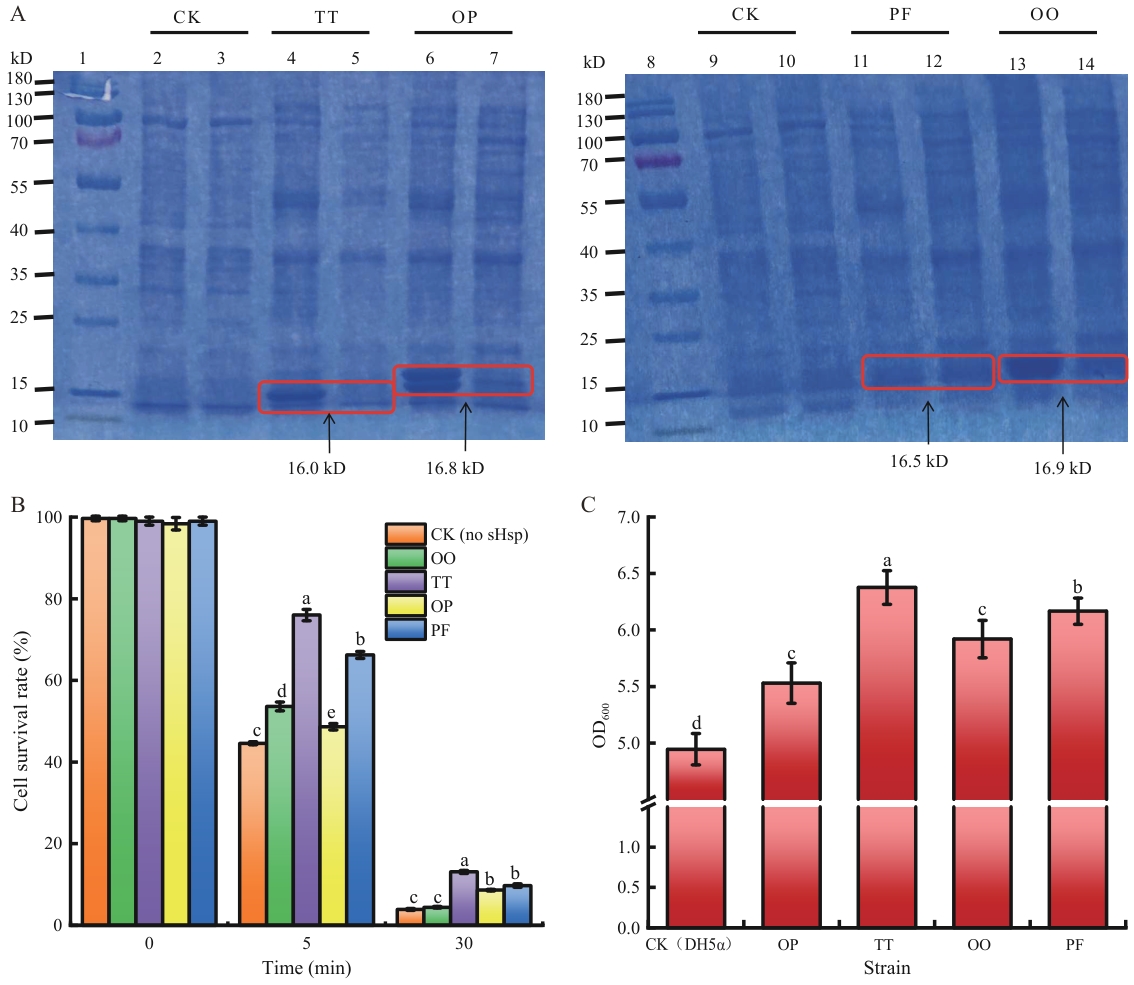
图1 小热休克蛋白的筛选A:不同小热休克蛋白在E. coli BL21(DE3)中的表达,1,8:180 kD蛋白Marker;2、4、6、9、11和13:细胞裂解后的上清;3、5、7、10、12和14:细胞裂解后的沉淀。B:小热休克蛋白表达对宿主在52 ℃热激下存活率的影响;C:小热休克蛋白的表达对宿主在45 ℃培养条件下生物量的影响。TT、OO、PF、OP:分别为Thermoanaerobacter tengcongensis MB4、Oenococcus oeni、Pyrococcus furiosus、Oceanithermus profundus的小热休克蛋白
Fig. 1 Screening of small heat shock proteinsA: Expression of different small heat shock proteins in E. coli BL21(DE3). Lanes 1 and 8: 180 kD protein marker; 2, 4, 6, 9, 11, 13: supernatant after cell lysis; 3, 5, 7, 10, 12, 14: pellet after cell lysis. B: Effect of small heat shock protein expression on host cell survival under heat shock at 52 ℃. C: Effect of small heat shock protein expression on host biomass under cultivation at 45 ℃. TT, OO, PF and OP refer to the small heat shock proteins derived from Thermoanaerobacter tengcongensis MB4, Oenococcus oeni, Pyrococcus furiosus and Oceanithermus profundus, respectively
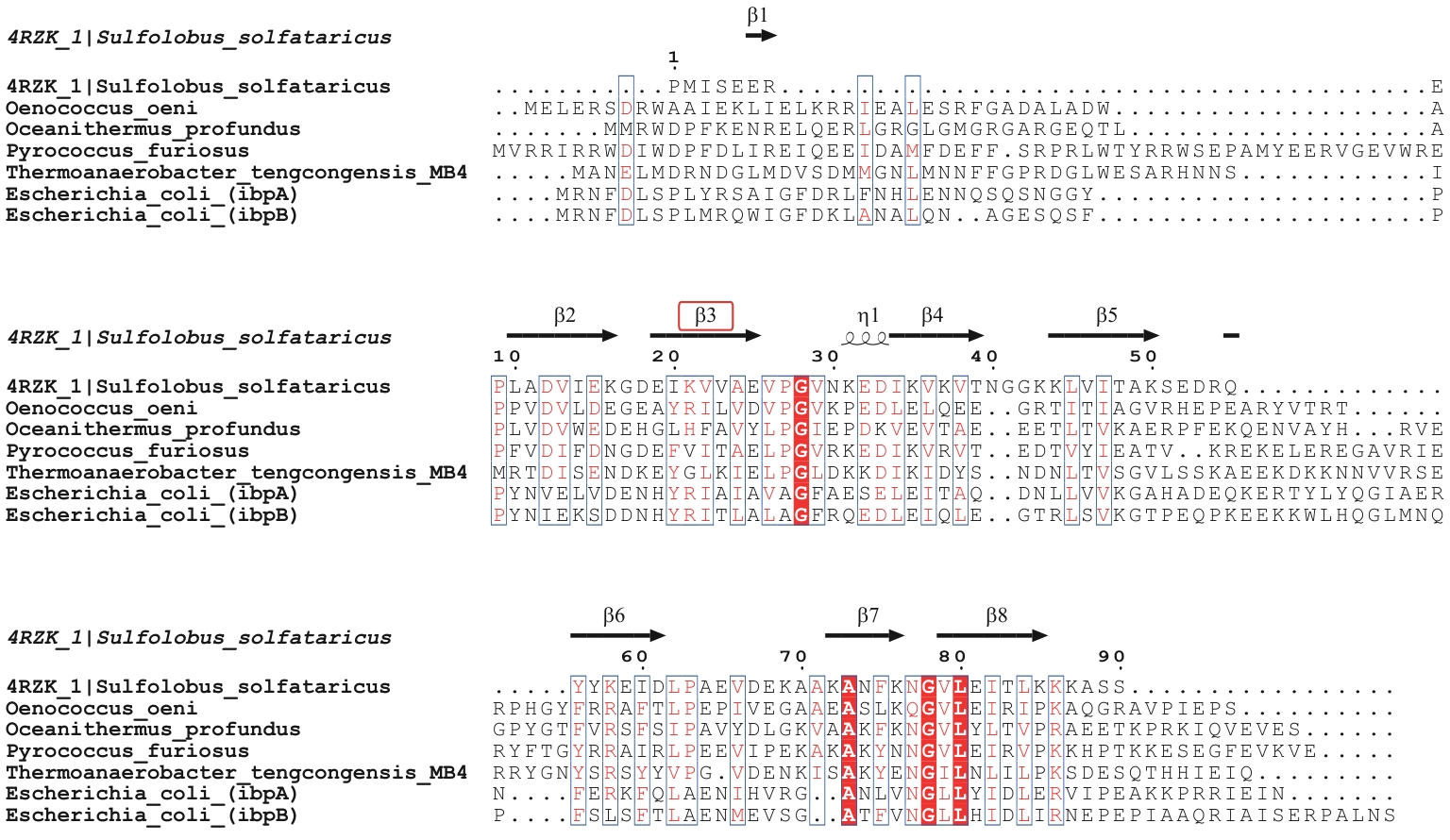
图2 小热休克蛋白氨基酸多序列比对
Fig. 2 Multiple sequence alignment of amino acid for small heat shock proteins
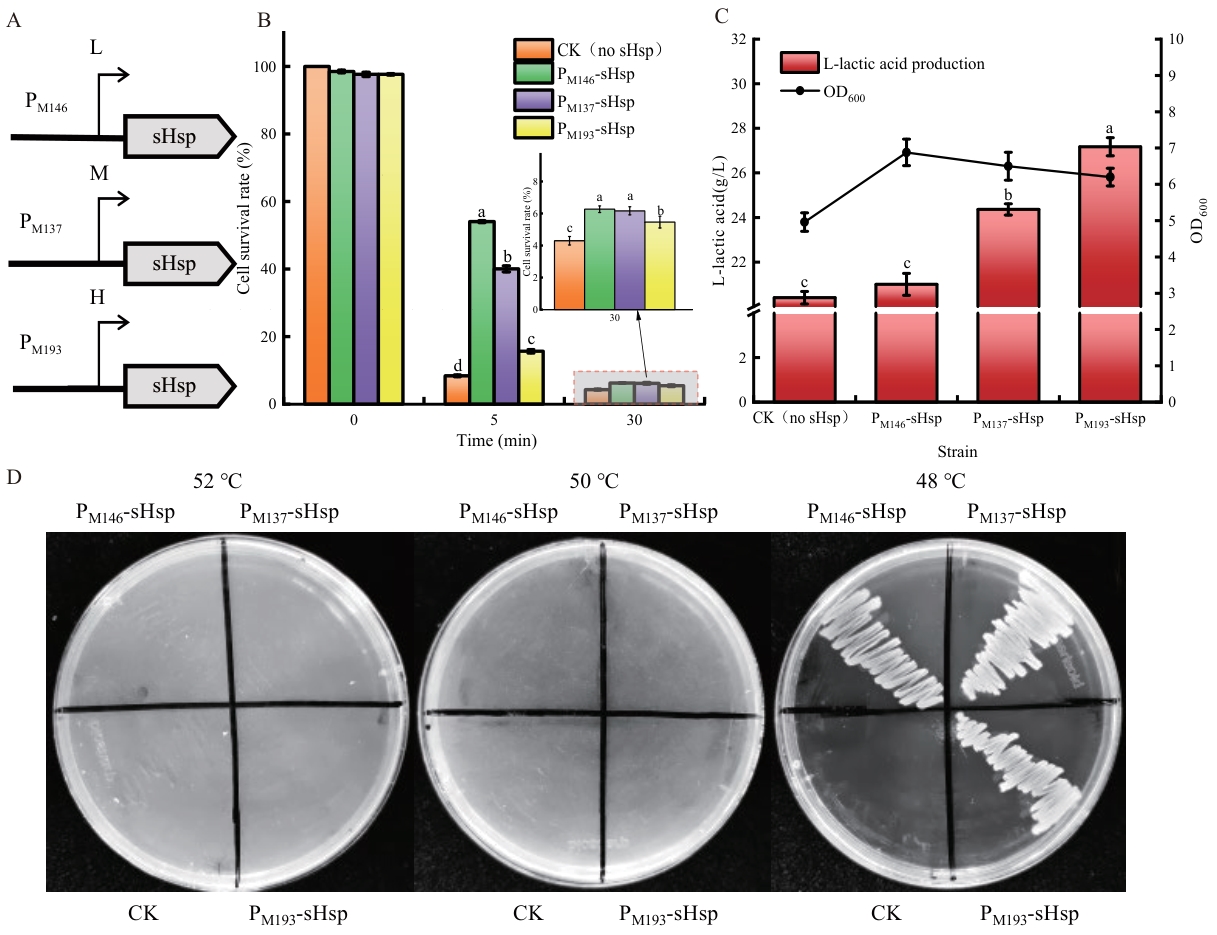
图3 不同启动子表达小热休克蛋白对宿主耐热性影响A:不同强度的启动子表达小热休克蛋白sHsp的示意图;B:在52 ℃热应激条件下不同强度启动子驱动小热休克蛋白表达对宿主存活率影响;C:不同组成型启动子驱动小热休克蛋白表达对乳酸45 ℃发酵的影响;D:不同强度启动子驱动小热休克蛋白表达对宿主最高温度耐受度的影响
Fig. 3 Effects of heat shock protein expression driven by different promoters on host thermotoleranceA: Schematic diagram of small heat shock protein (sHsp) expression driven by promoters of different strengths. B: Effects of the expression of small heat shock proteins driven by promoters of different strengths on host cell survival rate under 52 ℃ heat stress. C: Effects of the expression of small heat shock proteins driven by different constitutive promoters on lactic acid fermentation at 45 ℃. D: Effect of different strength promoters driving the expression of small heat shock proteins on the host maximum temperature tolerance
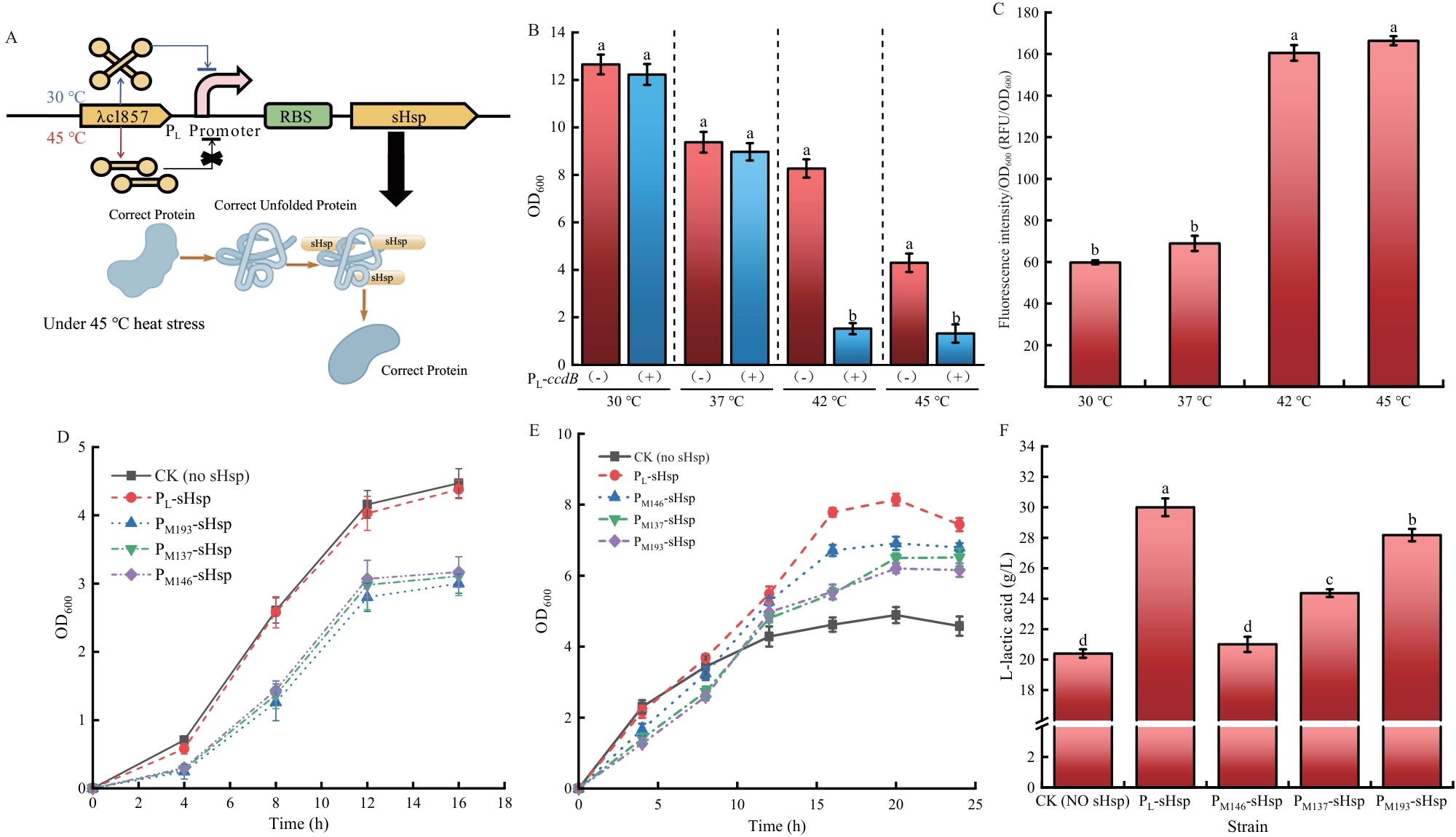
图4 温敏性启动子PL对小热休克蛋白表达耐受发酵产酸情况A:温敏性启动子PL动态调控示意图[20];B-C:致死基因ccdB(B)和绿色荧光蛋白GFP(C)分别作为报告基因测试PL启动子的温控性能;D:PL启动子相对于组成型启动子在种子阶段30 ℃培养对宿主生物量的影响;E:PL启动子相对于组成型启动子在发酵阶段45 ℃下培养对宿主生物量的影响;F:PL启动子相对于组成型启动子对L-乳酸产量的影响
Fig. 4 Effects of thermosensitive promoter PL mediated heat shock protein expression on acid production during stress-tolerant fermentationA: Schematic diagram of dynamic regulation of thermosensitive promoter PL[20]. B-C: Evaluation of the temperature-controlled performance of the PL promoter using the lethal gene ccdB (B) and green fluorescent protein GFP (C) as reporter genes. D: Effect of the PL promoter on host biomass in comparison with a constitutive promoter during seed culture at 30 ℃. E: Effect of the PL promoter on host biomass in comparison with a constitutive promoter during fermentation at 45 ℃; F: Effect of the PL promoter on L‑lactic acid production in comparison with a constitutive promoter
启动子 Promoter | 热休克蛋白 Heat shock protein | 来源 Source | 特点 Characteristics | 参考文献 References |
|---|---|---|---|---|
| T7 | Hsp20 | Tepidimonas sediminis(沉积物暖单胞菌) | 强表达;泄漏表达、IPTG依赖、代谢负担重、菌株限制 | [ |
| PLac | IbpA/IbpB | Escherichia coli | 适应菌株范围广;IPTG依赖 | [ |
| PIbpA | IbpA/IbpB | Escherichia coli | σ32调控,在受到胁迫时才表达,生长负荷小;诱导温度严格、表达时间窗口窄 | [ |
| PgapA | Hsp20 | Thermoanaerobacter tengcongensis MB4 | 适用菌株范围广,组成型强表达,σ32/σ70双调控 | [ |
| PL | Hsp20 | Thermoanaerobacter tengcongensis MB4 | 无需诱导剂,通过温度控制,使小热休克蛋白在生长阶段和发酵阶段处于不同开关状态,减少生长期间负荷;生长阶段必须控制在较低温度30 ℃,会一定程度影响生长 | 本研究 |
表 2 常见的小热休克蛋白启动子
Table 2 Common promoters for small heat shock proteins
启动子 Promoter | 热休克蛋白 Heat shock protein | 来源 Source | 特点 Characteristics | 参考文献 References |
|---|---|---|---|---|
| T7 | Hsp20 | Tepidimonas sediminis(沉积物暖单胞菌) | 强表达;泄漏表达、IPTG依赖、代谢负担重、菌株限制 | [ |
| PLac | IbpA/IbpB | Escherichia coli | 适应菌株范围广;IPTG依赖 | [ |
| PIbpA | IbpA/IbpB | Escherichia coli | σ32调控,在受到胁迫时才表达,生长负荷小;诱导温度严格、表达时间窗口窄 | [ |
| PgapA | Hsp20 | Thermoanaerobacter tengcongensis MB4 | 适用菌株范围广,组成型强表达,σ32/σ70双调控 | [ |
| PL | Hsp20 | Thermoanaerobacter tengcongensis MB4 | 无需诱导剂,通过温度控制,使小热休克蛋白在生长阶段和发酵阶段处于不同开关状态,减少生长期间负荷;生长阶段必须控制在较低温度30 ℃,会一定程度影响生长 | 本研究 |
| [1] | Li Y, Xu XG, Qu R, et al. Heterologous expression of Oenococcus oeni sHSP20 confers temperature stress tolerance in Escherichia coli [J]. Cell Stress Chaperones, 2018, 23(4): 653-662. |
| [2] | Sánchez-Adriá IE, Sanmartín G, Prieto JA, et al. Sourdough yeast strains exhibit thermal tolerance, high fermentative performance, and a distinctive aromatic profile in beer wort [J]. Foods, 2024, 13(7): 1059. |
| [3] | Zhang B, Geberekidan M, Yan Z, et al. Very high thermotolerance of an adaptive evolved Saccharomyces cerevisiae in cellulosic ethanol fermentation [J]. Fermentation, 2023, 9(4): 393. |
| [4] | Pan RZ, Yuan YC, Xu AM, et al. Biofilm engineering to improve succinic acid production in Escherichia coli by enhancing extracellular polysaccharide synthesis [J]. Bioresour Technol, 2025, 431: 132627. |
| [5] | Sun WJ, Chen Y, Li MK, et al. Integration of (S)-2,3-oxidosqualene enables E. coli to become Iron Man E. coli with improved overall tolerance [J]. Biotechnol Biofuels, 2023, 16: 191. |
| [6] | Kurokawa N, Ogawa M, Midorikawa R, et al. A study on the temperature-dependent behavior of small heat shock proteins from methanogens [J]. Int J Mol Sci, 2025, 26(12): 5748. |
| [7] | Ahn YJ, Im E. Heterologous expression of heat shock proteins confers stress tolerance in Escherichia coli, an industrial cell factory: a short review [J]. Biocatal Agric Biotechnol, 2020, 29: 101833. |
| [8] | Sato Y, Okano K, Honda K. Effects of small heat shock proteins from thermotolerant bacteria on the stress resistance of Escherichia coli to temperature, pH, and hyperosmolarity [J]. Extremophiles, 2024, 28: 12. |
| [9] | Kruglikov A, Wei YL, Xia XH. Proteins from thermophilic Thermus thermophilus often do not fold correctly in a mesophilic expression system such as Escherichia coli [J]. ACS Omega, 2022, 7(42): 37797-37806. |
| [10] | Blum P, Ory J, Bauernfeind J, et al. Physiological consequences of DnaK and DnaJ overproduction in Escherichia coli [J]. J Bacteriol, 1992, 174(22): 7436-7444. |
| [11] | Laksanalamai P, Maeder DL, Robb FT. Regulation and mechanism of action of the small heat shock protein from the hyperthermophilic Archaeon Pyrococcus furiosus [J]. J Bacteriol, 2001, 183(17): 5198-5202. |
| [12] | 孙翔英, 刘月芹, 孙欢, 等. 大肠杆菌耐热元器件的构建及其应用 [J]. 化工学报, 2014, 65(8): 3128-3135. |
| Sun XY, Liu YQ, Sun H, et al. Construction of heat resistance devices for Escherichia coli and their application [J]. CIESC J, 2014, 65(8): 3128-3135. | |
| [13] | 王金华, 王永泽, 赵筱, 等. 高效利用蔗糖生产L-乳酸的大肠杆菌及应用: CN115873773A [P]. 2023-03-31. |
| [14] | Zou SY, Chen WQ, Cao Y, et al. Lethal endotoxin (ccdB) based counterselection improved the efficiency of sequential gene editing in Escherichia coli [J]. Biotechnol Lett, 2025, 47(5): 118. |
| [15] | Datta S, Costantino N, Court DL. A set of recombineering plasmids for gram-negative bacteria [J]. Gene, 2006, 379: 109-115. |
| [16] | Jiang Y, Qian FH, Yang JJ, et al. CRISPR-Cpf1 assisted genome editing of Corynebacterium glutamicum [J]. Nat Commun, 2017, 8: 15179. |
| [17] | 刘利, 陈炜琪, 邹诗瑶, 等. 亚磷酸脱氢酶表达对大肠杆菌琥珀酸发酵的影响 [J]. 中国调味品, 2025, 50(1): 210-215. |
| Liu L, Chen WQ, Zou SY, et al. Effect of phosphite dehydrogenase expression on succinic acid fermentation in Escherichia coli [J]. China Condiment, 2025, 50(1): 210-215. | |
| [18] | Roy M, Bhakta K, Ghosh A. Minimal yet powerful: the role of archaeal small heat shock proteins in maintaining protein homeostasis [J]. Front Mol Biosci, 2022, 9: 832160. |
| [19] | Zhao J, Li QY, Sun T, et al. Engineering central metabolic modules of Escherichia coli for improving β-carotene production [J]. Metab Eng, 2013, 17: 42-50. |
| [20] | Jiang S, Li HQ, Zhang L, et al. Generic Diagramming Platform (GDP): a comprehensive database of high-quality biomedical graphics [J]. Nucleic Acids Res, 2025, 53(D1): D1670-D1676. |
| [21] | Boelens WC. Structural aspects of the human small heat shock proteins related to their functional activities [J]. Cell Stress Chaperones, 2020, 25(4): 581-591. |
| [22] | Gil-Durán C, Ravanal MC, Ubilla P, et al. Heterologous expression, purification and characterization of a highly thermolabile endoxylanase from the Antarctic fungus Cladosporium sp. [J]. Fungal Biol, 2018, 122(9): 875-882. |
| [23] | Konieczny I, Liberek K. Cooperative action of Escherichia coli ClpB protein and DnaK chaperone in the activation of a replication initiation protein [J]. J Biol Chem, 2002, 277(21): 18483-18488. |
| [24] | Fu XM, Chang ZY. Identification of a highly conserved pro-gly doublet in non-animal small heat shock proteins and characterization of its structural and functional roles in Mycobacterium tuberculosis Hsp 16.3 [J]. Biochem Mosc, 2006, 71(S1): S83-S90. |
| [25] | 周帮顺, 王茜, 李海燕, 等. Hsp提高细菌的逆境生存能力和乙醇产量 [J]. 生物技术, 2008, 18(4): 26-29. |
| Zhou BS, Wang X, Li HY, et al. Effect of heat shock treatment to increase the resistance to adversity and production of ethanol of E. coli [J]. Biotechnology, 2008, 18(4): 26-29. | |
| [26] | Miwa T, Taguchi H. Escherichia colismall heat shock protein IbpA plays a role in regulating the heat shock response by controlling the translation of σ32 [J]. Proc Natl Acad Sci U S A, 2023, 120(32): e2304841120. |
| [27] | Ting WW, Tan SI, Ng IS. Development of chromosome-based T7 RNA polymerase and orthogonal T7 promoter circuit in Escherichia coli W3110 as a cell factory [J]. Bioresour Bioprocess, 2020, 7: 54. |
| [28] | Suo YK, Luo S, Zhang YN, et al. Enhanced butyric acid tolerance and production by Class I heat shock protein-overproducing Clostridium tyrobutyricum ATCC 25755 [J]. J Ind Microbiol Biotechnol, 2017, 44(8): 1145-1156. |
| [29] | Saltepe B, Bozkurt EU, Hacıosmanoğlu N, et al. Genetic circuits to detect nanomaterial triggered toxicity through engineered heat shock response mechanism [J]. ACS Synth Biol, 2019, 8(10): 2404-2417. |
| [30] | Li ZP, Rinas U. Recombinant protein production associated growth inhibition results mainly from transcription and not from translation [J]. Microb Cell Fact, 2020, 19: 83. |
| [31] | Snoeck S, Guidi C, De Mey M. ‘Metabolic burden’ explained: stress symptoms and its related responses induced by (over)expression of (heterologous) proteins in Escherichia coli [J]. Microb Cell Fact, 2024, 23: 96. |
| [32] | Xu WB, Li SC, Bock R, et al. A heat-inducible expression system for external control of gene expression in plastids [J]. Plant Biotechnol J, 2024, 22(4): 960-969. |
| [33] | Lin TH, Cheng SY, Lin YF, et al. Development of the low-temperature inducible system for recombinant protein production in Escherichia coli nissle 1917 [J]. J Agric Food Chem, 2024, 72(13): 7318-7325. |
| [34] | Reinikainen P, Sevella B, Suutari M, et al. Analysis and modelling of the lambda pL promoter controlled expression of a cloned thermostable α-amylase gene in Escherichia coli during batch cultivation [J]. J Biotechnol, 1989, 9(3): 221-234. |
| [35] | Ezemaduka AN, Yu J, Shi X, et al. A small heat shock protein enables Escherichia coli to grow at a lethal temperature of 50 C conceivably by maintaining cell envelope integrity [J]. J Bacteriol, 2014, 196(11): 2004-2011. |
| [1] | 李正, 邱炜玥, 孙瑞雪, 赵筱. 不同启动子过表达xylR基因提高大肠杆菌的葡萄糖-木糖共利用能力[J]. 生物技术通报, 2026, 42(1): 329-337. |
| [2] | 闫梦阳, 梁晓阳, 戴君昂, 张妍, 关团, 张辉, 刘良波, 孙志华. 阿莫西林降解菌的筛选及降解机制研究[J]. 生物技术通报, 2025, 41(9): 314-325. |
| [3] | 黄旭升, 周雅莉, 柴旭东, 闻婧, 王计平, 贾小云, 李润植. 紫苏质体型PfLPAT1B基因的克隆及其在油脂合成中的功能分析[J]. 生物技术通报, 2025, 41(7): 226-236. |
| [4] | 毛李晶, 金晓萱, 施婉婷, 胡飞杨, 张苑蓉, 熊亮斌, 任璐. 代谢工程改造益生菌E. coli Nissle 1917合成靛玉红[J]. 生物技术通报, 2025, 41(12): 74-81. |
| [5] | 周思延, 丁炜权, 董平, 翁含之, 胥睿睿, 康振. 大肠杆菌Nissle 1917的合成生物学平台开发及应用进展[J]. 生物技术通报, 2025, 41(11): 47-61. |
| [6] | 魏敏华, 李晓童, 姜亚文, 周飘飘, 汪凯, 孙浩, 芦楠, 张成林. |
| [7] | 杨熠辰, 朱宏宇, 苏小运, 王苑, 罗会颖, 田健, 姚斌, 黄火清, 张杰. 以果葡糖浆为底物高效合成肌醇细胞工厂的构建[J]. 生物技术通报, 2025, 41(11): 121-133. |
| [8] | 何听雨, 逄雨, 张远洋, 孙雪, 李玉, 路福平, 李庆刚. 高产乳酰-N-三糖Ⅱ大肠杆菌菌株的构建[J]. 生物技术通报, 2025, 41(11): 143-152. |
| [9] | 吕欢欢, 张高阳, 王赛笛, 孙忠科, 李成伟, 罗德平. 5-氨基乙酰丙酸(5-ALA)的生物合成研究进展[J]. 生物技术通报, 2025, 41(11): 75-88. |
| [10] | 饶峻, 赵晨, 李端华, 廖豪, 黄加雨, 王辂. 自诱导策略在麦角硫因生物合成中的应用[J]. 生物技术通报, 2025, 41(1): 333-346. |
| [11] | 张静安, 胡孝龙, 曹蓓蓓, 廖敏, 束长龙, 张杰, 王奎, 操海群. 苏云金芽胞杆菌可视化快速表达载体的构建与特性分析[J]. 生物技术通报, 2025, 41(1): 95-102. |
| [12] | 王周, 余杰, 王金华, 王永泽, 赵筱. 厌氧表达乳酸脱氢酶以提高大肠杆菌产D-乳酸光学纯度[J]. 生物技术通报, 2024, 40(5): 290-299. |
| [13] | 庄棵, 梁至轩, 何英婷, 谢秋玲. 大肠杆菌DH5α通过外膜囊泡传递抗生素抗性基因AmpR[J]. 生物技术通报, 2024, 40(12): 275-281. |
| [14] | 杨红艳, 韩筱, 杨建军. pDNA质粒在一次性生物反应器中的放大生产研究[J]. 生物技术通报, 2024, 40(1): 168-175. |
| [15] | 陈彩萍, 任昊, 龙腾飞, 何冰, 鲁兆祥, 孙坚. 大肠杆菌Nissle 1917对炎症性肠病治疗作用的研究进展[J]. 生物技术通报, 2023, 39(6): 109-118. |
| 阅读次数 | ||||||
|
全文 |
|
|||||
|
摘要 |
|
|||||
