







• 研究报告 • 下一篇
王杰1,2, 李清2, 罗永坚2, 江洁明1, 刘军2( )
)
收稿日期:2025-12-25
出版日期:2026-09-14
通讯作者:
刘军liujun@gdaas.cn基金资助:
WANG Jie1,2, LI Qing2, LUO Yong-jian2, JIANG Jie-ming1, LIU Jun2()
Received:2025-12-25
Published:2026-09-14
摘要:
目的 探究广东省野生莼菜叶绿体基因组特征及系统发育关系,揭示其遗传变异与种群分化,为该物种的进化分类及水生植物保护与基因组学研究提供分子依据。 方法 对采自广东的莼菜进行基因组测序并组装和注释叶绿体基因组。随后,将其与不同物种及不同地理来源的同种个体的叶绿体基因组开展比较分析,涵盖基因组的结构与组成、重复序列的类型和数量、密码子使用偏好性、基因组边界差异、基因组比较、核苷酸多态性、基因统计及系统发育关系等多个方面。 结果 基因组呈环状四分体结构,由一个大的单拷贝区、两个反向重复区和一个小的单拷贝区构成。其基因组长度为158 974 bp,共鉴定出133个编码基因,GC含量为39%,其中蛋白编码基因87个,转运RNA基因38个,核糖体RNA基因8个。此外,该基因组含有25个SSR位点,其中单核苷酸重复最为丰富,主要以A/T碱基为主。鉴定出具有高核苷酸多样性的9个高度可变位点(ndhF、ndhD、psaC-ndhE、ndhE、ndhA、ndhH、ycf1、trnR-ACG-rrn5s和rrn23s)为潜在的分子标记。该植物的高频密码子为29个,偏好以A/U结尾。基于20个近缘物种及1个不同地理来源的同种个体的叶绿体基因组数据构建的系统发育树表明,莼菜属与水盾草属聚为一个高支持率的单系分支(即莼菜科)。该分支作为一个整体,与睡莲科的萍蓬草属亲缘关系最近,共同形成了一个更大的进化支。 结论 广东野生莼菜叶绿体基因组结构及组成保守性强,不同地区个体存在极小差异,且对A/T密码子偏好性强,与水盾草的亲缘关系密切。
王杰, 李清, 罗永坚, 江洁明, 刘军. 广东省野生莼菜叶绿体基因组及其系统发育关系[J]. 生物技术通报, doi: 10.13560/j.cnki.biotech.bull.1985.2025-1418.
WANG Jie, LI Qing, LUO Yong-jian, JIANG Jie-ming, LIU Jun. Chloroplast Genome of Wild Brasenia schreberi in Guangdong Province and Its Phylogenetic Relationships[J]. Biotechnology Bulletin, doi: 10.13560/j.cnki.biotech.bull.1985.2025-1418.
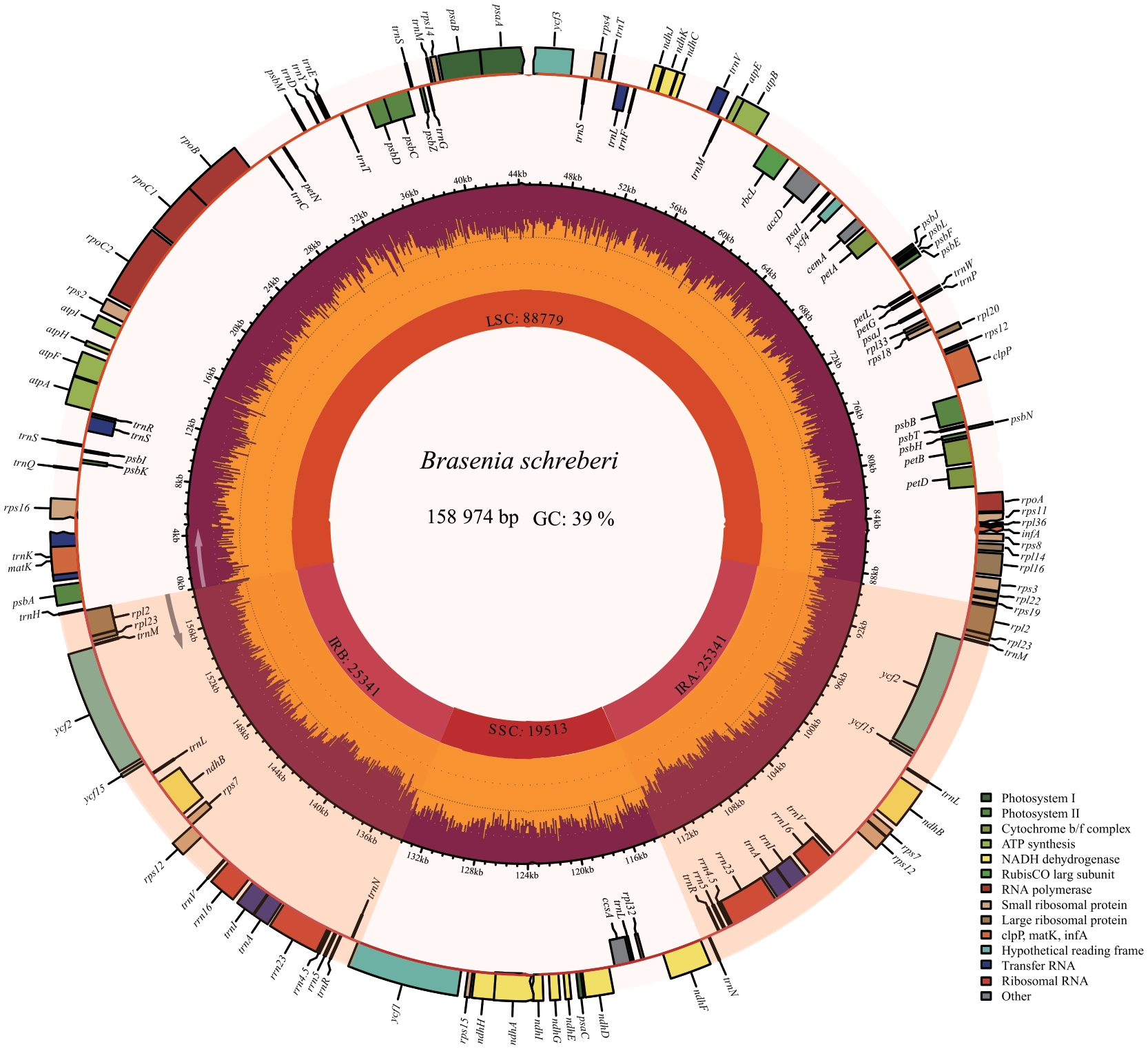
图1 莼菜叶绿体基因组图谱
Fig. 1 Chloroplast genome map of Brasenia schreberi
基因组特征 Genome feature | 莼菜 B. schreberi | 水生金鱼藻 C. aquatica | 卡罗莱纳金鱼藻 C. caroliniana | 叉枝金鱼藻 C. furcata |
|---|---|---|---|---|
| 基因组大小 Genome size (bp) | 158 974 | 159 487 | 164 057 | 160 271 |
| LSC长度 LSC length (bp) | 88 779 | 89 434 | 82 090 | 90 038 |
| SSC长度 SSC length (bp) | 19 513 | 19 115 | 18 827 | 19 385 |
| IR长度 IR length (bp) | 25 341 | 25 469 | 31 570 | 25 424 |
| 基因总数 Number of genes | 133 | 135 | 146 | 135 |
| 蛋白质编码基因数 Number of protein-coding genes | 87 | 89 | 111 | 89 |
| rRNA基因数 Number of rRNA genes | 8 | 8 | 8 | 8 |
| tRNA基因数 Number of tRNA genes | 38 | 38 | 37 | 38 |
| GC含量 GC content (%) | 39.0 | 38.0 | 38.3 | 38.1 |
| LSC中GC含量 GC content in LSC (%) | 37.5 | 36.4 | 36.8 | 36.4 |
| SSC中GC含量 GC content in SSC (%) | 34.3 | 32.7 | 33.1 | 32.9 |
| IR中GC含量 GC content in IR (%) | 43.5 | 43.1 | 41.8 | 43.2 |
表1 莼菜、水生金鱼藻、卡罗莱纳金鱼藻及叉枝金鱼藻的完整叶绿体基因组特征
Table 1 Complete cp genome features of B. schreberi, C. aquatica, C. caroliniana, and C. furcata
基因组特征 Genome feature | 莼菜 B. schreberi | 水生金鱼藻 C. aquatica | 卡罗莱纳金鱼藻 C. caroliniana | 叉枝金鱼藻 C. furcata |
|---|---|---|---|---|
| 基因组大小 Genome size (bp) | 158 974 | 159 487 | 164 057 | 160 271 |
| LSC长度 LSC length (bp) | 88 779 | 89 434 | 82 090 | 90 038 |
| SSC长度 SSC length (bp) | 19 513 | 19 115 | 18 827 | 19 385 |
| IR长度 IR length (bp) | 25 341 | 25 469 | 31 570 | 25 424 |
| 基因总数 Number of genes | 133 | 135 | 146 | 135 |
| 蛋白质编码基因数 Number of protein-coding genes | 87 | 89 | 111 | 89 |
| rRNA基因数 Number of rRNA genes | 8 | 8 | 8 | 8 |
| tRNA基因数 Number of tRNA genes | 38 | 38 | 37 | 38 |
| GC含量 GC content (%) | 39.0 | 38.0 | 38.3 | 38.1 |
| LSC中GC含量 GC content in LSC (%) | 37.5 | 36.4 | 36.8 | 36.4 |
| SSC中GC含量 GC content in SSC (%) | 34.3 | 32.7 | 33.1 | 32.9 |
| IR中GC含量 GC content in IR (%) | 43.5 | 43.1 | 41.8 | 43.2 |
基因功能分类 Category of gene function | 基因类别 Gene group | 基因名称 Gene name |
|---|---|---|
光合作用相关 Photosynthesis-related | 光系统Ⅰ Photosystem I | psaA, psaB, psaC, psaI, psaJ |
光系统Ⅱ Photosystem Ⅱ | psbA, psbB, psbC, psbD, psbE, psbF, psbI, psbJ, psbK, psbL, psbM, psbN, psbT, psbZ, ycf3** | |
NADH氧化还原酶基因 NADH dehydrogenase | ndhA*, ndhB*(2), ndhC, ndhD, ndhE, ndhF, ndhG, ndhH, ndhI, ndhJ, ndhK | |
细胞色素b/f复合体 Cytochrome b/f complex | petA, petB*, petD*, petG, petL, petN | |
ATP酶 ATP synthase | atpA, atpB, atpE, atpF*, atpH, atpI | |
二磷酸核酮糖羧化酶大亚基 Rubisco large subunit | RbcL | |
自我复制基因 Self-replication | 核糖体蛋白大亚基 Large subunit of ribosome | rpl14, rpl16*, rpl2*(2), rpl20, rpl22, rpl23(2),rpl32, rpl33, rpl36 |
核糖体蛋白小亚基 Small subunit of ribosome | rps11, rps12(3), rps14, rps15, rps16*, rps18, rps19, rps2, rps3, rps4, rps7(2), rps8 | |
RNA聚合酶 RNA polymerase | rpoA, rpoB, rpoC1*, rpoC2 | |
核糖体RNAs Ribosomal RNAs | rrn16(2),rrn23(2),rrn4.5(2),rrn5(2) | |
转运RNA Transfer RNA | trnH-GUG, trnK-UUU*, trnQ-UUG, trnS-GCU, trnS-CGA, trnR-UCU, trnC-GCA, trnD-GUC, trnY-GUA, trnE-UUC, trnT-GGU, trnS-UGA, trnG-GCC, trnM-CAU(4), trnS-GCU*, trnT-UGU, trnL-UAA*, trnF-GAA, trnV-UAC*, trnW-CCA, trnP-UGG, trnL-CAA(2), trnV-GAC(2), trnI-GAU*(2), trnA-UGC*(2), trnR-ACG(2), trnL-UAG, trnN-GUU(2) | |
其他基因 Other genes | 成熟酶 Maturase | MatK |
蛋白酶 Protease | ClpP** | |
包膜蛋白基因 Envelope membrane protein gene | cemA | |
C型细胞色素合成基因 C-type cytochrome synthesis gene | ccsA | |
转录起始因子 Transcription initiation factor | infA | |
乙酰辅酶A羧化酶的亚基 Subunit of Acetyl-CoA-carboxylase | accD | |
未知基因 Unknown genes | 保守开放阅读框 Conserved open reading frame | ycf1, ycf15(2), ycf2(2), ycf4 |
表2 莼菜叶绿体基因功能分类统计
Table 2 Classification and statistics of chloroplast gene function of B. schreberi
基因功能分类 Category of gene function | 基因类别 Gene group | 基因名称 Gene name |
|---|---|---|
光合作用相关 Photosynthesis-related | 光系统Ⅰ Photosystem I | psaA, psaB, psaC, psaI, psaJ |
光系统Ⅱ Photosystem Ⅱ | psbA, psbB, psbC, psbD, psbE, psbF, psbI, psbJ, psbK, psbL, psbM, psbN, psbT, psbZ, ycf3** | |
NADH氧化还原酶基因 NADH dehydrogenase | ndhA*, ndhB*(2), ndhC, ndhD, ndhE, ndhF, ndhG, ndhH, ndhI, ndhJ, ndhK | |
细胞色素b/f复合体 Cytochrome b/f complex | petA, petB*, petD*, petG, petL, petN | |
ATP酶 ATP synthase | atpA, atpB, atpE, atpF*, atpH, atpI | |
二磷酸核酮糖羧化酶大亚基 Rubisco large subunit | RbcL | |
自我复制基因 Self-replication | 核糖体蛋白大亚基 Large subunit of ribosome | rpl14, rpl16*, rpl2*(2), rpl20, rpl22, rpl23(2),rpl32, rpl33, rpl36 |
核糖体蛋白小亚基 Small subunit of ribosome | rps11, rps12(3), rps14, rps15, rps16*, rps18, rps19, rps2, rps3, rps4, rps7(2), rps8 | |
RNA聚合酶 RNA polymerase | rpoA, rpoB, rpoC1*, rpoC2 | |
核糖体RNAs Ribosomal RNAs | rrn16(2),rrn23(2),rrn4.5(2),rrn5(2) | |
转运RNA Transfer RNA | trnH-GUG, trnK-UUU*, trnQ-UUG, trnS-GCU, trnS-CGA, trnR-UCU, trnC-GCA, trnD-GUC, trnY-GUA, trnE-UUC, trnT-GGU, trnS-UGA, trnG-GCC, trnM-CAU(4), trnS-GCU*, trnT-UGU, trnL-UAA*, trnF-GAA, trnV-UAC*, trnW-CCA, trnP-UGG, trnL-CAA(2), trnV-GAC(2), trnI-GAU*(2), trnA-UGC*(2), trnR-ACG(2), trnL-UAG, trnN-GUU(2) | |
其他基因 Other genes | 成熟酶 Maturase | MatK |
蛋白酶 Protease | ClpP** | |
包膜蛋白基因 Envelope membrane protein gene | cemA | |
C型细胞色素合成基因 C-type cytochrome synthesis gene | ccsA | |
转录起始因子 Transcription initiation factor | infA | |
乙酰辅酶A羧化酶的亚基 Subunit of Acetyl-CoA-carboxylase | accD | |
未知基因 Unknown genes | 保守开放阅读框 Conserved open reading frame | ycf1, ycf15(2), ycf2(2), ycf4 |
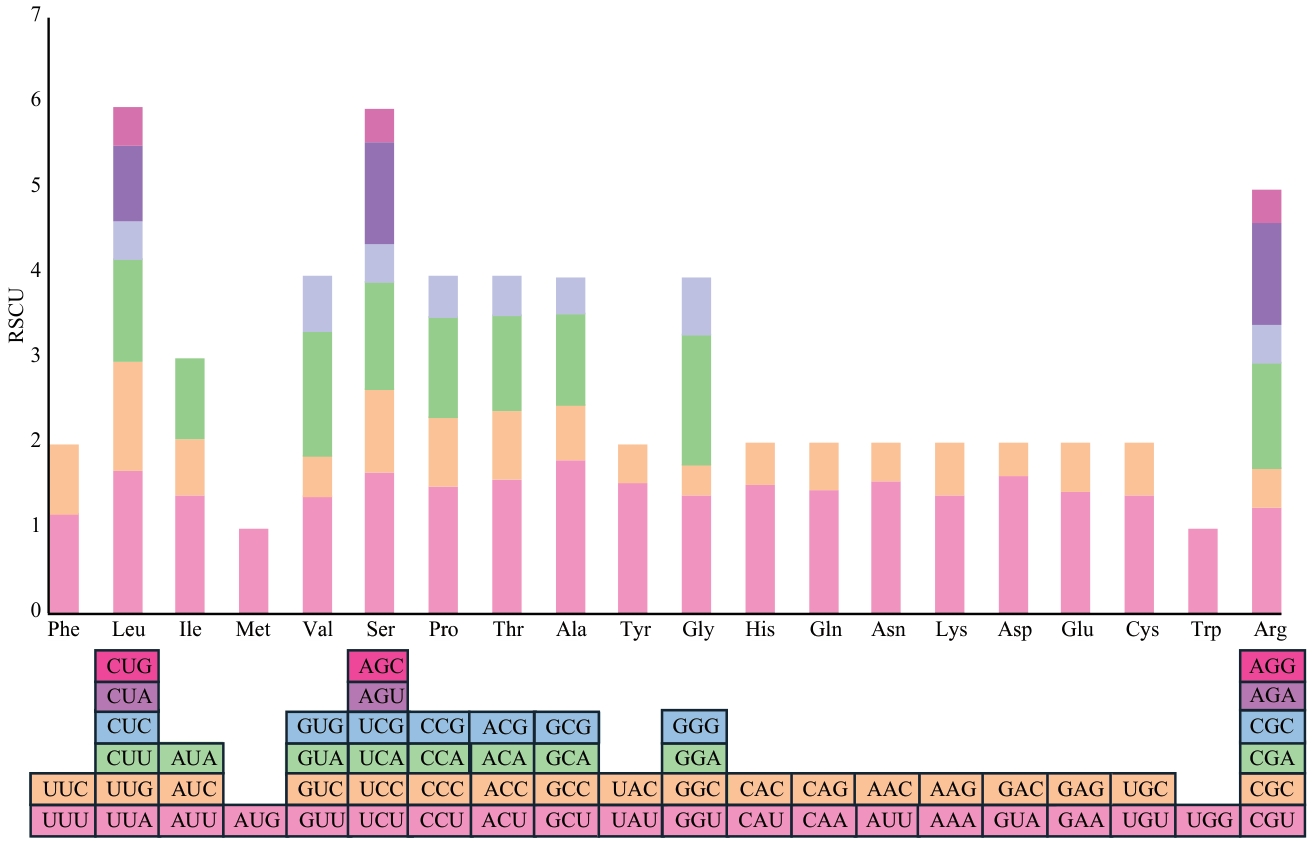
图2 莼菜叶绿体基因组蛋白质编码基因中20种氨基酸的相对同义密码子使用频率(RSCU)图下方的方框展示了编码每种氨基酸的所有密码子。柱状图的颜色与对应密码子的颜色一致
Fig. 2 Relative synonymous codon usage (RSCU) values of 20 amino acids in the protein-coding genes of B. schreberi chloroplast genomeBoxes below the graphs represent all codons encoding each amino acid. The colors of the histograms correspond to the colors of the codons
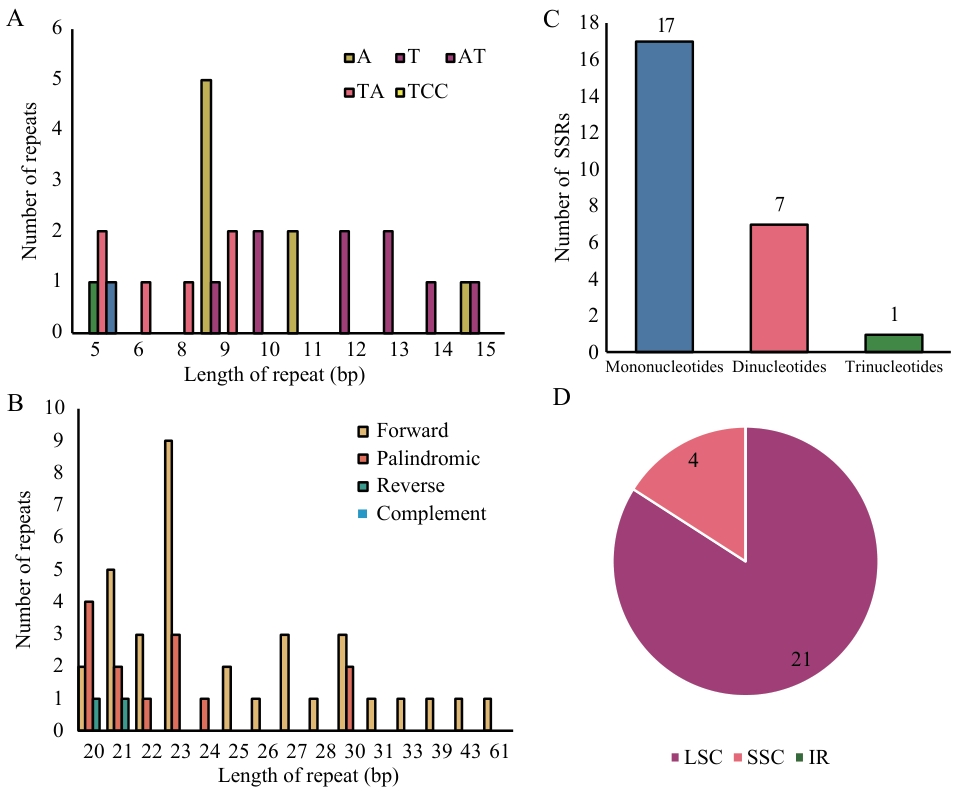
图3 简单重复序列分析A:各类SSR数目;B:长重复序列数量;C:各类核苷酸数量;D:SSR的分布情况
Fig. 3 Simple sequence repeat (SSR) analysisA: Number of various SSRs. B: Number of long repeat sequences. C: Number of various nucleotides. D: Distribution of SSRs
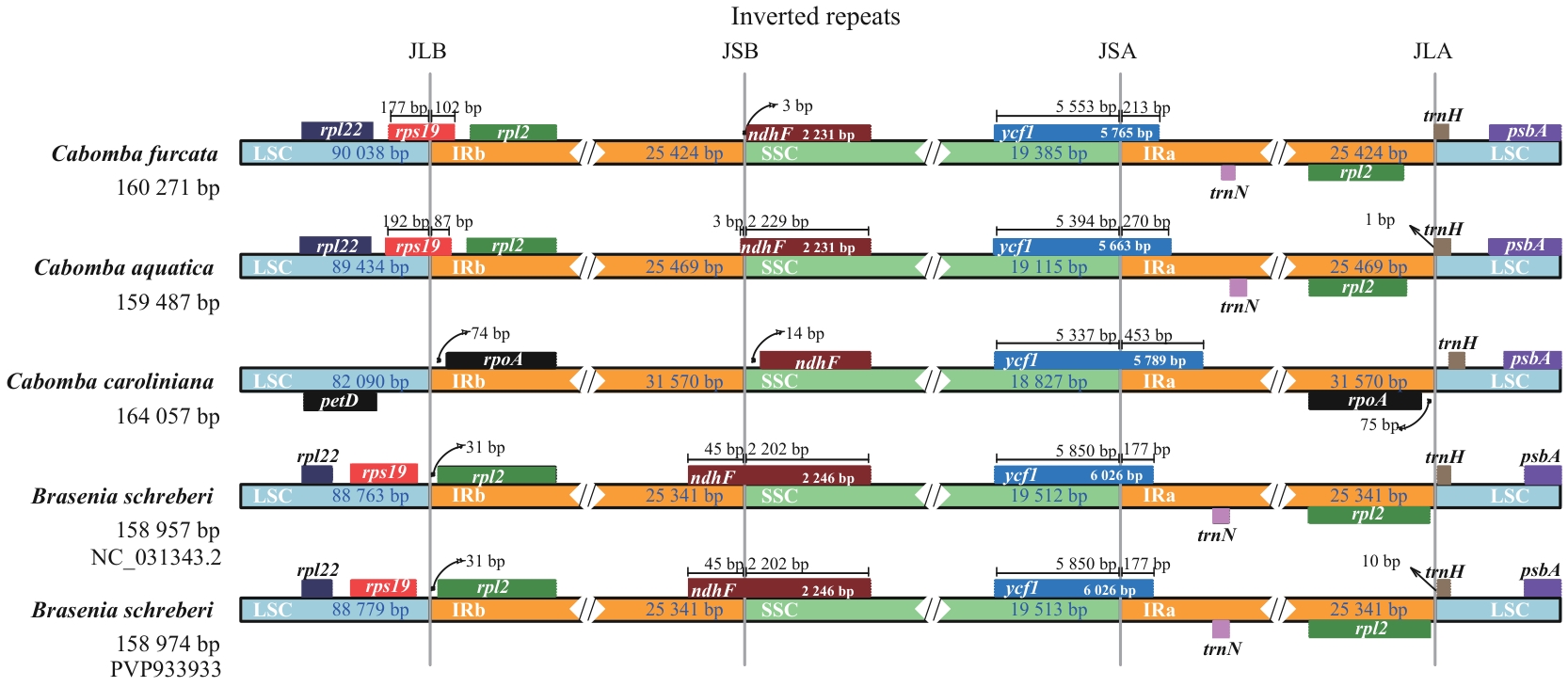
图4 5种植物叶绿体基因组IR边界的比较
Fig. 4 Comparison of IR boundaries in the cp genomes of five plant species
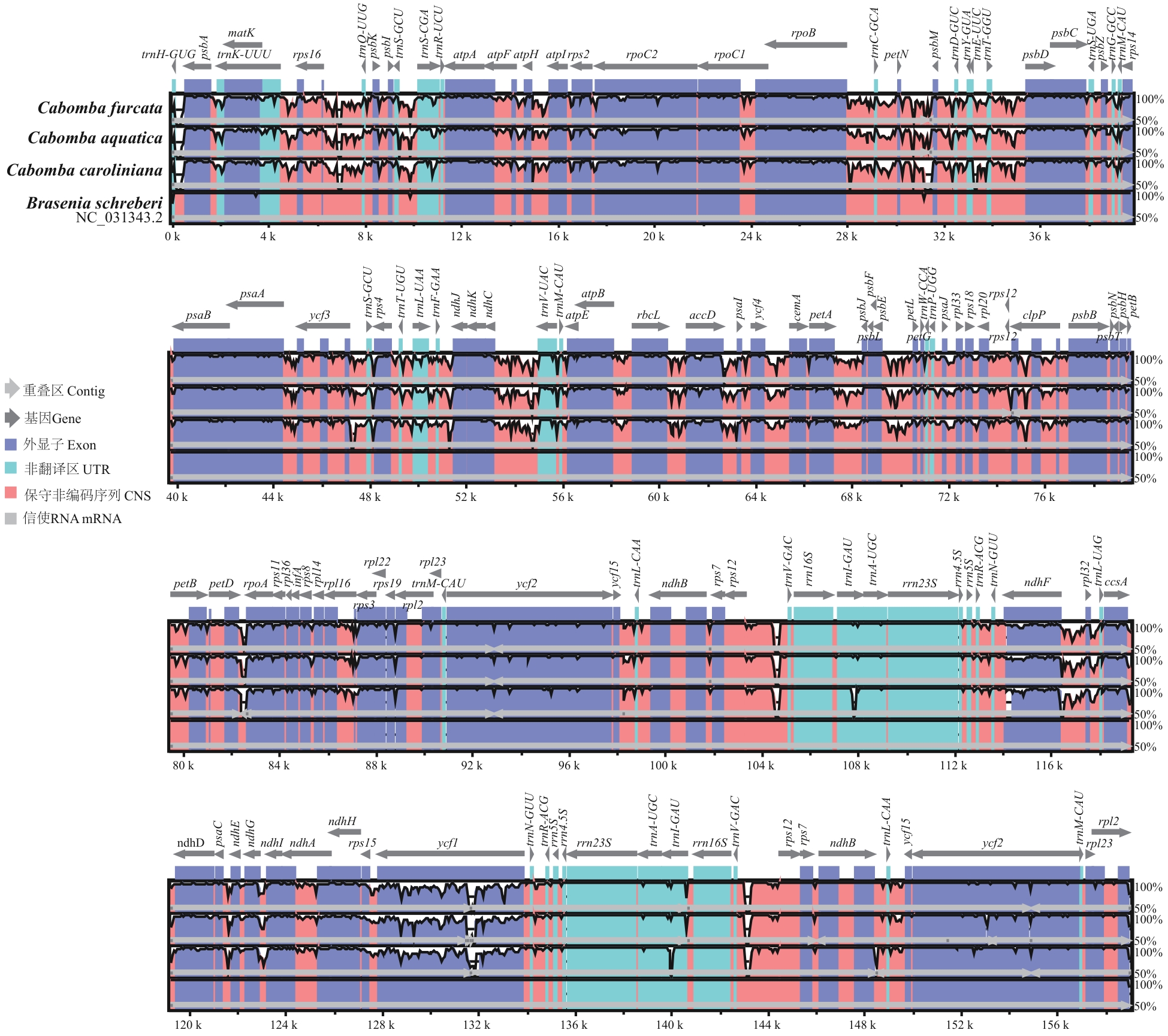
图5 莼菜叶绿体基因组序列比对
Fig. 5 Alignment of B. schreberi chloroplast genome sequences
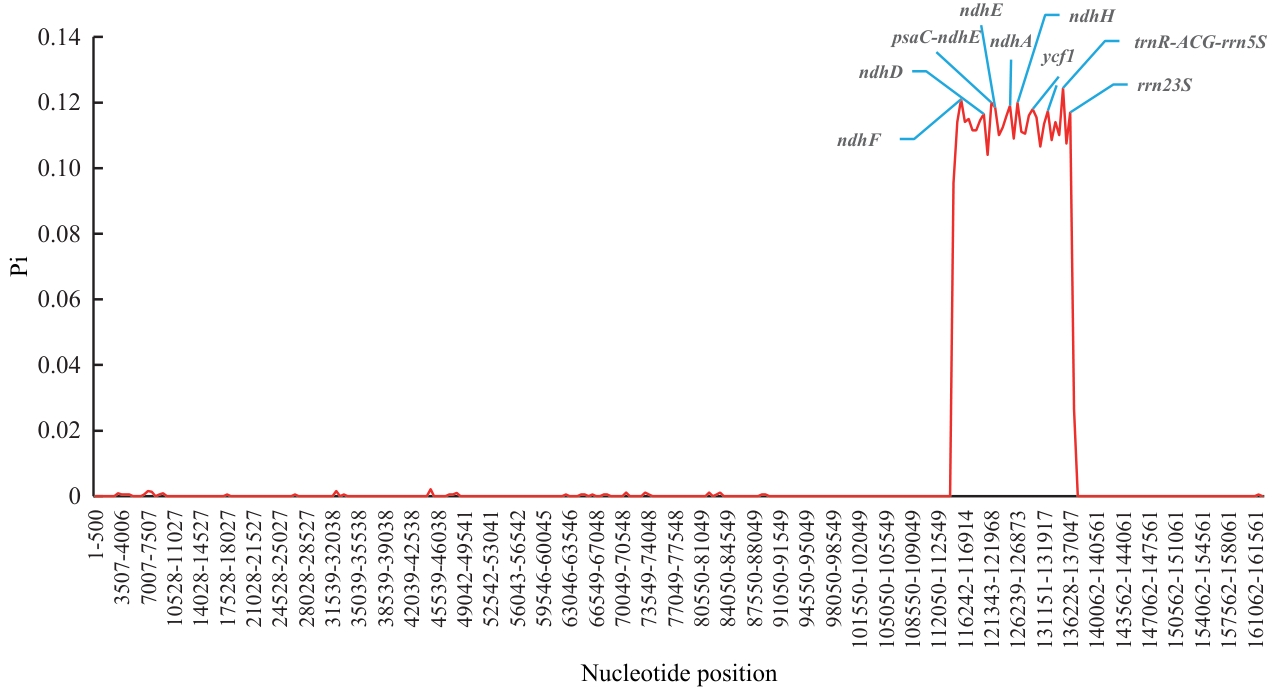
图6 莼菜叶绿体基因组核苷酸多态性分析
Fig. 6 Nucleotide polymorphism analysis of the chloroplast genome of B. schreberi
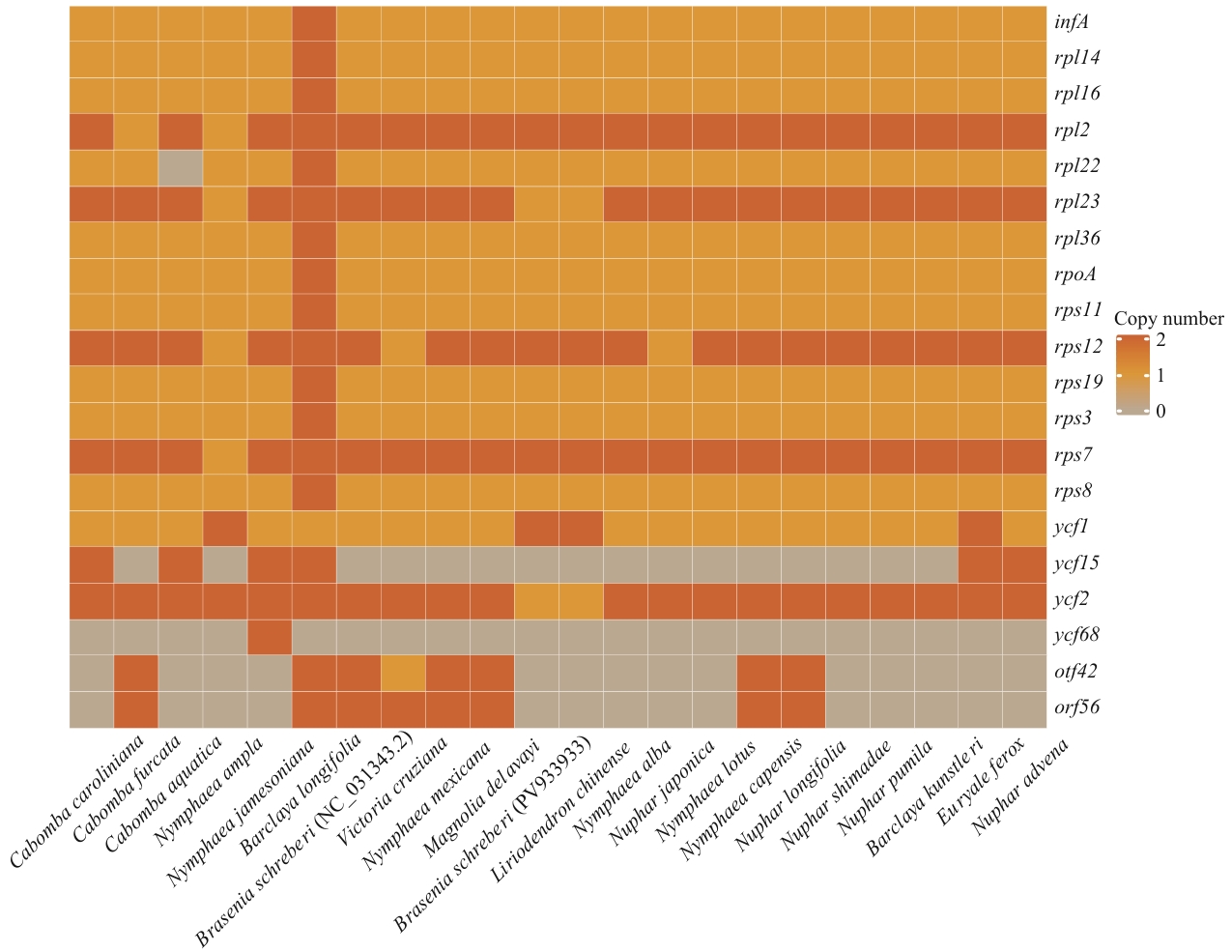
图7 基因统计分析
Fig. 7 Statistical analysis of genes
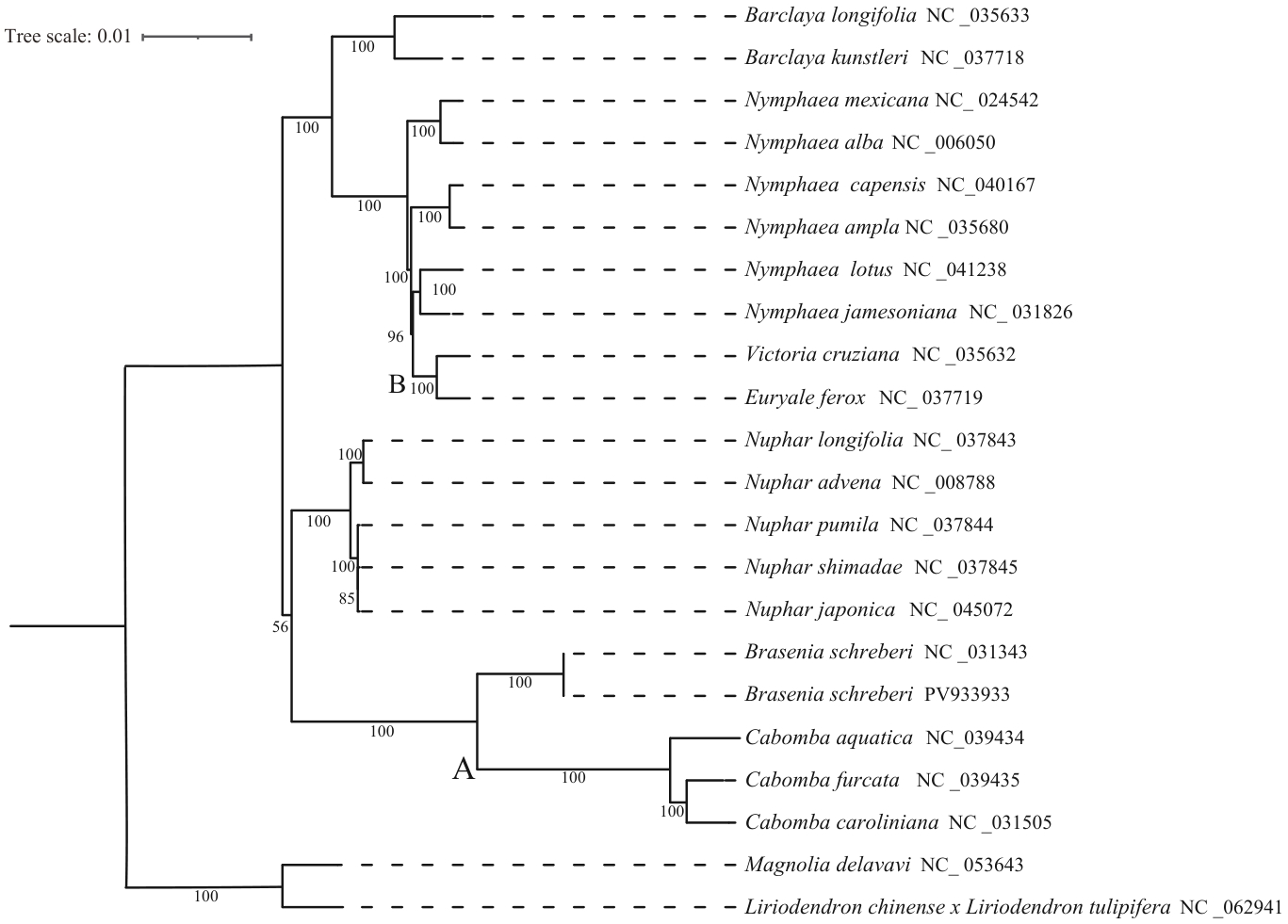
图8 基于22个物种叶绿体基因组序列构建的最大似然系统发育树以山玉兰和鹅掌楸为外类群;分支上数值为自展支持率(%);A与B分别指示睡莲目2个分支
Fig. 8 Maximum likelihood phylogenetic tree based on 22 chloroplast genome sequencesUsing Magnolia delavayi and Liriodendron chinense as the outgroups. The values on the branches indicate bootstrap support values (%). A and B denote the two branches of Nymphaeales, respectively
| [1] | Xie C, Li JF, Pan F, et al. Environmental factors influencing mucilage accumulation of the endangered Brasenia schreberi in China [J]. Sci Rep, 2018, 8: 17955. |
| [2] | Kim C, Na HR, Choi HK. Conservation genetics of endangered Brasenia schreberi based on RAPD and AFLP markers [J]. J Plant Biol, 2008, 51(4): 260-268. |
| [3] | Li ZZ, Gichira AW, Wang QF, et al. Genetic diversity and population structure of the endangered basal angiosperm Brasenia Schreberi (Cabombaceae) in China [J]. PeerJ, 2018, 6: e5296. |
| [4] | 刘虹, 黄文, 黄凌丽, 等. 莼菜资源及其营养成份研究进展 [J]. 植物学研究, 2019(1): 7-14. |
| Liu H, Huang W, Huang LL, et al. Research progress on resources and nutritional components of Brasenia schreberi [J]. Bot Res, 2019(1): 7-14. | |
| [5] | Li JF, Yi CY, Zhang CR, et al. Effects of light quality on leaf growth and photosynthetic fluorescence of Brasenia schreberi seedlings [J]. Heliyon, 2021, 7(1): e06082. |
| [6] | Feng S, Luan D, Ning K, et al. Ultrafiltration isolation, hypoglycemic activity analysis and structural characterization of polysaccharides from Brasenia schreberi [J]. Int J Biol Macromol, 2019, 135: 141-151. |
| [7] | 朱秀红, 夏丹, 杨阳, 等. 4种水生植物对污染水体净化效果的研究 [J]. 河南农业大学学报, 2013, 47(1): 87-91. |
| Zhu XH, Xia D, Yang Y, et al. Study on the purifying effect of four kinds of hydrophyte upon polluted water [J]. J Henan Agric Univ, 2013, 47(1): 87-91. | |
| [8] | Lee MK, Park HJ, Kwon SH, et al. Tellimoside, a flavonol glycoside from Brasenia schreberi, inhibits the growth of cyanobacterium (Microcystis aeruginosa LB 2385) [J]. J Korean Soc Appl Biol Chem, 2013, 56(1): 117-121. |
| [9] | 李佳楠, 董元火. 杭州西湖莼菜种质资源保护区的莼菜群落特征 [J]. 安徽农业科学, 2010, 38(27): 14905-14906. |
| Li JN, Dong YH. Brasenia schreberi community characteristics in conservation zone of west lake in China [J]. J Anhui Agric Sci, 2010, 38(27): 14905-14906. | |
| [10] | 吴洪梅, 吕泽芳, 张昭, 等. 四大莼菜产区商品成分种类和质量分数测定及比较研究 [J]. 西南大学学报: 自然科学版, 2017, 39(5): 76-82. |
| Wu HM, Lv ZF, Zhang Z, et al. A comparative study of the commercially valuable components of water shield (Brasenia schreberi) from 4 cultivation areas in China [J]. J Southwest Univ Nat Sci, 2017, 39(5): 76-82. | |
| [11] | 沈珉, 黄炳元. 太湖莼菜无公害栽培技术 [J]. 中国蔬菜, 2006, 9: 50-51. |
| Shen M, Huang BY. Pollution-free cultivation techniques of water shield in Taihu Lake [J]. China Veg, 2006(9): 50-51. | |
| [12] | Zhang GF, Gao BQ. Analysis on genetic diversity and genetic structure of Brasenia schreberi in Jiangsu and Zhejiang Provinces revealed by ISSR markers [J]. J Lake Sci, 2008, 20(5): 662-668. |
| [13] | Kim C, Jung J, Na HR, et al. Population genetic structure of the endangered Brasenia schreberi in South Korea based on nuclear ribosomal spacer and chloroplast DNA sequences [J]. J Plant Biol, 2012, 55(1): 81-91. |
| [14] | Liu H, Long ZC, Li LN, et al. Development and characterization of microsatellite loci in Brasenia schreberi (Cabombaceae) based on the next-generation sequencing [J]. Genet Mol Res, 2016, 15(2). DOI: 10.4238/gmr.15027886 . |
| [15] | 朱红莲, 杜娟, 刘正位, 等. 我国野生莼菜考察及遗传多样性研究 [J]. 植物遗传资源学报, 2020, 21(6): 1586-1595. |
| Zhu HL, Du J, Liu ZW, et al. Investigation and genetic diversity of wild watershield (Brasenia schreberi) in China [J]. J Plant Genetic Resources, 2020, 21(6): 1586-1595. | |
| [16] | Sun Y, Li MY, Ma JY, et al. Complete chloroplast genome sequence of a new variety of Brasenia schreberi: genome characteristics, comparative analysis, and phylogenetic relationships [J]. Agronomy, 2022, 12(12): 2972. |
| [17] | Zheng SY, Poczai P, Hyvönen J, et al. Chloroplot: an online program for the versatile plotting of organelle genomes [J]. Front Genet, 2020, 11: 576124. |
| [18] | Amiryousefi A, Hyvönen J, Poczai P. IRscope: an online program to visualize the junction sites of chloroplast genomes [J]. Bioinformatics, 2018, 34(17): 3030-3031. |
| [19] | Frazer KA, Pachter L, Poliakov A, et al. VISTA: computational tools for comparative genomics [J]. Nucleic Acids Res, 2004, 32(): W273-W279. |
| [20] | 朱陇强, 朱志煌, 朱雷宇, 等. 匙指虾科线粒体基因组结构与系统进化分析 [J]. 大连海洋大学学报, 2022, 37(3): 428-434. |
| Zhu LQ, Zhu ZH, Zhu LY, et al. Characteristics and phylogenetic analysis of mitogenome in Atyidae [J]. J Dalian Ocean Univ, 2022, 37(3): 428-434. | |
| [21] | 张东, 李文祥, 王桂堂. PhyloSuite: 生物领域分子系统发育分析新平台 [J]. 科学观察, 2023, 18(6): 35-37. |
| Zhang D, Li WX, Wang GT. PhyloSuite: a novel biological platform for molecular phylogenetics studies [J]. Sci Focus, 2023, 18(6): 35-37. | |
| [22] | Yang Y, Li JW, Wang N, et al. The complete chloroplast genome sequence of Brasenia schreberi (Cabombaceae) [J]. Mitochondrial DNA Part B, 2019, 4(2): 3842-3843. |
| [23] | Nguyen HQ, Nguyen TNL, Doan TN, et al. Complete chloroplast genome of novel Adrinandra megaphylla Hu species: molecular structure, comparative and phylogenetic analysis [J]. Sci Rep, 2021, 11: 11731. |
| [24] | Xiong Y, Xiong YL, Jia SG, et al. The complete chloroplast genome sequencing and comparative analysis of reed canary grass (Phalaris arundinacea) and hardinggrass (P. aquatica) [J]. Plants, 2020, 9(6): 748. |
| [25] | Liu HS, Su ZH, Yu SQ, et al. Genome comparison reveals mutation hotspots in the chloroplast genome and phylogenetic relationships of Ormosia species [J]. BioMed Res Int, 2019, 2019: 7265030. |
| [26] | Xu XM, Wei Z, Sun JZ, et al. Phylogeny of Leontopodium (Asteraceae) in China—with a reference to plastid genome and nuclear ribosomal DNA [J]. Front Plant Sci, 2023, 14: 1163065. |
| [27] | Kawabe A, Miyashita NT. Patterns of codon usage bias in three dicot and four monocot plant species [J]. Genes Genet Syst, 2003, 78(5): 343-352. |
| [28] | Zhao YC, Zheng H, Xu AY, et al. Analysis of codon usage bias of envelope glycoprotein genes in nuclear polyhedrosis virus (NPV) and its relation to evolution [J]. BMC Genom, 2016, 17: 677. |
| [29] | Pintó RM, Bosch A. The codon usage code for cotranslational folding of viral capsids [J]. Genome Biol Evol, 2021, 13(9): evab089. |
| [30] | Li MY, Zhang R, Li J, et al. Analyses of chloroplast genome of Eutrema japonicum provide new insights into the evolution of Eutrema species [J]. Agronomy, 2021, 11(12): 2546. |
| [31] | Yi X, Gao L, Wang B, et al. The complete chloroplast genome sequence of Cephalotaxus oliveri (Cephalotaxaceae): evolutionary comparison of Cephalotaxus chloroplast DNAs and insights into the loss of inverted repeat copies in gymnosperms [J]. Genome Biol Evol, 2013, 5(4): 688-698. |
| [32] | Sheng JJ, Yan M, Wang J, et al. The complete chloroplast genome sequences of five Miscanthus species, and comparative analyses with other grass plastomes [J]. Ind Crops Prod, 2021, 162: 113248. |
| [33] | 魏瑶, 张晶晶, 崔云晓, 等. 忍冬属忍冬组植物叶绿体基因组进化分析 [J]. 生物技术通报, 2025, 41(8): 276-288. |
| Wei Y, Zhang JJ, Cui XY, et al. Phylogenetic analysis of Lonicera Sect. Nintooa based on chloroplast genomes data [J]. Biotechnol Bull, 2025, 41(8): 276-288. | |
| [34] | Zhang Y, Li L, Yan TL, et al. Complete chloroplast genome sequences of Praxelis (Eupatorium catarium Veldkamp), an important invasive species [J]. Gene, 2014, 549(1): 58-69. |
| [35] | Wang LY, Wang J, He CY, et al. Characterization and comparison of chloroplast genomes from two sympatric Hippophae species (Elaeagnaceae) [J]. J For Res, 2021, 32(1): 307-318. |
| [36] | Chen JH, Hao ZD, Xu HB, et al. The complete chloroplast genome sequence of the relict woody plant Metasequoia glyptostroboides Hu et Cheng [J]. Front Plant Sci, 2015, 6: 447. |
| [37] | Dong WP, Xu C, Li CH, et al. ycf1, the most promising plastid DNA barcode of land plants [J]. Sci Rep, 2015, 5: 8348. |
| [38] | Yang YC, Zhou T, Duan D, et al. Comparative analysis of the complete chloroplast genomes of five Quercus species [J]. Front Plant Sci, 2016, 7: 959. |
| [39] | 涂国章, 张显强. DNA条形码技术在石斛分类鉴定中的应用进展 [J]. 食品安全质量检测学报, 2023, 14(2): 154-160. |
| Tu GZ, Zhang XQ. Application progress of DNA barcoding technology in Dendrobium classification and identification [J]. J Food Saf Qual, 2023, 14(2): 154-160. | |
| [40] | Wang XY, Dorjee T, Chen YR, et al. The complete chloroplast genome sequencing analysis revealed an unusual IRs reduction in three species of subfamily Zygophylloideae [J]. PLoS One, 2022, 17(2): e0263253. |
| [41] | Dong WP, Liu J, Yu J, et al. Highly variable chloroplast markers for evaluating plant phylogeny at low taxonomic levels and for DNA barcoding [J]. PLoS One, 2012, 7(4): e35071. |
| [42] | Wu ZH, Gui ST, Quan ZW, et al. A precise chloroplast genome of Nelumbo nucifera (Nelumbonaceae) evaluated with Sanger, Illumina MiSeq, and PacBio RS II sequencing platforms: insight into the plastid evolution of basal eudicots [J]. BMC Plant Biol, 2014, 14: 289. |
| [1] | 刘柔知, 吴嘉琦, 吴辉烨, 袁婧怡, 程堂仁, 张启翔, 袁存权. 三种不同栽培类型菊花品种的叶绿体基因组特征对比分析[J]. 生物技术通报, 2026, 42(8): 239-250. |
| [2] | 汪志, 胡光明, 罗轩, 高磊, 叶丽霞, 黄穷, 肖涛, 张蕾. 革叶猕猴桃叶绿体基因组特征及系统发育分析[J]. 生物技术通报, 2026, 42(8): 173-187. |
| [3] | 梁慧琪, 陈益存, 汪阳东, 赵耘霄, 高暝. 山苍子PAT1基因亚家族鉴定及其在嫁接愈合过程中的表达分析[J]. 生物技术通报, 2026, 42(5): 302-311. |
| [4] | 赵艳侠, 李倩, 孙家波, 梁红敏, 李冰冰. 草莓果实品质形成的关键调控基因及分子网络解析[J]. 生物技术通报, 2026, 42(3): 111-132. |
| [5] | 庄娜, 贺红利, 张兴政. 蒺藜苜蓿SMXL基因家族全基因组鉴定及表达分析[J]. 生物技术通报, 2026, 42(2): 250-266. |
| [6] | 魏瑶, 张晶晶, 崔云晓, 刘钰, 刘海瑞. 忍冬属忍冬组植物叶绿体基因组进化分析[J]. 生物技术通报, 2025, 41(8): 276-288. |
| [7] | 安昌, 徐文波, 陆琳, 李登麟, 姚艺新, 林彦翔, 杨成梓, 秦源, 郑平. 不同产地珊瑚菜叶绿体基因组特征的差异性研究[J]. 生物技术通报, 2025, 41(6): 229-242. |
| [8] | 程诗袁, 何佳丽, 韩福彬, 杨娜娜, 杨利平, 符勇耀. 麝香百合和‘雪皇后’的形态特征、核型及ISSR标记分析[J]. 生物技术通报, 2025, 41(3): 219-229. |
| [9] | 李斌, 苏香萍, 刘畅, 王玉兵, 张勇洪, 周超, 徐青. 玄参科植物叶绿体基因组特征及系统发育分析[J]. 生物技术通报, 2025, 41(3): 240-254. |
| [10] | 岳园园, 胡哲源, 何琪, 黄晨阳, 郑素月, 赵梦然. 基于全基因组SNP位点和性状特征解析我国野生肺形侧耳的遗传多样性[J]. 生物技术通报, 2025, 41(3): 282-293. |
| [11] | 杨晨欣, 李梦秀, 姜唐, 张文娥, 潘学军. 美人蕉R2R3-MYB基因家族的鉴定及与花青素相关成员的表达分析[J]. 生物技术通报, 2025, 41(12): 201-213. |
| [12] | 杜雨晴, 蒋路园, 汪奕衡, 吴宸炜, 杨梦露, 刘旭升, 王晓君, 邱德有, 樊玮, 杨艳芳. 太行山地区南方红豆杉SSR遗传多样性分析[J]. 生物技术通报, 2025, 41(12): 214-224. |
| [13] | 秦文俊, 熊言杰, 赵冉, 马萧然, 叶霄萌, 宋江华. 甘蓝ARF基因家族的鉴定及其在非生物胁迫下的表达分析[J]. 生物技术通报, 2025, 41(10): 253-263. |
| [14] | 江宏燕, 陈世春, 廖姝然, 陈亭旭, 王晓庆. 曙厉蝽和益蝽线粒体基因组全序列特征及系统发育分析[J]. 生物技术通报, 2025, 41(1): 312-323. |
| [15] | 杨雨青, 谭娟, 汪芳, 彭顺利, 陈婕, 谭明燕, 吕美艳, 周富裕, 刘声传. 茶树叶绿体基因组的研究与应用进展[J]. 生物技术通报, 2024, 40(2): 20-30. |
| 阅读次数 | ||||||
|
全文 |
|
|||||
|
摘要 |
|
|||||
