







• 综述与专论 • 下一篇
巩慧玲1( ), 曹爱青1, 曾子贤2,3
收稿日期:2026-03-13
出版日期:2026-08-21
通讯作者:
巩慧玲gonghl@lut.edu.cn作者简介:第一联系人:同等贡献
基金资助:
GONG Hui-ling1(), CAO Ai-qing1, ZENG Zi-xian2,3
Received:2026-03-13
Published:2026-08-21
摘要:
多倍体是指具有两套以上完整染色体组的生物个体。相较于二倍体,植物多倍体通常表现出代谢旺盛、生长势强、营养器官与繁殖器官(花、果、种子等)巨大等优势,且在面对环境胁迫时往往具有更强的抗逆性与适应能力,但其抗性表现具有复杂性,亦存在抗性减弱的现象。本文系统梳理了植物多倍体与二倍体在非生物胁迫(如干旱、高盐、极端温度、重金属)及生物胁迫(如病原菌侵染、虫害)下响应差异的基础上,从细胞结构适应性变化、生理代谢调控、基因表达调控、表观遗传修饰以及染色质高级结构重塑等多个层面,深入探讨多倍体抗性增强或减弱的生理与分子机制。抗性增强源于细胞结构优化、渗透调节与抗氧化等能力的提升,胁迫相关基因表达网络的高效激活,以及DNA甲基化、组蛋白修饰等表观遗传调控与染色质高级结构(如A/B区室转换、拓扑结构域重组)的重塑,共同实现对抗性相关基因表达的精细调控。抗性减弱则与细胞体积增大所导致的生理调控效率降低、关键防御通路的紊乱及表观遗传调控系统的不稳定等因素有关。这种抗性表现的不确定性与物种特异性、环境依赖性密切相关,反映出不同倍性水平下生长与防御之间资源分配的动态权衡,存在兼顾适应优势与生存成本的最佳倍性阈值。未来研究需结合单细胞测序与空间转录组技术,解析多倍体在时空维度上的抗逆响应图谱,为深入理解多倍体植物对环境变化的适应策略提供系统的理论依据与研究参考。
巩慧玲, 曹爱青, 曾子贤. 植物多倍体抗性及其机制研究进展[J]. 生物技术通报, doi: 10.13560/j.cnki.biotech.bull.1985.2026-0294.
GONG Hui-ling, CAO Ai-qing, ZENG Zi-xian. Research Progress on Plant Polyploid Resistance and Its Mechanisms[J]. Biotechnology Bulletin, doi: 10.13560/j.cnki.biotech.bull.1985.2026-0294.
| 胁迫类型 Stress conditions | 材料种类 Type of materials | 抗性差异 Phenomenon | 参考文献 References |
|---|---|---|---|
| 干旱胁迫Drought resistance | 海大麦 Hordeum marinum | 4X>2X | [ |
| 枇杷 Eriobotrya japonica | 4X>2X | [ | |
| 桑树 Morus alba | 4X>3X>2X | [ | |
| 颤杨 Populus tremuloides | 3X<2X | [ | |
| 花生 Arachis duranensis | 4X<2X | [ | |
| 花生 Arachis ipaënsis | 4X<2X | [ | |
| 花生 Arachis hypogaea | 4X<2X | [ | |
| 蔓菁 Brassica rapa | 4X<2X | [ | |
| 甘蓝 Brassica oleracea | 4X<2X | [ | |
| 甘蓝型油菜 Brassica napus | 4X<2X | [ | |
| 高盐胁迫High salt resistance | 苹果 Malus domestica | 4X>2X | [ |
| 西瓜 Citrullus lanatus | 4X>2X | [ | |
| 金银花 Lonicera japonica | 4X>2X | [ | |
| 柑橘 Citrus reticulata | 4X>2X | [ | |
低温胁迫 Low temperature resistance | 野生草莓 Fragaria nilgerrensis | 4X>2X | [ |
| 毛茛 Ranunculus kuepferi | 4X>2X | [ | |
| 美味猕猴桃 Actinidia deliciosa | 4X>2X | [ | |
| 中华猕猴桃 Actinidia chinensis | 4X>2X | [ | |
| 青钱柳 Cyclocarya paliurus | 4X<2X | [ | |
| 杜鹃花 Rhododendron simsii | 4X<2X | [ | |
| 西瓜 Citrithus lanatus | 4X<2X | [ | |
| 三色堇 Viola tricolor | 8X>14X>12X>16X | [ | |
高温胁迫 High temperature resistance | 芦笋 Asparagus officinalis | 4X>2X | [ |
| 加拿大一枝黄花 Solidago canadensis | 4X>2X | [ | |
| 药用川芎 Ligusticum chuanxiong | 4X>2X | [ | |
重金属胁迫 Heavy metal resistance | 青葙 Celosia argentea | 4X>2X | [ |
| 大青杨 Populus ussuriensis | 3X>2X | [ | |
| 水稻 Oryza sativa | 4X>2X | [ |
表1 不同倍性植物非生物胁迫抗性比较
Table 1 Comparison of abiotic stress resistance in plants with different ploidy levels
| 胁迫类型 Stress conditions | 材料种类 Type of materials | 抗性差异 Phenomenon | 参考文献 References |
|---|---|---|---|
| 干旱胁迫Drought resistance | 海大麦 Hordeum marinum | 4X>2X | [ |
| 枇杷 Eriobotrya japonica | 4X>2X | [ | |
| 桑树 Morus alba | 4X>3X>2X | [ | |
| 颤杨 Populus tremuloides | 3X<2X | [ | |
| 花生 Arachis duranensis | 4X<2X | [ | |
| 花生 Arachis ipaënsis | 4X<2X | [ | |
| 花生 Arachis hypogaea | 4X<2X | [ | |
| 蔓菁 Brassica rapa | 4X<2X | [ | |
| 甘蓝 Brassica oleracea | 4X<2X | [ | |
| 甘蓝型油菜 Brassica napus | 4X<2X | [ | |
| 高盐胁迫High salt resistance | 苹果 Malus domestica | 4X>2X | [ |
| 西瓜 Citrullus lanatus | 4X>2X | [ | |
| 金银花 Lonicera japonica | 4X>2X | [ | |
| 柑橘 Citrus reticulata | 4X>2X | [ | |
低温胁迫 Low temperature resistance | 野生草莓 Fragaria nilgerrensis | 4X>2X | [ |
| 毛茛 Ranunculus kuepferi | 4X>2X | [ | |
| 美味猕猴桃 Actinidia deliciosa | 4X>2X | [ | |
| 中华猕猴桃 Actinidia chinensis | 4X>2X | [ | |
| 青钱柳 Cyclocarya paliurus | 4X<2X | [ | |
| 杜鹃花 Rhododendron simsii | 4X<2X | [ | |
| 西瓜 Citrithus lanatus | 4X<2X | [ | |
| 三色堇 Viola tricolor | 8X>14X>12X>16X | [ | |
高温胁迫 High temperature resistance | 芦笋 Asparagus officinalis | 4X>2X | [ |
| 加拿大一枝黄花 Solidago canadensis | 4X>2X | [ | |
| 药用川芎 Ligusticum chuanxiong | 4X>2X | [ | |
重金属胁迫 Heavy metal resistance | 青葙 Celosia argentea | 4X>2X | [ |
| 大青杨 Populus ussuriensis | 3X>2X | [ | |
| 水稻 Oryza sativa | 4X>2X | [ |
| 胁迫类型 Stress conditions | 材料种类 Type of materials | 抗性差异 Phenomenon | 参考文献 References |
|---|---|---|---|
| 刺线虫 Belonolaimus longicaudatus | 侧钝叶草 Stenotaphrum secundatum | 6X>4X>2X | [ |
| 苹果黑星病 Venturia inaequalis | 苹果 Malusdomestica | 4X>2X | [ |
| 青枯雷尔氏菌 Ralstonia solanacearum | 野生型花生 Arachis stenosperma等 | 6X>3X>4X>2X | [ |
| 青枯雷尔氏菌 Ralstonia solanacearum | 栽培型花生 Arachis hypogaea | 6X>3X>4X>2X | [ |
表2 不同倍性植物生物胁迫抗性比较
Table 2 Comparison of biotic stress resistance in plants with different ploidies
| 胁迫类型 Stress conditions | 材料种类 Type of materials | 抗性差异 Phenomenon | 参考文献 References |
|---|---|---|---|
| 刺线虫 Belonolaimus longicaudatus | 侧钝叶草 Stenotaphrum secundatum | 6X>4X>2X | [ |
| 苹果黑星病 Venturia inaequalis | 苹果 Malusdomestica | 4X>2X | [ |
| 青枯雷尔氏菌 Ralstonia solanacearum | 野生型花生 Arachis stenosperma等 | 6X>3X>4X>2X | [ |
| 青枯雷尔氏菌 Ralstonia solanacearum | 栽培型花生 Arachis hypogaea | 6X>3X>4X>2X | [ |
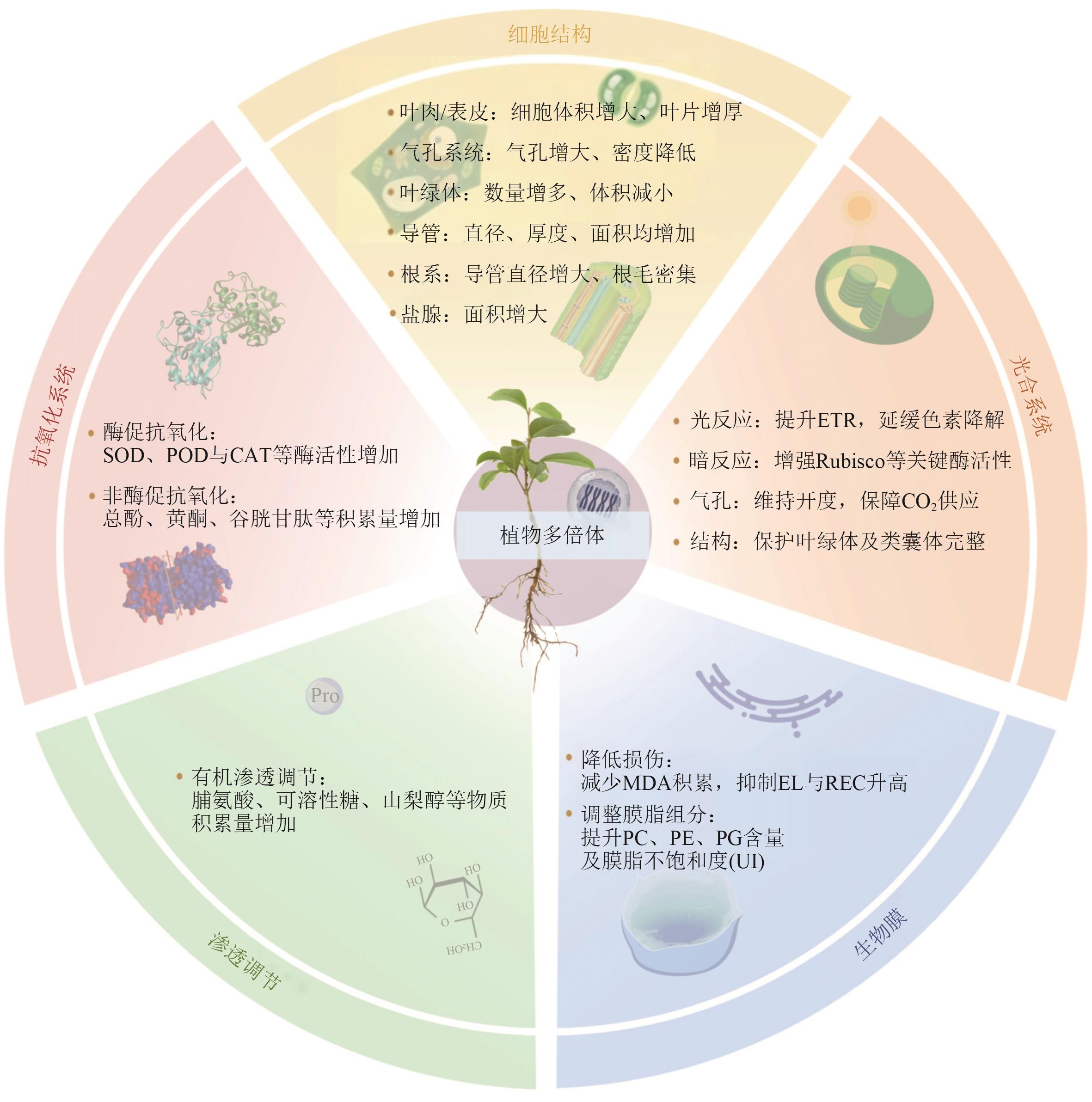
图1 植物多倍体对非生物胁迫与生物胁迫抗性增强的生理机制ETR:电子传递速率;Rubisco:核酮糖-1,5-二磷酸羧化酶;SOD:超氧化物歧化酶;POD:过氧化物酶;CAT:过氧化氢酶;MDA:丙二醛;EL:电解质渗漏率;REC:相对电导率;PC:磷脂酰胆碱;PE:磷脂酰乙醇胺;PG:磷脂酰甘油;UI:不饱和指数
Fig. 1 Physiological mechanisms of increased resistance of plant polyploids to abiotic and biotic stressesETR: Electron transport rate; Rubisco: ribulose-1,5-bisphosphate carboxylase; SOD: superoxide dismutase; POD: peroxidase; CAT: catalase; MDA: malondialdehyde; EL: electrolyte leakage rate; REC: relative conductivity; PC: phosphatidylcholine; PE: phosphatidylethanolamine; PG: phosphatidylglycerol; UI: unsaturation index
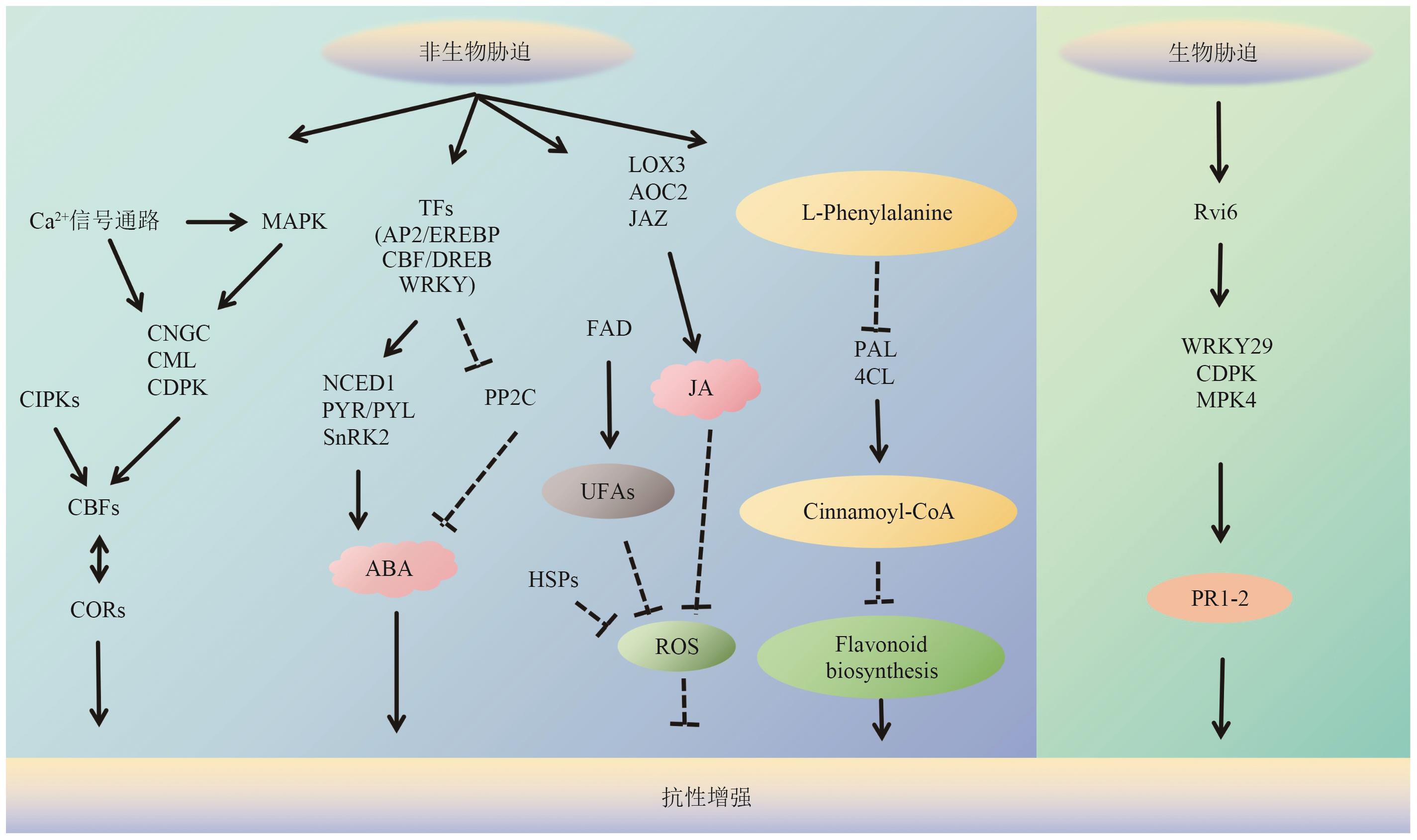
图2 植物多倍体对非生物胁迫与生物胁迫抗性增强的分子机制实线表示激活或调控作用,虚线表示抑制作用,粗箭头表示水平上升,双向粗箭头表示互作。MAPK:丝裂原活化蛋白激酶;CNGC:环核苷酸门控通道;CML:类钙调素;CDPK:钙依赖蛋白激酶;CIPKs:钙调磷酸酶B样蛋白互作激酶;CBFs:C-重复结合因子;CORs:冷诱导基因;L-Phenylalanine:L-苯丙氨酸;PAL:苯丙氨酸解氨酶;4CL:CoA连接酶;Cinnamoyl-CoA:肉桂酰辅酶A还原酶;Flavonoid biosynthesis:类黄酮生物合成;TFs (Transcription factors):转录因子;NCED1:9-顺式环氧类胡萝卜素双加氧酶;PYR/PYL:ABA受体蛋白;SnRK2:蔗糖非发酵相关蛋白激酶;ABA:脱落酸;JA:茉莉酸;FAD:脂肪酸去饱和酶基因;LOX:赖氨酰氧化酶基因;AOC:丙二烯氧化物环化酶基因;JAZ:茉莉酸信号抑制因子;UFAs:不饱和脂肪酸;HSPs:热休克蛋白基因;ROS:活性氧;Rvi6:抗苹果黑星病6号基因;WRKY:WRKY转录因子;CDPK:钙依赖性蛋白激酶;MPK4:丝裂原活化蛋白激酶4;PR1-2:病程相关蛋白基因;AP2:AP2转录因子;EREBP:乙烯响应元件结合蛋白;DREB:脱水响应元件结合蛋白
Fig. 2 Molecular mechanisms of enhanced abiotic and biotic stress resistance in plant polyploidsSolid lines indicate activation or regulation, dashed lines indicate inhibition, thick arrows indicate level increase, and thick bidirectional arrows indicate interaction. MAPK: mitogen-activated protein kinase; CNGC: cyclic nucleotide-gated channel; CML: Calmodulin-like; CDPK: Calcium-dependent protein kinase; CIPKs: CBL-interacting protein kinases; CBFs: C-repeat binding factors; CORs: cold-responsive genes; L-Phenylalanine: L-Phenylalanine; PAL: Phenylalanine ammonia-lyase; 4CL: CoA ligase; Cinnamoyl-CoA: Cinnamoyl-CoA reductase; NCED1: 9-cis-epoxycarotenoid dioxygenase; PYR/PYL: ABA receptor proteins; SnRK2: sucrose non-fermenting 1-related protein kinase 2; ABA: abscisic acid; JA: jasmonic acid; FAD: fatty acid desaturase genes; LOX: lipoxygenase genes; AOC: allene oxide cyclase genes; JAZ: jasmonate ZIM-domain repressors; UFAs: unsaturated fatty acids; HSPs: heat shock protein genes; ROS: reactive oxygen species; Rvi6: apple scab resistance gene 6; WRKY: WRKY transcription factor; CDPK: Calcium-dependent protein kinase; MPK4: Mitogen-activated protein kinase 4; PR1-2: pathogenesis-related protein genes; AP2: AP2 transcription factor; EREBP: ethylene-responsive element binding protein; DREB: dehydration-responsive element binding protein
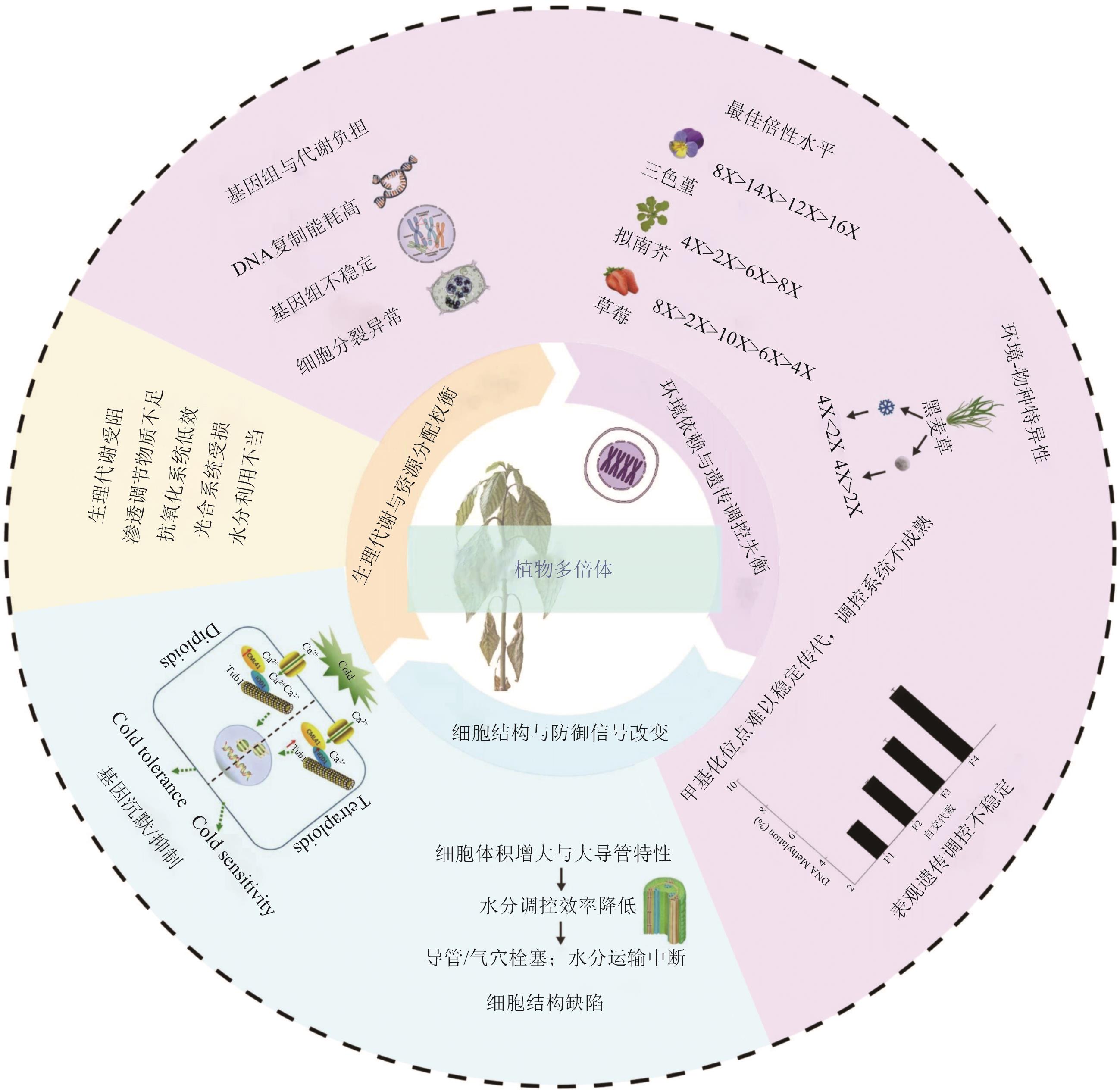
图3 植物多倍体对非生物胁迫与生物胁迫抗性减弱的机制红色箭头线表示冷胁迫下响应基因的高表达水平。CML41:钙调蛋白基因;IQD1:钙调结合蛋白基因;Tub1:微管蛋白基因
Fig. 3 Mechanisms of reduced resistance of plant polyploids to abiotic and biotic stressesThe red arrow line indicates the high expression levels of genes responsive to cold stress. CML41: calmodulin-like protein gene; IQD1: calmodulin-binding protein gene; Tub1: Tubulin epsilon 1
| [1] | Shimizu KK. Robustness and the generalist niche of polyploid species: Genome shock or gradual evolution? [J]. Curr Opin Plant Biol, 2022, 69: 102292. |
| [2] | 孟南. 四倍体山杨的生长性状及抗逆性分析 [D]. 哈尔滨: 东北林业大学, 2023. |
| Meng N. Analysis of growth characters and stress resistance of Populus davidiana dod [D]. Harbin: Northeast Forestry University, 2023. | |
| [3] | Song QX, Chen ZJ. Epigenetic and developmental regulation in plant polyploids [J]. Curr Opin Plant Biol, 2015, 24: 101-109. |
| [4] | Guo HW, Zhou M, Zhang GY, et al. Development of homozygous tetraploid potato and whole genome doubling-induced the enrichment of H3K27ac and potentially enhanced resistance to cold-induced sweetening in tubers [J]. Hortic Res, 2023, 10(3): uhad017. |
| [5] | Van de Peer Y, Mizrachi E, Marchal K. The evolutionary significance of polyploidy [J]. Nat Rev Genet, 2017, 18(7): 411-424. |
| [6] | Fox DT, Soltis DE, Soltis PS, et al. Polyploidy: a biological force from cells to ecosystems [J]. Trends Cell Biol, 2020, 30(9): 688-694. |
| [7] | Tossi VE, Martínez Tosar LJ, Laino LE, et al. Impact of polyploidy on plant tolerance to abiotic and biotic stresses [J]. Front Plant Sci, 2022, 13: 869423. |
| [8] | Zhou K, Liu BB, Wang YL, et al. Evolutionary mechanism of genome duplication enhancing natural autotetraploid sea barley adaptability to drought stress [J]. Environ Exp Bot, 2019, 159: 44-54. |
| [9] | 温国, 孙皓浦, 党江波, 等. 多倍体与二倍体枇杷叶片特征及抗旱性初步分析 [J]. 果树学报, 2019, 36(8): 968-979. |
| Wen G, Sun HP, Dang JB, et al. A preliminary study on leaf characteristics and drought resistance of polyploid and diploid loquat [J]. J Fruit Sci, 2019, 36(8): 968-979. | |
| [10] | Hui T, Bao LJ, Shi X, et al. Grafting seedling rootstock strengthens tolerance to drought stress in polyploid mulberry (Morus alba L.) [J]. Plant Physiol Biochem, 2024, 208: 108441. |
| [11] | Blonder B, Ray CA, Walton JA, et al. Cytotype and genotype predict mortality and recruitment in Colorado quaking aspen (Populus tremuloides) [J]. Ecol Appl, 2021, 31(8): e02438. |
| [12] | Leal-Bertioli SCM, Bertioli DJ, Guimarães PM, et al. The effect of tetraploidization of wild Arachis on leaf morphology and other drought-related traits [J]. Environ Exp Bot, 2012, 84: 17-24. |
| [13] | Zhou HP, Shi HF, Yang YQ, et al. Insights into plant salt stress signaling and tolerance [J]. J Genet Genom, 2024, 51(1): 16-34. |
| [14] | Xue H, Zhang F, Zhang ZH, et al. Differences in salt tolerance between diploid and autotetraploid apple seedlings exposed to salt stress [J]. Sci Hortic, 2015, 190: 24-30. |
| [15] | Zhu HJ, Zhao SJ, Lu XQ, et al. Genome duplication improves the resistance of watermelon root to salt stress [J]. Plant Physiol Biochem, 2018, 133: 11-21. |
| [16] | Yan K, Cui JX, Zhi YB, et al. Deciphering salt tolerance in tetraploid honeysuckle (Lonicera japonica Thunb.) from ion homeostasis, water balance and antioxidant defense [J]. Plant Physiol Biochem, 2023, 195: 266-274. |
| [17] | Podda A, Checcucci G, Mouhaya W, et al. Salt-stress induced changes in the leaf proteome of diploid and tetraploid mandarins with contrasting Na+ and Cl- accumulation behaviour [J]. J Plant Physiol, 2013, 170(12): 1101-1112. |
| [18] | Song X, Duan YY, Tan FQ, et al. Comparative transcriptome analysis of salt tolerance of roots in diploid and autotetraploid Citrus rootstock (C. junos cv. Ziyang Xiangcheng) and identification of salt tolerance-related genes [J]. Sci Hortic, 2023, 317: 112083. |
| [19] | 王晓辉. 天然三倍体枇杷资源抗逆性系统评价 [D]. 重庆: 西南大学, 2013. |
| Wang XH. The resistance systematic review of natural triploid loquat resources [D]. Chongqing: Southwest University, 2013. | |
| [20] | Liu J, Li JM, Fu CX. Comparative physiology and transcriptome analysis reveals the regulatory mechanism of genome duplication enhancing cold resistance in Fragaria nilgerrensis [J]. Environ Exp Bot, 2021, 188: 104509. |
| [21] | Deng BL, Du WC, Liu CL, et al. Antioxidant response to drought, cold and nutrient stress in two ploidy levels of tobacco plants: low resource requirement confers polytolerance in polyploids? [J]. Plant Growth Regul, 2012, 66(1): 37-47. |
| [22] | 李文萃. 中华猕猴桃和多倍体美味猕猴桃的抗冷基因表达及进化研究 [D]. 北京: 中国环境科学研究院, 2024. |
| Li WC. Study on the expression and evolution of cold resistance genes in Actinidia chinensis and polyploid Actinidia deliciosa [D]. Beijing: Chinese Research Academy of Environmental Sciences, 2024. | |
| [23] | Zhang ZP, Mao QX, Gu YY, et al. Ploidy levels influence cold tolerance of Cyclocarya paliurus: insight into the roles of WRKY genes [J]. BMC Genom, 2025, 26: 31. |
| [24] | Väinölä A, Repo T. Cold hardiness of diploid and corresponding autotetraploid rhododendrons [J]. J Hortic Sci Biotechnol, 1999, 74(5): 541-546. |
| [25] | 刘文革, 王鸣, 阎志红. 不同倍性蜜枚西瓜幼苗在低温胁迫下的生理生化特性 [J]. 果树学报, 2003, 20(1): 44-48. |
| Liu WG, Wang M, Yan ZH. Studies on physiological and biochemical characteristics of seedlings of different ploidy watermelons under cold-stress [J]. J Fruit Sci, 2003, 20(1): 44-48. | |
| [26] | Gao MJ, Wang LH, Li M, et al. Physiological and transcriptome analysis accentuates microtubules and calcium signaling in Ziziphus jujuba Mill ‘Dongzao’ autotetraploids with sensitive cold tolerance [J]. Sci Hortic, 2021, 285: 110183. |
| [27] | Dwivedi SK, Basu S, Kumar S, et al. Heat stress induced impairment of starch mobilisation regulates pollen viability and grain yield in wheat: Study in Eastern Indo-Gangetic Plains [J]. Field Crops Res, 2017, 206: 106-114. |
| [28] | Chen HL, Lu ZW, Wang J, et al. Induction of new tetraploid genotypes and heat tolerance assessment in Asparagus officinalis L [J]. Sci Hortic, 2020, 264: 109168. |
| [29] | 田忠赛,冯冬艳,陈世国,等.快速叶绿素荧光(O-J-I-P)揭示了多倍化增强加拿大一枝黄花光合系统稳定性赋予其耐热性机制[C]//中国植物学会.首届植物科学前沿学术大会摘要集(二):南京农业大学生命科学学院杂草研究室,2022:116. |
| Tian ZS, Feng DY, Chen SG,et al.Rapid chlorophyll fluorescence (O-J-I-P) reveals that polyploidy enhances the stability of the photosynthetic system in Canadian goldenrod,conferring its heat tolerance mechanism [C]//Chinese Botanical Society.Proceedings of the First Conference on Frontiers in Plant Science (Vol.2): Weed Research Laboratory,College of Life Sciences,Nanjing Agricultural University,2022:116. | |
| [30] | Kim HE, Han JE, Lee H, et al. Tetraploidization increases the contents of functional metabolites in Cnidium officinale [J]. Agronomy, 2021, 11(8): 1561. |
| [31] | Xue DW, Jiang H, Deng XX, et al. Comparative proteomic analysis provides new insights into cadmium accumulation in rice grain under cadmium stress [J]. J Hazard Mater, 2014, 280: 269-278. |
| [32] | 郑君健. 锰超富集植物青葙同源多倍体诱导及修复性能研究 [D]. 桂林: 桂林理工大学, 2014. |
| Zheng JJ. Studies on the induction and remediation performance of Mn hyperaccumulator Celosia argentea L. autopolyploid [D]. Guilin: Guilin University of Technology, 2014. | |
| [33] | 宋子文, 刘焕臻, 马晓雨, 等. 镉胁迫对大青杨不同倍体的生长及生理生化的影响 [J]. 植物研究, 2020, 40(5): 728-734. |
| Song ZW, Liu HZ, Ma XY, et al. Effects of cadmium stress on growth, physiology and biochemistry of different ploidy of Populus ussuriensis [J]. Bull Bot Res, 2020, 40(5): 728-734. | |
| [34] | Ghouri F, Shahid MJ, Zhong MH, et al. Alleviated lead toxicity in rice plant by co-augmented action of genome doubling and TiO2 nanoparticles on gene expression, cytological and physiological changes [J]. Sci Total Environ, 2024, 911: 168709. |
| [35] | Douglas AE. Strategies for enhanced crop resistance to insect pests [J]. Annu Rev Plant Biol, 2018, 69: 637-660. |
| [36] | Busey P, Giblin-Davis RM, Center BJ. Resistance in Stenotaphrum to the sting nematode [J]. Crop Sci, 1993, 33(5): 1066-1070. |
| [37] | Švara A, Ilnikar K, Carpentier S, et al. Polyploidy affects the development of Venturia inaequalis in scab-resistant and-susceptible apple cultivars [J]. Sci Hortic, 2021, 290: 110436. |
| [38] | Du P, Zeng FP, Wang Q, et al. Development and characterization of bacterial wilt-resistant synthetic polyploid peanuts [J]. Crop J, 2025, 13(1): 125-134. |
| [39] | Harms N, Shearer J, Cronin JT, et al. Geographic and genetic variation in susceptibility of Butomus umbellatus to foliar fungal pathogens [J]. Biol Invasions, 2020, 22(2): 535-548. |
| [40] | Soltis PS, Marchant DB, Van de Peer Y, et al. Polyploidy and genome evolution in plants [J]. Curr Opin Genet Dev, 2015, 35: 119-125. |
| [41] | Ræbild A, Anamthawat-Jónsson K, Egertsdotter U, et al. Polyploidy-A tool in adapting trees to future climate changes? A review of polyploidy in trees [J]. For Ecol Manag, 2024, 560: 121767. |
| [42] | Šmarda P, Klem K, Knápek O, et al. Growth, physiology, and stomatal parameters of plant polyploids grown under ice age, present-day, and future CO2 concentrations [J]. New Phytol, 2023, 239(1): 399-414. |
| [43] | Xue H, Zhang B, Tian JR, et al. Comparison of the morphology, growth and development of diploid and autotetraploid ‘Hanfu’ apple trees [J]. Sci Hortic, 2017, 225: 277-285. |
| [44] | Duan YF, Jiang LQ, Lei T, et al. Increasing Ca2+ accumulation in salt glands under salt stress increases stronger selective secretion of Na+ in Plumbago auriculata tetraploids [J]. Front Plant Sci, 2024, 15: 1376427. |
| [45] | Jurado JL, Bourbia I, Brodribb TJ. Polyploidy drives changes in tissue allocation modifying whole-plant water relations [J]. Plant Physiol, 2025, 197(3): kiaf079. |
| [46] | De Baerdemaeker NJF, Hias N, Van den Bulcke J, et al. The effect of polyploidization on tree hydraulic functioning [J]. American J Botany, 2018, 105(2): 161-171. |
| [47] | Song X, Zhang M, Wang TT, et al. Polyploidization leads to salt stress resilience via ethylene signaling in Citrus plants [J]. New Phytol, 2025, 246(1): 176-191. |
| [48] | Barceló-Anguiano M, Holbrook NM, Hormaza JI, et al. Changes in ploidy affect vascular allometry and hydraulic function in Mangifera indicatrees [J]. Plant J, 2021, 108(2): 541-554. |
| [49] | 刘明秀. 耐寒与高光效三倍体枇杷筛选及其机理研究 [D]. 重庆: 西南大学, 2021. |
| Liu MX. Screening strong cold-hardiness and high-light-efficiency triploid loquat (Eriobotrya japonica) and study on the underlying mechanisms [D]. Chongqing: Southwest University, 2021. | |
| [50] | López-Jurado J, Picazo-Aragonés J, Alonso C, et al. Physiology, gene expression, and epiphenotype of two Dianthus broteri polyploid cytotypes under temperature stress [J]. J Exp Bot, 2024, 75(5): 1601-1614. |
| [51] | 郭欢欢, 崔胜佳, 范畅, 等. 三倍体白榆对NaCl胁迫的生长及生理响应 [J]. 林业科技, 2024, 49(4): 8-13. |
| Guo HH, Cui SJ, Fan C, et al. Growth and physiological response of triploid Ulmus pumila to NaCl stress [J]. For Sci Technol, 2024, 49(4): 8-13. | |
| [52] | Oustric J, Morillon R, Luro F, et al. Tetraploid Carrizo citrange rootstock (Citrus sinensis Osb. × Poncirus trifoliata L. Raf.) enhances natural chilling stress tolerance of common clementine (Citrus clementina Hort. ex Tan) [J]. J Plant Physiol, 2017, 214: 108-115. |
| [53] | 韦同路, 郭大勇, 谢宗周, 等. 植物四倍体抗性及其机理研究进展 [J]. 植物科学学报, 2017, 35(3): 435-443. |
| Wei TL, Guo DY, Xie ZZ, et al. Current advancement on stress resistance and its underlying mechanisms in tetraploid plants [J]. Plant Sci J, 2017, 35(3): 435-443. | |
| [54] | Wang Y, Zuo LL, Wei TL, et al. CHH methylation of genes associated with fatty acid and jasmonate biosynthesis contributes to cold tolerance in autotetraploids of Poncirus trifoliata [J]. J Integr Plant Biol, 2022, 64(12): 2327-2343. |
| [55] | Fakhrzad F, Jowkar A. Water stress and increased ploidy level enhance antioxidant enzymes, phytohormones, phytochemicals and polyphenol accumulation of tetraploid induced wallflower [J]. Ind Crops Prod, 2023, 206: 117612. |
| [56] | Liu C, Zhang ZJ, Li WT, et al. Mechanisms of differential responses to drought stress in polyploid of Malus toringo (Siebold) Siebold ex de Vriese [J]. Planta, 2026, 263(2): 41. |
| [57] | Carretero-Paulet L, Van de Peer Y. The evolutionary conundrum of whole-genome duplication [J]. American J Botany, 2020, 107(8): 1101-1105. |
| [58] | 权威, 薛文通, 赵天瑶, 等. 植物对低温胁迫的响应机制研究进展 [J]. 中国农业大学学报, 2023, 28(2): 14-22. |
| Quan W, Xue WT, Zhao TY, et al. A review on the response mechanism of plant to low temperature stress [J]. J China Agric Univ, 2023, 28(2): 14-22. | |
| [59] | Yang YX, Cai QH, Yang YB, et al. Transcriptomics and metabolomics reveal biosynthetic pathways and regulatory mechanisms of phenylpropanes in different ploidy of Capsicum frutescens [J]. Plants, 2024, 13(23): 3393. |
| [60] | Islam MM, Deepo DM, Nasif SO, et al. Cytogenetics and consequences of polyploidization on different biotic-abiotic stress tolerance and the potential mechanisms involved [J]. Plants, 2022, 11(20): 2684. |
| [61] | Nie WF. DNA methylation: from model plants to vegetable crops [J]. Biochem Soc Trans, 2021, 49(3): 1479-1487. |
| [62] | Wang LF, Cao S, Wang PT, et al. DNA hypomethylation in tetraploid rice potentiates stress-responsive gene expression for salt tolerance [J]. Proc Natl Acad Sci U S A, 2021, 118(13): e2023981118. |
| [63] | Garcia-Lozano M, Natarajan P, Levi A, et al. Altered chromatin conformation and transcriptional regulation in watermelon following genome doubling [J]. Plant J, 2021, 106(3): 588-600. |
| [64] | Aina R, Sgorbati S, Santagostino A, et al. Specific hypomethylation of DNA is induced by heavy metals in white clover and industrial hemp [J]. Physiol Plant, 2004, 121(3): 472-480. |
| [65] | Hao YY, Su X, Li W, et al. The creation of autotetraploid provides insights into critical features of DNA methylome changes after genome doubling in water spinach (Ipomoea aquatica Forsk) [J]. Front Plant Sci, 2023, 14: 1155531. |
| [66] | Meng C, Liu XD, Wu F, et al. DNA methylation, metabolome, and transcriptome analysis reveal epigenomic differences between diploid Chinese cabbage seeds and tetraploid Chinese cabbage seeds [J]. Genomics, 2025, 117(5): 111088. |
| [67] | 郑美,李金鹏,褚蔚,等.组蛋白乙酰转移酶基因TaGCN5调控多倍体小麦耐盐性的研究[C]//中国作物学会.第十届全国小麦基因组学及分子育种大会摘要集.中国农业大学农学院,2019:42. |
| Zheng M, Li JP, Chu W,et al.Study on the role of histone acetyltransferase gene TaGCN5 in regulating salt tolerance in polyploid wheat [C]//Chinese Crop Science Society.Abstracts of the 10th National Conference on Wheat Genomics and Molecular Breeding.College of Agriculture,China Agricultural University,2019:42. | |
| [68] | Zheng M, Lin JC, Liu XB, et al. Histone acetyltransferase TaHAG1 acts as a crucial regulator to strengthen salt tolerance of hexaploid wheat [J]. Plant Physiol, 2021, 186(4): 1951-1969. |
| [69] | Van de Peer Y, Ashman TL, Soltis PS, et al. Polyploidy: an evolutionary and ecological force in stressful times [J]. Plant Cell, 2021, 33(1): 11-26. |
| [70] | Wang MJ, Wang PC, Lin M, et al. Evolutionary dynamics of 3D genome architecture following polyploidization in cotton [J]. Nat Plants, 2018, 4(2): 90-97. |
| [71] | Zhang H, Zheng RQ, Wang YL, et al. The effects of Arabidopsis genome duplication on the chromatin organization and transcriptional regulation [J]. Nucleic Acids Res, 2019, 47(15): 7857-7869. |
| [72] | Wu HY, Song XM, Lyu SW, et al. Integrated analysis of Hi-C and rna-Seq reveals the molecular mechanism of autopolyploid growth advantages in pak choi (Brassica rapa ssp. chinensis) [J]. Front Plant Sci, 2022, 13: 905202. |
| [73] | Liu YY, Zhu T, Zhou XK,et al.Integration of the DD-genome reshapes gene transcription, chromatin architecture and metabolome of allohexaploid wheat leading to enhanced adaptability[J].bioRxiv,2024. |
| [74] | Wei N, Du ZK, Liston A, et al. Genome duplication effects on functional traits and fitness are genetic context and species dependent: studies of synthetic polyploid Fragaria [J]. American J Botany, 2020, 107(2): 262-272. |
| [75] | Comai L. The advantages and disadvantages of being polyploid [J]. Nat Rev Genet, 2005, 6(11): 836-846. |
| [76] | 方婷婷. 人工合成甘蓝型油菜与其二倍体亲本抗旱性及DNA甲基化差异研究 [D]. 扬州: 扬州大学, 2016. |
| Fang TT. Study on the difference of drought resistance and DNA methylation of resynthesized Brassica napus and its diploid parent [D]. Yangzhou: Yangzhou University, 2016. | |
| [77] | Jan F, Parthiban M, Kaur S, et al. Do different wheat ploidy levels respond differently against stripe rust infection: Interplay between reactive oxygen species (ROS) and the antioxidant defense system? [J]. Plant Physiol Biochem, 2025, 219: 109259. |
| [78] | 贾林光, 王红宁, 邵建柱, 等. 二倍体、四倍体苹果矮化砧木SH40抗寒性的比较研究 [J]. 河北农业大学学报, 2015, 38(4): 62-65. |
| Jia LG, Wang HN, Shao JZ, et al. Comparison of cold resistance between the diploid and the tetraploid apple dwarf rootstock SH40 [J]. J Agric Univ Hebei, 2015, 38(4): 62-65. | |
| [79] | Sobhanian H, Song WY, Soltis PS, et al. Polyploidy and plant resilience to environmental stresses: Molecular mechanisms and future applications [J]. Plant Commun, 2026, 7(4): 101748. |
| [80] | Madlung A, Tyagi AP, Watson B, et al. Genomic changes in synthetic Arabidopsis polyploids [J]. Plant J, 2005, 41(2): 221-230. |
| [81] | Morgan C, Zhang HK, Henry CE, et al. Derived alleles of two axis proteins affect meiotic traits in autotetraploid Arabidopsis arenosa [J]. Proc Natl Acad Sci U S A, 2020, 117(16): 8980-8988. |
| [82] | te Beest M, Le Roux JJ, Richardson DM, et al. The more the better? The role of polyploidy in facilitating plant invasions [J]. Ann Bot, 2012, 109(1): 19-45. |
| [83] | Spoelhof JP, Soltis PS, Soltis DE. Pure polyploidy: Closing the gaps in autopolyploid research [J]. J Sytematics Evolution, 2017, 55(4): 340-352. |
| [84] | Helgadóttir, Aavola R, Isolahti M, et al. Adaptability and phenotypic stability of Lolium perenne L. cultivars of diverse origin grown at the margin of the species distribution [J]. J Agronomy Crop Science, 2018, 204(5): 493-504. |
| [85] | Lagibo AD, Kobza F, Suchánková P. Polyploidy effects on frost tolerance and winter survival of garden pansy genotypes [J]. Hortic Sci, 2005, 32(4): 138-146. |
| [86] | Corneillie S, De Storme N, Van Acker R, et al. Polyploidy affects plant growth and alters cell wall composition [J]. Plant Physiol, 2019, 179(1): 74-87. |
| [87] | Yang YL, Davis TM. A new perspective on polyploid Fragaria (strawberry) genome composition based on large-scale, multi-locus phylogenetic analysis [J]. Genome Biol Evol, 2017, 9(12): 3433-3448. |
| [1] | 王亚乐, 李雪君, 孙计平, 孙焕. 烟草豫浓香201对低温胁迫的生理响应及转录组分析[J]. 生物技术通报, 2026, 42(2): 228-238. |
| [2] | 弥春霞, 许澍, 王守现, 刘宇, 宋庆港, 宋爽. 糙皮侧耳覆土栽培对土壤中抗生素抗性基因的影响[J]. 生物技术通报, 2025, 41(6): 335-343. |
| [3] | 牛若宇, 高瞻, 熊显鹏, 祝德, 罗皓天, 马学远, 胡冠菁. 棉花野生种质资源的育种应用研究与前景[J]. 生物技术通报, 2025, 41(4): 21-32. |
| [4] | 宋佳怡, 苏芸丽, 郑兴艳, 夏文念, 杨冬梅, 胡慧贞. 金鱼草Expansin基因家族鉴定及其抗核盘菌相关基因筛选[J]. 生物技术通报, 2025, 41(4): 227-242. |
| [5] | 马天意, 许家佳, 路文婧, 吴艳, 沙伟, 张梅娟, 彭疑芳. ‘金小童’大白菜BrcGASA3基因在盐碱胁迫下的表达分析及抗性鉴定[J]. 生物技术通报, 2025, 41(2): 127-138. |
| [6] | 王美玲, 耿丽丽, 房瑜, 束长龙, 张杰. 苏云金芽胞杆菌4BM1菌株对油菜菌核病的防治潜力[J]. 生物技术通报, 2024, 40(9): 260-269. |
| [7] | 范宗强, 冯靖涵, 郑丽雪, 王硕, 彭向前, 陈芳. 枯草芽孢杆菌B579对黄瓜枯萎病的防治及其诱导抗性研究[J]. 生物技术通报, 2024, 40(7): 226-234. |
| [8] | 黄丹, 姜山, 彭涛. 褐角苔FfCYP98基因克隆及其功能分析[J]. 生物技术通报, 2024, 40(7): 273-284. |
| [9] | 彭羽佳, 李文萃, 刘勇波. 昆虫对杀虫剂和转Bt基因植物的抗性进化机制研究进展[J]. 生物技术通报, 2024, 40(4): 40-51. |
| [10] | 方天一, 岳艳玲. 根系分泌物介导的植物对土传病害的抗性机制[J]. 生物技术通报, 2024, 40(3): 52-61. |
| [11] | 邹修为, 岳佳妮, 李志宇, 戴良英, 李魏. 水稻热激转录因子HsfA2b调控非生物胁迫抗性的功能分析[J]. 生物技术通报, 2024, 40(2): 90-98. |
| [12] | 庄棵, 梁至轩, 何英婷, 谢秋玲. 大肠杆菌DH5α通过外膜囊泡传递抗生素抗性基因AmpR[J]. 生物技术通报, 2024, 40(12): 275-281. |
| [13] | 王凤婷, 赵福顺, 乔凯彬, 徐珣, 刘金亮. 蔬菜嫁接砧穗互作分子机制研究进展[J]. 生物技术通报, 2024, 40(10): 149-159. |
| [14] | 王俊芳, 黄秋斌, 张飘丹, 张彭湃. Surfactin的结构、生物合成及其在生物防治中的作用[J]. 生物技术通报, 2024, 40(1): 100-112. |
| [15] | 杨志晓, 侯骞, 刘国权, 卢志刚, 曹毅, 芶剑渝, 王轶, 林英超. 不同抗性烟草品系Rubisco及其活化酶对赤星病胁迫的响应[J]. 生物技术通报, 2023, 39(9): 202-212. |
| 阅读次数 | ||||||
|
全文 |
|
|||||
|
摘要 |
|
|||||
