







• 研究报告 • 下一篇
卢可新, 殷梦茹, 户倩, 蒋甲福( )
)
收稿日期:2026-03-22
出版日期:2026-08-24
通讯作者:
蒋甲福jiangjiafu@njau.edu.cn基金资助:
LU Ke-xin, YIN Meng-ru, HU Qian, JIANG Jia-fu()
Received:2026-03-22
Published:2026-08-24
摘要:
目的 核因子Y(nuclear factor Y)是一种普遍存在于真核生物中的转录因子,其在植物胚胎发育、光合作用、开花调控、逆境胁迫等多方面有重要作用。克隆菊花(Chrysanthemum morifolium ‘Jinba’)CmNFYC4基因、分析其表达模式并进行功能验证,为菊花开花调控分子机制研究奠定基础。 方法 以菊花‘神马’为试验材料,克隆CmNFYC4的编码区序列。利用生物信息学技术对该蛋白的理化性质进行分析预测;同时采用荧光定量PCR技术检测该基因在菊花各组织中及在不同光照处理下基因表达量的变化。利用烟草瞬时表达系统研究该基因的亚细胞定位,并采用酵母双杂交技术对CmNFYC4的转录激活活性进行验证。构建融合抑制子沉默载体,通过农杆菌介导的叶盘侵染法,结合菊花转基因体系获得沉默株系;利用菊花瞬时转化体系创制CmNFYC4过表达株系,并进行开花表型观察。 结果 CmNFYC4开放阅读框(ORF)全长726 bp,编码241个氨基酸,相对分子质量为26.48 kD,理论等电点(pI)为5.35。系统进化发育树分析表明,CmNFYC4蛋白与拟南芥和甘蓝型油菜的NFYC类基因亲缘关系较近,且具有较高的保守性。烟草亚细胞定位试验表明CmNFYC4定位于细胞核,酵母双杂交试验验证CmNFYC4具有转录激活活性。荧光定量PCR数据分析显示,CmNFYC4在菊花‘神马’各组织中均有表达,且在叶片中表达量最高。创制CmNFYC4融合抑制子沉默株系并进行表型观察,发现具有晚花表型,同时瞬转CmNFYC4过表达株系具有早花表型。 结论 CmNFYC4在菊花叶片中表达量最高,其沉默株系具有晚花表型,过表达株系则表现为早花,表明CmNFYC4具有促进菊花开花的功能。
卢可新, 殷梦茹, 户倩, 蒋甲福. 菊花CmNFYC4促进开花的功能研究[J]. 生物技术通报, doi: 10.13560/j.cnki.biotech.bull.1985.2026-0324.
LU Ke-xin, YIN Meng-ru, HU Qian, JIANG Jia-fu. Functional Study of CmNFYC4 in Promoting Flowering of Chrysanthemum morifolium[J]. Biotechnology Bulletin, doi: 10.13560/j.cnki.biotech.bull.1985.2026-0324.
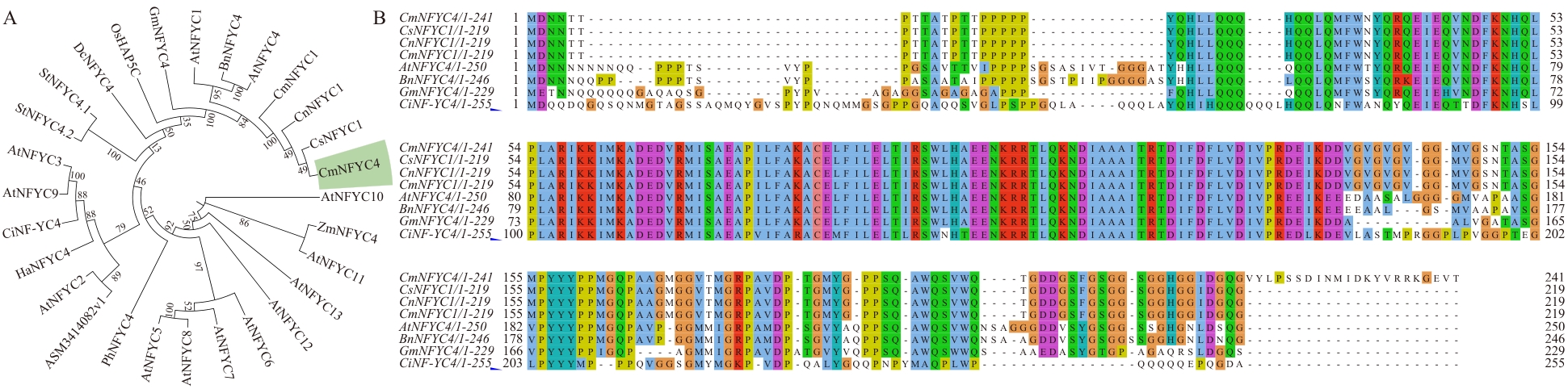
图1 CmNFYC4氨基酸序列系统发育树分析A:不同物种间NFYC蛋白的进化树分析;B:CmNFYC4蛋白与其他物种的氨基酸序列比对;AtNFYC1/AtNFYC4/AtNFYC10/AtNFYC11/AtNFYC13/AtNFYC12/AtNFYC6/AtNFYC7/AtNFYC8/AtNFYC5/AtNFYC2/AtNFYC9/AtNFYC3:拟南芥,AT3G48590/AT5G63470/AT1G07980/AT3G12480/AT5G43250/AT5G38140/AT5G50480/AT5G50470/AT5G27910/AT5G50490/AT1G56170/AT1G08970/AT1G54830;BnNFYC4:甘蓝型油菜,BnaA03g29270D;CmNFYC1:菊花,evm.TU.scaffold_223.199;CnNFYC1:菊花脑,Cn1014650;CsNFYC1:甘野菊,CsG_LG8.g62859;ZmNFYC4:玉米,Zm00001d020874;PhNFYC4:矮牵牛,Peaxi162Scf00102g01519;ASM3414082v1:粳稻,ASM3414082v1;HaNFYC4:向日葵,LOC110935072;CiNFYC4:野菊,CHR00079409-RA;StNFYC4.1/StNFYC4.2:马铃薯,XP_006351565/XP_006351565.1;DcNFYC1:铁皮石斛,DOG01G001230;OsHAP5C:水稻,Os03g0252000;GmNFYC4:大豆,06G169600
Fig. 1 Phylogenetic tree analysis of CmNFYC4 amino acid sequencesA: Phylogenetic tree analysis of NFYC proteins among different species. B: Amino acid sequence alignment of CmNFYC4 protein with other species. AtNFYC1/AtNFYC4/AtNFYC10/AtNFYC11/AtNFYC13/AtNFYC12/AtNFYC6/AtNFYC7/AtNFYC8/AtNFYC5/AtNFYC2/AtNFYC9/AtNFYC3: Arabidopsis thaliana, AT3G48590/AT5G63470/AT1G07980/AT3G12480/AT5G43250/AT5G38140/AT5G50480/AT5G50470/AT5G27910/AT5G50490/AT1G56170/AT1G08970/AT1G54830. BnNFYC4: Brassica napus L., BnaA03g29270D. CmNFYC1: C. morifolium, evm.TU.scaffold_223.199. CnNFYC1: Chrysanthemum nankingense, Cn1014650. CsNFYC1: C. seticuspe, CsG_LG8.g62859. ZmNFYC4: Zea mays ssp., Zm00001d020874. PhNFYC4: Petunia hybrida Vilm., Peaxi162Scf00102g01519. ASM3414082v1: Oryza sativa L. subsp. japonica, ASM3414082v1. HaNFYC4: Helianthus annuus L., LOC110935072. CiNFYC4: C. indicum L., CHR00079409-RA. StNFYC4.1/StNFYC4.2: Solanum tuberosum L., XP_006351565/XP_006351565.1. DcNFYC1: Dendrobium officinale Kimura et Migo, DOG01G001230. OsHAP5C: Oryza sativa L., Os03g0252000. GmNFYC4: Glycine max (L.) Merr., 06G16960
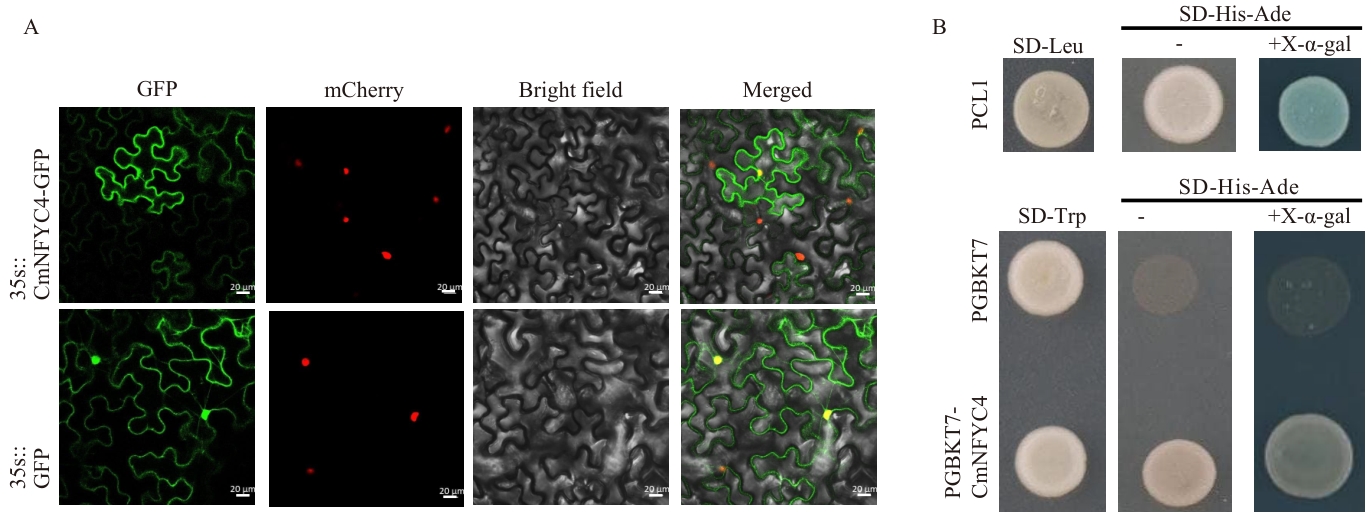
图2 CmNFYC4亚细胞定位及转录活性分析A:CmNFYC4亚细胞定位分析;B:CmNFYC4在酵母中转录激活活性分析;GFP:绿色荧光通道;mCherry:核定位信号;Bright field:白光通道;Merged:叠加图片。标尺=20 μm;pCL1:阳性对照;pGBKT7:阴性对照;左侧:SD/-Leu培养基;中间:SD/-His-Ade培养基;右侧:涂有20 mg/mL X-α-gal的SD/-His-Ade培养基
Fig. 2 Subcellular localization and transcriptional activity analysis of CmNFYC4A: Subcellular localization of CmNFYC4. B: Analysis of transcriptional activation activity of CmNFYC4 in yeast. GFP: Green fluorescence channel. mCherry: Nuclear localization signal. Bright field: Bright field channel. Merged: Merged image. Scale bar =20 μm; pCL1: Positive control. pGBKT7: Negative control. Left: SD/-Leu medium. Middle: SD/-His-Ade medium. Right: SD/-His-Ade medium coated with 20 mg/mL X-α-gal
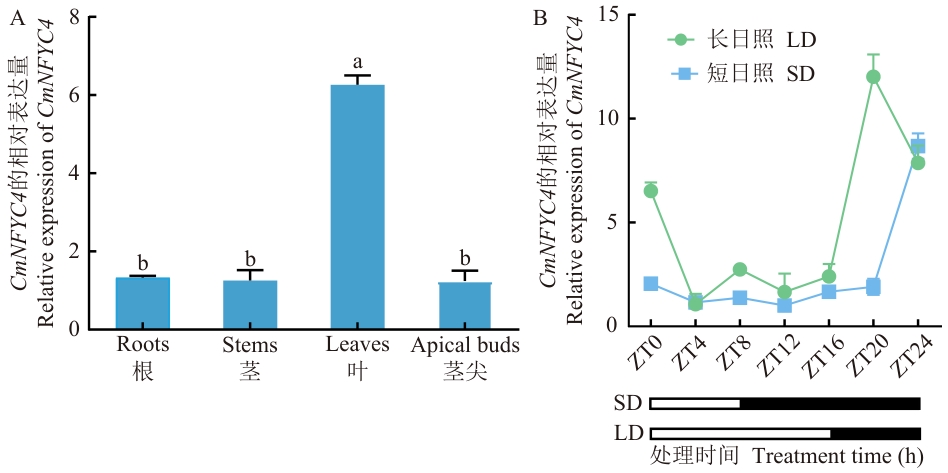
图3 CmNFYC4表达模式分析A:CmNFYC4在菊花‘神马’不同组织中的表达量;B:CmNFYC4在长短日照下的表达模式分析;白框代表光照时间,黑框代表黑暗时间;试验结果以EF1α内参基因为对照,用2-∆∆Ct方法分析,数值表示平均值±SD(n=3)。图中不同字母表示差异显著,使用Tukey检验(P<0.05)
Fig. 3 Expression pattern analysis of CmNFYC4A:Expression level of CmNFYC4 in different tissues of C. morifolium ‘Jinba’. B: Analysis of the expression pattern of CmNFYC4 under long-day and short-day conditions. White boxes represent light duration, and black boxes represent dark duration. The experimental results were analyzed using the 2-∆∆Ct method with EF1α as the reference gene. Values are presented as mean±SD (n=3). Different letters above the bars indicate significant differences by Tukey test (P<0.05)
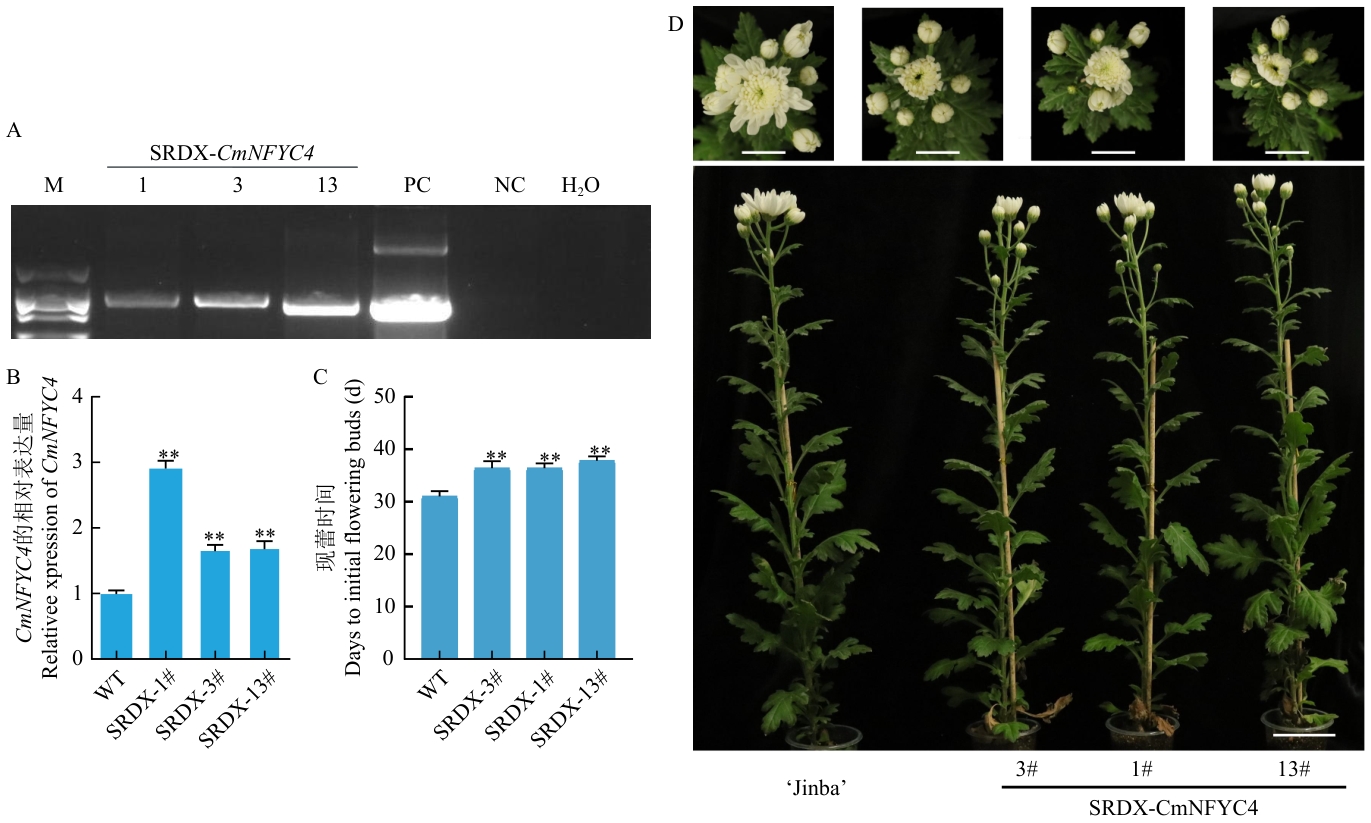
图4 CmNFYC4沉默株系鉴定及开花表型观察A:CmNFYC4沉默株系DNA水平鉴定;B:CmNFYC4在沉默株系及野生型中的表达量;C:CmNFYC4沉默株系现蕾时间统计;D:CmNFYC4沉默株系开花表型观察;NC:阴性对照;PC:阳性对照。试验结果以CmEF1α内参基因为对照,用2-∆∆Ct法分析,数值表示平均值±SD(n=3)。星号表示差异显著性,使用Tukey检验(P<0.01),标尺=5 cm,下同
Fig. 4 Identification of CmNFYC4-silenced lines and observation of flowering phenotypesA: DNA-level identification of CmNFYC4-silenced lines. B: Expression levels of CmNFYC4 in silenced lines and wild type. C: Statistics of budding time in CmNFYC4-silenced lines. D: Observation of flowering phenotypes in CmNFYC4-silenced lines. NC: Negative control. PC: Positive control. The experimental results were analyzed using the 2-∆∆Ct method with CmEF1α as the reference gene. Values are presented as mean±SD (n=3). Asterisks indicate significant differences by Tukey’s test (P < 0.01). Scale bar = 5 cm. The same below
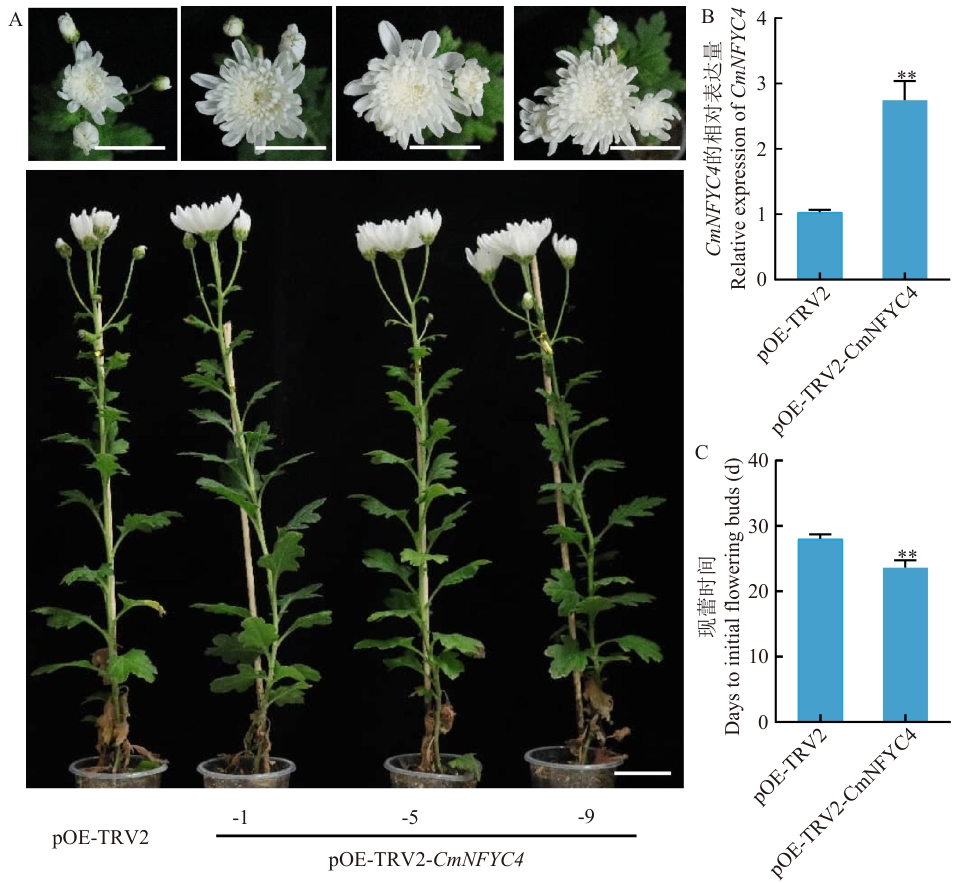
图5 CmNFYC4瞬转过表达株系鉴定及开花表型观察A:CmNFYC4过表达株系开花表型观察;B:CmNFYC4在过表达株系及野生型中的表达量;C:CmNFYC4过表达株系现蕾时间统计
Fig. 5 Identification of CmNFYC4 transient overexpression lines and observation of flowering phenotypesA: Observation of flowering phenotypes in CmNFYC4-overexpressing lines. B: Expression levels of CmNFYC4 in overexpression lines and wild type. C: Statistics of budding time in CmNFYC4-overexpressing lines
| [1] | 杨真, 李海涛. 观赏菊花分类探讨 [J]. 现代园艺, 2016, 39(11): 81-82. |
| Yang Z, Li HT. Discussion on the classification of ornamental chrysanthemums [J]. Xiandai Hortic, 2016, 39(11): 81-82. | |
| [2] | 芦亚娟. 菊花周年生产技术要点 [J]. 世界热带农业信息, 2024(1): 62-64. |
| Lu YJ. Key points of Chrysanthemum annual production technology [J]. World Trop Agric Inf, 2024(1): 62-64. | |
| [3] | 张乔雨, 吴沙沙, 段燕如, 等. 观赏植物花期调控技术与分子机制研究进展 [J]. 浙江农林大学学报, 2025, 42(5): 898-910. |
| Zhang QY, Wu SS, Duan YR, et al. Advance in flowering regulation technologies and molecular mechanisms of ornamental plants [J]. J Zhejiang A&F Univ, 2025, 42(5): 898-910. | |
| [4] | Oda A, Narumi T, Li TP, et al. CsFTL3, a Chrysanthemum FLOWERING LOCUS T-like gene, is a key regulator of photoperiodic flowering in chrysanthemums [J]. J Exp Bot, 2012, 63(3): 1461-1477. |
| [5] | Zhang ZX, Hu Q, Gao Z, et al. Flowering repressor CmSVP recruits the TOPLESS corepressor to control flowering in Chrysanthemum [J]. Plant Physiol, 2023, 193(4): 2413-2429. |
| [6] | 魏倩. 菊花核因子NF-YB调节开花时间和干旱胁迫耐性的机理分析 [D]. 北京: 中国农业大学, 2015: 1-10. |
| Wei Q. Nuclear factor CmNF-YB regultes flowering time and drought tolerance in Chrysanthemum [D]. Beijing: China Agricultural University, 2015: 1-10. | |
| [7] | Wei Q, Ma C, Xu YJ, et al. Control of Chrysanthemum flowering through integration with an aging pathway [J]. Nat Commun, 2017, 8: 829. |
| [8] | Mantovani R. The molecular biology of the CCAAT-binding factor NF-Y [J]. Gene, 1999, 239(1): 15-27. |
| [9] | 李世贵, 马瑞, 王芳芳, 等. 植物NF-Y转录因子研究进展 [J]. 植物生理学报, 2021, 57(2): 248-256. |
| Li SG, Ma R, Wang FF, et al. Research progresses on plant NF-Y transcription factors [J]. Plant Physiol J, 2021, 57(2): 248-256. | |
| [10] | Wu H, Hou XL, Zhang CY. Nuclear factor-Y transcription factors in crops: Biological roles, regulation, and breeding applications [J]. Plant Commun, 2025, 6(11): 101530. |
| [11] | 黄俊文, 南建宗, 阳成伟. NF-Y转录因子调控植物生长发育及胁迫响应的研究进展 [J]. 植物生理学报, 2020, 56(12): 2595-2605. |
| Huang JW, Nan JZ, Yang CW. Research progress of NF-Y transcription factors in plant growth and development and stress response [J]. Plant Physiol J, 2020, 56(12): 2595-2605. | |
| [12] | 王园园, 赵春月, 孙润润, 等. 亚洲棉NF-YA基因家族的全基因组鉴定及表达分析 [J]. 分子植物育种, 2021, 19(14): 4564-4573. |
| Wang YY, Zhao CY, Sun RR, et al. Genome-wide identification and expression analysis of NF-YA gene family in Gossypium arboreum [J]. Mol Plant Breed, 2021, 19(14): 4564-4573. | |
| [13] | Zhang DD, Ji KN, Wang JF, et al. Nuclear factor y-A3b binds to the single flower truss promoter and regulates flowering time in tomato [J]. Hortic Res, 2024, 11(5): uhae088. |
| [14] | Bin J, Tan QH, Wen SY, et al. Comprehensive analyses of four PhNF-YC genes from Petunia hybrida and impacts on flowering time [J]. Plants, 2024, 13(5): 742. |
| [15] | Kumimoto RW, Zhang Y, Siefers N, et al. NF-YC3, NF-YC4 and NF-YC9 are required for CONSTANS-mediated, photoperiod-dependent flowering in Arabidopsis thaliana: NF-YC function in flowering time [J]. Plant J, 2010, 63(3): 379-391. |
| [16] | Cai YP, Chen L, Liu XQ, et al. GmNF-YC4 delays soybean flowering and maturation by directly repressing GmFT2a and GmFT5a expression [J]. J Integr Plant Biol, 2024, 66(7): 1370-1384. |
| [17] | 任文才, 岳杨, 丁柏水, 等. 菊芋14-3-3基因家族的鉴定及其对非生物胁迫响应的分析 [J]. 南京农业大学学报, 2024, 47(3): 477-488. |
| Ren WC, Yue Y, Ding BS, et al. Identification of 14-3-3 gene family and analysis of its response to abiotic stress in Jerusalem artichoke [J]. J Nanjing Agric Univ, 2024, 47(3): 477-488. | |
| [18] | 司超娜. 菊花CmCDKL9调控开花的分子机理研究 [D]. 南京: 南京农业大学, 2021. |
| Si CN. The molecular mechanism of CmCDKL9 involved in the flowering of Chrysanthemum [D]. Nanjing: Nanjing Agricultural University, 2021. | |
| [19] | Wang HB, Chen SM, Jiang JF, et al. Reference gene selection for cross-species and cross-ploidy level comparisons in Chrysanthemum spp [J]. Sci Rep, 2015, 5: 8094. |
| [20] | Blümel M, Dally N, Jung C. Flowering time regulation in crops—what did we learn from Arabidopsis? [J]. Curr Opin Biotechnol, 2015, 32: 121-129. |
| [21] | Leijten W, Koes R, Roobeek I, et al. Translating flowering time from Arabidopsis thaliana to Brassicaceae and Asteraceae crop species [J]. Plants, 2018, 7(4): 111. |
| [22] | 陆思宇, 杨再强, 杨立, 等. 不同光周期对菊花生长发育及内源激素的影响 [J]. 华北农学报, 2021, 36(6): 106-115. |
| Lu SY, Yang ZQ, Yang L, et al. Effects of different photoperiods on the growth and development process and endogenous hormones of Chrysanthemum [J]. Acta Agric Boreali Sin, 2021, 36(6): 106-115. | |
| [23] | Wang L, O’Conner S, Tanvir R, et al. CRISPR/Cas9-based editing of NF-YC4 promoters yields high-protein rice and soybean [J]. New Phytol, 2025, 245(5): 2103-2116. |
| [24] | Chen CX, Hussain N, Wang YR, et al. An ethylene-inhibited NF-YC transcription factor RhNF-YC9 regulates petal expansion in rose [J]. Hortic Plant J, 2020, 6(6): 419-427. |
| [25] | Wu XL, Shi HF, Guo ZF. Overexpression of a NF-YC gene results in enhanced drought and salt tolerance in transgenic seashore Paspalum [J]. Front Plant Sci, 2018, 9: 1355. |
| [26] | Hwang K, Susila H, Nasim Z, et al. Arabidopsis ABF3 and ABF4 transcription factors act with the NF-YC complex to regulate SOC1 expression and mediate drought-accelerated flowering [J]. Mol Plant, 2019, 12(4): 489-505. |
| [27] | Kim SK, Park HY, Jang YH, et al. OsNF-YC2 and OsNF-YC4 proteins inhibit flowering under long-day conditions in rice [J]. Planta, 2016, 243(3): 563-576. |
| [28] | Komiya R, Yokoi S, Shimamoto K. A gene network for long-day flowering activates RFT1 encoding a mobile flowering signal in rice [J]. Development, 2009, 136(20): 3443-3450. |
| [29] | Das S, Parida SK, Agarwal P, et al. Transcription factor OsNF-YB9 regulates reproductive growth and development in rice [J]. Planta, 2019, 250(6): 1849-1865. |
| [30] | Wang XT, Yao Y, Wen SY, et al. Genome-wide characterization of Chrysanthemum indicum nuclear factor Y, subunit C gene family reveals the roles of CiNF-YCs in flowering regulation [J]. Int J Mol Sci, 2022, 23(21): 12812. |
| [31] | Mei XP, Li P, Wang L, et al. Molecular and functional characterization of ZmNF-YC14 in transgenic Arabidopsis [J]. J Plant Biol, 2018, 61(6): 410-423. |
| [32] | Wang RK, Zhu L, Zhang Y, et al. Genome-wide analysis of poplar NF-YB gene family and identified PtNF-YB1 important in regulate flowering timing in transgenic plants [J]. BMC Plant Biol, 2019, 19: 251. |
| [33] | Xu F, Li T, Xu PB, et al. DELLA proteins physically interact with CONSTANS to regulate flowering under long days in Arabidopsis [J]. FEBS Lett, 2016, 590(4): 541-549. |
| [34] | 许婧, 牛百晓, 陈忱. NF-Y转录因子调控植物生长发育的功能研究进展 [J]. 植物生理学报, 2022, 58(7): 1191-1200. |
| Xu J, Niu BX, Chen C. Advances on the function of NF-Y transcription factors in regulation of plant growth and development [J]. Plant Physiol J, 2022, 58(7): 1191-1200. |
| [1] | 秦娟, 卢蔚雯, 李佳徽, 李晨, 李斌, 王治业. 红花2个G6PDH基因的克隆与表达特征分析[J]. 生物技术通报, 2026, 42(8): 217-228. |
| [2] | 刘柔知, 吴嘉琦, 吴辉烨, 袁婧怡, 程堂仁, 张启翔, 袁存权. 三种不同栽培类型菊花品种的叶绿体基因组特征对比分析[J]. 生物技术通报, 2026, 42(8): 239-250. |
| [3] | 李淑婷, 王影, 丁家豪, 胡荣芳, 李琛, 宋亚楠, 薛金爱. 油莎豆FAT家族全基因组鉴定及CeFATA的功能分析[J]. 生物技术通报, 2026, 42(8): 162-172. |
| [4] | 何婧婧, 朋毛拉专, 姚晓华, 姚有华, 吴昆仑, 崔永梅. 青稞HvNAC53的克隆及功能分析[J]. 生物技术通报, 2026, 42(8): 142-152. |
| [5] | 冉丹丹, 邰森林, 欧小宏, 周涛, 徐娇. 天麻尿苷二磷酸糖基转移酶基因家族鉴定与分析[J]. 生物技术通报, 2026, 42(7): 163-172. |
| [6] | 张艾岑, 闫会, 马居奎, 张允刚, 李强. 甘薯DNA甲基转移酶和去甲基化酶基因家族的全基因组鉴定与表达分析[J]. 生物技术通报, 2026, 42(6): 1-12. |
| [7] | 熊仕发, 陈益存, 吴立文, 施翔, 张盛剿, 彭方有, 陈涛梅, 汪阳东. 白栎TCP基因家族的鉴定及功能分析[J]. 生物技术通报, 2026, 42(6): 258-266. |
| [8] | 李旭龙, 徐世强, 张龙, 李静宇, 何伟贤, 陈立凯, 王继华. 巴戟天萜烯合成酶基因家族鉴定、进化及表达模式分析[J]. 生物技术通报, 2026, 42(6): 314-325. |
| [9] | 张欣, 陈骋, 霍元博, 黄仁丽, 张丽, 张凯, 童华荣, 袁连玉. 茶树CsCRD1基因的克隆及其对叶绿素生物合成的影响[J]. 生物技术通报, 2026, 42(5): 280-291. |
| [10] | 梁慧琪, 陈益存, 汪阳东, 赵耘霄, 高暝. 山苍子PAT1基因亚家族鉴定及其在嫁接愈合过程中的表达分析[J]. 生物技术通报, 2026, 42(5): 302-311. |
| [11] | 孙婷, 张艳, 刘玉珊, 冯媛媛, 秦恒山, 张军, 何小岗, 张景荣. 黄秋葵AeF3H基因的克隆与功能分析[J]. 生物技术通报, 2026, 42(4): 153-160. |
| [12] | 陈登科, 兰刚, 夏芝, 侯保国, 杨六六, 曹彩荣, 李朋波, 吴翠翠. 花生ZF-HD基因家族的鉴定和非生物胁迫响应分析[J]. 生物技术通报, 2026, 42(4): 114-128. |
| [13] | 郭道祥, 苏全, 李奥婷, 王燕, 陈清, 王小蓉, 何文. 柚MYB基因家族的鉴定及其在砧穗不亲和叶片黄化中的功能分析[J]. 生物技术通报, 2026, 42(4): 170-181. |
| [14] | 冯成蒿, 党雨乐, 王志泽, 聂蔚丹, 杨中敏, 杜崇. 基于RNA-seq筛选番茄防御南方根结线虫病的差异基因与RPP13的表达特征分析[J]. 生物技术通报, 2026, 42(4): 141-152. |
| [15] | 倪飞飞, 陈益存, 高暝, 张盛剿, 彭方有, 陈涛梅, 赵耘霄, 汪阳东. 山苍子TCP基因鉴定及其调控萜类合成的研究[J]. 生物技术通报, 2026, 42(4): 227-238. |
| 阅读次数 | ||||||
|
全文 |
|
|||||
|
摘要 |
|
|||||
