







生物技术通报 ›› 2026, Vol. 42 ›› Issue (9): 137-146.doi: 10.13560/j.cnki.biotech.bull.1985.2026-0106
• 植物发育生物学专题 • 上一篇
秦少敏1,2, 苗晗2, 董邵云2, 官健涛2, 顾兴芳2, 李森1, 刘小萍2( ), 张圣平2()
收稿日期:2026-01-23
出版日期:2026-09-26
发布日期:2026-09-16
通讯作者:
刘小萍liuxiaoping@caas.cn基金资助:
QIN Shao-min1,2, MIAO Han2, DONG Shao-yun2, GUAN Jian-tao2, GU Xing-fang2, LI Sen1, LIU Xiao-ping2(), ZHANG Sheng-ping2()
Received:2026-01-23
Published:2026-09-26
Online:2026-09-16
摘要:
目的 明确黄瓜(Cucumis sativus L.)CAD基因家族的组成特征及其在叶柄夹角形成中的潜在作用,为解析株型建成机制提供候选基因资源。 方法 基于黄瓜参考基因组CLv4.0,利用结构域检索与同源比对方法鉴定CAD基因家族成员,并对其染色体定位、蛋白理化性质、基因结构、保守基序、系统进化关系、启动子顺式作用元件及共线性关系进行系统分析;结合多组织转录组数据筛选候选基因,在不同叶柄夹角材料中通过RT-qPCR分析其在近轴叶柄基部与生长点叶片中的表达模式,并测定木质素含量及进行亚细胞定位验证。 结果 在黄瓜基因组中共鉴定到22个CAD基因,分布于7条染色体上,并检测到3对串联重复基因。系统进化分析将其划分为4个亚类,其中第Ⅱ亚类成员数量最多,表现出明显扩张趋势。启动子分析显示,CsCAD基因富含激素响应及非生物胁迫相关顺式作用元件。多组织表达分析表明,部分CsCAD基因在机械支撑相关组织中高表达。进一步分析发现,在小叶柄夹角材料中,CsCAD13等基因在近轴叶柄基部显著高表达;而在大叶柄夹角材料中,CsCAD19、CsCAD14等基因在生长点叶片中高表达。木质素含量测定结果表明,小夹角材料在近轴叶柄基部的木质素积累显著高于大夹角材料。亚细胞定位结果显示,不同CsCAD蛋白在细胞内定位存在差异。 结论 黄瓜CAD基因家族在进化过程中既保持保守性,又发生扩张与功能分化。部分CsCAD基因通过调控近轴叶柄基部木质素积累或顶端组织发育,参与叶柄夹角形成,可作为黄瓜株型改良的潜在候选基因。本研究首次将CAD基因家族与黄瓜叶柄夹角这一株型关键性状建立联系。
秦少敏, 苗晗, 董邵云, 官健涛, 顾兴芳, 李森, 刘小萍, 张圣平. 黄瓜CAD家族基因介导木质素沉积调控叶柄夹角建成[J]. 生物技术通报, 2026, 42(9): 137-146.
QIN Shao-min, MIAO Han, DONG Shao-yun, GUAN Jian-tao, GU Xing-fang, LI Sen, LIU Xiao-ping, ZHANG Sheng-ping. CsCAD Genes Mediate Lignin Deposition to Regulate Petiole Angle Formation in Cucumber[J]. Biotechnology Bulletin, 2026, 42(9): 137-146.
| 材料 Material | 节位15 Node15 (°) | 节位16 Node16 (°) | 节位17 Node17 (°) | 平均值 Mean (°) |
|---|---|---|---|---|
| R369 | 25.67 ± 0.67 | 26.00 ± 0.58 | 26.33 ± 0.67 | 26.00 ± 0.33 |
| R506 | 43.67 ± 1.76 | 44.33 ± 0.88 | 43.67 ± 1.76 | 43.89 ± 0.67 |
| R116 | 63.00 ± 3.46 | 61.33 ± 0.88 | 61.67 ± 3.33 | 62.00 ± 1.04 |
| R60 | 55.00 ± 1.73 | 55.33 ± 2.03 | 54.67 ± 0.33 | 55.00 ± 0.33 |
表1 不同黄瓜材料15-17节位叶柄夹角测定
Table 1 Petiole angle measurements at nodes 15-17 in different cucumber materials
| 材料 Material | 节位15 Node15 (°) | 节位16 Node16 (°) | 节位17 Node17 (°) | 平均值 Mean (°) |
|---|---|---|---|---|
| R369 | 25.67 ± 0.67 | 26.00 ± 0.58 | 26.33 ± 0.67 | 26.00 ± 0.33 |
| R506 | 43.67 ± 1.76 | 44.33 ± 0.88 | 43.67 ± 1.76 | 43.89 ± 0.67 |
| R116 | 63.00 ± 3.46 | 61.33 ± 0.88 | 61.67 ± 3.33 | 62.00 ± 1.04 |
| R60 | 55.00 ± 1.73 | 55.33 ± 2.03 | 54.67 ± 0.33 | 55.00 ± 0.33 |
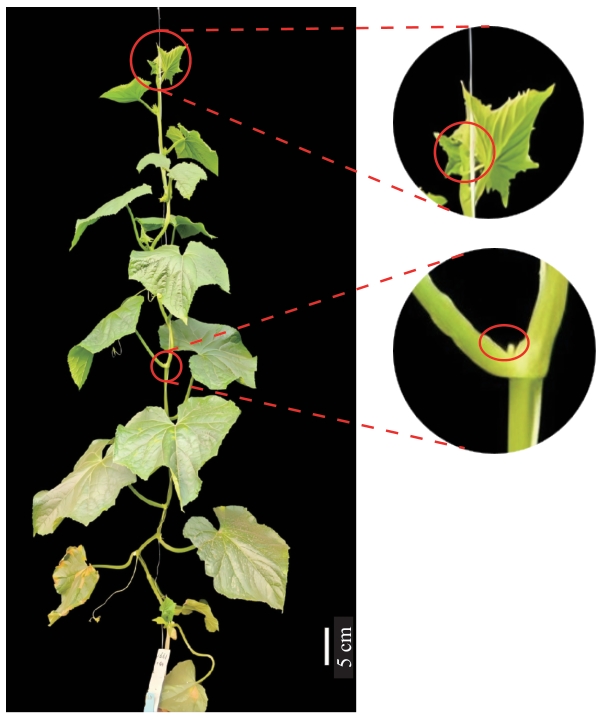
图1 植物样本采集位置分布图
Fig. 1 Distribution diagram of plant sample collection sites
材料 Sample | 取样部位 Sampling part | 木质素含量 Lignin content (mg/g) | 百分含量 Percentage (%) |
|---|---|---|---|
| R116 | 近轴叶柄基部 | 91.87 ± 0.50 | 9.19 ± 0.04 |
| 生长点叶片 | 44.41 ± 4.17 | 4.44 ± 0.37 | |
| R60 | 近轴叶柄基部 | 96.10 ± 1.51 | 9.61 ± 0.15 |
| 生长点叶片 | 73.53 ± 1.32 | 7.35 ± 0.13 | |
| R369 | 近轴叶柄基部 | 145.89 ± 1.31 | 14.59 ± 0.13 |
| 生长点叶片 | 103.23 ± 0.87 | 10.32 ± 0.09 | |
| R506 | 近轴叶柄基部 | 140.36 ± 1.53 | 14.04 ± 0.15 |
| 生长点叶片 | 67.70 ± 0.44 | 6.77 ± 0.04 |
表2 不同叶柄夹角黄瓜材料近轴叶柄基部和生长点叶片的木质素含量比较
Table 2 Comparison of lignin content in adaxial petiole base and shoot-tip leaves among cucumber materials with different petiole angles
材料 Sample | 取样部位 Sampling part | 木质素含量 Lignin content (mg/g) | 百分含量 Percentage (%) |
|---|---|---|---|
| R116 | 近轴叶柄基部 | 91.87 ± 0.50 | 9.19 ± 0.04 |
| 生长点叶片 | 44.41 ± 4.17 | 4.44 ± 0.37 | |
| R60 | 近轴叶柄基部 | 96.10 ± 1.51 | 9.61 ± 0.15 |
| 生长点叶片 | 73.53 ± 1.32 | 7.35 ± 0.13 | |
| R369 | 近轴叶柄基部 | 145.89 ± 1.31 | 14.59 ± 0.13 |
| 生长点叶片 | 103.23 ± 0.87 | 10.32 ± 0.09 | |
| R506 | 近轴叶柄基部 | 140.36 ± 1.53 | 14.04 ± 0.15 |
| 生长点叶片 | 67.70 ± 0.44 | 6.77 ± 0.04 |
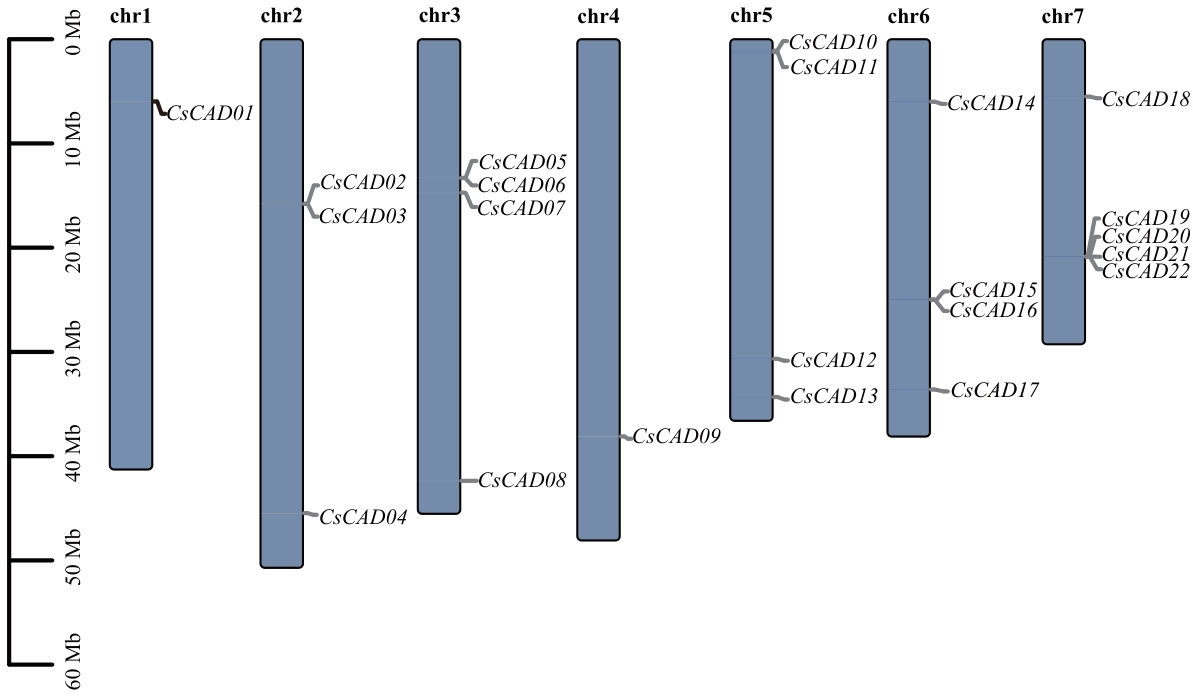
图2 黄瓜CsCAD家族基因的染色体定位
Fig. 2 Chromosomal distribution of the CsCAD gene family in cucumber
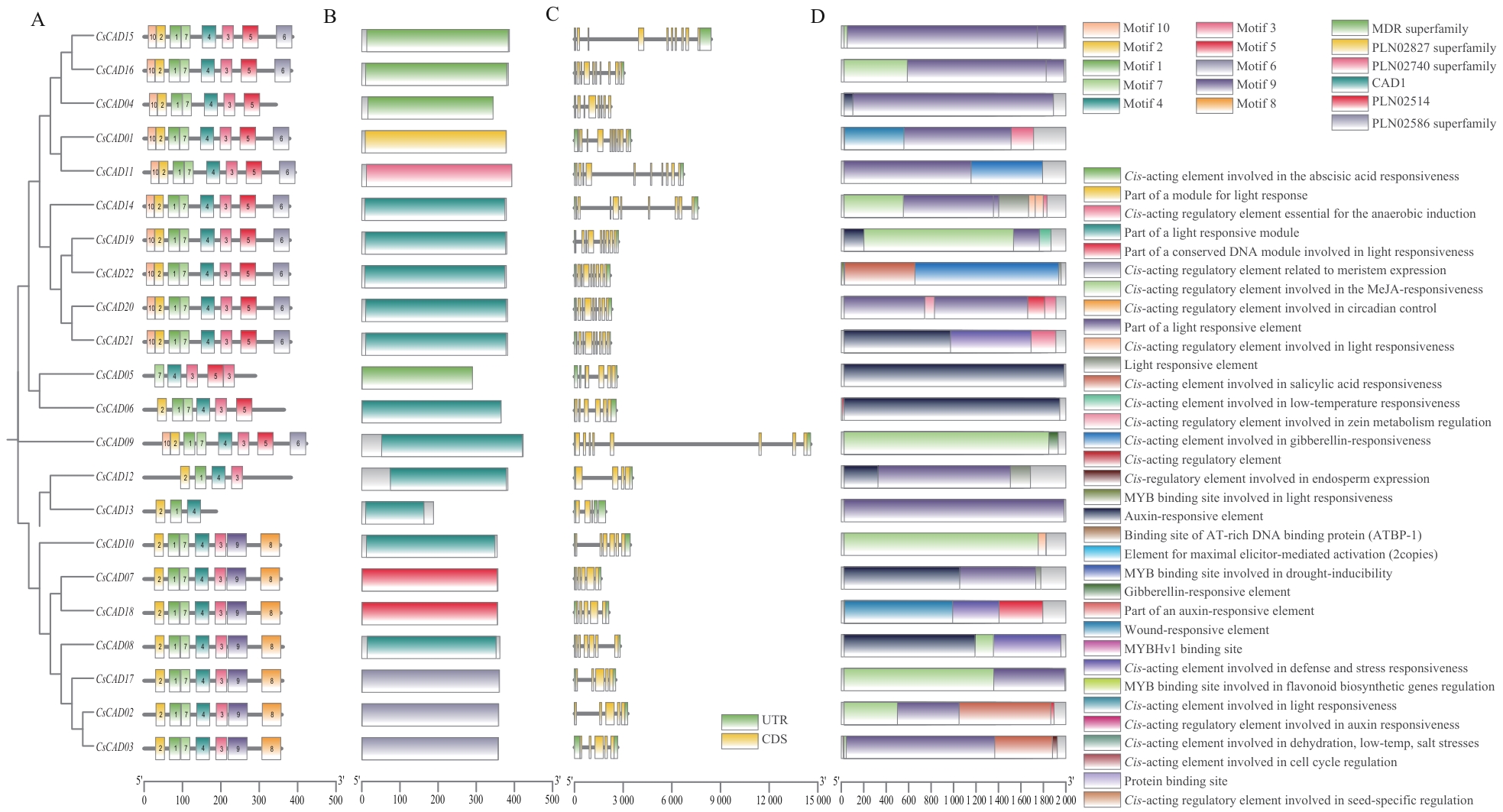
图3 CsCAD基因结构分析A:系统发育树与保守基序;B:保守结构域;C:基因结构;D:顺式作用元件
Fig. 3 Gene structure analysis of CsCADA: Phylogenetic tree and conserved motifs. B: Conserved domains. C: Gene structures. D: Cis-acting elements
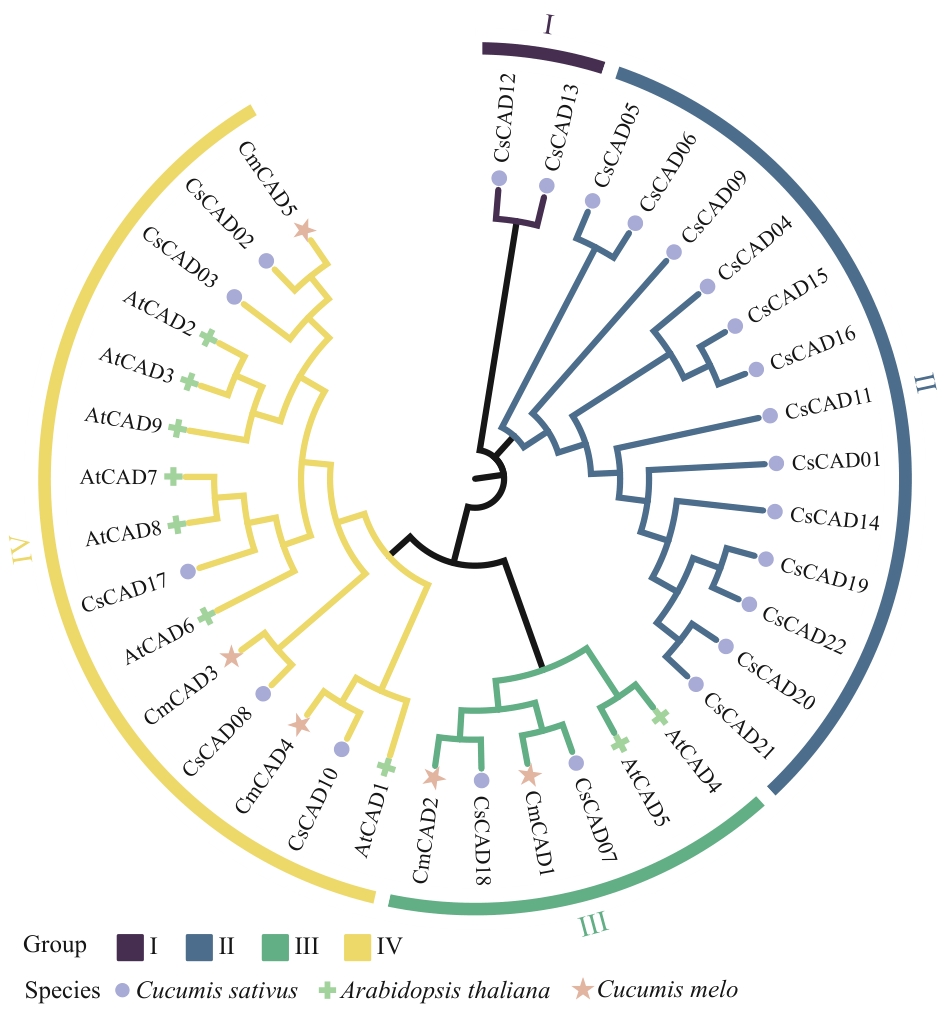
图4 CAD基因家族系统进化分析
Fig. 4 Phylogenetic analysis of the CAD gene family
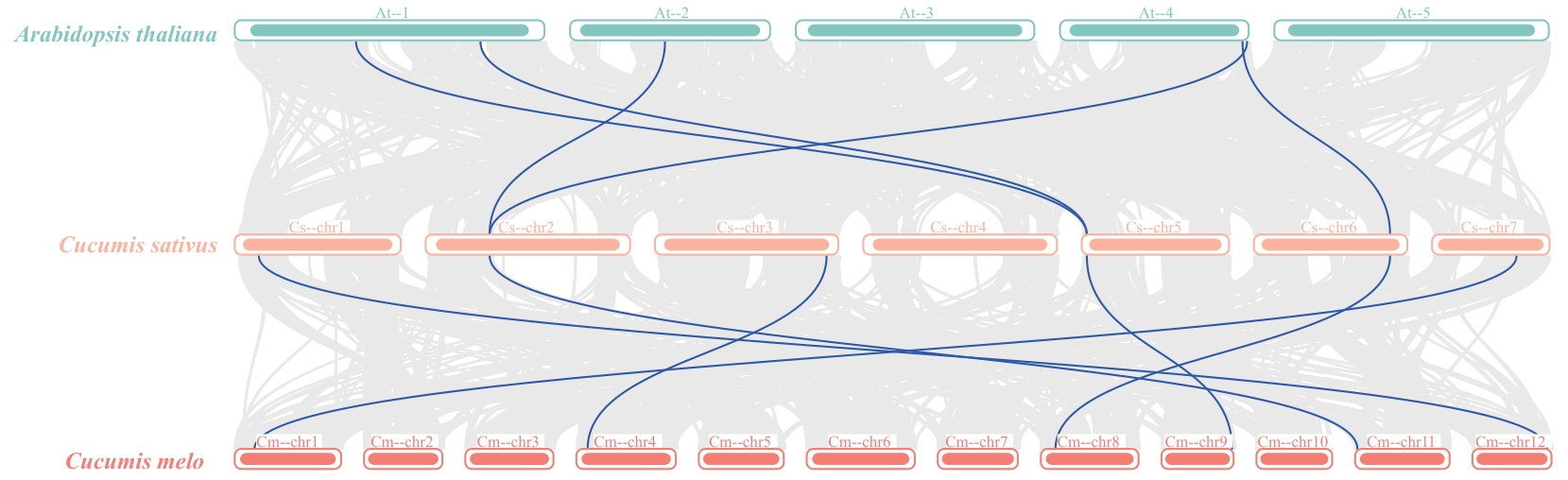
图5 黄瓜与拟南芥、甜瓜的CsCAD基因共线性分析
Fig. 5 Collinearity analysis of CsCAD genes among cucumber, Arabidopsis thaliana, and Cucumis melo
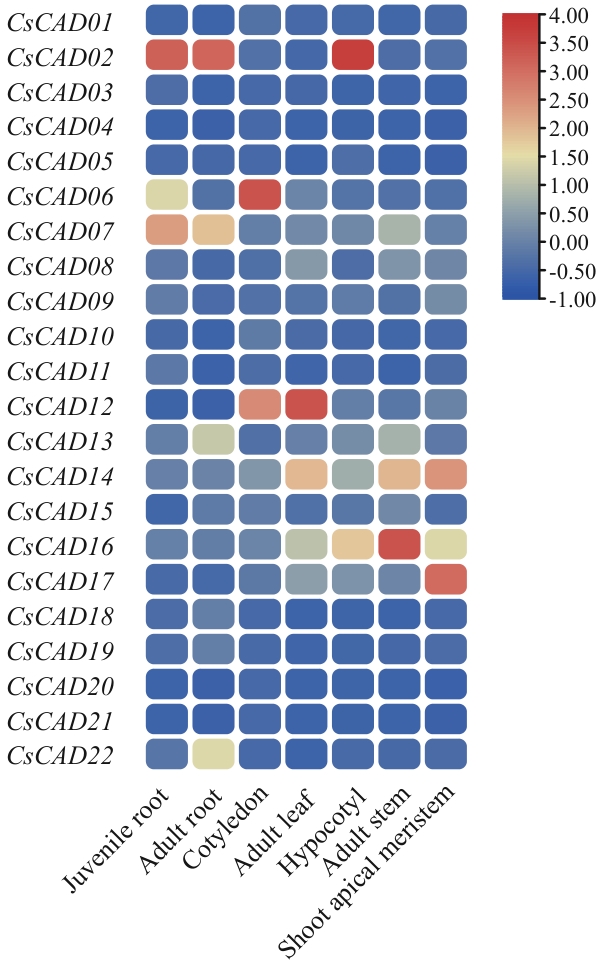
图6 黄瓜CsCAD基因在不同组织中的表达谱分析
Fig. 6 Expression profiles of CsCAD genes across different tissues in cucumber
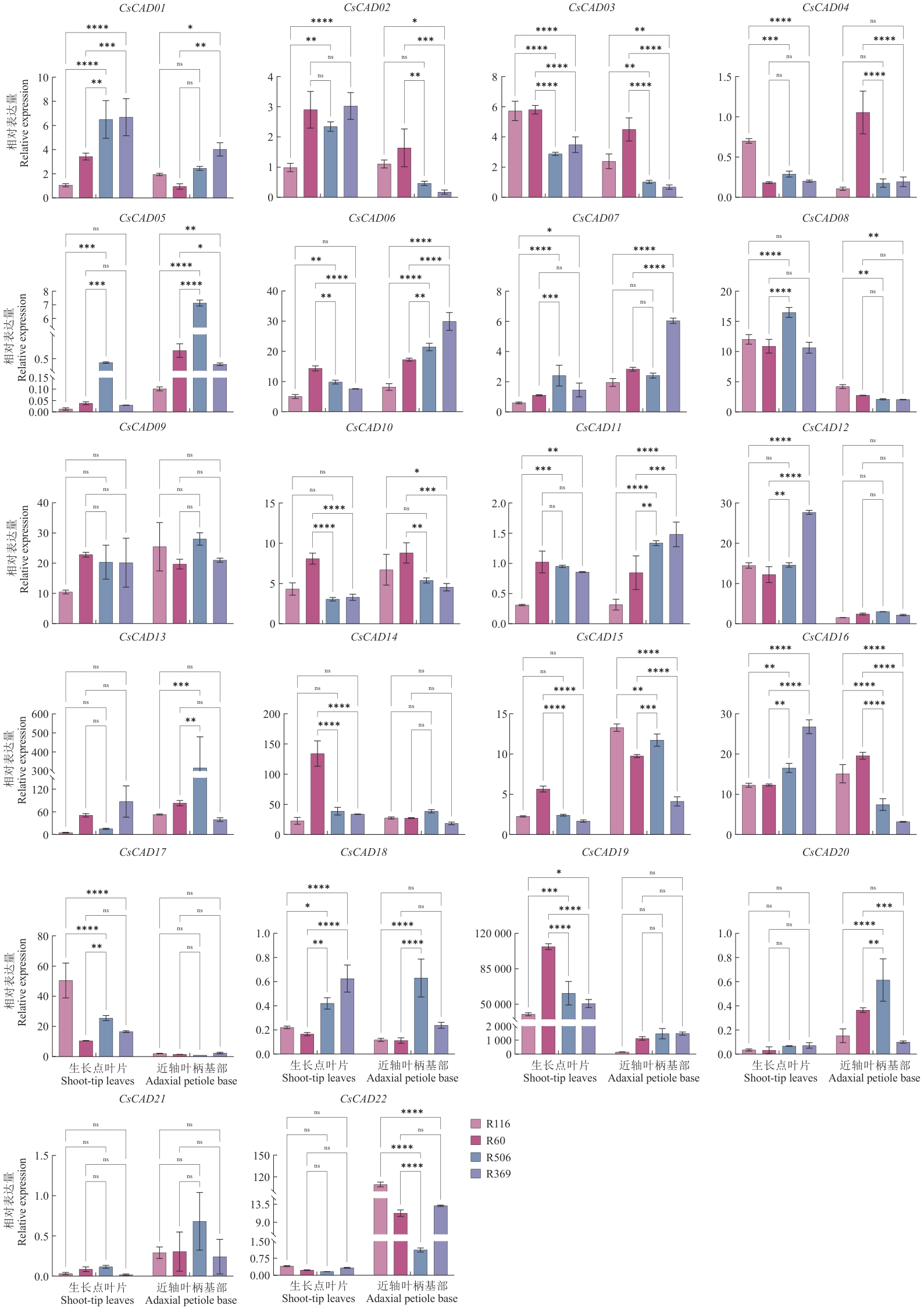
图7 候选CsCAD基因在不同叶柄夹角材料近轴叶柄基部和生长点叶片中的表达分析柱状图上方的横线和符号表示组间差异的显著性;ns表示差异不显著(P>0.05);星号表示差异显著:* P<0.05,** P<0.01,*** P<0.001,**** P<0.000 1
Fig. 7 Expression analysis of candidate CsCAD genes in adaxial petiole base and shoot-tip leaves of cucumber materials with different petiole anglesHorizontal lines and symbols above the bars indicate the significance of differences between groups. ns indicates no significant difference (P>0.05); asterisks indicate significant differences: * P<0.05, ** P<0.01, *** P<0.001, and **** P<0.000 1
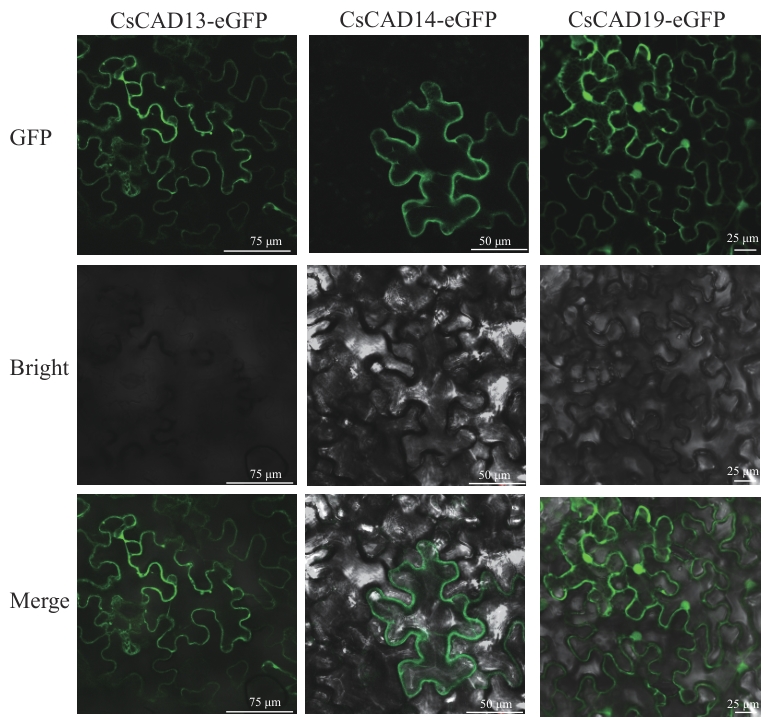
图8 CsCAD13、CsCAD14和CsCAD19的亚细胞定位
Fig. 8 Subcellular localization of CsCAD13, CsCAD14 and CsCAD19 proteins
| [1] | 张圣平, 董邵云, 官健涛, 等. 黄瓜抗病分子育种研究进展 [J]. 园艺学报, 2025, 52(3): 773-791. |
| Zhang SP, Dong SY, Guan JT, et al. Research progress on molecular breeding of disease resistance in cucumber [J]. Acta Hortic Sin, 2025, 52(3): 773-791. | |
| [2] | Cao YY, Zhong ZJ, Wang HY, et al. Leaf angle: a target of genetic improvement in cereal crops tailored for high-density planting [J]. Plant Biotechnol J, 2022, 20(3): 426-436. |
| [3] | Liu HC, Zhang J, Wang JX, et al. The rice R2R3 MYB transcription factor FOUR LIPS connects brassinosteroid signaling to lignin deposition and leaf angle [J]. Plant Cell, 2024, 36(11): 4768-4785. |
| [4] | Li HP, Zhang SL, Zhao YL, et al. Identification and characterization of cinnamyl alcohol dehydrogenase encoding genes involved in lignin biosynthesis and resistance to Verticillium dahliae in upland cotton (Gossypium hirsutum L.) [J]. Front Plant Sci, 2022, 13: 840397. |
| [5] | 刘威. 薄皮甜瓜肉桂醇脱氢酶(CAD)在非生物胁迫下参与木质素合成的功能探究 [D]. 沈阳: 沈阳农业大学, 2019. |
| Liu W. Functional research of CmCADs in lignin biosynthesis in oriental melon (Cucumis melo L.) under abiotic stresses [D]. Shenyang: Shenyang Agricultural University, 2019. | |
| [6] | Kim YH, Huh GH. Overexpression of cinnamyl alcohol dehydrogenase gene from sweetpotato enhances oxidative stress tolerance in transgenic Arabidopsis [J]. In Vitro Cell Dev Biol-Plant, 2019, 55(2): 172-179. |
| [7] | 尚军, 吴旺泽, 马永贵. 植物苯丙烷代谢途径 [J]. 中国生物化学与分子生物学报, 2022, 38(11): 1467-1476. |
| Shang J, Wu WZ, Ma YG. Phenylpropanoid metabolism pathway in plants [J]. Chin J Biochem Mol Biol, 2022, 38(11): 1467-1476. | |
| [8] | Muro-Villanueva F, Kim H, Ralph J, et al. H-lignin can be deposited independently of cinnamyl alcohol dehydrogenase c and d in Arabidopsis [J]. Plant Physiol, 2022, 189(4): 2015-2028. |
| [9] | Kim SJ, Kim MR, Bedgar DL, et al. Functional reclassification of the putative cinnamyl alcohol dehydrogenase multigene family in Arabidopsis [J]. Proc Natl Acad Sci U S A, 2004, 101(6): 1455-1460. |
| [10] | Özparpucu M, Gierlinger N, Burgert I, et al. The effect of altered lignin composition on mechanical properties of cinnamyl alcohol dehydrogenase (cad) deficient poplars [J]. Planta, 2018, 247(4): 887-897. |
| [11] | Tobias CM, Chow EK. Structure of the cinnamyl-alcohol dehydrogenase gene family in rice and promoter activity of a member associated with lignification [J]. Planta, 2005, 220(5): 678-688. |
| [12] | Li LG, Cheng XF, Leshkevich J, et al. The last step of syringyl monolignol biosynthesis in angiosperms is regulated by a novel gene encoding sinapyl alcohol dehydrogenase [J]. Plant Cell, 2001, 13(7): 1567-1586. |
| [13] | Guan JT, Miao H, Zhang ZH, et al. A near-complete cucumber reference genome assembly and Cucumber-DB, a multi-omics database [J]. Mol Plant, 2024, 17(8): 1178-1182. |
| [14] | 胡文冉, 郝晓燕, 赵准, 等. 棉花CAD基因家族的生物信息学分析 [J]. 生物技术进展, 2023, 13(3): 412-424. |
| Hu WR, Hao XY, Zhao Z, et al. Bioinformatic analysis of the CAD gene family in cotton [J]. Curr Biotechnol, 2023, 13(3): 412-424. | |
| [15] | 辛明, 姜赫然, 李英楠, 等. 黄瓜IDD基因家族鉴定及其在雌花花冠发育中的表达分析 [J]. 东北农业大学学报, 2024, 55(2): 19-31. |
| Xin M, Jiang HR, Li YN, et al. Genome-wide identification of IDD gene family and its expression in female flower corolla development in cucumber (Cucumis sativus L.) [J]. J Northeast Agric Univ, 2024, 55(2): 19-31. | |
| [16] | Hu L, Zhang X, Ni HH, et al. Identification and functional analysis of CAD gene family in pomegranate (Punica granatum) [J]. Genes, 2023, 14(1): 26. |
| [17] | Chen CJ, Chen H, Zhang Y, et al. TBtools: an integrative toolkit developed for interactive analyses of big biological data [J]. Mol Plant, 2020, 13(8): 1194-1202. |
| [18] | Lescot M, Déhais P, Thijs G, et al. PlantCARE, a database of plant cis-acting regulatory elements and a portal to tools for in silico analysis of promoter sequences [J]. Nucleic Acids Res, 2002, 30(1): 325-327. |
| [19] | 刘巳塬, 罗瑜杭, 邓思航, 等. 梅花肉桂醇脱氢酶基因的鉴定和功能分析 [J]. 植物遗传资源学报, 2025, 26(2): 356-368. |
| Liu SY, Luo YH, Deng SH, et al. Identification and functional analysis of cinnamyl alcohol dehydrogenase (PmCAD) genes in Prunus mume [J]. J Plant Genet Resour, 2025, 26(2): 356-368. | |
| [20] | 畅志鹏, 孙莹莹, 李佳阳, 等. 柠条CkCAD基因的克隆转化及其抗旱功能分析 [J]. 草业学报, 2021, 30(3): 68-80. |
| Chang ZP, Sun YY, Li JY, et al. Cloning and transformation of the CkCAD gene in Caragana korshinskii and analysis of its drought resistance function [J]. Acta Prataculturae Sin, 2021, 30(3): 68-80. | |
| [21] | 王贺萍, 孙震, 刘雨辰, 等. 蒙古冰草肉桂醇脱氢酶基因序列鉴定及功能分析 [J]. 植物学报, 2024, 59(2): 204-216. |
| Wang HP, Sun Z, Liu YC, et al. Sequence identification and functional analysis of cinnamyl alcohol dehydrogenase gene from Agropyron mongolicum [J]. Chin Bull Bot, 2024, 59(2): 204-216. | |
| [22] | An FF, Chen T, Zhu WL, et al. Systematic analysis of cinnamyl alcohol dehydrogenase family in cassava and validation of MeCAD13 and MeCAD28 in lignin synthesis and postharvest physiological deterioration [J]. Int J Mol Sci, 2024, 25(21): 11668. |
| [23] | Saballos A, Ejeta G, Sanchez E, et al. A genomewide analysis of the cinnamyl alcohol dehydrogenase family in sorghum [Sorghum bicolor (L.) moench] identifies SbCAD2 as the Brown midrib6 gene [J]. Genetics, 2009, 181(2): 783-795. |
| [24] | Wang L, Sun GH, Wang J, et al. Systematic characterization of cinnamyl alcohol dehydrogenase members revealed classification and function divergence in Haplomitrium mnioides [J]. J Plant Res, 2025, 138(1): 173-187. |
| [25] | Sibout R, Eudes A, Mouille G, et al. CINNAMYL ALCOHOL DEHYDROGENASE-C and -D are the primary genes involved in lignin biosynthesis in the floral stem of Arabidopsis [J]. Plant Cell, 2005, 17(7): 2059-2076. |
| [26] | 郝立冬, 张金汕, 张超, 等. 小麦肉桂醇脱氢酶基因家族的鉴定及其表达模式分析 [J/OL]. 分子植物育种, 2022. . |
| Hao LD, Zhang JS, Zhang C, et al. Identification and expression pattern analysis of cinnamyl alcohol dehydrogenase gene family in wheat [J/OL]. Mol Plant Breed, 2022. . | |
| [27] | 朱金鑫, 孙金金, 原晓龙, 等. 巴拉圭瓜多竹CAD基因的克隆与分析 [J]. 西部林业科学, 2017, 46(1): 6-11, 16. |
| Zhu JX, Sun JJ, Yuan XL, et al. Cloning and sequence analysis of cinnamoyl alcohol dehydrogenase gene from Guadua paraguayana [J]. J West China For Sci, 2017, 46(1): 6-11, 16. |
| [1] | 付彩霞, 张瑞花, 祝云俊, 李靖, 杨科, 王轩鹏. 拟南芥种子的胚与胚乳中pOp6/LhG4AtO表达系统的构建与验证[J]. 生物技术通报, 2026, 42(9): 120-127. |
| [2] | 孙常胜, 尉万聪, 王一衡, 张桂霞, 兰青阔, 王永. 黄瓜耐盐种质筛选评价及分子机制研究进展[J]. 生物技术通报, 2026, 42(8): 35-46. |
| [3] | 辛晴, 郑永杰, 李雨华, 涂白连, 刘新亮, 张月婷, 伍艳芳. 樟树MYC转录因子的全基因组鉴定与表达分析[J]. 生物技术通报, 2026, 42(7): 214-225. |
| [4] | 罗威, 宫奥, 仲阳, 胡迪, 周洪源, 张泓欣, 艾菊, 罗有卫, 高冬丽. 黄瓜SEPALLATA2基因敲除对果实及疣状结构发育的多效性影响[J]. 生物技术通报, 2026, 42(3): 283-293. |
| [5] | 刘林娅, 刘欢艳, 梁鑫钰, 宋姝熠, 何斌, 王绪英, 黄亚成. ‘红阳’猕猴桃BGAL基因家族的全基因组鉴定与表达分析[J]. 生物技术通报, 2026, 42(3): 312-323. |
| [6] | 庄娜, 贺红利, 张兴政. 蒺藜苜蓿SMXL基因家族全基因组鉴定及表达分析[J]. 生物技术通报, 2026, 42(2): 250-266. |
| [7] | 程婷婷, 刘俊, 王利丽, 练从龙, 魏文君, 郭辉, 吴尧琳, 杨晶凡, 兰金旭, 陈随清. 杜仲查尔酮异构酶基因家族全基因组鉴定及其表达模式分析[J]. 生物技术通报, 2025, 41(9): 242-255. |
| [8] | 李凯月, 邓晓霞, 殷缘, 杜亚彤, 徐元静, 王竞红, 于耸, 蔺吉祥. 蓖麻LEA基因家族的鉴定和铝胁迫响应分析[J]. 生物技术通报, 2025, 41(7): 128-138. |
| [9] | 龚钰涵, 陈兰, 尚方慧子, 郝灵颖, 刘硕谦. 茶树TRB基因家族鉴定及表达模式分析[J]. 生物技术通报, 2025, 41(7): 214-225. |
| [10] | 王斌, 李健荣, 占朝霞, 袁晓. CsGR-RBP3克隆及其在采后黄瓜耐冷性中的功能[J]. 生物技术通报, 2025, 41(6): 155-166. |
| [11] | 刘晓天, 何毓琦, 刘畅, 薛华. 家榆UpNOA1的克隆及其互作蛋白的筛选[J]. 生物技术通报, 2025, 41(6): 297-306. |
| [12] | 孙天国, 衣兰, 秦旭洋, 乔梦雪, 谷新颖, 韩艺, 沙伟, 张梅娟, 马天意. 大白菜DABB基因家族的全基因组鉴定及盐碱胁迫下的表达分析[J]. 生物技术通报, 2025, 41(4): 156-165. |
| [13] | 宋姝熠, 蒋开秀, 刘欢艳, 黄亚成, 刘林娅. ‘红阳’猕猴桃TCP基因家族鉴定及其在果实中的表达分析[J]. 生物技术通报, 2025, 41(3): 190-201. |
| [14] | 杨宗辉, 李利斌, 孟昭娟, 高天, 祝利霞, 杜海梅, 董伟伟, 曹齐卫. 比较转录组学揭示乙烯信号与表观遗传协同调控黄瓜性别决定[J]. 生物技术通报, 2025, 41(12): 139-155. |
| [15] | 徐嘉妤, 赵阁, 唐叶, 刘雯雯, 彭清忠, 吴家和. 陆地棉WRKY基因家族全基因组鉴定及WRKY44在纤维发育中的表达分析[J]. 生物技术通报, 2025, 41(12): 124-138. |
| 阅读次数 | ||||||
|
全文 |
|
|||||
|
摘要 |
|
|||||
